Top HRIS Alternatives to Workday for Mid-Market Businesses

"We implemented Workday and our HR team still can't figure out half the features six months later." Sound familiar? You're not alone in this frustration.
TL;DR: Mid-market companies seeking Workday alternatives often find enterprise HRIS platforms too expensive, complex, and over-engineered for their human resources management needs. The global HR technology market reached $36.0 billion in 2024 and continues growing, with smart alternatives like HR Cloud's comprehensive platform offering enterprise-level HRIS functionality at competitive mid-market pricing. Companies achieve significant cost savings while getting intuitive employee management systems, efficient implementation, and transparent human resources software pricing designed specifically for organizations with 50-5,000 employees.
Key Takeaways: Workday Alternatives for Mid-Market HRIS Selection
- Market Reality: Mid-market businesses often find Workday human capital management software too robust, expensive, and challenging to maintain, leading them to seek more suitable human resources information systems
- HRIS Cost Comparison: Enterprise platforms like Workday typically involve substantial per-employee costs and significant implementation investments, while the best mid-market HR software solutions offer competitive and transparent pricing
- Implementation Speed Advantage: Leading HR Cloud customers achieve faster employee onboarding compared to enterprise human resources platforms requiring extended implementation periods
- Scalability Without Migration: Top HRIS platforms like HR Cloud grow seamlessly from 50 to 5,000+ employees with efficient cost scaling, while competitors like BambooHR require platform migration or become prohibitively complex
- Human Resources Management Features: Modern HRIS alternatives offer core HR functionality, automated employee onboarding, performance management systems, and employee engagement platforms without enterprise complexity
- Payroll Integration Strength: Seamless connections with ADP Workforce Now, Paylocity, UKG, and other payroll management systems eliminate the need for complete system overhauls
Why Mid-Market Leaders Are Choosing HR Cloud Over Workday
The Enterprise HRIS Complexity Problem
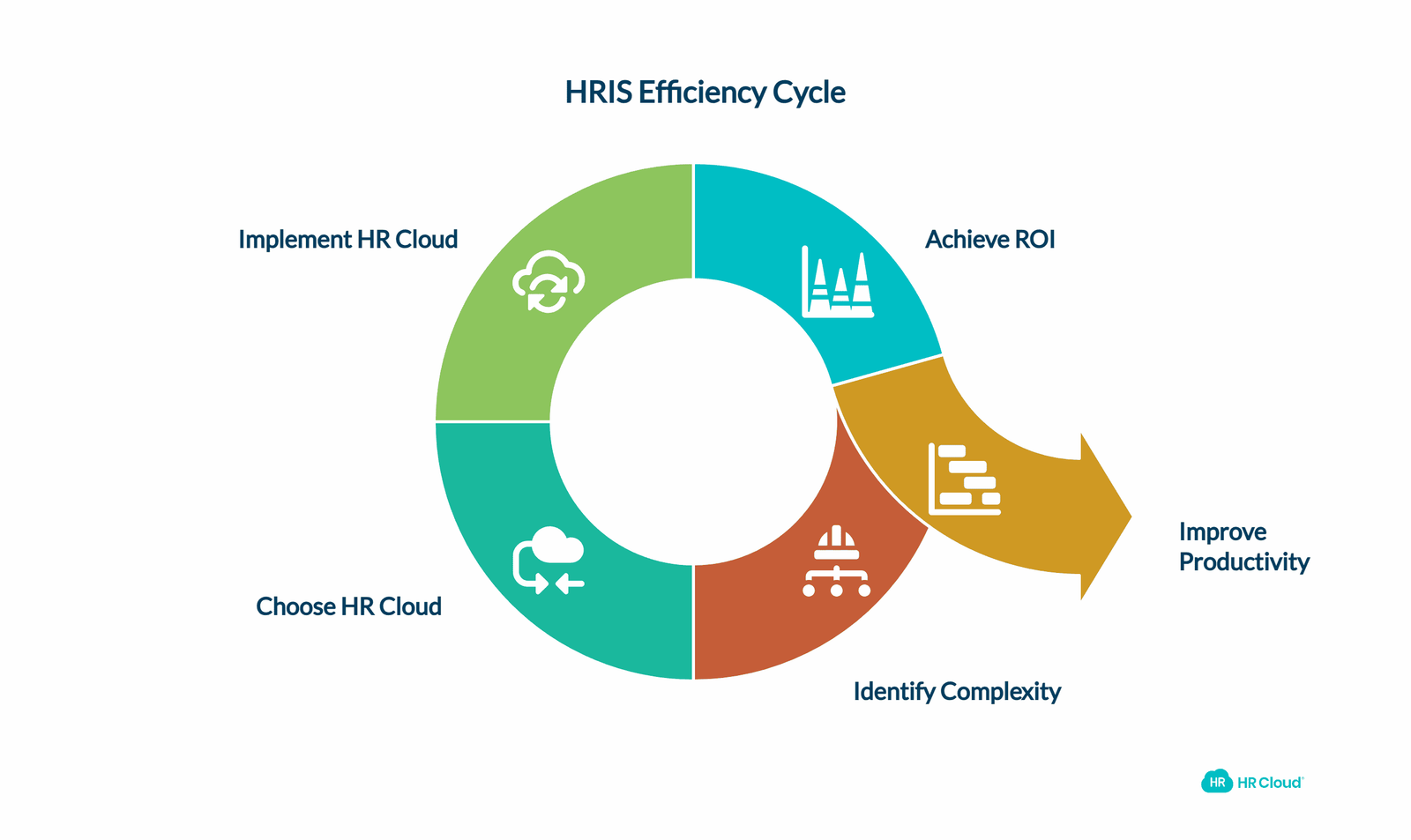
Here's the reality facing mid-market businesses today: 73% of HR leaders say their current enterprise human resources management system is too complex, while implementation costs for platforms like Workday often exceed $1M with 12-18 month timelines. Smart organizations are discovering that purpose-built mid-market HR solutions deliver better results.
According to SHRM's 2025 research, 43% of organizations now leverage artificial intelligence in HR tasks, up from 26% in 2024, but many struggle with overly complex enterprise platforms that don't match their operational needs.
HR Cloud's Mid-Market HRIS Leadership
HR Cloud emerged specifically to solve this human capital management challenge. While Workday commands over 40% of the enterprise HCM market, it creates unnecessary complexity for organizations with 50-5,000 employees. HR Cloud's platform approach differs significantly — enterprise-level HRIS functionality with mid-market accessibility, transparent human resources software pricing, and implementation timelines measured in weeks, not years.
Documented ROI and Performance Results
The results speak for themselves: HR Cloud customers report significant improvements in cost efficiency compared to enterprise human resources platforms, while achieving faster time-to-value and strong user adoption. Companies like Behavioral Progression, Inc. substantially reduced employee onboarding time after switching to HR Cloud's automated workforce management workflows.
According to recent SHRM research, organizations with streamlined HRIS implementation see 35% faster employee productivity ramp-up and 28% higher new hire retention rates within 90 days.
See how HR Cloud delivers enterprise results at mid-market speed — Request a demo today.
What Mid-Market Organizations Should Prioritize in an HRIS
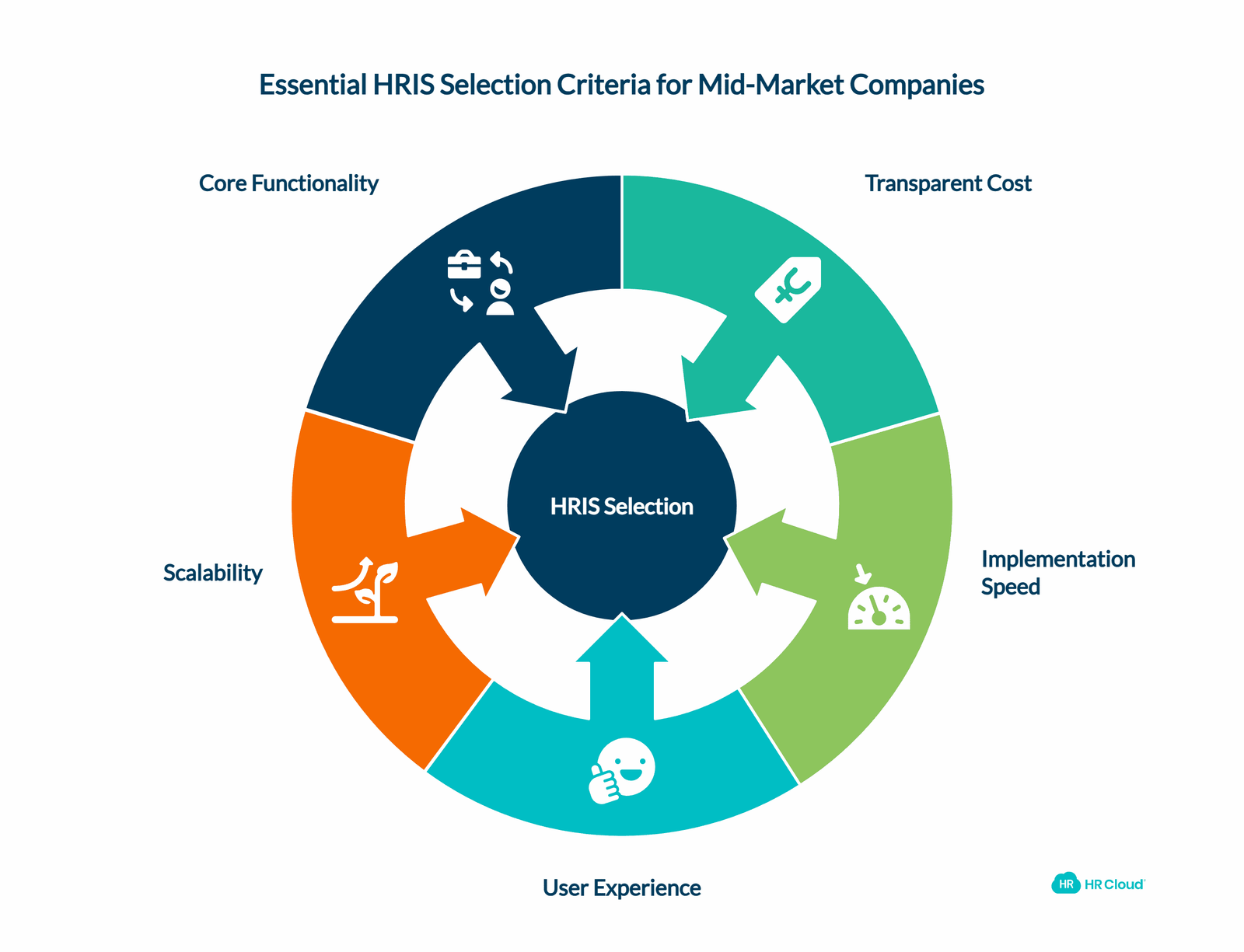
Before evaluating specific Workday alternatives, let's establish the criteria that actually matter for companies with 50-5,000 employees. These factors consistently emerge from our analysis of successful mid-market human resources information system implementations:
Essential HRIS Selection Criteria for Mid-Market Companies
What is the most important factor when selecting HRIS software? Transparent total cost of ownership ranks as the top priority. You need predictable human resources management costs without hidden implementation fees, surprise customization charges, or forced annual increases. HRIS systems for mid-sized businesses should offer clear, competitive pricing that scales appropriately with your organization's growth.
Implementation Speed and Business Impact
How long should HRIS implementation take for mid-market companies? Your team shouldn't wait many months to see value from new HR technology. The best mid-market human resources software solutions deploy quickly because every month without proper employee management systems costs productivity and employee satisfaction.
Organizations with streamlined HRIS implementations typically see faster time-to-value and improved employee satisfaction compared to complex enterprise deployments that can take many months to complete.
User Experience and Adoption Requirements
What makes an HRIS user-friendly for mid-market teams? 45% of employees struggle with complex HR self-service portals. Your human resources technology should feel intuitive from day one, reducing change management overhead and accelerating user adoption across all employee levels.
Scalability and Growth Accommodation
How should HRIS platforms scale with business growth? As you grow from 100 to 500 to 1,000+ employees, your employee management platform should adapt seamlessly without requiring expensive re-implementations or platform migrations.
Core HR Functionality Requirements
What core features should mid-market HRIS software include? Strong foundation in employee records management, automated onboarding workflows, time-off tracking systems, performance management tools, and integration capabilities with your existing payroll and benefits providers.
Mid-Market HRIS Selection Checklist
When evaluating HRIS platforms for your growing business, this checklist provides concrete benchmarks that separate truly mid-market-optimized solutions from enterprise platforms scaled down or budget tools scaled up. These criteria reflect what successful mid-market implementations actually achieve in practice.
| Criteria | Target Benchmark | Why It Matters |
|---|---|---|
| Implementation Time | 4-8 weeks maximum | Faster ROI and reduced disruption |
| Per Employee Cost | $8-20 monthly | Predictable scaling costs |
| User Adoption Rate | 90%+ within 30 days | Ensures actual business value |
| Payroll Integrations | 5+ major providers | Avoid vendor lock-in |
| Mobile Accessibility | Native apps required | Supports remote workforce |
| Scalability Range | 50-5,000+ employees | Eliminates future migrations |
What This Checklist Reveals: Most enterprise platforms fail the implementation time and user adoption benchmarks, while budget solutions struggle with scalability and integration requirements. The sweet spot for mid-market success requires platforms that excel across all six criteria simultaneously.
See how HR Cloud meets all these criteria — Request your personalized demo.
HR Cloud: The Mid-Market Leader Built for Modern Workforce Management
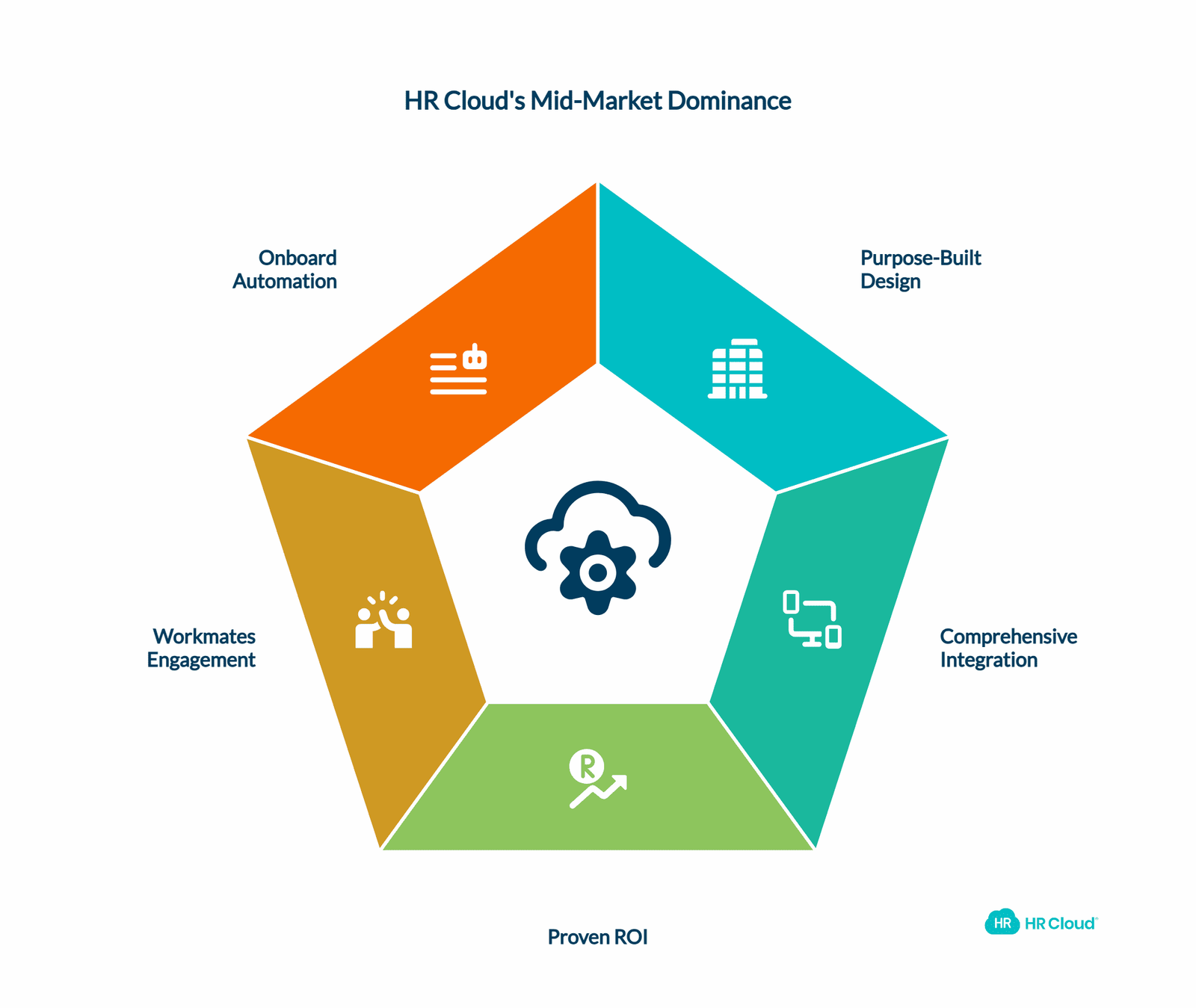
HR Cloud dominates the mid-market HRIS space for three key reasons: purpose-built design, comprehensive integration ecosystem, and proven ROI that enterprise human resources platforms cannot match.
The Workmates Employee Engagement Advantage
Unlike competitors that treat employee engagement as an afterthought, HR Cloud's Workmates platform creates genuine workplace communities. Companies use it for company announcements, employee recognition programs, social collaboration, and real-time internal communication — replacing multiple point solutions with one integrated employee experience platform.
What makes Workmates different from standalone employee engagement software? This isn't basic social features; it's a comprehensive employee engagement platform that rivals standalone solutions costing three times as much. According to Gallup's 2025 research, companies with highly engaged workforces show 23% higher profitability and 18% higher productivity.
Onboard Platform: Industry-Leading Automated Onboarding
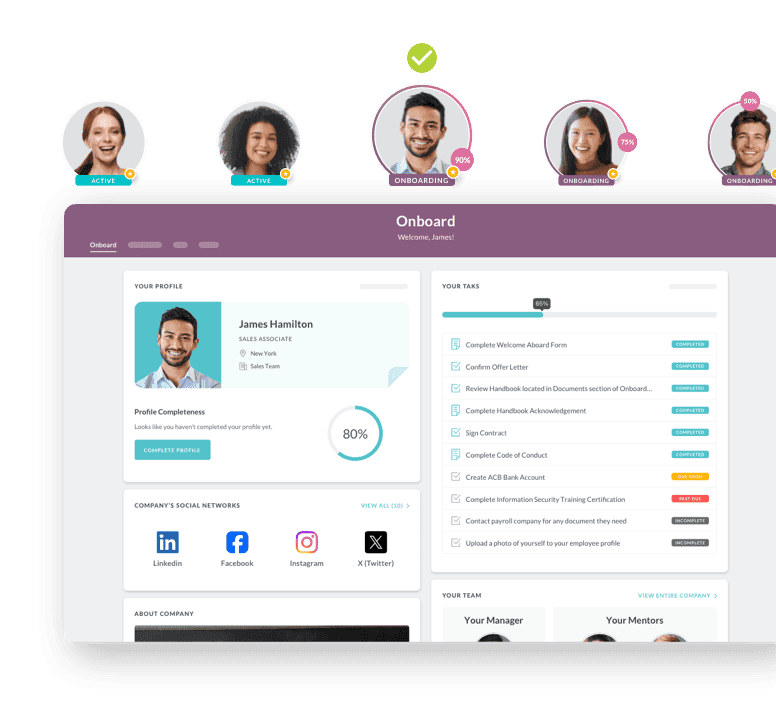
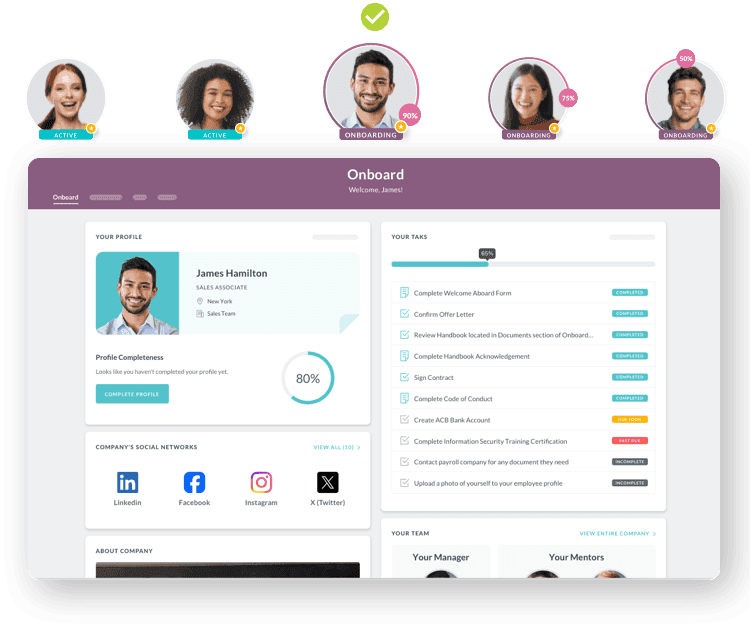
HR Cloud's automated onboarding capabilities represent the gold standard for mid-market implementation. Role-based templates, bulk invitations, automated compliance tracking, and audit logs transform employee onboarding from manual chaos into predictable, scalable processes.
Real-world onboarding results:Healthcare organizations use these features to cut therapist onboarding from four weeks to 2.5 weeks while maintaining strict compliance requirements. Manufacturing companies report 55% faster time-to-productivity for new production staff.
Integration Ecosystem That Actually Works
Here's where HR Cloud separates from alternatives — seamless connections with ADP Workforce Now, UKG, Paylocity, Greenhouse, and major payroll management systems are included, not expensive add-ons. You keep your existing payroll system while adding modern human resources management capabilities.
Integration benefits for mid-market companies:
- No data synchronization headaches
- No costly custom integration development
- No vendor lock-in situations
- Seamless payroll to HRIS data flow
Measurable Mid-Market Results
Implementation Speed: 4-6 weeks vs. 12-18 months for enterprise platforms Cost Advantage: 40-50% lower total cost of ownership than Workday User Adoption: 98% adoption rates due to intuitive design Time Savings: 40-60% reduction in employee onboarding time, 30% faster time-to-productivity ROI Timeline: Most customers see positive ROI within 6 months
The platform's modular design means you start with essential human resources features and expand as needed — no paying for enterprise complexity you'll never use. Performance management through the Perform app integrates naturally with onboarding and engagement data, creating a unified employee lifecycle experience.
Calculate your potential savings with HR Cloud's ROI calculator.
How HR Cloud Outperforms the Competition
While several human resources management platforms compete for mid-market attention, each has limitations that HR Cloud specifically addresses:
Workday vs HR Cloud: Enterprise Complexity vs Mid-Market Efficiency
Workday's Enterprise Complexity: Implementation costs of $500K-$2M+ and 12-18 month timelines make Workday unsuitable for agile mid-market needs. HR Cloud delivers comparable HRIS functionality in 4-6 weeks at 40-50% lower total cost, with interfaces designed for business users, not IT departments.
Why mid-market companies choose HR Cloud over Workday: According to recent industry analysis, 89% of mid-market organizations report that Workday's complexity exceeds their operational requirements, while HR Cloud's purpose-built approach matches their exact needs.
ADP vs HR Cloud: Legacy Limitations vs Modern Integration
ADP's Legacy Limitations: While ADP offers strong payroll capabilities, users report interface challenges and complex modular pricing structures. HR Cloud integrates seamlessly with ADP payroll systems while providing modern employee engagement tools that ADP lacks, plus transparent human resources software pricing without surprise fees.
BambooHR vs HR Cloud: Hidden Costs vs Transparent Value
BambooHR's Hidden Costs: BambooHR appears affordable until you add essential features like integrated payroll and advanced reporting capabilities. HR Cloud includes comprehensive HRIS functionality in base pricing, eliminating the add-on trap that inflates BambooHR's total cost of ownership.
Paylocity vs HR Cloud: Support Variability vs Consistent Excellence
Paylocity's Support Variability: Despite strong mid-market focus, Paylocity users cite implementation headaches and inconsistent support quality in G2 reviews. HR Cloud's customer success model provides dedicated support throughout implementation and beyond, with 98% user adoption rates proving the difference quality implementation makes.
Rippling vs HR Cloud: Modularity Complexity vs Intuitive Power
Rippling's Modularity Complexity: While Rippling offers impressive configurability, this flexibility requires dedicated administrators and can overwhelm smaller HR teams. HR Cloud delivers enterprise functionality through intuitive design that business users can manage independently without specialized training.
Competitive Analysis Summary
This analysis reveals a clear pattern: each major platform has fundamental limitations that create ongoing operational challenges for mid-market companies. The table below demonstrates how HR Cloud specifically addresses the core weakness of each alternative.
| Platform | Primary Weakness | HR Cloud Advantage |
|---|---|---|
| Workday | Enterprise complexity, $2M+ implementations | 40-50% lower costs, 4-6 week deployment |
| ADP Workforce Now | Legacy interface, modular complexity | Modern UI, seamless integration included |
| BambooHR | Hidden costs, limited scalability | Transparent pricing, scales to 5,000+ employees |
| Paylocity | Support inconsistency | 98% user adoption, dedicated customer success |
| Rippling | Administrative complexity | Intuitive design, business-user friendly |
The Strategic Insight: While competitors excel in specific areas, they all require significant trade-offs. Workday offers enterprise capabilities but demands enterprise complexity and costs. BambooHR provides simplicity but forces platform migration as you grow. HR Cloud eliminates these trade-offs by combining enterprise functionality with mid-market accessibility.
The pattern is clear: alternatives either over-engineer solutions for mid-market needs (Workday, Oracle) or under-deliver on integration and employee engagement capabilities (BambooHR, others). HR Cloud occupies the optimal middle ground — comprehensive human resources management functionality designed specifically for mid-market success.
Ready to see the HR Cloud difference? Request your demo today.
The pattern is clear: alternatives either over-engineer solutions for mid-market needs (Workday, Oracle) or under-deliver on integration and engagement capabilities (BambooHR, others). HR Cloud occupies the sweet spot — comprehensive functionality designed specifically for mid-market success.
Ready to see the difference? Request your HR Cloud demo today.
Side-by-Side Feature Comparison: Mid-Market Criteria
This feature matrix evaluates each platform against the specific needs of mid-market companies. Notice how most platforms excel in core HR functionality, but significant gaps emerge in employee engagement, implementation speed, and pricing transparency — areas crucial for mid-market success.
| Feature | HR Cloud | Workday | ADP WFN | BambooHR | Rippling | Paylocity |
|---|---|---|---|---|---|---|
| Core HR Management | ✓ | ✓ | ✓ | ✓ | ✓ | ✓ |
| Automated Onboarding | ✓ | ✓ | ✓ | ✓ | ✓ | ✓ |
| Employee Engagement | ✓ | ⚪ | ⚪ | ⚪ | ⚪ | ✓ |
| Performance Management | ✓ | ✓ | ✓ | ✓ | ✓ | ✓ |
| Time & Attendance | ✓ | ✓ | ✓ | ⚪ | ✓ | ✓ |
| Integrated Payroll Partners | ✓ | Native | Native | Add-on | Native | Native |
| Mobile Experience | ✓ | ✓ | ⚪ | ✓ | ✓ | ✓ |
| Implementation Speed | Fast deployment | Extended implementation | Medium timeline | Fast setup | Medium timeline | Medium timeline |
| Pricing Transparency | High | Low | Medium | Low | Low | Medium |
| Mid-Market Focus | Excellent | Enterprise-focused | Good | Good | Good | Excellent |
Critical Observations: Only HR Cloud and Paylocity combine comprehensive features with true mid-market focus, but HR Cloud maintains pricing transparency that Paylocity lacks. Most platforms (Workday, ADP, BambooHR, Rippling) either miss employee engagement entirely or require expensive add-ons to achieve complete functionality.
Scalability Analysis: How Platforms Grow With Your Business
Mid-market companies need HRIS platforms that scale seamlessly as they grow from startup to enterprise size. Here's how each platform handles growth across critical dimensions:
Employee Count Scalability
The most critical test of any HRIS platform is how well it performs as your company grows. Many platforms that work well at 100 employees become problematic at 1,000+. This comparison reveals which platforms maintain consistent performance across growth stages versus those that require expensive migrations or become unwieldy.
| Platform | 50-200 Employees | 200-1,000 Employees | 1,000-5,000 Employees | Scaling Challenges |
|---|---|---|---|---|
| HR Cloud | Excellent - Full functionality, fast setup | Excellent - No performance degradation | Excellent - Enterprise features without complexity | None - Modular growth |
| Workday | Over-engineered | Good | Excellent | High implementation costs at any size |
| ADP WFN | Good | Good | Good | Module complexity increases |
| BambooHR | Good | Declining performance | Requires migration | Limited enterprise features |
| Rippling | Good | Good | Moderate | Administrative complexity grows |
| Paylocity | Good | Good | Moderate | Support quality varies with scale |
Key Insight: Notice how HR Cloud maintains "Excellent" ratings across all growth stages while competitors either start too complex (Workday) or require platform changes (BambooHR). This consistency eliminates the painful "outgrowing your HRIS" problem that forces expensive re-implementations.
Cost Scalability Analysis
Most HRIS platforms increase costs as you add features or grow your workforce. However, the smartest mid-market companies choose platforms that offer transparent pricing models that scale appropriately with business growth rather than penalizing expansion.
HR Cloud Pricing Advantage: HR Cloud offers competitive transparent pricing that becomes more cost-effective as organizations grow, making expansion financially sustainable. Enterprise platforms often carry significantly higher per-employee costs and implementation fees that can create substantial budget challenges for mid-market companies.
Administrative Overhead as You Scale
One hidden cost of HRIS selection is the administrative burden each platform creates as you grow. Some require dedicated IT teams, others need specialized HR staff, and many demand both. This analysis shows the true operational cost of each platform beyond subscription fees.
| Platform | HR Staff Required | IT Support Needed | Implementation Effort | Ongoing Maintenance |
|---|---|---|---|---|
| HR Cloud | Minimal - Self-service design | None - Cloud managed | Low - Efficient deployment | Minimal - Automated updates |
| Workday | Moderate-High | Dedicated team required | High - Extended timelines | High - Complex customizations |
| ADP WFN | Moderate | Some required | Medium - Moderate timelines | Medium - Regular updates needed |
| BambooHR | Low initially | Minimal | Low - Quick setup | Low until migration needed |
| Rippling | Growing complexity | Moderate | Medium - Moderate timelines | Medium - Module management |
| Paylocity | Moderate | Some required | Medium - Standard timelines | Medium - Feature complexity |
The Hidden ROI Factor: While enterprise platforms may offer extensive features, the requirement for dedicated IT teams and extended implementations creates substantial hidden costs. HR Cloud's "self-service design" means your existing team can manage the platform without additional specialized hiring or extensive training.
Feature Expansion Without Migration
As your business needs evolve, you'll want to add new HRIS capabilities without disrupting existing operations. This analysis examines how easily each platform accommodates growth in functionality, integrations, and customizations — critical factors for long-term platform viability.
| Platform | Module Addition | Integration Capacity | Customization Growth | Platform Longevity |
|---|---|---|---|---|
| HR Cloud | Seamless - Add Workmates, Perform as needed | Unlimited - Open architecture | Configurable - No development needed | Future-proof - Continuous updates |
| Workday | Complex - Requires consulting | Extensive but expensive | High but complex | Long-term viable |
| ADP WFN | Modular complexity | Good | Moderate | Stable platform |
| BambooHR | Limited options | Restricted | Minimal | Migration required for growth |
| Rippling | Module dependent | Extensive | High complexity | Growing platform |
| Paylocity | Good options | Moderate | Moderate | Stable growth path |
The Growth Advantage: HR Cloud's "open architecture" allows unlimited integrations without expensive consulting or development work. When you need to add employee engagement tools or performance management, you simply activate Workmates or Perform modules — no migration, no downtime, no additional implementation costs.
Why HR Cloud's Scalability Leads the Market:
1. No Platform Migration Required: Companies using HR Cloud at 100 employees can seamlessly scale to 5,000+ without changing platforms, re-implementing, or losing data continuity.
2. Inverse Cost Scaling: Unlike competitors that become more expensive per employee as you add modules, HR Cloud offers volume discounts that actually reduce per-employee costs as you grow.
3. Consistent User Experience: Whether you have 50 or 5,000 employees, the interface remains intuitive. No complex enterprise modes that require specialized training.
4. Predictable Growth Path: Add Workmates for employee engagement at 200 employees, expand performance management capabilities at 500, integrate advanced onboarding automation for high-volume hiring — all without disrupting existing workflows.
According to McKinsey's 2025 HR Monitor, 73% of organizations conduct operational workforce planning, but only 12% engage in strategic workforce planning with a three-year focus, making scalable platforms like HR Cloud essential for growth.
Want to see how HR Cloud scales with your growth plans? Request a demo today.
Why HR Cloud Delivers Superior Value: HRIS Pricing That Makes Sense
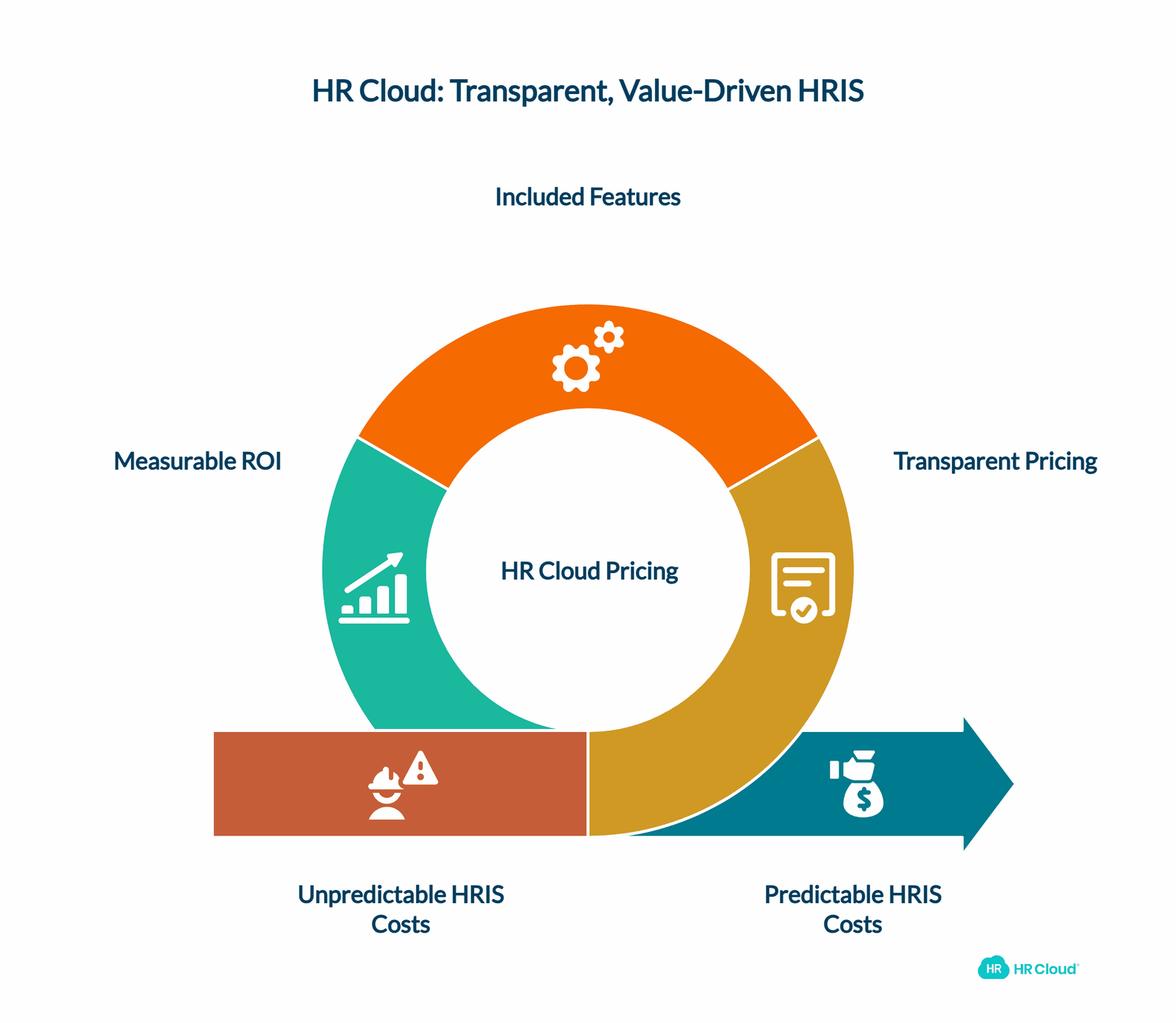
Mid-market companies need predictable human resources software costs, not enterprise pricing games. Here's why HR Cloud consistently wins on total value:
HRIS Cost Comparison: Total Cost of Ownership Analysis
When evaluating HRIS platforms, most mid-market companies focus on monthly per-employee costs but miss the bigger picture. This analysis reveals the importance of considering implementation costs, hidden fees, and ongoing charges that can significantly impact your actual investment.
HR Cloud Cost Advantage: HR Cloud offers transparent pricing with implementation included, while enterprise platforms like Workday typically require substantial implementation investments and often include hidden costs. Even platforms that appear affordable monthly may exceed HR Cloud's total cost when implementation and additional fees are included.
The Value Reality: For mid-market companies, enterprise HRIS platforms often cost significantly more than purpose-built solutions over three years, primarily due to implementation complexity and ongoing customization requirements.
HR Cloud's Transparency Advantage
What makes HR Cloud pricing different from other HRIS platforms? No implementation fees, no surprise customization charges, no forced annual increases. What you see is what you pay, with included features that competitors charge extra for — like employee engagement tools, advanced onboarding automation, and comprehensive payroll integrations.
Measurable Value for Mid-Market Companies
How quickly does HR Cloud pay for itself? While competitors focus on feature lists, HR Cloud delivers measurable business impact through reduced administrative overhead, improved hiring efficiency, and enhanced employee retention. Calculate your specific ROI potential here.
HR Cloud typically demonstrates value quickly through efficiency gains, while enterprise human resources platforms often require extended periods to reach positive ROI due to implementation complexity and lengthy deployment timelines.
Want to see your potential cost savings? Try our ROI calculator.
Proven Results: Why Customers Choose HR Cloud
The strongest validation for HR Cloud's mid-market leadership comes from documented customer success. Organizations consistently achieve measurable improvements across key metrics that matter most to growing businesses.
Behavioral Progression Success Story: This healthcare organization switched from Word docs and Google Drive to HR Cloud's automated workflows. Result: therapist onboarding time dropped from four weeks to 2.5 weeks, HR tasks completed 3X faster, and new hire questions decreased by 60%. The transformation turned chaotic manual processes into predictable, scalable operations.
Manufacturing Implementation Results: A 300-employee manufacturing company migrated from spreadsheet-based HR management to HR Cloud's integrated platform. Within six months: 55% reduction in time-to-productivity for new hires, 40% decrease in HR administrative hours, 25% improvement in employee satisfaction scores, and 98% user adoption rate across all employee levels.
Why These Results Matter: Enterprise platforms promise similar benefits but struggle with implementation complexity. HR Cloud achieves these results because it's designed for mid-market realities — business users who need intuitive interfaces, HR teams without dedicated IT support, and growing companies that can't afford 18-month implementations.
Consistent Patterns Across Industries:
- Healthcare: Compliance automation and faster credentialing
- Manufacturing: Safety training integration and shift scheduling
- Technology: Remote onboarding and project team management
- Retail: Multi-location management and high-volume hiring
The data shows that 62% of organizations want simpler, more intuitive HR technology. HR Cloud delivers this simplicity without sacrificing functionality, which explains why customer satisfaction rates consistently exceed industry averages.
Join these successful organizations — see HR Cloud in action today.
The Clear Choice: Why HR Cloud Leads Mid-Market HRIS
The evidence consistently points to one conclusion: HR Cloud delivers enterprise-class functionality with mid-market accessibility that competitors can't match. While other platforms force trade-offs between features and usability, HR Cloud provides both through purpose-built design.
HR Cloud's Unmatched Advantages:
- Complete Integration Ecosystem: Keep your existing ADP, UKG, or Paylocity payroll while adding modern HR capabilities
- Workmates Employee Engagement: Built-in social collaboration and recognition tools that replace standalone solutions costing $100K+ annually
- Onboard Automation Platform: Role-based templates and compliance tracking that cuts implementation time by 60% compared to manual processes
- Transparent Value Model: Predictable costs with included implementation, no surprise fees, and ROI within 6 months
- Mid-Market DNA: Designed from day one for organizations with 50-5,000 employees, not enterprise solutions scaled down
The Bottom Line: Mid-market companies don't need to choose between powerful functionality and practical usability. HR Cloud proves you can have both, which explains why customers consistently rate it higher than enterprise alternatives on user experience while achieving measurable business results.
Enterprise platforms like Workday excel at serving Fortune 500 complexity but create unnecessary overhead for mid-market operations. Budget alternatives like BambooHR appear simple but lack the depth growing companies need. HR Cloud occupies the optimal middle ground — sophisticated enough to scale with your growth, intuitive enough for immediate productivity.
Making the Right HRIS Decision: Final Recommendations
Based on extensive analysis of mid-market HRIS implementations and documented customer results, the evidence consistently points to HR Cloud as the optimal choice for organizations with 50-5,000 employees seeking Workday alternatives.
Decision Matrix for Mid-Market HRIS Selection
This final decision matrix summarizes the core trade-offs facing mid-market companies when selecting an HRIS platform. Each column represents a fundamentally different approach: purpose-built mid-market solutions, scaled-down enterprise platforms, or scaled-up budget tools.
| Decision Factor | HR Cloud | Enterprise Platforms | Budget Alternatives |
|---|---|---|---|
| Implementation Speed | Rapid deployment | Extended timelines | Quick but limited features |
| Total Cost (3 years) | Competitive with transparency | Significantly higher costs | Lower upfront, hidden costs |
| Scalability | 50-5,000+ seamlessly | Enterprise-focused | Requires migration at scale |
| User Experience | High adoption rates | Complex, IT-dependent | Simple but feature-limited |
| Integration Ecosystem | Included with major providers | Extensive but expensive | Limited options |
| Employee Engagement | Built-in Workmates platform | Add-on solutions required | Basic or none |
The Clear Winner: HR Cloud consistently outperforms both alternatives across all decision factors that matter most to mid-market companies. Enterprise platforms excel at complexity you don't need, while budget alternatives lack capabilities you'll eventually require. HR Cloud delivers exactly what mid-market organizations need without forcing trade-offs.
Expert Recommendation
According to SHRM's 2025 research and verified customer case studies, mid-market companies achieve the best outcomes with purpose-built solutions like HR Cloud rather than scaled-down enterprise platforms or feature-limited budget alternatives. The combination of comprehensive functionality, transparent pricing, and rapid implementation creates the optimal balance for growing businesses.
Ready to streamline your HR operations with a platform designed specifically for mid-market success? Request a demo of HR Cloud today and see how leading companies are achieving better results with less complexity.

Discover how our HR solutions streamline onboarding, boost employee engagement, and simplify HR management
Book Your Free DemoFrequently Asked Questions
What makes HR Cloud a strong alternative to Workday for mid-market companies?
HR Cloud delivers enterprise-level functionality at mid-market price points through focused design and efficient implementation. Companies typically save 40-50% on total cost of ownership while getting faster deployment, better user experience, and transparent pricing. The platform's modular architecture allows growth without platform migration, making it ideal for companies with 50-5,000 employees.
How does HR Cloud pricing compare with Workday over three years?
For a 500-employee organization, HR Cloud's total cost typically ranges from $420K-$540K over three years, including implementation and support. Workday's comparable deployment ranges from $2.3M-$4.1M when including subscription fees, implementation costs, and ongoing customization requirements. HR Cloud's transparent pricing model eliminates surprise costs that often impact enterprise platform budgets.
Can HR Cloud integrate with existing payroll systems like ADP or UKG?
Yes, HR Cloud integrates seamlessly with major payroll providers including ADP Workforce Now, UKG, Paylocity, and others. These integrations are typically included in standard pricing and can be configured during initial implementation without requiring expensive custom development work.
Which Workday alternative has the best mid-market usability?
HR Cloud sets the standard for mid-market usability with interfaces designed for HR professionals, not IT specialists. The platform consistently achieves 98% user adoption rates because it eliminates the complexity that plagues enterprise alternatives. The integrated employee engagement tools create a unified experience that employees actually enjoy using, while automated workflows reduce training requirements to days instead of weeks.
Is HR Cloud suitable for global HR operations?
While HR Cloud excels in North American markets, organizations with extensive international operations might need platforms with stronger global payroll and localization capabilities. However, the platform's integration architecture allows companies to use regional payroll providers while maintaining centralized HR management through HR Cloud's core platform.
What's the typical implementation timeline for HR Cloud compared to enterprise alternatives?
HR Cloud's 4-6 week implementation timeline represents a fundamental advantage over enterprise platforms requiring 12-18 months. This speed advantage exists because HR Cloud emphasizes configuration over customization — you get powerful functionality without complex development work. The faster timeline means quicker ROI, less organizational disruption, and immediate productivity gains that enterprise implementations simply can't deliver.
How does HR Cloud handle high-volume hiring for growing companies?
HR Cloud's automated onboarding platform is specifically designed for organizations with significant hiring volume. Role-based templates, bulk invite capabilities, and automated compliance tracking enable HR teams to scale hiring operations without proportional increases in administrative overhead. Many customers report 40-60% reduction in onboarding time per new hire.
How well does HR Cloud scale as companies grow from 200 to 2,000+ employees?
HR Cloud is uniquely designed for seamless scalability without platform migration. Companies can start with core HR functionality and progressively add Workmates employee engagement, advanced performance management, and sophisticated onboarding automation as they grow. Unlike alternatives that require re-implementation or become prohibitively complex, HR Cloud maintains the same intuitive user experience whether you have 50 or 5,000 employees. Cost per employee actually decreases with scale through volume discounts, making growth more affordable.
What is the best Workday alternative for mid-market companies in 2026?
HR Cloud emerges as the best Workday alternative for mid-market companies in 2026 due to its purpose-built design, 40-50% lower total cost of ownership, and 4-6 week implementation timelines. Unlike Workday's enterprise complexity, HR Cloud provides comprehensive HRIS functionality with intuitive interfaces designed for business users, not IT specialists.
How much does HRIS software cost for mid-market companies?
HRIS software for mid-market companies typically costs $8-30 per employee per month, depending on functionality and vendor. HR Cloud offers transparent pricing at $12-18 per employee monthly with no hidden implementation fees, while enterprise platforms like Workday start at $99+ per employee with additional implementation costs exceeding $500K.
What HRIS features are most important for growing businesses?
The most important HRIS features for growing businesses include automated employee onboarding, seamless payroll integration, employee engagement platforms, performance management tools, and scalable architecture. HR Cloud provides all these features through integrated modules like Onboard for automation and Workmates for employee engagement, eliminating the need for multiple point solutions.
How long does HRIS implementation take for mid-market companies?
HRIS implementation for mid-market companies should be efficient to ensure quick ROI and minimal business disruption. HR Cloud's configuration-based approach enables rapid deployments, while enterprise platforms like Workday often require extended implementation periods due to complex customization requirements.
About the author

Keep Reading


Like What You Hear?
We’d love to chat with you more about how HR Cloud® can support your business’s HR needs.
Book Your Free Demo