5-Step Framework for Onboarding Classified Staff Successfully in K-12 Districts (Free checklists inside)

When you say school, everyone thinks of students and teachers and may be admin staff. That’s it.
But there are others who keep the schools running smoothly.
People like the bus drivers navigating icy roads at 6 a.m., the custodians unlocking buildings before anyone else arrives, the food service workers who know which kids need an extra helping, and the paraprofessionals who become lifelines for students with special needs.
And these classified staff are often the last to receive a thoughtful onboarding experience—a problem we need to talk about.
According to the Economic Policy Institute's November 2025 analysis, K-12 schools are still operating with 21,200 fewer bus drivers than they had in August 2019—a 9.5% decline that's forcing districts to cut routes, consolidate stops, and ask parents to figure it out themselves.
But the same report points out that the median hourly wage for school bus drivers hit $22.45 in 2025—a 4.2% inflation-adjusted increase.
This indicates districts are investing in compensation. So why isn't it working?
Because money alone doesn't solve the onboarding problem.
This article outlines a 5-step framework for changing that for your organization. Whether you're a district HR director managing hundreds of new hires each August, a superintendent trying to stabilize your transportation department, or an operations leader wondering why turnover keeps eating your budget, this guide walks you through what actually works.
But before talking about the solution, let’s explore the problems facing classified staff onboarding a bit more.
Why Classified Staff Onboarding Is Different
As we have said again and again—and will continue to repeat till the problem goes away—most HR systems were designed for people who sit at desks, check email regularly, and have predictable schedules.
A description that fits exactly 0% of your bus drivers, custodians, food service workers, and many of your paraprofessionals.
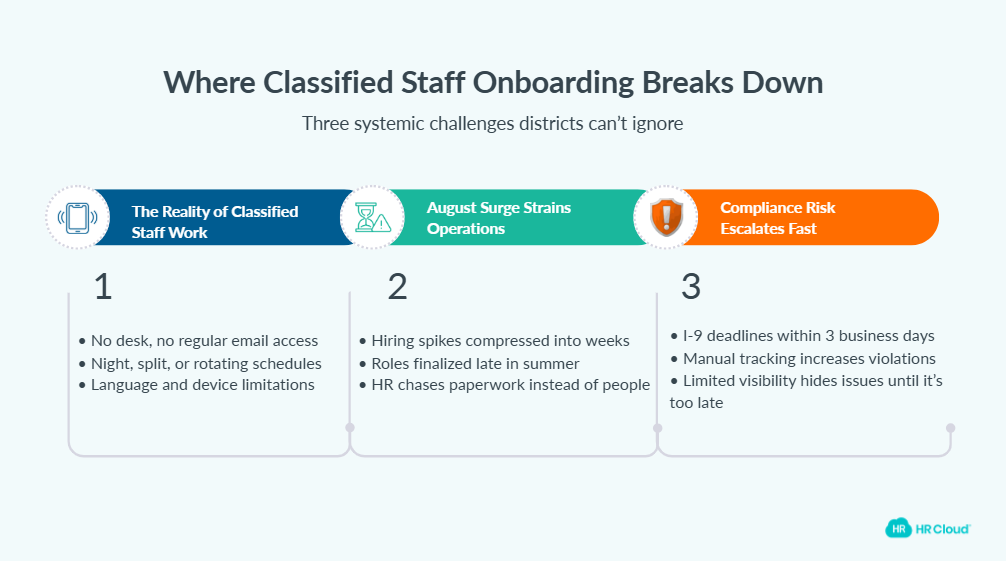
1. No fixed workplace or synchronous schedule for classified staff
Your bus driver doesn't have a district email address. Or if they do, they've probably never logged into it.
Your custodian works a 3 p.m. to 11 p.m. shift and can't attend daytime orientation sessions.
Your food service worker speaks Spanish as a first language and struggles with English-only compliance forms.
Your paraprofessional splits time between three different buildings and doesn't have a "home base" where they can access a computer.
Traditional onboarding—the kind that works perfectly fine for teachers and administrators—falls apart completely for these employees. And when onboarding fails, so does retention.
Brandon Hall Group research found that organizations with strong onboarding programs improve new hire retention by 82%.
Flip that around: weak onboarding is actively driving your classified staff out the door.
So, to ensure a "strong onboarding" experience for your field staff, include this:
- Mobile-first processes that work on a smartphone (that's the only device most of them have)
- Manager notification systems (supervisors need to know when their people are ready)
- Asynchronous completion windows (they work non-traditional hours)
- Compliance automation (manual I-9 tracking creates liability)
- Multi-language support (workforce diversity requires it)
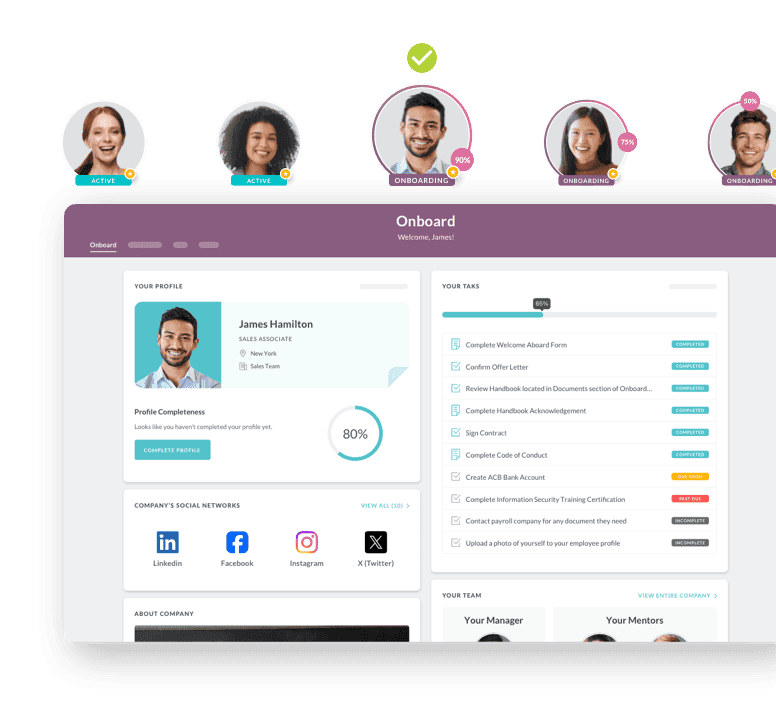
HR Cloud has been built specifically for organizations with distributed, deskless workforces who need mobile-first onboarding. An onboarding system that meets people where they are, not where HR wishes they were.
2. August Surge Timeline is Even More Compressed for Classified Staff
If you work in K-12 HR, you probably have nightmares about August.
The "August surge"—that frantic period when districts scramble to fill positions before the first day of school—represents one of the most challenging onboarding scenarios in any industry.
Unlike corporate hiring that flows relatively steadily throughout the year, education hiring follows a brutal seasonal pattern: slow in winter, building through spring, and exploding in late summer.
A mid-sized district (10,000-15,000 students) might onboard 200-400 new employees between July 15 and September 1. That's 6-8 weeks to process background checks, complete I-9 verification, collect tax forms, verify credentials, assign equipment, coordinate training, and—oh yes—actually welcome people to the organization.
But districts often don't finalize transportation routes until late July, which means bus driver positions can't be posted until then. Food service staffing depends on enrollment projections that shift throughout summer. Custodial needs change as portable classrooms get added or removed.
The result is that many districts are processing dozens of classified staff hires during the first week of school, which means new employees are working before their paperwork is complete.
And this is a huge red flag for compliance.
3. Onboarding compliance is highly exposed to liability
According to USCIS regulations, employers have exactly three business days after an employee's first day of work to complete Section 2 of the I-9 form. 2025 penalty guidelines set I-9 paperwork violations at $281-$2,789 per form for first offenses, escalating to $28,619 per violation for repeat offenders.
For a district processing 300 August hires the potential liability exposure can be staggering and the only way to survive this is to front-load as much as possible:
1. Pre-boarding before day one: Send offer letters with embedded links to digital onboarding portals. Let employees complete paperwork from their phones before they ever show up.
2. Automated compliance workflows: Use systems that trigger background check requests automatically, track E-Verify submissions in real-time, and flag incomplete documents before they become emergencies.
3. Batch processing with individual tracking: Group new hires into cohorts for efficiency, but maintain individual visibility into each person's onboarding status.
4. Mobile notifications: Alert supervisors when their new employees have completed required training. Alert HR when someone's stuck on a form. Alert the employee when their badge is ready for pickup.
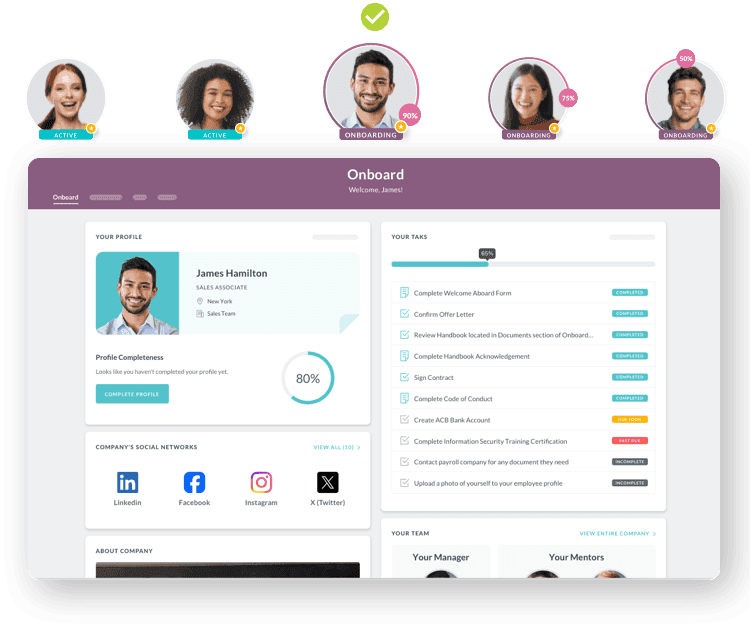
HR Cloud's Onboard module is capable of handling automated workflows that scale during high-volume periods while maintaining the individual attention that makes new employees feel welcomed rather than processed.
When you are managing the August surge, that combination of efficiency and humanity can be a lifesaver.
5-Step Framework for Effective Onboarding of Classified Employees
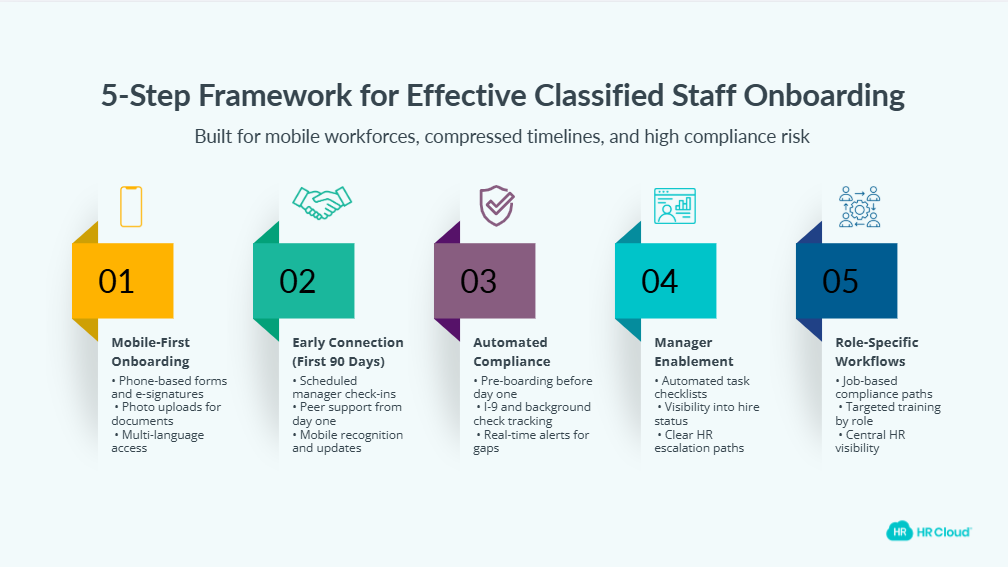
Let’s dive into the 5 steps right away.
Step 1: Building Mobile-First Onboarding for Classified Employees
Before we proceed, let me ask you something: when was the last time you completed your own district's new hire paperwork on a phone?
If the answer is "never" or a very long time ago, you might not fully comprehend how broken the experience is for classified staff.
Why do classified employees need mobile-first onboarding?
According to Pew Research Center data, 97% of Americans own a cellphone of some kind, with 90% owning smartphones. For workers under 50, smartphone ownership is nearly universal. But here's the key insight: for many hourly workers, a smartphone is their only computing device.
So if you want your classified staff to feel welcome, you cannot ignore mobile-first onboarding any longer.
What mobile-first actually means?
Mobile-first doesn't mean "our website technically loads on a phone." It means designing every step of the onboarding process with phone users as the primary audience:
- Responsive forms: Fields that work with thumb-typing, not mouse-clicking
- Photo capture: Let employees photograph documents (driver's license, Social Security card) instead of scanning or faxing
- E-signature: Touch-based signatures that complete legally binding documents
- Progress tracking: Visual indicators showing how much remains (people abandon confusing processes)
- Offline capability: Forms that save locally if cell service drops
- Push notifications: Reminders sent to phones, not just emails
The language factor:
National Center for Education Statistics data indicates that approximately 10% of K-12 students come from households where a language other than English is the primary home language. That diversity is reflected—and often amplified—in classified staff populations, particularly in food service and custodial roles.
Mobile-first onboarding platforms must support multi-language functionality. Not just translated text, but culturally appropriate communication patterns. An onboarding message that works in English might feel cold or confusing when directly translated to Spanish.
Mobile Onboarding Readiness Assessment (for Classified Staff)
This survey takes about 5 minutes and helps us improve the experience for future employees.
Download Now
Step 2: Build Connection in the First 90 Days
The first 90 days of onboarding are critical for employee retention. Research shows that 20% of employee turnover happens within the first 45 days. For classified staff in K-12, where turnover already runs higher than district averages, that window is even more critical.
A bus driver whose route starts at 6:15 a.m. and ends at 8:30 a.m. might never overlap with the school principal. A night custodian might work for months without meeting most teachers. A food service worker might feel invisible to everyone except students.
What you need to do is build connections with the new classified employees to ensure they stay. Here are some practical strategies for building connection:
1. Structured supervisor check-ins: Require managers to meet with new classified staff at day 7, day 30, and day 60. Brief conversations—even 10 minutes—create touchpoints that surface problems before they become resignations.
2. Peer mentorship programs: Pair new hires with experienced staff in similar roles. The bus driver who's been running the same route for 15 years has wisdom that no orientation video captures.
3. Recognition systems: Simple acknowledgment matters enormously. Platforms like HR Cloud's Workmates enable peer-to-peer recognition through mobile kudos—a quick "thank you" from a teacher to a custodian that shows up on the employee's phone.
4. Communication channels that actually reach people: If your district communication strategy relies on email newsletters that classified staff never read, that’s not the right channel for communicating with them. Mobile-first announcements, text message updates, and physical bulletin boards in break rooms will help move the needle on building connection.
5. Career development opportunities:Work Institute's 2024 Retention Report found that lack of career development is consistently among the top reasons employees leave. For classified staff, "career development" might look different than it does for teachers but it still matters. Cross-training opportunities (can a food service worker learn inventory management?), credential advancement programs (supporting paraprofessionals pursuing teaching licenses), and skill-building workshops all signal that the district values classified staff growth, not just their labor.
Step 3: Automate Compliance to Protect Your District
Beyond the per-form penalties for I-9 violations, compliance failures create broader liability. A district that employs someone who should have been flagged during a background check faces devastating legal and reputational consequences if that employee harms a student.
Automation doesn't just save time; it protects children. That's the frame that should guide every compliance conversation. But still, compliance for classified staff is frequently mishandled.
Let me spell it out for you.
The background check bottleneck
Most states require classified staff to pass criminal background checks before starting work. Many require additional fingerprinting, child abuse clearances, and (for transportation staff) driving record reviews. Some positions require drug testing.
These checks take time. And when a district needs 50 new bus drivers by August 15, the 2-3 week turnaround on FBI fingerprint checks creates impossible timelines.
Here are a few strategies that can work when handling compliance for classified staff:
1. Provisional start dates with documented compliance tracking: Some states allow conditional employment pending background check results. If your state permits this, build clear systems that track provisional employees and ensure no one falls through the cracks.
2. Automated document collection: Don't wait for orientation day to gather the documents you need for background checks. Send secure links immediately after offer acceptance and let candidates upload from their phones.
3. E-Verify integration: For I-9 compliance, manual E-Verify submission creates delays and errors. Integrated systems that automatically submit verification requests once Section 2 is complete eliminate this bottleneck.
4. State clearance tracking: Different positions require different clearances. A paraprofessional working with students who have disabilities might need clearances that a custodian doesn't. Build workflows that route employees through position-appropriate compliance requirements.
HR Cloud's compliance automation features handle exactly this complexity—tracking required clearances by position type, sending automated reminders when certifications approach expiration, and maintaining audit-ready documentation that protects districts during investigations.
Step 4: Empower Managers for Successful Onboarding
Even the best onboarding system fails if managers are not fully involved. Gallup’s 2025 State of Workplace report emphasizes this further.
For classified staff, "manager" often means someone with minimal HR training who's juggling their own overwhelming workload. Think transportation supervisor managing 80 bus drivers. The head custodian coordinating crews across 15 buildings. The cafeteria manager who's also the lead cook.
These folks aren't bad managers but typically overworked managers (remember the staff shortage data we discussed earlier) who haven't been given the tools or training to onboard effectively.
You need to enable your managers for onboarding the new hires successfully. This could include:
1. Automated task lists: When a new employee is assigned to a manager, that manager should automatically receive a checklist of what they need to do—and when. Day 1: facility walkthrough. Day 7: first check-in. Day 14: equipment training verification.
2. Visibility into onboarding status: Managers shouldn't have to call HR to find out if their new hire has completed compliance requirements. They should see it in a dashboard.
3. Templates for common situations: Pre-written scripts for first-day conversations, 30-day check-ins, and early warning signs of disengagement help managers who've never been trained on these skills.
4. Escalation pathways: When a manager notices a new employee struggling, there should be a clear process for getting HR support—not an ambiguous "let me know if you need anything."
Platforms like HR Cloud include manager-facing dashboards that surface all the information managers need. Information such as which new hires are fully onboarded, which are stuck on compliance steps, and which might need additional support.
Once the managers have the information, they can act upon it to provide support to the new hires when and where needed.
Step 5: Include Role-Specific Onboarding Because One Size Doesn't Fit All
The onboarding experience for a bus driver should look fundamentally different from the onboarding experience for a food service worker.
Both are classified staff. Both are essential. But the job requirements, compliance obligations, and day-to-day realities diverge completely.
Here is how you can ensure role-based customized onboarding:
Bus Drivers:
- CDL verification and driving record reviews
- State-specific training requirements (hours behind the wheel, route familiarity)
- Student management protocols (emergency procedures, behavioral interventions)
- Technology training (GPS systems, student tracking apps, two-way radios)
- Physical requirements (pre-employment physical, drug testing)
Custodians:
- Facility-specific orientation (alarm codes, HVAC systems, emergency shutoffs)
- Chemical safety training (OSHA-required Right to Know, bloodborne pathogen protocols)
- Equipment operation (floor machines, pressure washers, specialized cleaning systems)
- Building security responsibilities (key management, after-hours protocols)
- Work order systems training
Food Service Workers:
- Food handler certification (often state-mandated)
- Allergen awareness training (critical for student safety)
- Point-of-sale system operation
- Free and reduced lunch program procedures
- Kitchen safety protocols
Paraprofessionals:
- Student privacy training (FERPA requirements)
- Behavioral intervention protocols (especially for special education settings)
- Communication systems (how to document and escalate concerns)
- Classroom management expectations (boundaries of their role vs. teacher responsibilities)
- Building-specific schedules and supervision responsibilities
Classified Staff Onboarding Checklists by Role
Role-specific checklists work best if they reflect what actually happens on the ground, not what your policy manual says should happen.
Download Now
Building role-specific workflows
Modern onboarding platforms allow districts to create position-specific pathways. When you mark a new hire as "Bus Driver," they receive bus-driver-appropriate training modules, compliance requirements, and supervisor assignments. When you mark someone as "Cafeteria Worker," they get an entirely different sequence.
HR Cloud's workflow builder enables a drag-and-drop process design that ensures each classified staff category receives appropriately tailored onboarding. All the while ensuring HR maintains centralized visibility into completion status across all employees.
Measuring What Matters: Onboarding Metrics for Classified Staff
Onboarding is never a one and done process. You need to keep improving it with each batch of new hires. But you can't improve what you don't measure. Start with metrics that are critical to effective onboarding:
1. Time-to-productivity: How many days from hire date until the employee is working their full schedule independently? For bus drivers, this might be the day they run their route without a trainer. For custodians, it might be when they're assigned their own buildings.
2. 90-day retention: What percentage of classified staff are still employed 90 days after their start date? This metric catches early turnover that indicates onboarding failures.
3. Compliance completion rate: What percentage of new hires complete all required compliance documentation within the first week? First month? Track this by position type to identify where bottlenecks occur.
4. Onboarding satisfaction scores: Simple surveys sent at day 30 asking "How prepared do you feel for your role?" and "How welcomed do you feel by your team?" surface problems before they become resignations.
5. Manager engagement: Are supervisors completing their required onboarding tasks? If managers aren't doing their part, the best HR systems in the world won't save the employee experience.
Classified Staff 30-Day Onboarding Satisfaction Survey Template
This survey takes about 5 minutes and helps us improve the experience for future employees.
Download Now
Using data to drive improvement:
When you track these metrics consistently, patterns emerge.
Maybe bus driver 90-day retention is strong, but food service retention is weak—pointing to role-specific onboarding gaps.
Maybe compliance completion is excellent in some buildings but terrible in others—pointing to manager training needs.
Maybe satisfaction scores drop significantly between day 7 and day 30—pointing to a "honeymoon period" that fades when structured support disappears.
Set up reporting dashboards in your onboarding platform to provide visibility into metrics that lets district HR leaders track not just whether onboarding is happening, but also if it's working.
Pilot Onboarding for The First 30 Days
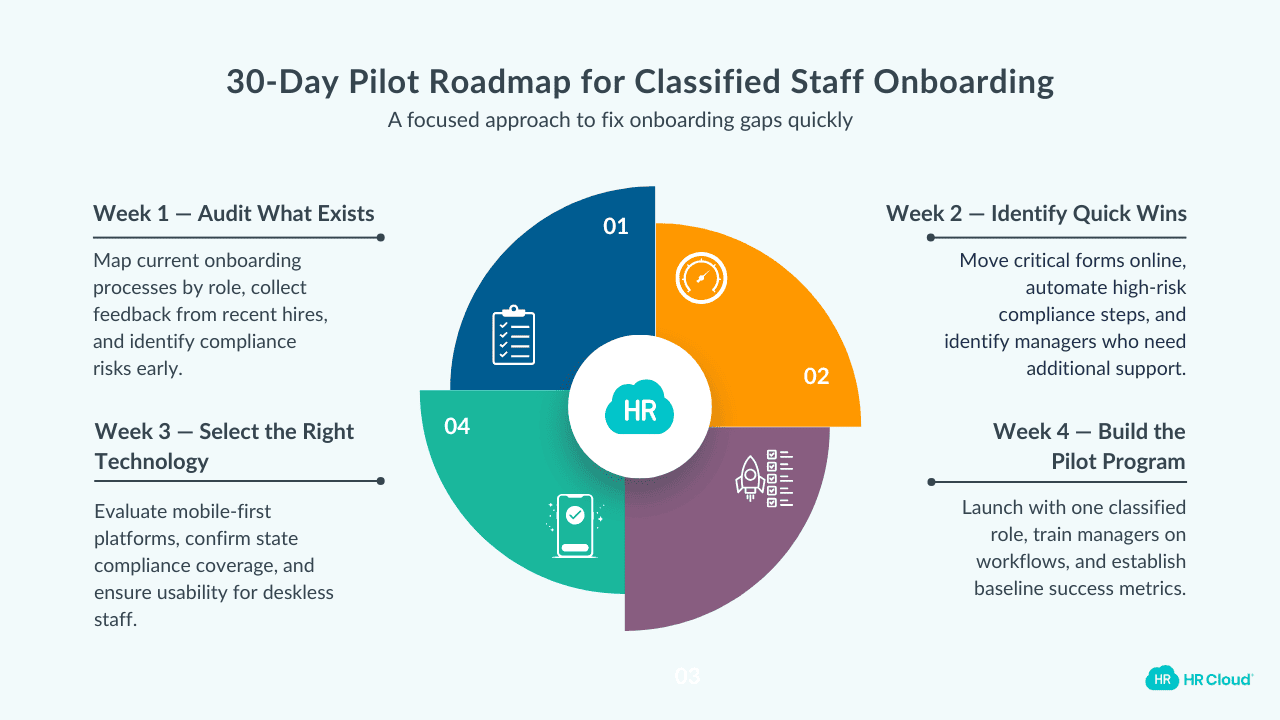
Onboarding improvement isn't a one-time project. It's an ongoing commitment to making every new employee's experience better than the last one's. If your district's classified staff onboarding needs improvement—and most likely it does—here's where to begin.
Week 1: Audit what exists
- Map the current onboarding process for each classified staff category
- Survey recent hires about their onboarding experience
- Identify compliance gaps and liability exposures
Week 2: Identify quick wins
- What can move online immediately? (Forms, policy acknowledgments, training videos)
- What automation would save the most time? (Usually I-9/E-Verify processing)
- Which managers need the most support?
Week 3: Select technology
- Evaluate platforms designed for deskless workforces (not retrofitted corporate systems)
- Ensure compliance features match your state's requirements
- Prioritize mobile-first functionality
Week 4: Build pilot program
- Choose one classified staff category for initial rollout
- Train managers on their responsibilities
- Design role-specific workflows
- Establish baseline metrics
Final Thoughts:These Workers Deserve Better
Let's complete the circle and end where we started: with the people who make schools run.
Think about the bus driver who learns every kid's name and notices when someone seems upset. The custodian who stays late to set up chairs for the band concert. The food service worker who sneaks an extra cookie to the student having a hard day. The paraprofessional who becomes a trusted adult for a child who doesn't have many.
Your classified staff chose to work in schools because they care about kids.
Your onboarding process should communicate that you care about them, so don’t lose that opportunity.

Discover how our HR solutions streamline onboarding, boost employee engagement, and simplify HR management
Book Your Free DemoFAQs
Why is classified staff onboarding different from teacher onboarding?
Classified staff are often a deskless workforce, which means they may not have consistent computer access, regular work hours, or even a district email address. Because of that, a mobile-first, asynchronous onboarding approach is essential to reach them where they actually are—on their phones, on the move, and on nontraditional schedules.
How can districts handle the August hiring surge?
Districts can reduce August chaos by front-loading paperwork through pre-boarding portals before day one and automating compliance workflows wherever possible. Batch processing helps HR move faster, but individual tracking ensures nothing gets lost. Mobile notifications then keep new hires moving through requirements without endless email chasing.
What compliance risks exist for classified staff onboarding?
Classified onboarding carries real compliance exposure because missing forms and late verifications are common when employees don’t sit at a desk. I-9 violations can cost $281 to $2,789 per form, and paper I-9 processes have error rates as high as 76%. Automated compliance systems with E-Verify integration reduce errors and help districts avoid expensive penalties.
How does mobile-first onboarding improve retention?
Mobile-first onboarding improves retention by removing friction at the exact moment a new hire is deciding whether this job will be a headache or a home. These processes can deliver faster time-to-productivity. And when deskless workers complete paperwork on their phones, they feel capable and included sooner—two feelings that quietly drive early commitment.
How do you build belonging for workers with irregular schedules?
Belonging has to be consistently engineered for irregular schedules. Districts can use structured supervisor check-ins at days 7, 30, and 60, along with peer mentorship programs that don’t rely on shared shifts. Mobile-based recognition and communication channels beyond email help people feel seen even when they aren’t present at the same time.
What is onboarding for a school?
School onboarding is the structured process of preparing a new hire to start smoothly and perform effectively. It typically includes completing required paperwork and compliance steps, learning school policies and routines, getting role-specific training and system access, and building early connections so the person feels supported and ready from day one.
About the author

Keep Reading


Like What You Hear?
We’d love to chat with you more about how HR Cloud® can support your business’s HR needs.
Book Your Free Demo