Reducing Healthcare Staff Turnover with Better Onboarding

Healthcare staff turnover costs hospitals millions annually, and a significant share of those exits happen within the first 90 days. Structured, automated onboarding that starts before a hire's first day is one of the most evidence-backed nurse retention strategies available to healthcare HR teams. HR Cloud's Onboard platform helps healthcare organizations automate compliance workflows, build role-specific portals, and connect new hires to their teams before their first shift.
Key Takeaways
- The national hospital staff turnover rate is 18.3%, but home healthcare facilities see rates near 79%
- Replacing one bedside RN costs an average of $61,110
- Up to 20% of employee turnover across industries occurs within the first 45 days (SHRM), a pattern healthcare organizations experience acutely given frontline role demands.
- Organizations with formal onboarding programs see 50% higher retention than those without.
- A structured onboarding program reduced new hire turnover at one hospital from 39.1% to 18.4%
- HR Cloud Onboard supports bulk onboarding, chained tasks, I-9/E-Verify, Checkr integration, and customizable portals by role and location
The First Week Nobody Talks About
Picture a certified nursing assistant on her first week at a regional home care agency. She gets a paper stack to sign, a brief building tour, and a phone number for HR "if you have questions." Her supervisor is covering two other facilities. Her badge takes three days to arrive. She never meets the team she'll actually work with.
By day 30, she's gone.
This isn't an edge case. It plays out constantly across U.S. healthcare. And it's not a pipeline problem. Candidates aren't bad fits. It's that first impressions compound fast. A disorganized onboarding experience sends a new hire a clear signal about how things work here. For healthcare workers already carrying significant clinical and emotional weight, that signal lands differently than in other industries.
Onboarding is fixable. And it costs a fraction of what turnover costs.
What Healthcare Turnover Actually Costs
The national hospital staff turnover rate dropped to 18.3% in 2024, according to the 2025 NSI National Healthcare Retention & RN Staffing Report. That's real progress. But the broader picture is harder to look at. In home healthcare, annual caregiver turnover runs near 79%. Nursing home staff face rates around 53%. Certified nursing assistants in acute care see turnover above 31%.
Then there's the cost math. Replacing a single bedside RN averages $61,110 according to the 2025 NSI Report. A mid-sized hospital loses somewhere between $3.9 and $5.8 million on nurse turnover each year. Every percentage point shift in nurse turnover rate equals roughly $289,000 gained or lost. Those aren't soft numbers.
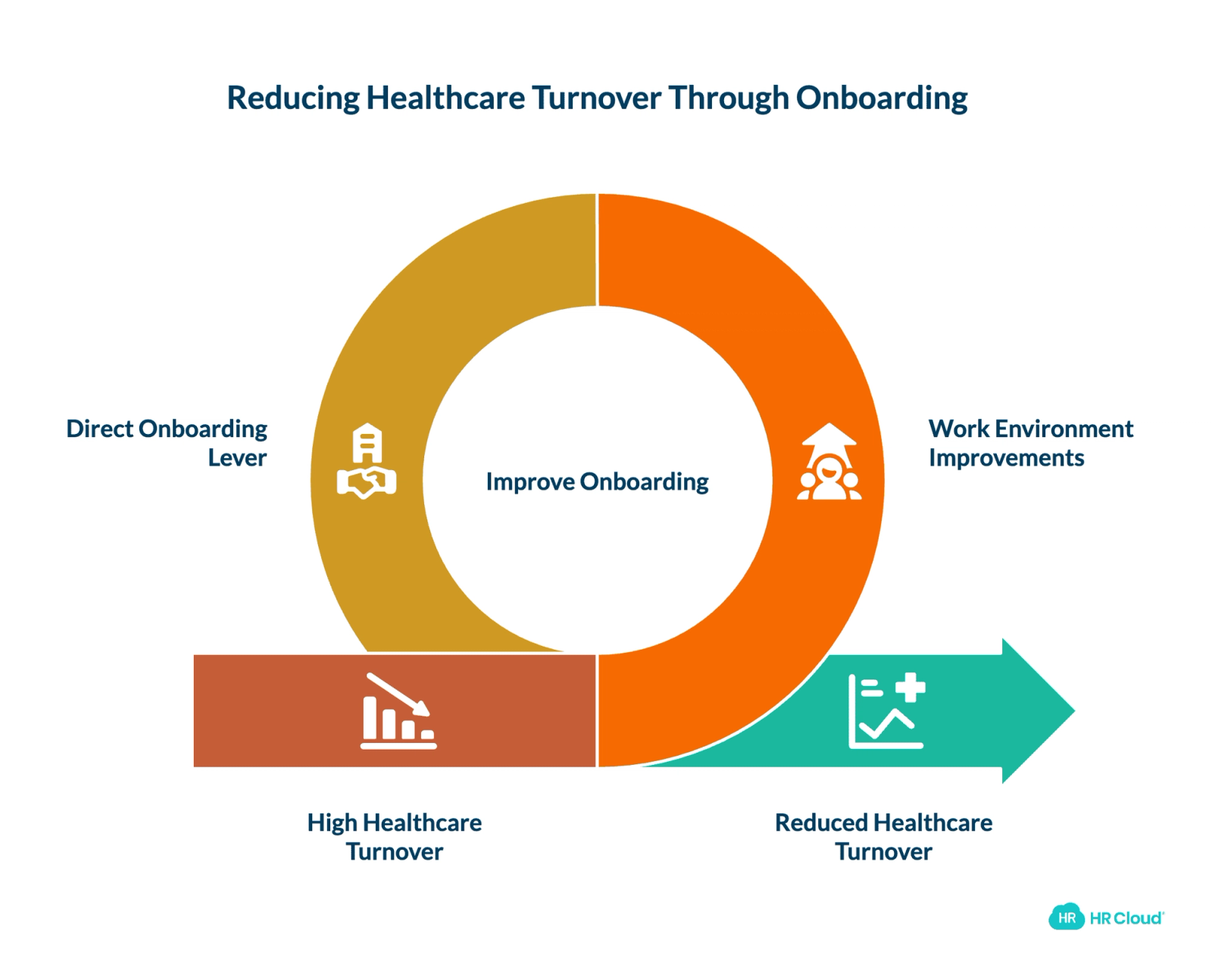
What makes this frustrating is that 44% of healthcare turnover is considered potentially preventable through work environment improvements. Onboarding is one of the most direct levers in that category.
Healthcare Turnover Cost by Role (2025 Benchmarks)
| Role | Average Turnover Rate | Replacement Cost Note |
|---|---|---|
| Bedside RN | 16.4% | $61,110 per departure (NSI 2025) |
| CNA / Patient Care Tech | 31.2% | Lower per-hire cost than RN; higher volume means significant aggregate spend |
| Home health aide | ~79% (sector-wide) | Industry-wide, constant churn; recruitment and retraining costs compound quickly |
| Nursing home staff (all) | ~53% | Among the highest rates in any care setting |
| ICU / Specialty RN | 29.7% | Specialty roles take longer to fill; vacancy costs compound during open weeks |
Sources: 2025 NSI National Healthcare Retention Report; Rellevate Healthcare Turnover Stats 2025
A hospital with 200 RNs at 20% turnover replaces 40 nurses annually. At $61,110 each, that's $2.4 million. Dropping that rate to 12% with structured onboarding cuts the bill by roughly $975,000 per year. That's not an HR metric. That's a CFO conversation.
The retention strategies that healthcare organizations actually see results from share a common thread: they invest in how people are treated before and during their first few months.
Why the First 90 Days Set the Tone
Employees don't leave suddenly. They decide slowly. And early.
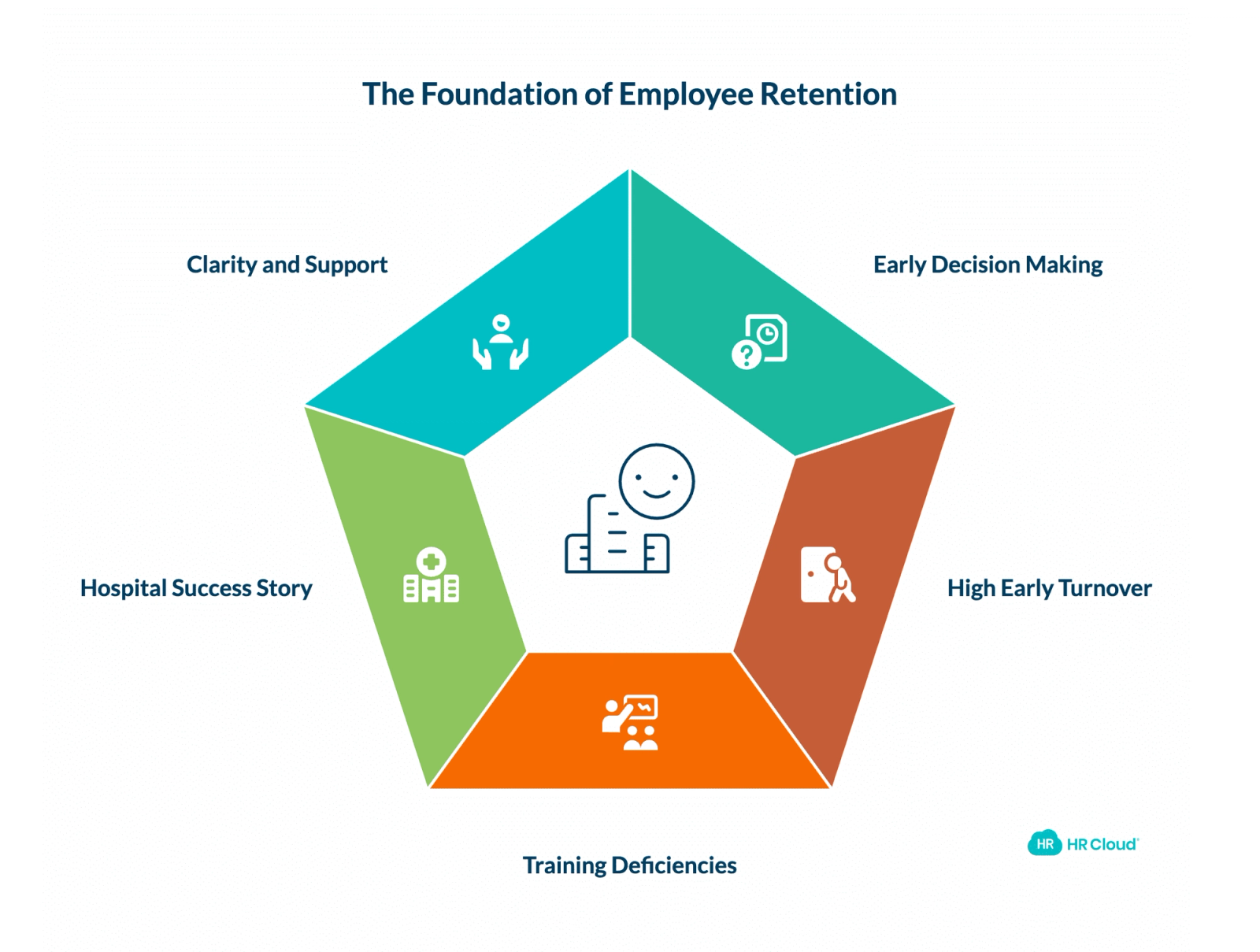
Research shows that 86% of new hires decide how long they'll stay at a company within their first six months. Twenty percent quit within the first 45 days. One in three new hires across all industries leaves before 90 days. Among those who departed early, 60% cited a lack of training or a disorganized training experience as their primary reason.
A specific hospital case illustrates what's possible in the other direction. A 187-bed community hospital in Washington, D.C. implemented a structured 10-element onboarding program. New hire turnover dropped from 39.1% to 18.4% for hospital and RN staff combined. No magic—just better training, clearer expectations, management support, and regular feedback.
That's what structured onboarding does. It removes the fog.
The Gap Between Orientation and Onboarding
Most healthcare HR teams know the difference, even if the organization doesn't act on it. Orientation is a single event: paperwork, policies, a tour, maybe a compliance video. Onboarding is the full experience of becoming part of an organization, and it should run at least 90 days.
Only 43% of employees experience onboarding that extends beyond a single-day orientation. That's a lot of organizations essentially dropping new hires into cold water and hoping they figure it out. In healthcare, where clinical errors have immediate consequences, that approach doesn't just hurt retention. It affects patient safety.
Organizations with formal onboarding programs see 50% higher retention rates than those without. Organizations with structured 90-day onboarding programs report dramatically higher retention rates compared to those that end onboarding within the first week. These are not marginal gains. They're structural improvements any healthcare organization can make by building a proper framework and treating onboarding as more than a single-day event.
Five Onboarding Changes That Reduce Healthcare Staff Turnover
1. Start Onboarding Before Day One
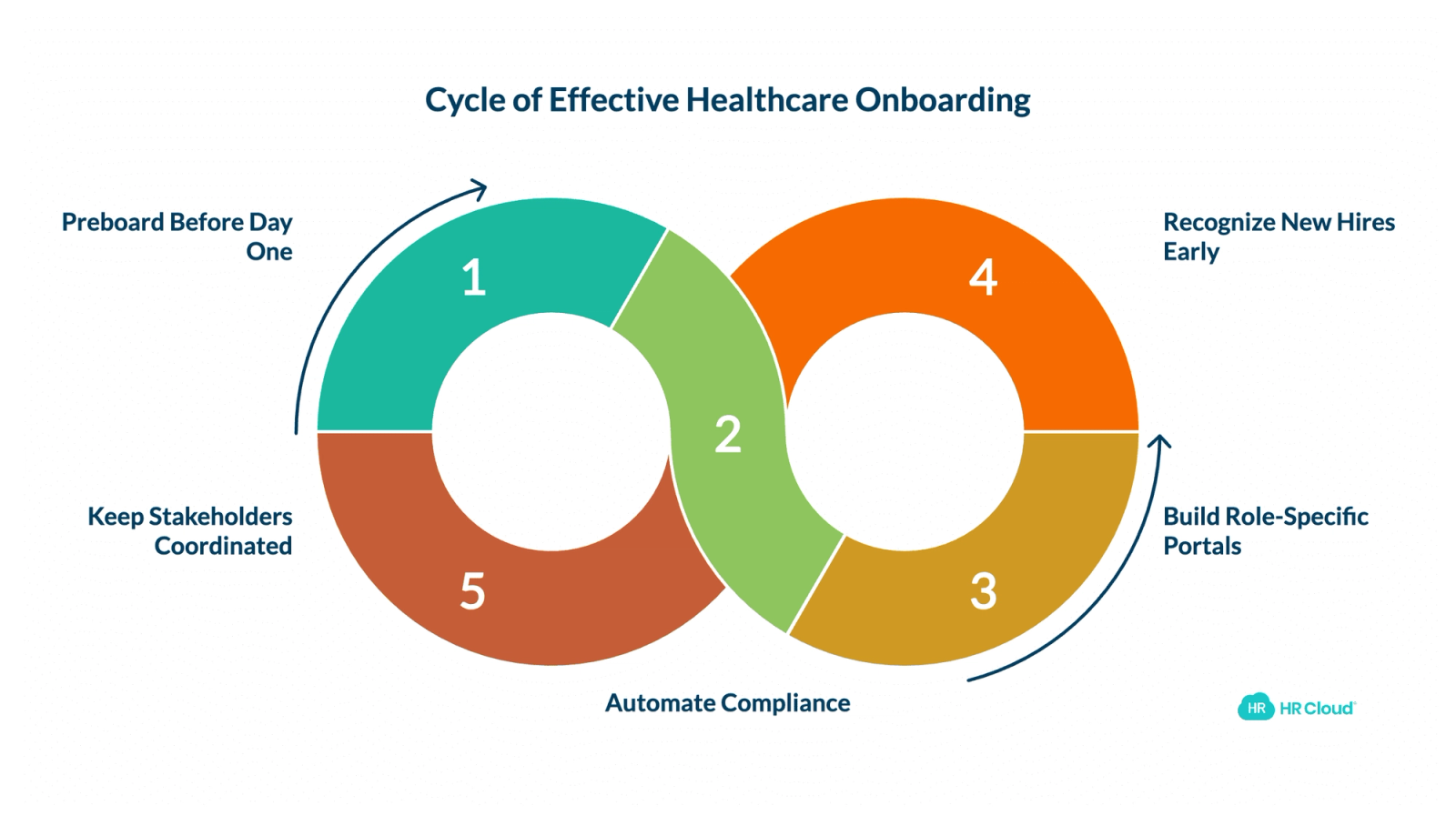
The first day of employment is too late to begin onboarding. Preboarding (the window between offer acceptance and start date) is where healthcare organizations have real leverage, and most leave it entirely unused.
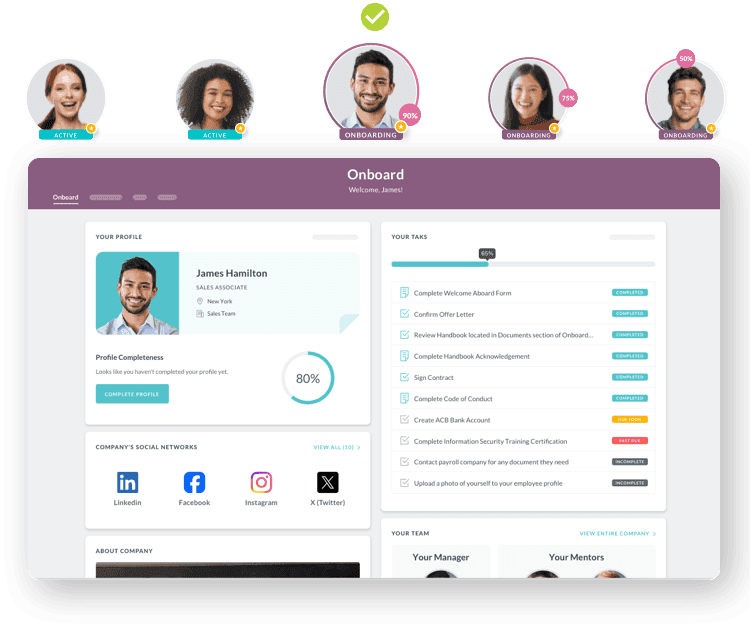
HR Cloud's Onboard platform allows HR teams to configure preboarding workflows with adjustable required fields for prehires. A new CNA can complete her I-9, review employment documents, acknowledge compliance policies, and access a welcome message from her manager before she steps through the door on day one. That first day becomes less about paperwork and more about connection. For healthcare teams managing I-9 and E-Verify compliance across multiple facilities, preboarding also means avoiding the costly errors that pile up when verification tasks get rushed on a busy orientation morning.
Background check integration through Checkr runs directly within the onboarding checklist. HR admins add an "Initiate Background Check" task, and once the employee completes their portion through Checkr's portal, results return automatically. No chasing, no delays, no separate logins.
This preboarding window is also when organizations can share essential onboarding documents digitally: role expectations, team introductions, compliance acknowledgments. New hires arrive informed rather than overwhelmed.
2. Automate Compliance Without Making New Hires Feel Like a File Number
Healthcare compliance isn't negotiable. I-9 completion, E-Verify, credential documentation, background checks. All of it has to happen correctly, on time, and in sequence. But when HR's first interactions with a new hire are entirely form-driven, new hires don't feel welcomed. They feel processed.
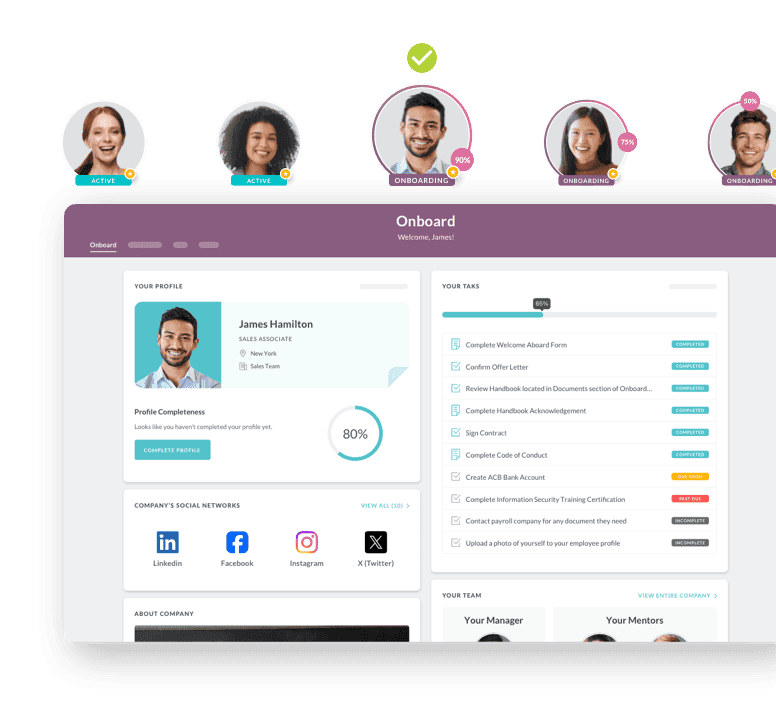
HR Cloud integrates directly with E-Verify as part of the I-9 workflow. Once an employee completes their portion of the I-9, the HR admin finishes the employer section and submits the case to E-Verify without leaving the platform. All past and current E-Verify cases track under a single tab in the Onboard application.
Chained tasks add intelligent structure. Task chains define a specific completion order for onboarding steps, with dependencies built in: step 2 stays locked until step 1 is complete. For healthcare organizations managing clinical credentials, compliance acknowledgments, and role-specific training, this prevents steps from being skipped while keeping the experience digestible rather than chaotic.
Automating healthcare employee onboarding also frees HR administrators to spend their time on the human side of welcoming new staff, not chasing down missing paperwork at 4 p.m. on a Friday.
3. Build Role-Specific Onboarding Portals
A travel nurse joining the ICU needs very different onboarding than a front desk coordinator at an outpatient clinic. Sending both through the same generic process is a missed opportunity. New hires notice.
HR Cloud supports multiple onboarding portals, each customizable with company branding, welcome messages, text and video widgets, links, and documents. Assignment policies mean only employees matching specific criteria (department, location, position, or employment type) see the portal relevant to their role. A home health aide in one city sees a different onboarding experience than a surgical tech in another, running within the same system.
Bulk onboarding handles volume. When a hospital hires 40 CNAs ahead of a seasonal surge, HR doesn't manually initiate 40 separate workflows. One action starts onboarding for the entire cohort. For healthcare organizations with cyclical hiring patterns, this feature alone saves meaningful administrative time.
Free onboarding checklists and templates can help HR teams define the structure before building it out in the platform.
4. Recognize New Hires Early
Healthcare workers form impressions of their organization continuously, especially in the first 30 days. In a sector defined by demanding schedules and emotional labor, recognition has outsized impact on whether a new employee feels they belong.
HR Cloud's Workmates platform includes a Kudos feature where team members recognize each other with badges, points, and peer posts visible across the company feed. A charge nurse can give Kudos to a new CNA who handled a difficult patient situation calmly. That recognition lands on the company feed, earns the recipient points redeemable for gift cards or custom rewards, and tells the new hire something important: people here are paying attention.
Auto Rewards handles milestone recognition automatically. Work anniversaries and birthdays trigger point awards without requiring any HR action. For a new hire finishing their first 30, 60, or 90 days, these automated moments signal that the organization is invested in them, not just their task completion rate.
Gallup research consistently shows that only 23% of employees globally feel engaged at work. In healthcare, where engagement gaps translate into patient outcomes and voluntary exits, recognition built into the workflow, not treated as a separate initiative, is genuinely worth building.
Book a demo to see how Workmates supports healthcare employee recognition from day one.
5. Keep Every Stakeholder Coordinated Without Email Chains
Poor coordination between HR, IT, department managers, and payroll is one of the most common failure modes in healthcare onboarding. A new hire shows up Monday morning. System access isn't ready. Her manager didn't know she was starting. Payroll hasn't been notified.
HR Cloud's automated workflows address this at the source. Workflows are if/then trigger chains. When a hire's employment status updates, the right people receive the right tasks automatically: payroll gets notified, IT receives a provisioning task, the manager sees a checklist. No manual coordination, no dropped handoffs.
Automated task reminders add another safeguard. When an onboarding task goes overdue, HR can send a manual reminder directly from the platform with one click. This is particularly useful in healthcare environments where managers are often covering clinical duties and routine email follow-up disappears in the noise.
A comprehensive new hire checklist gives every stakeholder (HR, managers, IT, and the new hire) a shared view of where things stand.
Traditional Onboarding vs. Structured Onboarding in Healthcare
| Area | Traditional Approach | Structured Approach with HR Cloud |
|---|---|---|
| Preboarding | Forms emailed or handed over on day one | Digital tasks assigned before start date, accessible from any device |
| Compliance (I-9, E-Verify) | Manual forms, HR follows up individually | Automated I-9 workflow with direct E-Verify integration |
| Background checks | Separate Checkr login, manual tracking | Integrated Checkr task in the onboarding checklist |
| Bulk hiring | Each employee started manually | Bulk onboarding initiated in one action for up to 100 employees |
| Task sequencing | No enforced order, steps get skipped | Chained tasks enforce correct completion order |
| Role-specific content | Same generic materials for all roles | Multiple branded portals by role, location, and department |
| Recognition | Ad hoc or nonexistent in first 30 days | Kudos peer recognition and Auto Rewards active from day one |
| Cross-department coordination | Email threads and manual follow-up | Automated workflow notifications to IT, payroll, and managers |
| 90-day visibility | Tracking stops after week one | Milestone tracking and reminders across the full onboarding period |
Each row in this table represents a moment where a new hire either builds confidence or starts reconsidering their decision. The organizations that keep staff past 90 days have usually made structured onboarding a deliberate priority, not a compliance checkbox.
What Younger Healthcare Workers Expect
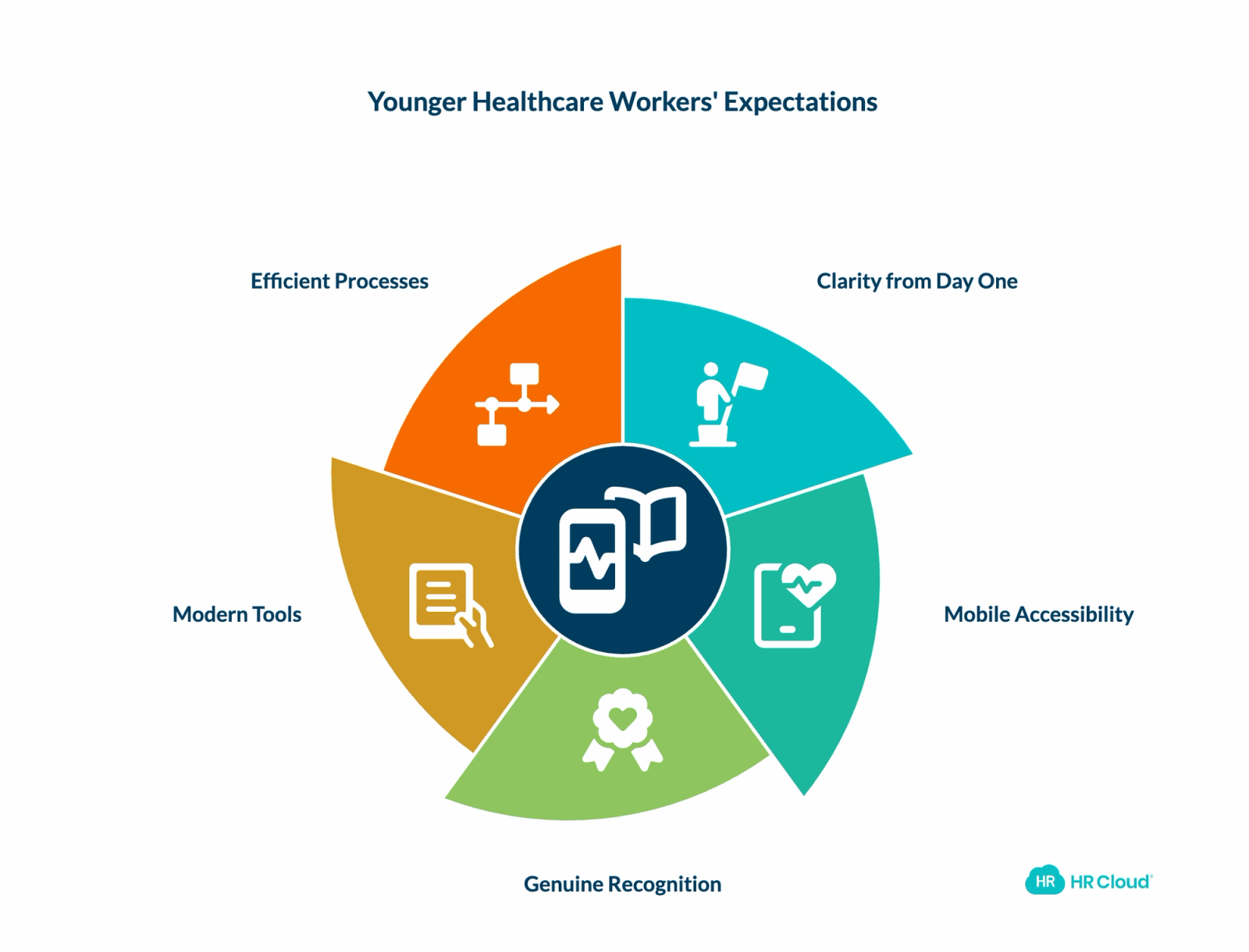
Gen Z healthcare workers leave at a 38% turnover rate, nearly double the national hospital average. Millennials turn over at 22%. Together, these two generations account for more than half the U.S. healthcare workforce.
Their expectations are different. They want clarity from day one. They expect mobile-accessible tools. They notice when recognition is genuine versus performative. They won't tolerate paper forms and email threads when every other part of their professional lives runs from a phone. HR Cloud's mobile app allows new hires to complete tasks, view their profile, and engage with Workmates from any device, which matters a lot for clinical and deskless workers who don't sit at desks between shifts.
Research on healthcare nurse burnout and engagement shows that organizations treating mobile accessibility as standard (not a nice-to-have) see measurably higher engagement from frontline staff in their first month. When a nurse can check her schedule from her phone during a break, she notices. This organization built systems around how she actually works.
A 30-60-90 Day Onboarding Framework for Healthcare
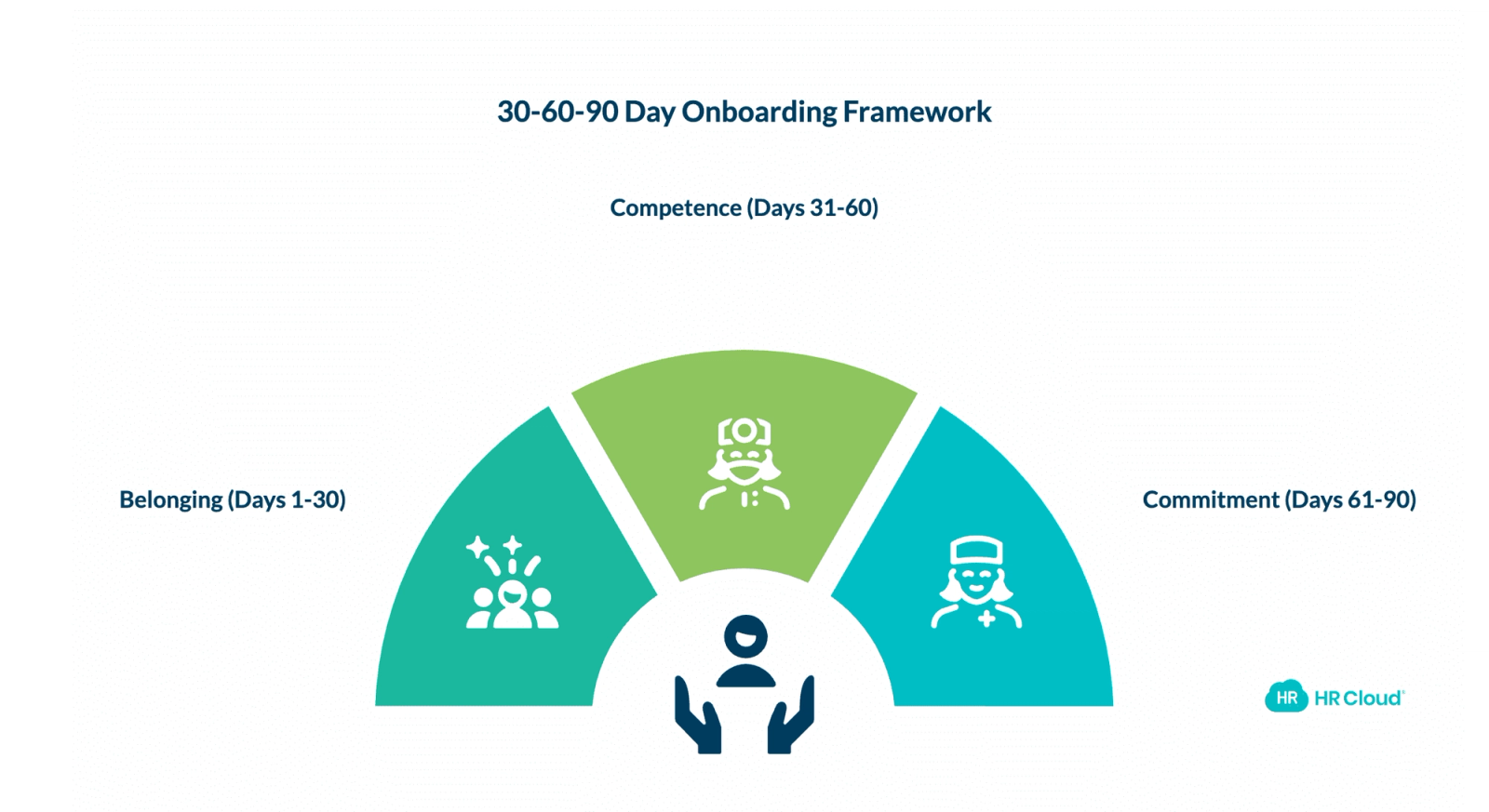
The 90-day window is where retention is won or lost. Most onboarding programs in healthcare collapse within the first two weeks, leaving new hires without structure during the period when they're most vulnerable to second-guessing their decision.
Days 1–30: Belonging. New hires should know their colleagues, understand their unit's culture, and feel safe asking questions. Compliance tasks are complete before day one through preboarding. The focus shifts to connection. Workmates Kudos can be active from the first week, letting peers extend recognition before the first month ends. Employee engagement ideas for healthcare teams in this phase are mostly relationship-based: buddy assignments, team introductions, quick wins.
Days 31–60: Competence. Clinical skills are reinforced. Role expectations are explicit. Regular check-ins between the new hire and their manager surface gaps before they become frustrations. HR Cloud's workflow system can automate check-in reminders so managers receive a prompt without HR having to follow up manually.
Days 61–90: Commitment. This is the confirmation phase. Is this person thriving? Are there early retention risk signals? Pulse surveys distributed through Workmates can surface issues quietly building underneath. By day 90, organizations should have enough signal to know whether this hire is set up for long-term success, or whether something needs to change.
HR Cloud Onboard supports every phase of this framework. See it in action.
Why this framework matters: Most healthcare onboarding programs are designed around administrative completion, not retention outcomes. The 30-60-90 structure shifts the goal from "get them through paperwork" to "make sure they're still here at day 91 and want to stay." Each phase targets the specific reason healthcare workers leave at that stage: disorientation in month one, competence gaps in month two, and quiet disengagement in month three.
Integrations That Reduce Friction in Healthcare HR
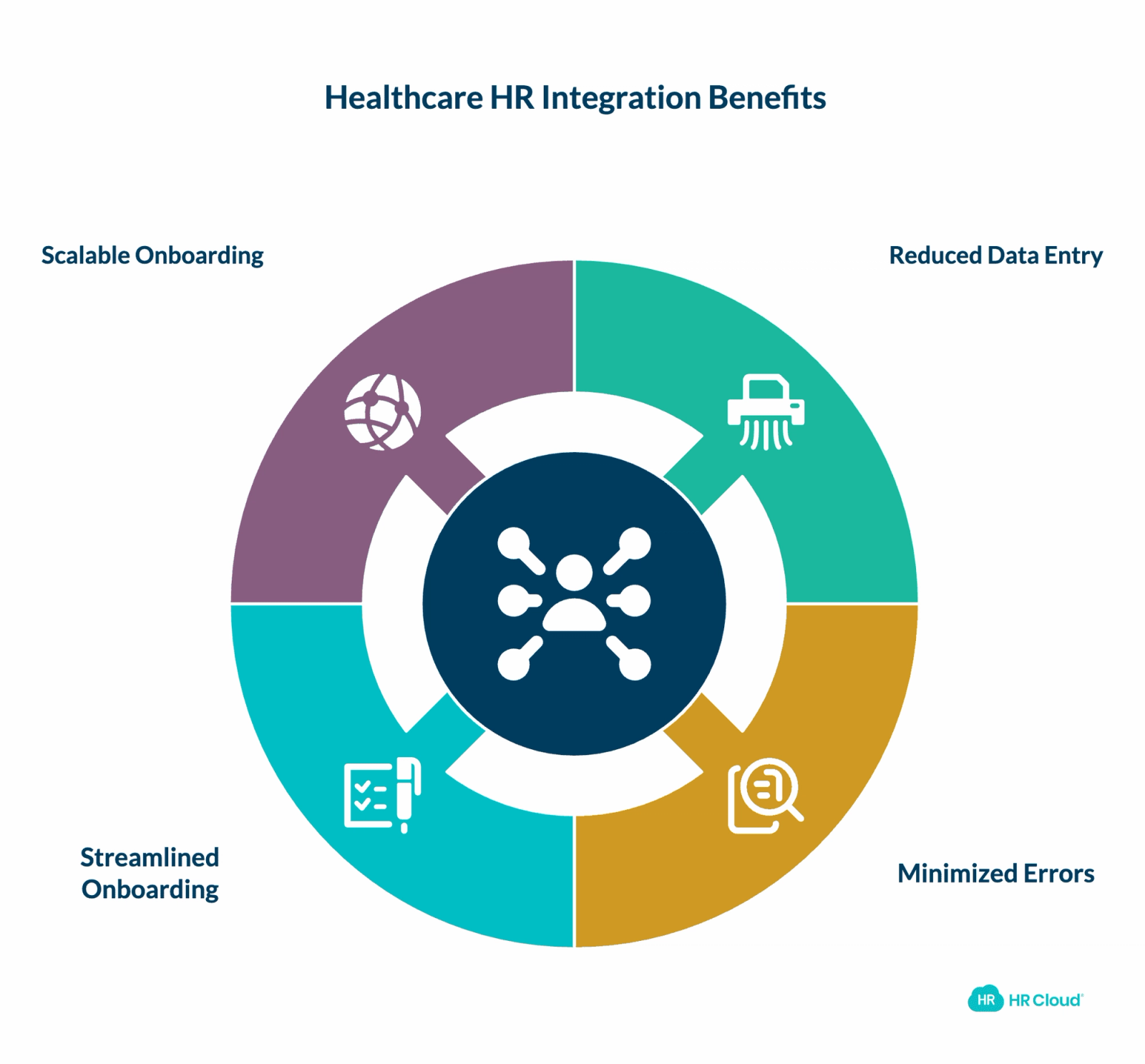
Healthcare organizations rarely live on a single platform. Payroll runs in UKG or ADP. Recruiting flowed through Indeed or Hireology. Background checks require Checkr. Compliance involves E-Verify. When onboarding software exists outside this ecosystem, data entry doubles and errors multiply.
HR Cloud connects with UKG to export new hire data (direct deposit, W-4, and I-9 information) directly to payroll at the point of onboarding completion. No duplicate entry. Checkr integration embeds background screening into the standard onboarding checklist, keeping the entire process within one interface. Zapier connectivity extends the platform to hundreds of additional tools without custom development.
For healthcare HR teams managing compliance across multiple facilities and locations, this connected approach is what makes structured onboarding sustainable at scale rather than a pilot project that only works for small cohorts. The nurse onboarding checklist for hospitals offers a concrete starting point for building this kind of integrated workflow across clinical roles.
Where Turnover Actually Gets Fixed
Healthcare organizations can't recruit their way out of a turnover problem. The math doesn't support it. What does work is keeping the people already in the building. And that starts with how new hires are welcomed, guided, and recognized in their first 90 days.
Onboarding isn't a check-the-box event. It's what tells a new hire, in the first few weeks, whether this organization is worth staying in. Structured onboarding, built on automated compliance workflows, role-specific portals, genuine early recognition, and coordinated stakeholder notifications, is one of the highest-ROI workforce investments available to healthcare HR teams.
HR Cloud Onboard was built for this level of complexity. If your current onboarding process can't tell you where a new hire stands at day 30, it's worth looking closer.
Schedule a demo with HR Cloud to see healthcare-specific onboarding automation in practice.

Discover how our HR solutions streamline onboarding, boost employee engagement, and simplify HR management
Book Your Free DemoFrequently Asked Questions
What causes healthcare staff turnover?
Exit interviews in healthcare tend to cluster around the same themes: burnout, unclear expectations, not enough support from managers, and a rough first 90 days. Other contributing factors include scheduling unpredictability, limited career development visibility, and the administrative complexity of compliance-heavy roles. Onboarding quality directly addresses several of these by establishing clarity, connection, and structure before the frustration cycle starts. In home care and long-term care settings specifically, high caregiver turnover is also tied to isolation from peers and lack of early recognition, both of which structured onboarding can address from day one.
How does onboarding reduce healthcare staff turnover?
Structured employee onboarding removes the ambiguity and isolation that push healthcare workers out the door in their first weeks. When new hires understand their role, feel connected to their team, and have compliance tasks handled before day one, the early-exit triggers (unclear expectations, feeling unsupported, information overload) don't get a chance to take root.
What should healthcare onboarding include?
At minimum: digital preboarding with compliance tasks completed before day one (I-9, E-Verify, background check), a role-specific onboarding portal, chained workflow tasks with clear sequencing, peer recognition tools, 30-60-90 day check-ins, and a structured introduction to team culture. HR Cloud's free onboarding checklists provide a starting template for healthcare teams.
How long should healthcare employee onboarding last?
Evidence supports a minimum of 90 days, with the first 45 being the highest-risk period. Programs lasting one year show 50% higher retention than those ending within 30 days. Most healthcare organizations under-invest here by a significant margin.
What does healthcare employee turnover actually cost?
Replacing a single bedside RN costs an average of $61,110 according to the 2025 NSI Report. A hospital with 200 RNs at 20% annual turnover loses roughly $2.4 million annually on nursing turnover alone. Reducing that rate by even a few percentage points delivers immediate financial impact, typically far exceeding the cost of the onboarding improvements that get you there.
How can HR Cloud help with healthcare onboarding specifically?
HR Cloud's Onboard platform supports bulk onboarding for high-volume hiring cycles, chained tasks with sequential workflow dependencies, I-9 and E-Verify integration, Checkr background check integration, role-specific branded portals, automated workflow notifications to all stakeholders, and the Workmates engagement platform for peer recognition and communication, all within a single system built for healthcare HR complexity.
About the author

Keep Reading


Like What You Hear?
We’d love to chat with you more about how HR Cloud® can support your business’s HR needs.
Book Your Free Demo