
AI Onboarding for Field Workers: Why Compliance Is the Real Test (And How to Pass It)

Approximately 80% of the global workforce is deskless — field workers, frontline staff, and distributed teams who do their jobs away from a desk, a laptop, and a corporate email address.
Yet most enterprise HR onboarding platforms were built for the 20% who work in an office.
That design gap has a cost, and in field-heavy industries such as healthcare, manufacturing, retail and education, it shows up as a compliance liability.
Missed I-9 deadlines. Unsigned HIPAA acknowledgments. Lapsed OSHA certifications. These are not the result of HR negligence; they are the predictable outcome of an onboarding process that never reached the people it was supposed to serve.
If you are still trying to onboard your frontline workers with systems never designed for them, AI onboarding can solve this exact challenge. But, it requires rethinking the complete onboarding process from the ground up.
The Workforce That Traditional Onboarding Was Never Built For
The HR tech industry has a blind spot, and most vendors aren't eager to admit it.
Almost every onboarding platform — every checklist, every digital workflow, every "new hire portal" — was designed with the assumption that your employee is deskbound.
That assumption fails for frontline deskless teams before you've even sent the welcome email.
Your delivery drivers clock in at 5 a.m.
Your nurses start a shift on floor, not a workstation.
Your construction crew arrives on a job site, not a fancy office.
Your school custodians don't have school email until their third week.
If you are sending an onboarding packet in a corporate inbox these workers don't have access to, the process breaks down. And compliance documentation is the first and most expensive casualty.
The pressure to minimize time to productivity makes it worse.
Hiring managers need bodies on the floor. "We'll sort the paperwork later" becomes standard practice. And "later" is when the auditor arrives, when the credential expires, or when the I-9 deadline quietly passes.
Deskless worker onboarding is not a minor variation on standard onboarding. It is a fundamentally different challenge. Treating it like a tweak rather than a redesign is where most organizations get themselves into trouble.
The Compliance Exposure No One Talks About
Most discussions about AI onboarding focus on efficiency gains. That framing misses what's actually at stake in field-heavy enterprises.
An I-9 violation carries a penalty of $2,203 to $22,016 per violation.
An unsigned HIPAA training acknowledgment is a breach waiting for a trigger event.
An OSHA certification that lapsed during a high-volume seasonal hiring wave is a compliance lapse during the next safety inspection.
These are specific, expensive, and directly connected to the speed-up-onboarding shortcuts that field onboarding tends to normalize.
What makes this harder is that compliance requirements aren't uniform across field industries. A few examples:
| Industry | Key Compliance Requirements |
|---|---|
| Healthcare | HIPAA training, credentialing verification, mandatory reporting acknowledgment |
| Manufacturing | OSHA safety training, equipment certification, shift-specific protocols |
| Construction | Site safety induction, licensing validation, drug testing documentation |
| Retail/Food Service | Food handling certification, harassment training, high-volume I-9 processing |
| Education (K-12) | Background checks, FERPA compliance, mandated reporter training |
If manufacturing hires are part of your profile, the compliance and certification requirements in that vertical go deeper than a table row can cover. Read our dedicated guide to AI onboarding for manufacturing workers before you build your onboarding workflow for that vertical.

Struggling to Support Frontline Workers?
- Centralize onboarding, policies, and updates
- Reach deskless workers without email
- Reduce confusion from day one
HR Cloud serves enterprise customers managing these exact requirements across all five of these verticals. The compliance challenge is not theoretical for them — it is the first phone call HR makes when something goes wrong.
And here's what I have observed: no amount of good intent closes a compliance gap that the process never captured.
What AI Onboarding Actually Does for Field Teams
The practical question is not "does AI onboarding work?" but "what does it actually change on a Tuesday morning when audit notice lands?"
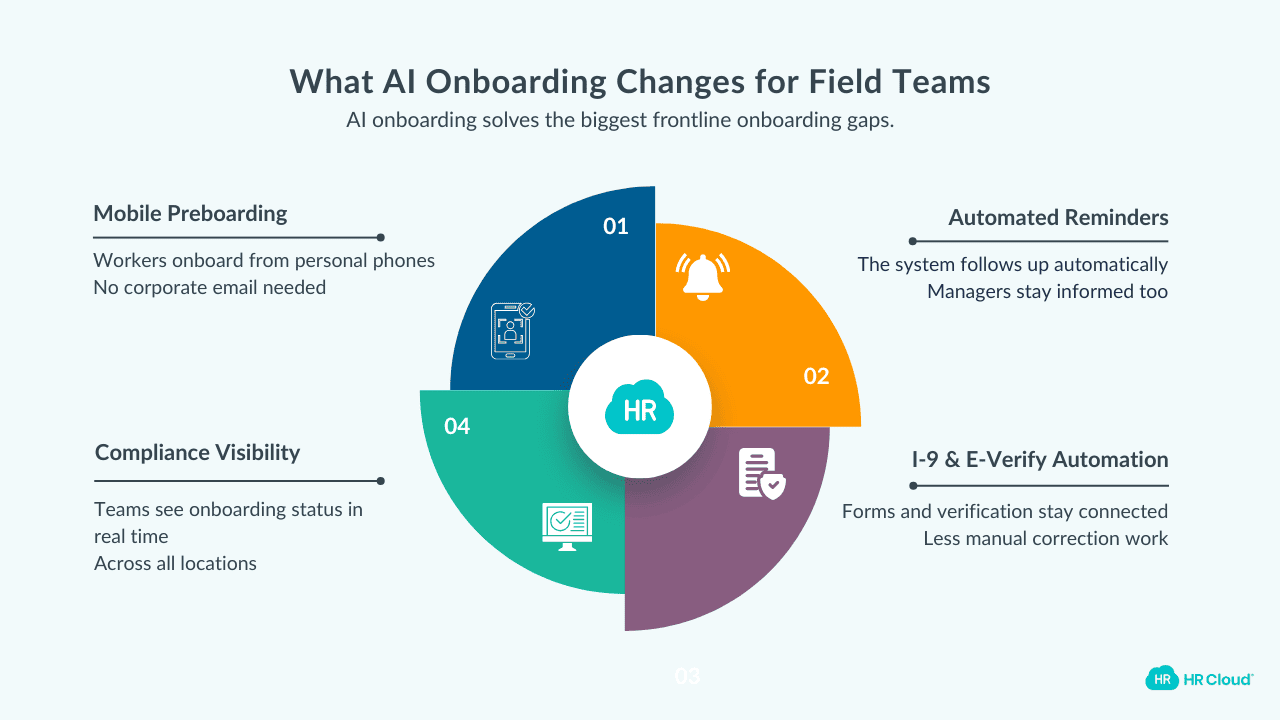
For a field workforce, AI onboarding changes four things that matter most.
Pre-boarding via personal mobile
Before a field worker ever sets foot on site, they can complete their onboarding on their personal phone — the device they already have, check 40 times a day, and know how to use.
No corporate email required. No waiting for an IT setup.
Role-based workflows mean a nurse gets HIPAA training queued on Day 0; a construction worker gets safety certification and licensing forms.
The right paperwork reaches the right person before the first shift.
Automated reminders replace the email chase
The system tracks every item in every new hire's queue — completed, pending, overdue, flagged. When a form goes unsigned, the worker gets a nudge. Their manager gets a nudge.
Nothing falls through because the system does the chasing — automatically.
Download Comprehensive AI Onboarding Checklist
Most onboarding checklists tell you what to do. This one also tells you who does it, and when, so that nothing falls through the cracks.
Download Now
Real-time compliance dashboard
The HR Operations Director and Compliance Officer see exactly where every new hire stands — irrespective of hiring scale, across any number of locations.
That alone changes how compliance conversations with leadership go.
I-9 and E-Verify automation
No manual entry. No retroactive corrections. No paper documents re-entered by an HR coordinator who is already managing 12 other things.
HR Cloud's Onboard module handles I-9 and E-verify as a standard workflow, not a separate process bolted on after the fact.
The result: frontline worker onboarding software stops being a tool that helps HR, and starts being a system that protects the organization.
Mobile-First, Offline-Ready — The Combination That Changes Everything
You've addressed onboarding challenges for the deskless workforce. But there is one other thing you need to consider. The assumption that your field workers have reliable internet connectivity.
They don't.
A construction crew working a remote infrastructure project doesn't have strong signal on the job site.
A rural home health nurse covers five counties and two dead zones.
A utility technician is in a substation.
These are not edge cases but the daily reality of field work. An onboarding system that requires a live internet connection fails the exact people it was built to reach.
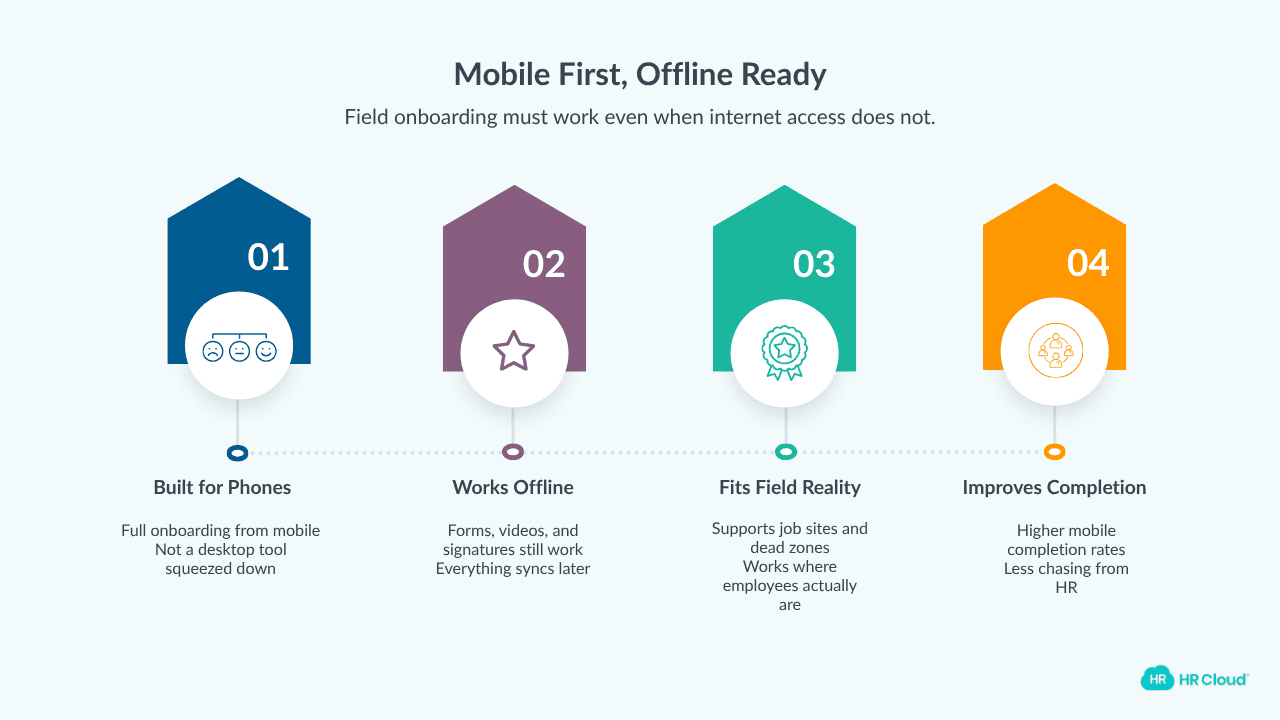
HR Cloud's mobile app is not a scaled-down version of the desktop platform.
It is a full-featured tool designed for employees who live on their phones.
In offline mode, workers complete forms, access training videos, and sign documents without any connection. Everything syncs automatically when connectivity returns.
The impact is measurable.
HR Cloud customers see 75%+ mobile completion rates for field worker onboarding because the process works where the workers actually are, not where the platform assumes they should be.
For mobile onboarding for field employees, this combination of AI-assisted workflows and offline capability is what separates a system that looks good in a demo from one that actually works in a field environment.
“Our hiring managers now have a reliable system that is easy to navigate. Our HR team can actively monitor the process, and assist if needed, but Onboard has helped them save so much valuable time and effort while increasing data accuracy.”
— Kaylee Collins, HR Analyst, Osmose

What Enterprise Scale Actually Looks Like
Theory is useful. Proof is better.
Veolia North America onboarded more than 10,000 field employees through HR Cloud — distributed teams, multiple locations across the country, seasonal hiring spikes, and compliance requirements across multiple states.
This was not a pilot program or a proof of concept but the real thing.
The results are specific:
- 3X faster onboarding compared to their previous manual process.
- A 65% improvement in HR team efficiency.
- Seven hours saved per HR team member, per week — time that goes back into strategic work rather than chasing paperwork.
What those numbers represent is:
- a field workforce that reaches full operational readiness faster,
- with a compliance record that holds up under audit, and
- an HR team that is no longer the bottleneck in a high-volume hiring operation.
That is what successful AI onboarding for field workers looks like at scale.
AI Handles the Paperwork. Humans Handle the Welcome.
Here is an honest caveat, because this article would be incomplete without it.
The efficiency gains of AI onboarding are real. But efficiency alone does not build retention.
Field workers who feel processed rather than welcomed leave faster than almost any other workforce segment.
The first-week experience matters enormously for early attrition, and "completing your forms on your phone before Day 1" is not the same as "feeling like you belong here."
AI is very good at routing the right form to the right person, tracking whether the deadline was met, and flagging the compliance gap before it becomes a liability.
But it cannot be a substitute for the manager who shows up early on someone's first shift to walk them through the job site. Or the peer who texts on Day 3 to check in. Or the moment of recognition that tells a new field worker they made the right choice.
HR Cloud's Workmates module extends the AI onboarding experience into the first weeks of employment — recognition, peer connection, and internal communication that reaches field workers on mobile, where they actually are.
The best HR software built for frontline teams handles both sides of the equation: the compliance infrastructure that protects the organization and the human layer that keeps people in it.
Getting Started: A Practical First Step
You don't have to redesign everything at once. Here is where I'd start.
Pick one workflow — I-9 automation or HIPAA/OSHA training assignment — and get it working before you touch anything else.
These are the highest-compliance, highest-risk steps in field worker onboarding, and automating them delivers the clearest, fastest payoff. Once you've proven it works for one workflow, everything else follows the same logic.
Run a mobile-first pilot with one team or one location before rolling out broadly.
Measure what changes — not just time-to-hire, but time-to-proficiency: how quickly each worker becomes fully compliant, fully trained, and operationally ready. That is the metric that matters most in a distributed field worker onboarding system.
HR Cloud's modular approach means you keep your existing payroll provider — ADP, UKG, Paylocity — and add Onboard exactly where you need it.
No rip-and-replace.
No 12-month implementation.
Because a field onboarding system should solve your problem, not create a new one.
Start there, see what changes, and then decide what's next.
Ready to Close the Gap?
If your field workforce is growing and your onboarding process wasn't built for them — you don't need a bigger HR team. You need a system that reaches your workers where they are, tracks every compliance step without manual intervention, and scales to 10 or 10,000 hires without creating new risk.
See how HR Cloud's Onboard works for field teams, or talk to an HR Cloud specialist who works with field-heavy enterprises every day.

Still Managing Frontline HR Manually?
- Paper forms slow down onboarding
- Missed updates create compliance gaps
- HR teams spend hours chasing tasks
Frequently Asked Questions
How does AI onboarding work for employees without desk or email access?
Workers receive onboarding via their personal phone — SMS, a mobile app, or a browser link — no corporate email needed. HR Cloud's Onboard module delivers role-specific tasks to each worker's device before Day 1. Reaching field workers on the device they already use is not a workaround — it is the default workflow.
Can AI onboarding maintain I-9 and compliance accuracy for field workers?
Yes — and more reliably than manual processes. Automated I-9 and E-Verify workflows eliminate entry errors and missed deadlines through built-in reminders and real-time tracking. Every signed document is timestamped, stored, and ready for inspection without anyone scrambling.
What ROI can enterprises expect from AI onboarding for high-volume field hiring?
ROI is fastest in high-turnover, high-volume environments. Veolia saw 3X faster onboarding, 65% efficiency gains, and 7 hours saved per HR team member weekly — because manual tracking across distributed locations creates compliance exposure with every shortcut taken under pressure.
About the author

Keep Reading


Like What You Hear?
We’d love to chat with you more about how HR Cloud® can support your business’s HR needs.
Book Your Free Demo