Night Shift, Float Pool, PRN: Onboarding Non-Traditional Nursing Schedules

Most nurse onboarding programs assume everyone works 9-to-5. Your carefully designed orientation sessions, your preceptor schedules, your HR availability windows—they're all built around daylight hours. And yet, 30% of U.S. nurses work night shifts. Float pool nurses rotate across units. PRN staff appear on schedules sporadically.
These nurses aren't edge cases. They're critical to how healthcare actually operates.
If your nurse onboarding process wasn't designed for them, they're navigating your organization's complexity largely on their own. And that's a retention problem waiting to happen.
Challenges Faced by the Invisible Workforce
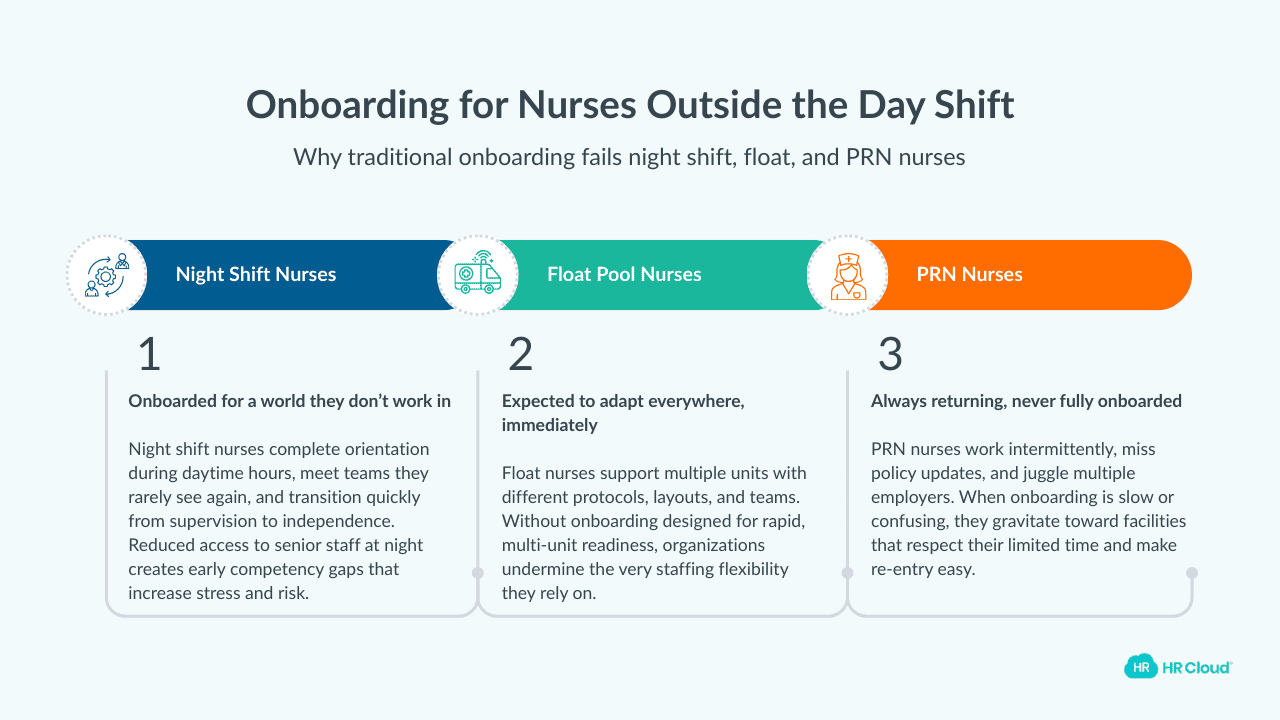
Research has found that night shift staff often feel invisible and undervalued compared to their daytime colleagues. This reflects real structural gaps in how organizations support non-traditional schedules.
That needs to change. Right from the moment these nurses are hired—the onboarding phase itself.
Onboarding in Day Shift for Night Shift Nurses
Put yourselves in the shoes of these night shift nurses.
Night shift nurses complete orientation during daytime hours, learning routines and meeting colleagues they'll rarely see again. But when these newly graduated nurses start working, supervision decreases and senior staff are less available. This makes them vulnerable to new challenges as there is no one to guide them, paving way for potential failure.
The quick transition from supervised daytime orientation to independent nighttime practice can create a significant competency gap as compared to day shift nurses.
Float pool nurses face different set of challenges.
Rapid Competence Development
These nurses, who cost significantly more compared to regular RNs, provide staffing flexibility that healthcare organizations desperately need. But that flexibility requires rapid competency development across multiple units, each with distinct protocols, equipment locations, and team dynamics.
If your onboarding doesn't adequately prepare float nurses for multi-unit work, you're undermining the very staffing model you depend on. And this seems to be the case, as a 2024 study found that onboarding and retention are the greatest challenges in recruiting pooling nurses.
And then there are PRN nurses.
PRN Staff: The Perpetual Newcomers
PRN nurses work "as needed"—sometimes going weeks between shifts at your facility. That sporadic presence creates compounding challenges:
- competencies and credentials must be maintained despite limited hours
- policy updates happen between their appearances
- HR availability rarely aligns with their windows of time
Because many PRN nurses work at multiple facilities simultaneously, a clunky or frustrating onboarding experience doesn't just slow productivity; it pushes them toward facilities that made starting easier.
Why Traditional Onboarding Fails Non-Traditional Nursing Schedules
Traditional onboarding assumes synchronous availability. That new hires will be able to attend scheduled sessions, access HR during business hours, and complete training alongside colleagues on similar schedules.
But for non-traditional nursing schedules, these assumptions break down immediately.
Night shift nurses often complete compliance training while sleep-deprived, their circadian rhythms fighting against daytime requirements.
PRN staff may have only narrow windows of availability that don't align with scheduled orientation sessions.
Float pool nurses need unit-specific knowledge that can't be delivered in a single comprehensive orientation. To compensate for that, they need information to be accessible before each new assignment.
So what’s the solution?
Let’s dive in.
Design Shift-Adaptive Onboarding
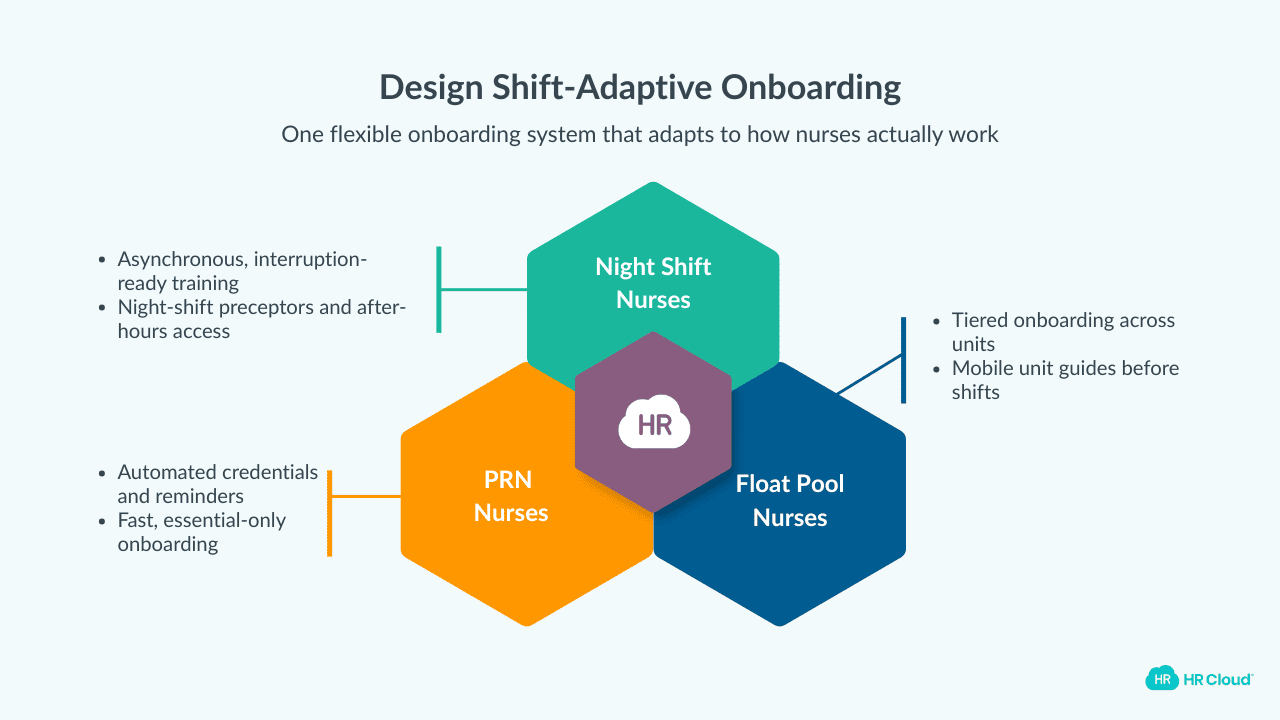
You do not need to create entirely separate onboarding programs for your day-shift and night-shift nurses. You simply need to design flexible systems that adapt to how people actually work.
If the training is not already modular, now is the time to allocate resources to break it down into smaller focused modules.
Trust me, the returns are much higher than the effort needed.
Let's look in more depth how the whole onboarding — right from culture training to buddy allocation — can be tweaked for each group of non-traditional staff.
Onboarding For Night Shift Staff
Here's what that can look like in practice:
- Build asynchronous modules that nurses can complete during quiet periods on night shift.
- Design content in 3-7, or max 10-15 minute, segments that accommodate unpredictable interruptions. We will come to that in a bit.
- Partner new night nurses with experienced night shift preceptors, not day-shift staff who won't share their actual work environment.
- Create dedicated communication channels (messaging groups, digital bulletin boards) where night shift staff can connect with leadership without waiting for morning meetings.
Onboarding For Float Pool Nurses
Optimized float pools reduce overtime costs and prevent staff burnout, but only when nurses feel prepared for each assignment. Here are a few ways to ensure that:
- Structure orientation in tiers starting with core organizational competencies. Preparedness for medical-surgical units and critical care units should come next. Finally, they should be able to access specific unit orientations on-demand before assignments.
- Create mobile-accessible quick-reference guides for each unit, such as supply locations, common protocols, key contacts, etc., that float nurses can review before a shift.
“The flexibility of the HR Cloud system is invaluable in ensuring compliance. It helped us stay a step ahead of changing document collection requirements.”

— Jesse Rose, Provider recruitment, onboarding, and compliance manager

Onboarding For PRN Nurses
PRN nurses often balance healthcare work with other commitments, so they need the fastest path to floor-readiness that maintains patient safety. Streamlining everything is the key here:
- Implement automated credential tracking that sends renewal reminders without requiring HR initiation.
- Create self-service compliance portals where PRN staff can complete requirements on their own schedule.
- Design abbreviated orientation paths that cover essentials without redundancy for experienced nurses.
Use Microlearning for Onboarding Training
Break onboarding training into bite-sized modules of 3-7 minutes each. One module dedicated to a single topic, such as policy, leave rules, culture, etc. For staff with limited window periods, shorter modules aren't just convenient but can be the difference between completion and abandonment.
Microlearning achieves 80% completion rates compared to 20% for traditional courses. Moreover, microlearning improves retention by 25-60% compared to traditional training methods.
When you are onboarding nurses who need to perform safely across variable schedules and units, retention of critical information is essential for effective and timely response.
Use Right Technology for Implementing Adaptive Onboarding
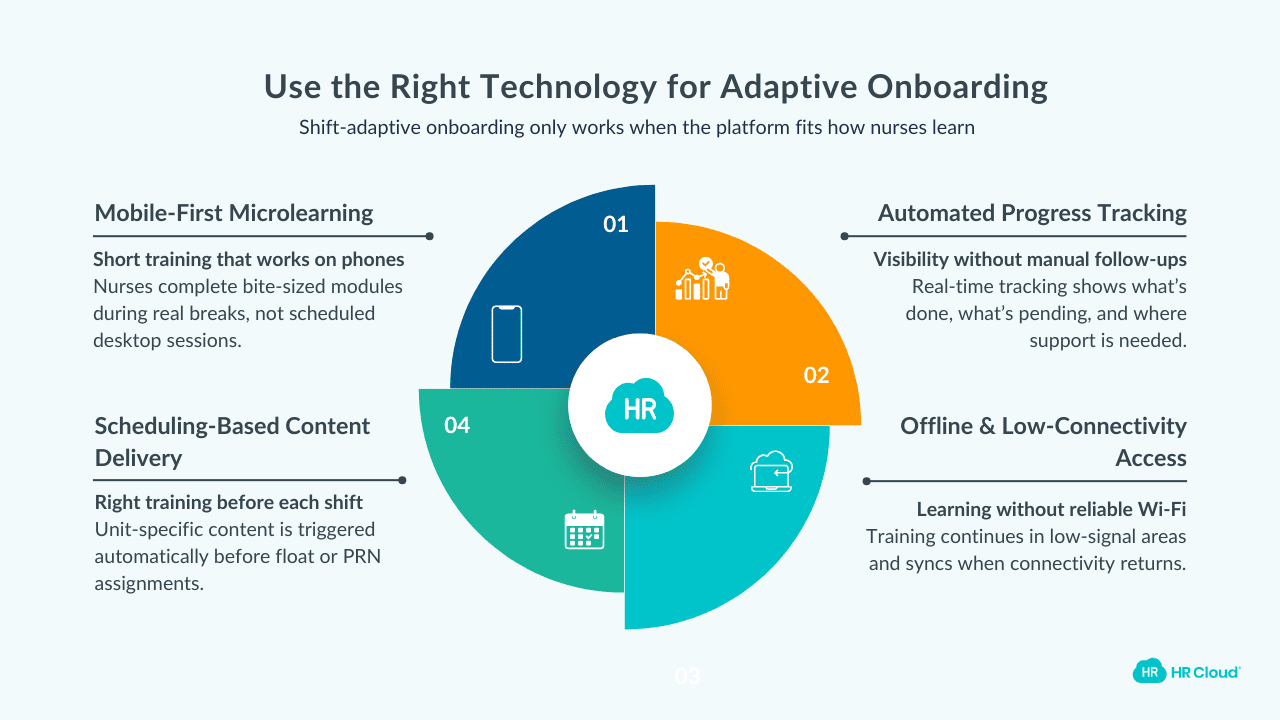
Shift-adaptive onboarding requires specific technological capabilities. Given that 85% of organizations now use video-based microlearning, your platform needs to support multimedia content accessible across devices.
Essential capabilities include:
- automated progress tracking
- mobile-first modules that work on smartphones
- offline access for content completion in areas with poor connectivity
- integration with scheduling systems (to trigger unit-specific content before float assignments)
Microlearning is 17% more efficient than traditional learning methods but only when the delivery platform supports how learners actually access content. The perfect learning management system that requires desktop access is useless to night shift nurses checking their phones during break.
Measure Success Differently
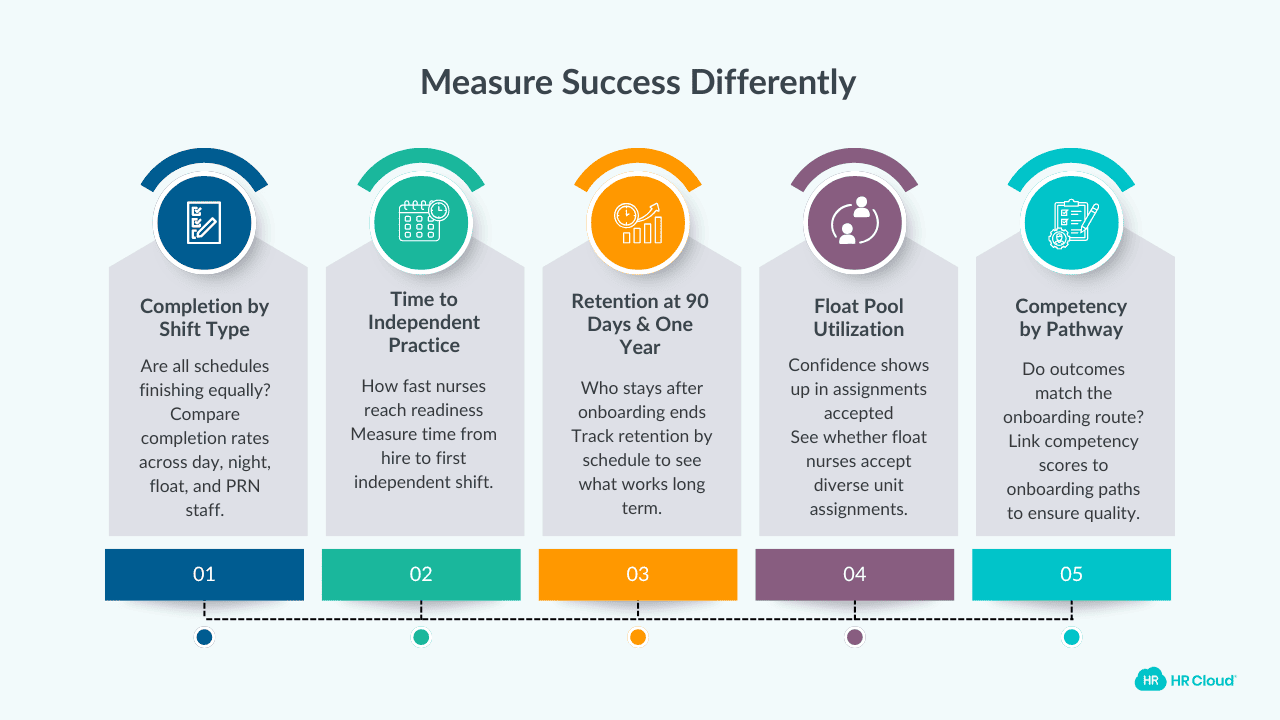
Traditional onboarding metrics such as time to complete orientation, attendance at sessions, initial competency verification, etc. won’t work for non-traditional schedules.
Better metrics include:
- Completion rates by shift type. Are night shift nurses completing at the same rate as day shift?).
- Time between hire and first independent shift for float pool nurses.
- Retention rates at 90 days and one year segmented by schedule type.
- Float pool utilization patterns. Are nurses comfortable accepting diverse assignments after orientation?
- Competency assessment scores correlated with onboarding pathway.
95.7% of medical workers believe training helps achieve positive healthcare outcomes.
But belief in training's importance doesn't guarantee completion when the training isn't accessible.
Track not just whether people finish, but whether the completion pathways work equally well across all schedule types.
Implementation Realities
When significant portions of your staff don't receive adequate onboarding because the program wasn't designed for their schedules, you're not just creating retention problems but also creating care quality risks.
Building shift-adaptive onboarding requires honest assessment of current gaps. Start by auditing your existing program through the lens of a night shift nurse: How many components require daytime availability? What happens if someone can't attend a scheduled session?
Then prioritize changes based on workforce composition.
If 40% of your nursing staff works non-traditional schedules, shift-adaptive design needs to be core program design. If your float pool handles significant staffing volume, their rapid effectiveness directly impacts patient care and organizational costs.
Moving Forward
Non-traditional nursing schedules aren't going away. If anything, the demand for workforce flexibility will increase. The question isn't whether to accommodate these populations, but how quickly you can redesign nurse onboarding to serve them effectively.
Here is how you can start:
- Start with one group.
- Audit their current onboarding experience.
- Identify the three biggest friction points.
- Address those first and then expand.
You don’t need to be perfect; just start. Your night shift nurses, float pool staff, and PRN workers are already adapting to your systems as best they can. It's time your systems adapted to them too.

Discover how our HR solutions streamline onboarding, boost employee engagement, and simplify HR management
Book Your Free DemoFAQs
How should organizations onboard float pool nurses differently?
Float pool nurses need tiered orientation: core competencies first, then unit-family modules (medical-surgical, critical care), then specific unit content accessible on-demand before assignments. Mobile-accessible quick-reference guides with supply locations, protocols, and key contacts enable float nurses to prepare just before each new shift assignment.
What is microlearning and why does it work for non-traditional schedules?
Microlearning delivers training in 10-15 minute segments rather than hour-long sessions. Research shows it achieves 80% completion rates versus 20% for traditional courses and improves retention by 25-60%. For nurses with unpredictable schedules or limited time windows, shorter modules enable completion without requiring extended availability.
How can healthcare organizations support PRN staff onboarding?
PRN staff need streamlined processes respecting their limited availability. Implement automated credential tracking with proactive renewal reminders, create self-service compliance portals accessible anytime, and design abbreviated orientation paths covering essentials without redundancy. The fastest path to floor-readiness that maintains safety should be the priority.
What technology features support shift-adaptive onboarding?
Essential features of shift-adaptive onboarding tech include mobile-first design (not just responsive—truly optimized for smartphone completion), offline content access for poor connectivity areas, automated progress tracking without administrative involvement, and scheduling system integration to trigger unit-specific content before float pool assignments.
How do you measure onboarding effectiveness for non-traditional schedules?
Track completion rates segmented by shift type to identify disparities. Measure time between hire and first independent shift for float nurses. Monitor 90-day and one-year retention rates by schedule type. Assess whether float nurses comfortably accept diverse unit assignments post-orientation as an indicator of preparation adequacy.
Why do float pool nurses command higher salaries?
Float pool nurses earn more than RNs because they provide critical staffing flexibility, working across multiple units with distinct protocols, equipment, and team dynamics. This adaptability reduces overtime costs and prevents burnout among permanent staff, but requires rapid competency development that effective onboarding must support.
What's the business case for shift-adaptive onboarding investment?
Continuous staff training increases patient satisfaction by 13% and reduces medical errors by 18%. When 30% of nurses work non-traditional schedules and onboarding doesn't serve them effectively, organizations face both retention problems and care quality risks. Float pool effectiveness directly impacts staffing costs and flexibility.
About the author

Keep Reading


Like What You Hear?
We’d love to chat with you more about how HR Cloud® can support your business’s HR needs.
Book Your Free Demo