HR Cloud vs Workday: Which Is Better for Mid-Sized Companies?

For a mid-sized company, HR Cloud is usually the better fit: it publishes real pricing starting at $295 a month for companies under 250 employees, goes live in an average of 6 weeks, and is built around the frontline and deskless workers that make up most mid-market headcount. Workday also competes for mid-sized companies now, through Workday GO, a package built for organizations with roughly 500 to 3,500 employees, but Workday's deepest strength is still further up-market: multi-country payroll, and HR unified with finance and planning data on one architecture, for organizations complex enough to justify a 10-to-27-week deployment and a custom quote with no published price. Neither platform is "wrong" for the other's use case. The real dividing line isn't headcount alone, it's operational complexity and how much of the workforce is deskless.
HR Cloud vs Workday at a Glance
| Category | HR Cloud | Workday |
|---|---|---|
| Built for | Small and mid-sized companies, frontline and deskless-heavy (also serves larger frontline employers like Veolia, 10,000+ employees onboarded) | Spans midsize (Workday GO, ~500–3,500 employees) through large multinational enterprise; 10,000+ organizations use Workday overall |
| Pricing model | Published monthly tiers under 250 employees; custom quote above that | Custom quote; based on employees, users, other size metrics, and usage for some products |
| Public pricing | Published: $295–$1,995/month by tier and headcount band (under 250 employees); custom quote above 250 | Not published; contact sales for a quote |
| Average implementation | 2–4 weeks (under-250 tier) to 6 weeks (customer-base average); Onboard module 2–3 weeks | 10–27+ weeks depending on package |
| Contract minimum | 12 months (special monthly contracts under 250 employees) | Multi-year, negotiated |
| Core HRIS | Yes: employee records, self-service, org charts | Yes: Core HR, global compliance |
| Payroll | Integrates with ADP, UKG, Paylocity, Paychex, Ceridian, Kronos, Workday | Workday Payroll (native in a handful of countries) plus a certified partner network for 100+ more |
| ATS / Recruiting | Recruit (built-in ATS) | Talent Management module |
| Onboarding automation | Onboard, plus Maya SMS-first AI agent for deskless workers | Included in Core HR workflows, plus Candidate Home preboarding before Day 1 |
| Employee engagement | Workmates (recognition, comms) | Workday Peakon Employee Voice |
| Mobile / no-desk access | Built around SMS and mobile-first workflows, no app download required | Native mobile app with real frontline features (shift swaps, check-in/out, time off), still requires the app |
| I-9 / E-Verify | Built-in, 5M+ forms processed | Not a core focus area |
| ROI calculator | Yes, published, models 3–9 month payback | Yes, published, benchmark-based 3-year estimate |
| Best for | Healthcare, retail, hospitality, construction, and other frontline-heavy mid-market employers | Organizations needing HR unified with finance/planning data, from midsize through large multinational enterprise |
What Is HR Cloud?
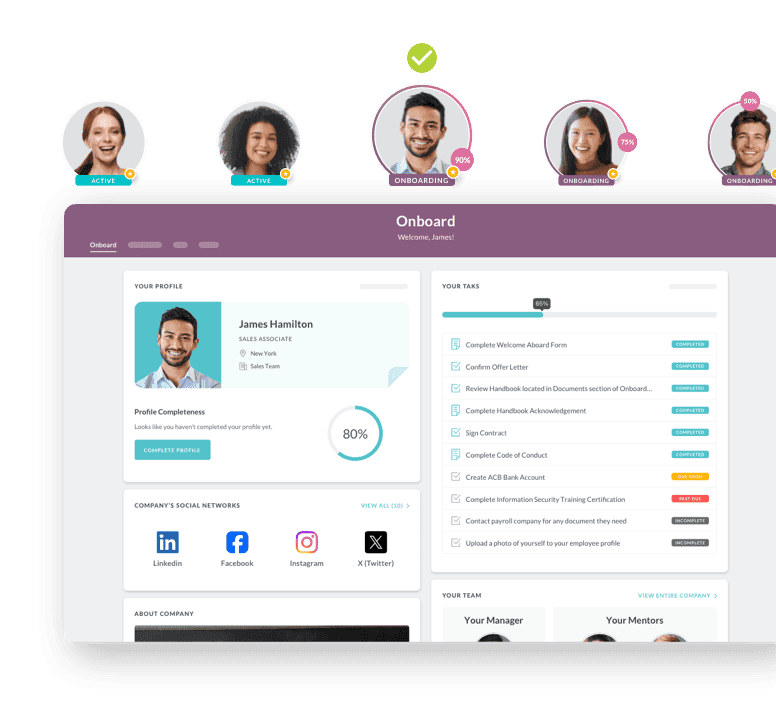
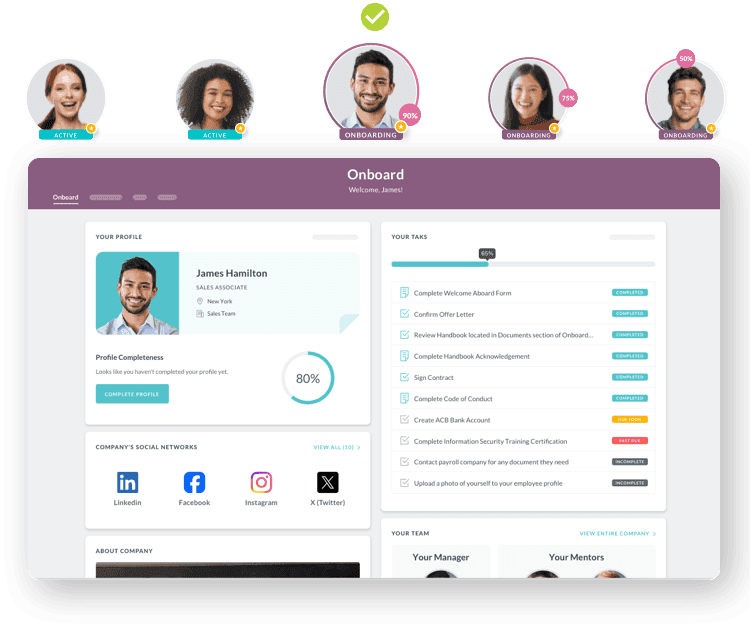
HR Cloud is a cloud-based HRIS and employee experience platform built for small and mid-size businesses, with a specific focus on companies whose workforce is partly or mostly deskless. The platform bundles Onboard (onboarding automation), People HRIS (employee records and workflow automation), Workmates (engagement, recognition, and internal communication), Perform (performance management), Time Off, Recruit (applicant tracking), and Shift Planner into one suite, priced as a single annual license rather than a collection of per-module subscriptions.
The differentiator most relevant to a Workday comparison is Maya, HR Cloud's SMS-first AI onboarding agent. Maya lets a new hire complete onboarding tasks by text message on any phone, without downloading an app or logging into a portal, which matters for industries like healthcare, retail, hospitality, and construction where a large share of new hires never sit at a desk on day one. HR Cloud is a Platinum ADP Marketplace Partner and, per HR Cloud's own ADP integration page, the "#1 Rated ADP Marketplace App," which reflects the platform's positioning as a layer that sits on top of an existing payroll system rather than a full payroll replacement.
Key differentiators:
Fixed annual license priced by company size, not by seat, so the invoice doesn't move when headcount fluctuates mid-year
All-inclusive pricing: training, support, account-manager meetings, and unlimited chat, with no per-seat fees or admin upsells
Maya, an SMS-first onboarding agent built for workers without regular desk or email access
Open API integrations with ADP, UKG, Paylocity, Paychex, Ceridian, Kronos, and Workday itself, so HR Cloud can layer onboarding and engagement on top of an existing system of record
Trusted by 760+ organizations worldwide, founded in 2012 and headquartered in El Segundo, California
HR Cloud's own HRIS product page cites customers including Taco Bell, Toyota, Chick-fil-A, Amazon, and YMCA, spanning both large service-sector brands and the mid-market frontline employers the platform is built around. The common thread across that customer base isn't company size on its own, it's a workforce with a meaningful share of employees who don't sit at a desk, which is the specific gap HR Cloud's mobile-first and SMS-first design is built to close.
What Is Workday?
Workday is a cloud-based Human Capital Management (HCM) and finance platform, historically built for large, complex, often multinational enterprises but now actively expanding into the mid-market too. According to Workday's own product overview, more than 10,000 organizations use the platform, including over 65% of the Fortune 500 and over 70% of the Fortune 50. Workday HCM includes Core HR, Talent Management, Payroll, Workforce Management, Analytics & Reporting, Peakon Employee Voice, Contingent Worker Management, and Workforce Planning, all built on a single data model that also connects to Workday's finance and planning products. Since 2025, Workday has also sold a midsize-specific package, Workday GO, aimed at organizations with roughly 500 to 3,500 employees, so "Workday" and "enterprise-only" are no longer the same claim.
That single-data-model architecture is Workday's real strength, at any size it sells into. A company running Workday HCM alongside Workday Financial Management gets one system of record for headcount, compensation, and budget, which matters a great deal for organizations with complex approval chains, multiple business units, and finance teams that need HR data to reconcile automatically with the general ledger. That's also generally why a full-scope Workday implementation takes longer and costs more than a single-module HRIS: the depth of integration requires configuration work a smaller, single-department rollout doesn't need, even when Workday's own newer packages are built to compress that timeline.
Key characteristics:
Now sold in a version built specifically for midsize organizations (Workday GO), in addition to its traditional large-enterprise HCM
Payroll processed natively in a handful of countries (including the U.S., Canada, the U.K., France, and Australia), with a certified partner network covering 100-plus additional countries
Deep native integration between HCM, finance, and planning data
Advanced workforce analytics and skills-intelligence tooling built for large HR and people-analytics teams
A published, interactive ROI/value calculator for HR and finance use cases
Deployment scoped through named packages (Launch Now, Launch Express, Launch Flex) rather than a single fixed timeline
No published pricing; subscription cost is based on employee count, user count, other size metrics, and usage for some products, quoted per deal
How Much Does HR Cloud Cost vs Workday?
This is the sharpest difference between the two platforms: HR Cloud actually publishes real prices for smaller companies. Workday does not publish pricing anywhere, for any company size.
For companies under 250 employees, HR Cloud's small-business pricing page lists three tiers with exact monthly prices, scaled across three headcount bands:
| Tier | 1–50 employees | 51–100 employees | 101–250 employees |
|---|---|---|---|
| Essential HR | $295/mo | $495/mo | $795/mo |
| Professional HR | $595/mo | $995/mo | $1,495/mo |
| Culture HR | $895/mo | $1,395/mo | $1,995/mo |
Essential HR includes the Onboard suite, time off and time tracking, and basic HRIS functionality. Professional HR adds performance management, applicant tracking, assets management, and recognition. Culture HR adds a custom-branded mobile app, task management, engagement surveys, and Workmates. Annual billing saves 20% off these monthly rates. Implementation is included if a company prepays 90 days upfront; otherwise there's a $500 implementation fee, with a typical timeline of 2 to 4 weeks for this tier.
For companies above 250 employees, HR Cloud moves to a custom-quote model. HR Cloud's enterprise pricing page states plainly: "Because every rollout of our all-in-one HR platform is different, we quote each customer directly." What's published at this tier is the structure, not a number: a fixed annual license priced by company size rather than per seat, the same 20% annual-billing discount, a standard 12-month minimum contract, and a one-time implementation fee starting at $750 for certain third-party payroll integrations like ADP, UKG, or Paylocity. Training, support, account-manager meetings, and unlimited chat are included in the license at this tier too, with no per-seat fees or admin-tier upsells layered on top.
Workday's pricing is not published anywhere on its site, at any company size. Per Workday's own contract FAQ, the subscription is "based on the number of employees, users, other applicable size metrics, and, for certain Service applications, usage," negotiated per deal rather than sold off a rate card. The only way to get a number is to contact Workday's sales team directly. What is publicly documented is the deployment structure: Workday's own deployment page describes "Launch Now" as a ten-to-sixteen-week rollout, "Launch Express" as a ten-to-twenty-plus-week rollout, and "Launch Flex" as going live in "as few as twenty-seven weeks" for broader scope; Workday GO, its midsize-specific package, advertises AI-led deployments going live "in as few as 18 weeks." Implementation for a full-scope rollout is generally billed as professional services on top of the subscription, though the exact split between license cost and implementation cost varies by deal and isn't something either vendor publishes.
For a company evaluating both, the practical difference isn't just which number is bigger, it's that one of them is an actual number you can look up right now, and the other requires a sales conversation regardless of company size. A 60-person single-location business can see HR Cloud's exact monthly cost today. A 15,000-person multinational evaluating Workday cannot see a single published figure anywhere on Workday's site.
What This Looks Like in Practice
Both vendors publish an interactive ROI calculator, and both explicitly frame their output as a model, not a guarantee. HR Cloud's ROI calculator reports that customers typically see a 40% to 60% reduction in administrative HR hours in the first year, with a payback period of 3 to 9 months, while noting the estimate is based on industry benchmarks and actual results depend on adoption, current processes, and which modules are implemented. Workday's Value Calculator produces a personalized 3-year benefit estimate based on company size and the products selected, built on what Workday describes as benchmark-driven assumptions rather than a company-specific audit.
Individual HR Cloud customers report more specific outcomes on their own case-study pages, worth reading as illustrations rather than an average: Osmose Utilities, a field-based utility contractor, reports saving 7 HR hours a week and a 65% HR-efficiency improvement from its ADP Workforce Now integration; Behavioral Progression, a healthcare provider, reports saving 8 HR hours a week and a 66% HR-efficiency improvement from the same integration. Those are two distinct companies' results, not a blended industry average, and neither vendor's calculator output should be read as a specific dollar figure your company will hit.
How Do HR Cloud and Workday Compare Feature by Feature?
Both platforms cover the same broad categories of HR functionality, but the depth and design intent behind each module differ in ways that matter more than a feature-parity checklist suggests. The breakdown below covers the ten areas most companies compare directly when evaluating an HRIS against an enterprise HCM platform.
Applicant Tracking & Recruiting
HR Cloud's Recruit module is a built-in ATS that handles requisitions, candidate pipelines, and collaborative hiring workflows, integrated directly with Onboard so an accepted candidate flows straight into onboarding without re-entering data. That handoff is the practical advantage: a candidate's resume, interview notes, and offer details carry over into their employee record automatically, instead of an HR generalist re-keying the same information into a second system. Workday's recruiting functionality lives inside its Talent Management module, built to handle both standard hiring and more complex enterprise recruiting scenarios like internal mobility across business units and multi-country requisition approval chains. HR Cloud's Recruit is faster to configure for a single-location or single-country hiring team; Workday's recruiting tools carry more weight for organizations managing recruiting across dozens of legal entities at once.
Onboarding Automation
This is where the two platforms diverge most, but not because Workday ignores onboarding before day one. Workday supports external preboarding through Candidate Home, letting a new hire review Day 1 information and complete some tasks before their start date using separate candidate credentials, without needing full Workday tenant access yet. The real difference is the interaction model: HR Cloud's Onboard module, combined with Maya, lets a new hire complete onboarding tasks by text message on any phone, no app or portal login required at all, and HR Cloud reports that Onboard deployments alone average a 2-to-3-week go-live. Workday's onboarding runs through its own app or browser portal, which still requires downloading an app or navigating a portal, even if it's built to be simple once there. For a healthcare system onboarding traveling nurses or a retailer onboarding seasonal staff across 40 stores, HR Cloud's zero-app SMS design removes a step Workday's onboarding flow still includes.
Payroll & Benefits Administration
Workday Payroll runs natively in a handful of countries, including the U.S., Canada, the U.K., France, and Australia, and connects to a certified partner network covering 100-plus additional countries for everywhere else, all inside the same data model as HR. That's meaningful for multinational employers who want one system managing pay and HR data with consistent compliance handling, even where the actual payroll processing runs through a partner rather than Workday itself. HR Cloud does not run payroll itself; instead, it integrates with ADP, UKG, Paylocity, Paychex, Ceridian, Kronos, and, notably, with Workday itself, syncing new-hire data automatically through single sign-on rather than replacing the payroll system a company already has. For a company that's already committed to ADP or UKG for payroll and just needs a stronger onboarding and engagement layer on top of it, that integration-first design is often the more practical fit than switching payroll providers, since it avoids the cost and risk of migrating payroll history and tax filings to a new system just to get better onboarding tools.
Performance Management & Reviews
HR Cloud's Perform module handles review cycles, goal tracking, and manager-employee check-ins, built to run inside the same login and data model as onboarding and engagement, so performance data doesn't live in a separate silo. Workday's performance tools are part of its broader Talent Management suite and connect to its compensation and succession planning modules, useful for large organizations running formal calibration processes across thousands of managers. Mid-market teams generally need review cycles that are easy for managers to actually complete; enterprise teams often need calibration and succession-planning depth that a smaller platform doesn't try to replicate.


Time & Attendance Tracking
Both platforms track time off and attendance, but the audience differs. HR Cloud's Time Off and time-tracking tools are built for hourly, shift-based, and multi-location workforces, the kind of scheduling complexity common in retail, healthcare, and hospitality. Workday's Workforce Management module includes scheduling and demand forecasting built for large-scale, often unionized or heavily regulated workforces, with deeper configuration options for complex labor rules across jurisdictions.
Employee Self-Service Portal
HR Cloud's self-service portal is built mobile-first, reflecting the platform's frontline focus: employees can check pay information, submit time-off requests, and complete tasks from a phone, with 75%+ mobile completion rates reported among frontline HR Cloud customers. Notably, none of it requires installing an app; it runs through SMS and mobile web. Workday's own mobile app is genuinely built for frontline use too, not just desk workers: Workday markets it explicitly for employees "from frontline workers to office staff," with shift swaps, check-in/check-out, time-off requests, and payslip access. The real difference is the entry point, not the audience: Workday's frontline features live inside an app a new hire has to download and log into, while HR Cloud's onboarding and self-service tasks can be completed by text message before that app or login even exists.
Reporting & Analytics
Workday's Analytics & Reporting module is one of its most cited strengths among enterprise buyers, offering augmented analytics and skills-intelligence tooling built for large people-analytics teams making workforce-planning decisions across a multinational headcount. That depth requires a dedicated analytics function to use well, which is realistic at Workday's typical customer size and less realistic for an HR team of two or three people. HR Cloud's reporting is built around the metrics a mid-market HR team actually tracks day to day: onboarding completion rates, turnover, time-to-hire, and compliance status, presented through dashboards a generalist HR manager can read without a training course, rather than a dedicated analytics team's toolkit.
Mobile App Experience
HR Cloud built its mobile experience around workers who may never use a company laptop: SMS-based task completion through Maya, mobile-first self-service, and workflows designed for a phone screen first, with no app to install. Workday's native mobile app is a genuine competitor here, not an afterthought: it covers self-service, approvals, scheduling, and time tracking, and Workday specifically positions it for frontline and shop-floor employees, not just office staff. The distinction that survives scrutiny is app-required versus app-free: Workday's frontline tools live behind a download and a login; HR Cloud's onboarding tasks don't require either.
Integrations
HR Cloud's open API connects to ADP, UKG, Paylocity, Paychex, Ceridian, Kronos, and Workday, plus tools like Slack and Intuit, positioned explicitly as a layer that works alongside a company's existing payroll and finance systems rather than replacing them. Workday's integration story runs the other direction: because HCM, Financial Management, and Adaptive Planning share one data model, a Workday customer running multiple Workday products gets integration by default, though connecting Workday to non-Workday systems typically requires more custom integration work.
Compliance & Multi-State Support
HR Cloud includes built-in I-9 and E-Verify handling, with HR Cloud reporting more than 5 million I-9 forms processed with zero audit fines, along with SOC 2 Type II certification. HR Cloud also reports 70% time savings on I-9 processing and 99.9% platform uptime, both figures published directly on its own compliance product page. This is built specifically around U.S. multi-state employers, particularly in healthcare and construction where credential and document tracking is a daily operational requirement, not just an annual audit concern. Workday's compliance strength runs global: local compliance rules across the dozens of countries a multinational Workday customer might operate in, which is a different and generally heavier compliance surface than a U.S.-only mid-market employer needs to solve for.
How Long Does Implementation Take With Each Platform?
HR Cloud reports an average go-live of 6 weeks across its customer base, with the Onboard module alone averaging 2 to 3 weeks for a focused deployment. That timeline includes setup, configuration, data import, and training, all bundled into the base implementation rather than billed separately, aside from a $750 starting fee for certain third-party payroll integrations. HR Cloud also reports a 97% adoption rate, tracked as the share of employees and managers who actually return to the system after go-live rather than reverting to spreadsheets or email.
Beyond the go-live date itself, HR Cloud reports that frontline employees complete onboarding tasks through its mobile experience at a rate of 75% or higher, and that HR teams save roughly 8 hours a week on onboarding-related work once the platform is running. Because setup, configuration, data import, and training are bundled into that base implementation, a mid-market HR team generally doesn't need to budget separately for an outside systems-integrator engagement the way an enterprise rollout typically requires. That matters operationally, not just financially: a company hiring seasonally, opening a new location, or absorbing an acquisition often can't wait several months for a system to go live, and a 6-week timeline means the HR team is running the new platform, not still configuring it, by the time the next hiring wave hits.
Workday's own deployment page lays out three named packages rather than a single number: Launch Now (10 to 16 weeks), Launch Express (10 to 20-plus weeks), and Launch Flex (as few as 27 weeks) for broader-scope rollouts. Workday GO, its midsize-specific package, advertises AI-led deployments going live "in as few as 18 weeks," faster than the standard packages but still well beyond HR Cloud's 6-week average. That's before accounting for change management, additional module configuration, or integration with existing finance systems on any of these packages. For a company that needs core HR and onboarding running before its next hiring wave, that gap between a 6-week and an 18-to-27-week timeline is often the deciding factor on its own.
Which Platform Offers Better Customer Support?
HR Cloud's support is included in the license rather than tiered: unlimited chat support and dedicated account-manager meetings come standard, without an add-on support package to negotiate separately. HR Cloud holds a 4.7-out-of-5 rating on both G2 (183 reviews across HR Cloud's product line) and Capterra (84 reviews), where reviewers frequently cite the support team, quick implementation, and the paperless onboarding workflow as strengths; one recent G2 review specifically describes HR Cloud stepping in after "a major limitation with ADP WFN" and delivering "a quick implementation" with strong support. On the ADP Marketplace specifically, HR Cloud is rated 5.0 by ADP customers and holds the "#1 Rated ADP Marketplace App" designation, both published directly on HR Cloud's own ADP integration page.
Workday support is typically structured around named account teams and support tiers tied to the size and complexity of the contract, consistent with how enterprise software vendors generally scope support for multi-year, multi-module deals. Larger Workday customers often work with a dedicated customer success team as part of their contract, reflecting the ongoing configuration and change-management needs of a system that spans HR, finance, and planning. Workday HCM holds a 4.1-out-of-5 rating on G2 (1,705 reviews) and a 4.5-out-of-5 rating on Capterra (more than 1,700 reviews), where reviewers frequently describe the platform as reliable and feature-rich but note a real learning curve, occasional interface lag, and configuration work that several reviewers say requires specialized training. Both sets of ratings will move over time; the figures above reflect what each platform's live review page showed as of this writing.
Who Should Choose HR Cloud?
Small and mid-sized companies that need a single HR platform without an enterprise implementation timeline, including companies under 250 employees that want to see exact pricing before ever talking to sales
Organizations with a meaningfully deskless or frontline workforce, including healthcare, retail, hospitality, construction, and manufacturing
Teams that already have a payroll provider (ADP, UKG, Paylocity, or others) and need a stronger onboarding, engagement, and compliance layer on top of it, not a payroll replacement
HR teams that want a fixed, predictable annual cost rather than a per-employee-per-month rate that scales unpredictably with headcount
Those needs look different depending on the industry. In healthcare, the deciding factor is usually license and credential expiration currently tracked in a spreadsheet, an inconsistent Day-1 experience across multiple facilities, and I-9 documentation for staff who float between locations. In retail and hospitality, it's usually 40%-plus annual turnover and getting a mobile-first onboarding flow in front of a new hire before their first shift instead of after it. In construction and field services, it's usually getting safety training and compliance documents onto a worker's phone before they ever set foot in an office, because for a meaningful share of that workforce, there isn't one.
If your organization is choosing between spreadsheets, a patchwork of point solutions, and a real HRIS, and your headcount is in the low thousands or below, HR Cloud is generally the faster and less expensive path to a working system.
Who Should Choose Workday?
Mid-sized to large organizations, roughly 500 employees and up, that want HR, finance, and planning data unified in one system with a single data model
Companies operating across multiple countries with local payroll and compliance requirements, where Workday's native payroll footprint or partner network covers the countries involved
Organizations with dedicated implementation and change-management resources, even at the midsize end where Workday GO compresses the typical timeline
HR and finance leadership that wants HR data to reconcile automatically with the general ledger, not just live next to it
This is really about entity count, country count, and finance-integration depth, not headcount alone: the coordination overhead of keeping HR, payroll, and finance data in sync across separate systems is what a unified Workday architecture solves. A large single-country employer with a deskless workforce, like Veolia's 10,000-plus field employees onboarded through HR Cloud, can still be well served by a mid-market HRIS instead. A company running operations across a dozen countries with complex approval chains and finance-to-HR reconciliation needs, even at 800 employees through Workday GO, usually can't be.
If your organization already runs Workday Financial Management, or is planning a global HR standardization project across dozens of subsidiaries, Workday's integration depth is difficult to replace with a smaller platform, and it isn't meant to be.
What Do Real Customers Say About Each Platform?
When MCO, a private equity firm, acquired lingerie retailer La Senza, it needed to onboard more than 2,000 employees across the U.S. and Canada quickly. "We needed an onboarding solution we could deploy in a month or less," said Ivana Placko, Product Manager at MCO. "Yet it was also important that this solution would be able to offer power HR capabilities we could use to manage these employees in the future. HR Cloud's Onboard was the only solution that could deliver." HR Cloud's Onboard platform deployed in under a month, and the team beat its original goal of getting 80% of the 2,000 employees to complete required agreements within five days, ultimately reaching 90% completion within that window.
Other verified HR Cloud customers in the mid-market range include Rehmann, a financial services firm with roughly 1,200 employees that uses HR Cloud to manage onboarding and recruiting across multiple client-facing teams, and Interim HealthCare Sioux Falls, which centralized onboarding compliance across three office locations.
Osmose Utilities Services, a field-based utility infrastructure company, reports cutting onboarding costs by 60% and ramping new hires 3 times faster after implementing HR Cloud's Onboard, alongside the platform-wide 97% adoption rate and 30-day go-live figure HR Cloud cites across its customer base. Veolia North America, which onboards more than 10,000 field employees through HR Cloud, reports a 75%-plus mobile onboarding completion rate and more than 80% of onboarding workflows now managed directly by HR rather than IT. Veolia is a reminder that HR Cloud isn't strictly capped at a small headcount: the platform scales to large, frontline-heavy employers too, it just isn't built around the global finance-and-planning integration that a company like Workday specializes in at that scale.
On the enterprise-scale end of Workday's customer base, Workday itself states that more than 65% of the Fortune 500 use its platform, a figure that reflects its strength with organizations running complex, often multinational operations that most mid-market companies haven't reached yet, and don't need to plan for.
“ Our hiring managers now have a reliable system that is easy to navigate. Our HR team can actively monitor the process, and assist if needed, but Onboard has helped them save so much valuable time and effort while increasing data accuracy.”

— Kaylee Collins, HR Analyst, Osmose

How Do You Migrate From Workday to HR Cloud?
Companies that outgrow spreadsheets typically move up into a platform like HR Cloud. Companies that find Workday's scope larger than they need sometimes move the other direction, especially divisions being spun out of a larger Workday-run parent company, or mid-market companies that adopted Workday early and outgrew the need for its finance-integration depth. A typical migration path looks like this:
Data export. Export employee records, historical time-off balances, and org-chart data from Workday's reporting tools before beginning implementation.
Field mapping. HR Cloud's implementation team maps Workday's data fields to HR Cloud's employee record structure, flagging any custom Workday fields that need a manual mapping decision.
Payroll continuity. If payroll is staying on a separate system (ADP, UKG, or another provider), HR Cloud connects to it directly rather than requiring a payroll migration at the same time as the HRIS switch. Because HR Cloud's open API also connects to Workday itself, some companies keep Workday running for a transition period rather than cutting over all at once.
Parallel testing. Most implementations run a short parallel period, validating that onboarding workflows, time-off balances, and compliance documents transferred correctly before the old system is retired.
Go-live and training. Based on HR Cloud's average 6-week implementation window, most mid-market migrations complete faster than a single Workday deployment package alone. Training is included in the base implementation, so there's no separate line item to budget for once go-live is scheduled.
Anyone planning this kind of switch should loop in whoever manages the existing Workday contract early, since enterprise software agreements typically carry notice periods and data-export windows that need to be factored into the migration timeline. A company mid-contract with Workday should also confirm cancellation and data-retention terms before setting a target go-live date on the new platform, since those terms vary by contract and aren't standardized across Workday customers.
Final Verdict
HR Cloud and Workday solve the same basic problem, managing employee data and workflows, but they're built around different operational priorities. HR Cloud is built for mid-sized companies, particularly those with frontline or deskless workers, that need a working HRIS in weeks, with no app to install for the onboarding tasks that matter most in the first week. Workday, including its newer Workday GO package, competes for that same mid-market territory now, but its architecture is built around unifying HR with finance and planning data, and its frontline mobile tools, while real and genuinely capable, still run through an app a new hire has to download.
Neither platform is trying to be the other in every dimension. HR Cloud doesn't offer native payroll processing or deep finance-system integration, and it isn't trying to. Workday doesn't offer app-free, SMS-only onboarding, and even its midsize package is built around its full HCM-and-finance architecture, not a lighter-weight alternative to it. The real question isn't company size on its own, it's whether a company needs that finance-HR architecture at all, and how much of its workforce needs to get through onboarding without ever downloading an app.
If your company needs onboarding and day-to-day HR tasks to work for employees who don't sit at a desk, and wants to see exact pricing before a sales call, HR Cloud's published pricing for companies under 250 employees and faster go-live make it the more practical starting point. If your company needs HR data reconciled with finance and payroll across multiple countries, Workday's architecture, now available through Workday GO even at the midsize level, is built specifically for that. And if your company already runs Workday but wants a frontline-specific onboarding layer that doesn't require the Workday app, HR Cloud's Workday integration means that isn't an either-or decision at all.

Discover how our HR solutions streamline onboarding, boost employee engagement, and simplify HR management
Book a DemoFrequently Asked Questions
Is HR Cloud cheaper than Workday?
Usually, for a mid-sized company. HR Cloud publishes exact monthly pricing starting at $295/month for companies under 250 employees. Workday publishes no pricing at any company size, and a full-scope rollout typically adds a professional-services implementation cost on top of the subscription, though the exact split varies by deal and neither vendor publishes it.
Does HR Cloud have a free trial?
HR Cloud does not offer a self-serve free trial; instead it provides a personalized demo and custom quote based on company size and modules needed. Workday follows a similar model, with pricing and access provided only after a sales conversation.
Can I migrate my data from Workday to HR Cloud easily?
Yes, with planning. HR Cloud's implementation team handles field mapping from Workday's data structure, and most mid-market migrations complete within HR Cloud's typical 6-week implementation window, though the exact timeline depends on data volume and whether payroll is migrating at the same time.
Which platform is better for companies under 500 employees?
HR Cloud will usually be the more natural shortlist candidate, since it publishes exact pricing and goes live faster. Workday's midsize package, Workday GO, technically starts around 500 employees, so a company just under that line is generally shopping in HR Cloud's core market, not Workday's.
Does Workday include payroll?
Yes, Workday Payroll runs natively in a handful of countries, including the U.S., Canada, the U.K., France, and Australia, and connects to a certified partner network covering 100-plus additional countries for the rest. HR Cloud does not run payroll directly; it integrates with existing payroll providers, including ADP, UKG, Paylocity, and Workday itself.
What integrations does HR Cloud support?
HR Cloud's open API connects to ADP, UKG, Paylocity, Paychex, Ceridian, Kronos, and Workday, along with tools like Slack and Intuit, allowing it to layer onboarding, engagement, and compliance features on top of a company's existing payroll system.
Is HR Cloud good for multi-state compliance?
Yes. HR Cloud includes built-in I-9 and E-Verify handling and reports processing more than 5 million I-9 forms with zero audit fines, built specifically around U.S. multi-state employer requirements.
How long does implementation take?
HR Cloud averages 6 weeks for a full go-live, with the Onboard module alone averaging 2 to 3 weeks. Workday's own deployment page lists packages ranging from 10 to 27-plus weeks depending on scope, before accounting for additional configuration or integration work.
Can HR Cloud and Workday work together instead of replacing each other?
Yes. HR Cloud's open API integrates directly with Workday, so a company can keep Workday as its system of record for HR and finance while using HR Cloud's Onboard and Maya tools for app-free, SMS-based onboarding that Workday's own onboarding flow, which runs through its app or portal, doesn't offer.
Does HR Cloud work for companies with frontline or deskless employees?
This is HR Cloud's core design focus. Maya, its SMS-first AI onboarding agent, lets new hires complete onboarding tasks by text message on any phone, without an app download, which is built specifically for healthcare, retail, hospitality, and construction workforces that don't sit at a desk on day one.
Does HR Cloud support multi-location companies?
Yes. HR Cloud is used by companies managing HR across multiple offices, facilities, or franchise locations, including healthcare organizations centralizing onboarding compliance across several sites from a single platform rather than tracking it separately per location.
Is Workday overkill for a single-country mid-sized company?
Often, though Workday GO exists specifically to make it less so. Workday's core strength is unifying HR with finance and planning data across multiple business units and countries. A single-country company without that complexity may still pay for architecture it doesn't fully use, even on the midsize package, and still goes through a longer deployment than a single-purpose HRIS like HR Cloud.
About the author

Keep Reading


Like What You Hear?
We’d love to chat with you more about how HR Cloud® can support your business’s HR needs.
Book Your Free Demo