
Top 10 Cloud HR Platforms for Remote Teams in 2026

The best cloud HR platforms for remote teams in 2026 are HR Cloud, BambooHR, Rippling, Deel, Gusto, Paylocity, UKG Ready, Paycor, HiBob, and TriNet HR Plus (formerly Zenefits). Each one solves a different piece of the remote-work puzzle: some focus on payroll, some on global compliance, and some on keeping a scattered workforce connected day to day. The right pick depends on where your team actually lives, how many countries you're hiring in, and whether your "remote" employees are laptop workers, frontline shift workers, or a mix of both.
This guide breaks down what each platform actually does for a distributed workforce, what it costs where pricing is published, and who it fits best, so you can shortlist two or three instead of demoing all ten.
Remote and hybrid work stopped being a temporary accommodation years ago, and most of these platforms were originally built for an office-first world before adapting. That history still shows up in where each one is strong and where it's thin: a payroll-first tool retrofits engagement features, while an engagement-first tool retrofits payroll or compliance. Knowing which starting point a platform came from tells you as much about its real fit as its current feature list does.
None of the ten platforms below are ranked by a single overall score, because "best" depends entirely on your team's shape. A ranking that treats a five-person domestic startup and a 3,000-person multi-country enterprise as the same buyer isn't actually useful to either one.
What Counts as a "Remote Team" for This List?
"Remote" gets used two different ways in HR software shopping, and mixing them up leads to the wrong shortlist. The narrow definition is a laptop-based knowledge worker who works from home instead of an office, often in a different state or country. The broader definition, and the one this guide actually uses, includes anyone who doesn't sit at a company desk on a fixed schedule: a home health aide who never visits an office, a retail associate splitting shifts across two locations, a field technician who starts the day at a job site instead of a login screen. Both groups are "remote" in the sense that matters to HR software: neither one can be assumed to have a company laptop, a daily email habit, or a manager standing nearby to walk them through a new system. That's why platforms built for internationally distributed knowledge workers, like Deel, and platforms built for frontline, multi-location teams, like HR Cloud, both earn a place on this list, even though they solve different versions of the same underlying access problem.
What Makes a Cloud HR Platform Good for Remote Teams?
A cloud HR platform earns a spot on this list only if it does something specific for distributed employees, not just because it happens to run in a browser. That means self-service access from any location, mobile-first onboarding that doesn't require a company laptop on day one, a way to keep people connected without a shared office, and (for internationally distributed teams) compliant payroll and employment across borders. A platform that's cloud-hosted but still built around everyone badging into the same building isn't really solving the remote-team problem, even if it markets itself that way.
Four things separate a platform that genuinely fits a remote team from one that just happens to be cloud-based:
- Mobile-first onboarding. A new hire should be able to complete paperwork, e-signatures, and orientation content from a phone before their first day, not wait for a laptop to arrive.
- Async-friendly communication. Recognition, announcements, and company updates need to reach someone in a different time zone the same way they'd reach someone at headquarters.
- Payroll and compliance that match where people actually live. A remote hire in a different state, or a different country, brings tax and employment-law requirements that an office-only system was never built to handle.
- Pricing you can actually plan around. A distributed team grows and shrinks unpredictably by nature. A platform that requires a new sales call every time headcount shifts adds friction exactly where a remote-first company needs the least of it.
The list below scores each platform against these four criteria, not just against a generic feature checklist.
1. HR Cloud: Best Overall for Distributed and Frontline-Heavy Remote Teams
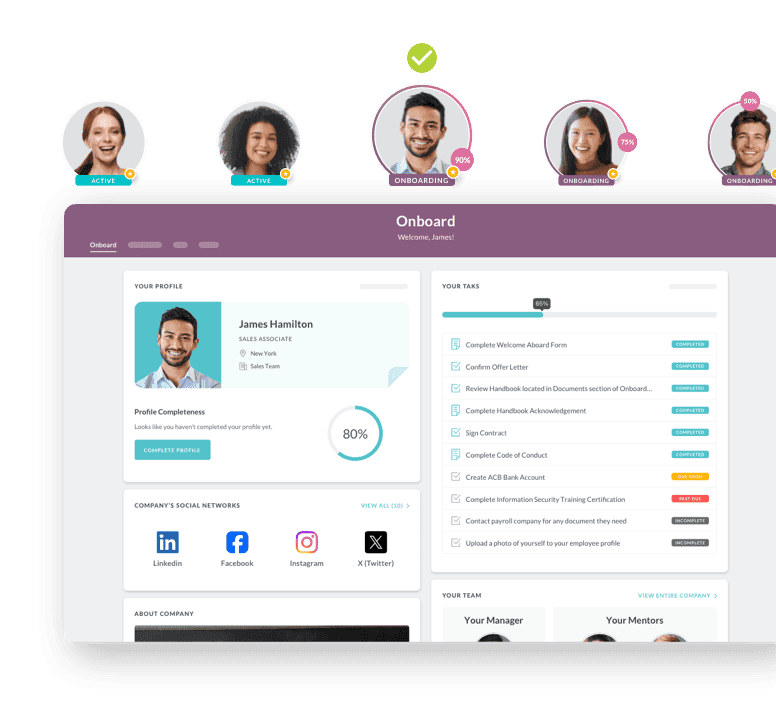
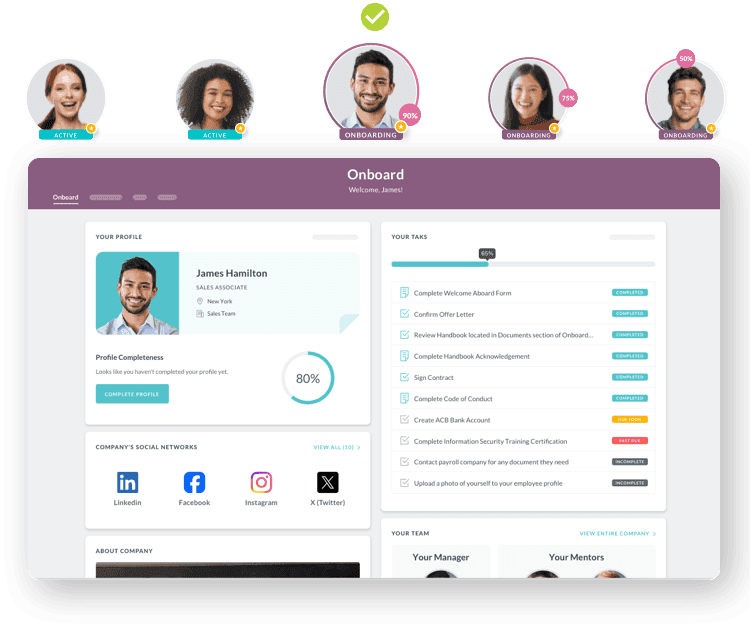
HR Cloud is a cloud HRIS and engagement suite built around Onboard, People HRIS, Workmates (engagement and recognition), Perform, Time Off, Recruit (its built-in ATS), and Shift Planner. For remote and distributed teams, the standout is Workmates: a company newsfeed, peer recognition (Kudos), and mobile access that keeps employees connected whether they're in a corporate office, working from home, or clocking in at a job site with no desk at all. Maya, HR Cloud's SMS-first onboarding agent, lets new hires complete paperwork and orientation from a phone before they ever set foot in an office, which matters for remote hires and frontline/deskless workers alike.
HR Cloud prices as a fixed annual license by company size rather than a strict per-seat fee, so adding a few remote hires mid-year doesn't trigger a new bill. Its own published comparison pages state plans starting at $295/month with published rates up to 250 employees; larger organizations get a custom quote. Paying annually instead of monthly saves 20%. A one-time implementation fee starting at $750 applies if you're connecting HR Cloud to an existing payroll system like ADP, UKG, or Paylocity. Average implementation runs about 6 weeks, per HR Cloud's own UKG comparison. The platform is rated 4.7 out of 5 across 182 reviews on G2 and 4.7 out of 5 across 84 reviews on Capterra.
For remote hiring specifically, HR Cloud's Recruit ATS module runs the applicant-tracking side of the process, including posting jobs to multiple boards and automatically converting a candidate record into an employee record at the point of hire, and its I-9/E-Verify module handles the compliance paperwork a remote hire still has to complete correctly regardless of where they're sitting, with 95% of cases resolved instantly through automated case management. A Slack integration lets recognition and updates from Workmates show up where a distributed team is already talking, including milestone shoutouts and out-of-office status, instead of asking people to check yet another separate app. None of this requires an in-office IT setup step, since it all runs through a browser or the mobile app from day one.
Multi-location and multi-facility employers make up a large share of HR Cloud's customer base, including organizations where "distributed" means employees spread across many physical sites rather than a single headquarters. See HR Cloud's customer case studies for verified examples. That's a closely related problem to fully remote work: both require onboarding, recognition, and communication tools that don't assume everyone shares one building.
Best for: Companies with distributed, hybrid, or multi-location remote teams, especially where some employees are frontline or deskless rather than sitting at a laptop all day.
Honest limitation: HR Cloud is not a native global payroll or Employer of Record platform. If your remote team includes workers in multiple countries and you need HR Cloud to run that payroll directly, you'll be pairing it with a payroll partner (see Deel, below) rather than replacing that function outright.
2. BambooHR: Best for Small, Remote-First Teams That Want One Simple System
BambooHR is a cloud HRIS built for small and mid-sized businesses, covering employee records, time-off management, benefits tracking, candidate records, and workflow automation. For remote teams, its mobile app lets employees clock in and out, submit PTO requests, e-sign documents, enroll in benefits, and pull up their own records entirely from a phone, and its Employee Community feature centralizes announcements, department groups, shoutouts, and event management so a distributed team has one place to stay connected instead of several disconnected tools.
BambooHR publishes its pricing: Core starts at $10 per employee/month, Pro at $17, and Elite at $25, with each tier adding more (performance reviews and community tools at Pro, compensation planning and advanced analytics at Elite). Companies with 25 or fewer employees can use a flat $250/month rate instead. A 15% discount applies when bundling payroll with benefits administration, and nonprofits get a 15% discount as well.
The tier a remote-first team lands on matters here. Core includes candidate records and job posting, which covers basic remote hiring, plus on-demand pay and one compliance training course. Pro adds 15 compliance training courses and the Employee Community feed, closer to what a fully distributed team needs to feel connected without a shared office. Elite adds compensation planning and 300+ compliance courses, which starts to matter once a remote workforce spans multiple states with different training requirements.
Best for: Small remote-first teams that want one straightforward system without juggling modules.
Honest limitation: BambooHR's per-employee pricing model means costs climb in a straight line as headcount grows, and it isn't built specifically around frontline or deskless-worker communication the way a platform like HR Cloud's Workmates is.
See HR Cloud's full breakdown in 7 Best BambooHR Alternatives & Competitors.
3. Rippling: Best for Tech-Forward, Remote-First Companies That Also Need IT
Rippling combines HR, payroll, benefits, and IT device management in one system, which makes it a genuine standout for remote-first tech companies: it can provision a new remote hire's laptop, software access, and payroll setup in the same workflow that creates their HR profile.
Confirmed directly on Rippling's own pricing page, the company doesn't publish standard tier pricing at all; the entire page is a quote-request form rather than a rate table. An independent analysis of 281 verified Rippling purchases by procurement platform Vendr found a median annual contract value of $45,691, ranging from $5,898 to $190,266 depending on which modules were included. Rippling itself displays 4.8/5 on G2, 4.9/5 on Capterra, and 4.9/5 on GetApp on its own site. Confirm current pricing directly with Rippling before budgeting, since it's fully quote-based.
The IT side is what actually differentiates Rippling for remote teams over a pure-HR tool: Rippling's own Identity & Access Management page lists automatic provisioning and deprovisioning as a named feature, and its Device Management page lists "Scheduled offboarding" directly among its features, meaning laptop access, software licenses, and SSO can be cut off automatically the moment HR processes a termination, instead of relying on a separate IT ticket that sometimes gets missed when nobody's walking past that person's desk to notice they're gone.
Best for: Remote-first, tech-forward companies that want unified HR, payroll, and device/IT management in one place.
Honest limitation: Cost is unpredictable until you're deep into a sales conversation, and the platform's breadth means more setup complexity than a team that only needs core HR.
See HR Cloud vs Rippling: Which HRIS Wins for Startups? for a full pricing and feature comparison.
4. Deel: Best for Internationally Distributed Remote Teams and Contractors
Deel is built specifically for hiring and paying people across borders, which makes it the clearest fit on this list for teams whose "remote" actually means "remote in a different country." It handles global payroll, contractor payments in 120+ currencies, and full legal employment through its Employer of Record service in 130+ countries, without you having to open a local legal entity.
Deel publishes real pricing: its ATS/talent product starts at $14 per worker/month, contractor management starts at $49 per contractor/month ($325/month if you need Deel to act as Contractor of Record), its PEO option starts at $125 per employee/month, and its Employer of Record service starts at $599 per employee/month. Deel states there are no hidden fees and no long-term contract requirement.
Worker classification is the specific compliance problem Deel solves that a domestic-only platform doesn't need to think about: misclassifying a contractor in another country as a full employee, or the reverse, carries real legal and tax exposure. Deel's contractor management product is built around getting that classification right by country before payments go out, not after a problem surfaces.
Best for: Companies hiring remote employees or contractors in multiple countries who need compliant local employment without setting up entities themselves.
Honest limitation: Deel's pricing is built around cross-border complexity. If your remote team is entirely domestic, you're paying for global compliance infrastructure you don't need.
5. Gusto: Best for Small, Domestic Remote-First Startups
Gusto is a payroll-first platform that's become a default choice for small U.S.-based startups that never expect to open a physical office. For remote teams, its appeal is a fast, paperless new-hire workflow: employees fill out tax forms, set up direct deposit, and get onboarded without a single piece of paper changing hands.
Gusto publishes its pricing: Simple starts at $49/month plus $6/month per person and covers single-state payroll only. Plus runs $80/month plus $12/month per person and adds multi-state payroll and time tracking. Premium runs $180/month plus $22/month per person and adds a dedicated service advisor, access to certified HR experts, and performance and compensation management. A Contractor Only plan runs $35/month plus $6/month per person for businesses with no W-2 employees yet. Gusto holds a 4.6-star average across 4,137 reviews on both Capterra and Software Advice.
Gusto also handles contractor payments for the same per-person fee as employee payroll, including automatic 1099-NEC filing, which matters for remote teams that mix full-time employees with contractors in different states, a common pattern for early-stage startups that scale headcount before they scale formal HR infrastructure.
Best for: Small, U.S.-based remote-first teams that want payroll and basic HR in one lightweight tool.
Honest limitation: Gusto is thin on the culture and engagement side. Beyond payroll, time off, and basic HR records, there isn't much built specifically to keep a remote workforce connected day to day.
See HR Cloud vs Gusto: Best Choice for Payroll + HR for where each platform's strengths actually lie.
6. Paylocity: Best for Mid-Sized Distributed Companies That Want a Built-In Social Layer
Paylocity is a cloud HCM suite that leans into a Community feature: a company feed, discussion groups, and a peer-recognition tool called Impressions that lets employees give each other virtual kudos visible in the shared feed, designed to work the same whether someone is in a corporate office or working from home. That makes it a reasonable fit for mid-sized companies with a distributed workforce that still wants an office-culture feel.
Paylocity doesn't publish standard per-employee pricing. Every quote is customized to company size, modules selected, and contract term, so check directly with Paylocity for current numbers.
Paylocity also runs talent acquisition and performance-review modules alongside payroll, so a distributed team doesn't have to bolt on a separate tool just to run remote performance reviews on the same schedule as in-office staff.
Best for: Mid-sized distributed companies that want payroll, HR, and a built-in social/recognition layer in one platform.
Honest limitation: Without published pricing, it's harder to budget-compare Paylocity against a tool like BambooHR or HR Cloud before talking to sales.
7. UKG Ready: Best for Large Enterprises With Complex Multi-State Compliance
UKG Ready is an enterprise-grade HCM covering payroll, time and attendance, scheduling, and talent management. For remote and distributed teams spread across many states (or countries), UKG's Compliance Hub centralizes labor-law tools and automatically updates pay and time rules as regulations change, built to handle that complexity at scale.
Confirmed directly on UKG Ready's own product page, there's no pricing table on the site at all, only a demo-request form; every quote is customized. Per HR Cloud's own UKG comparison, typical UKG implementations run 6 to 18 months, compared with HR Cloud's roughly 6-week average.
Scheduling is where UKG Ready shows up most for distributed workforces specifically: UKG's own scheduling feature page describes AI-driven labor forecasting that uses historical and real-time data to predict staffing needs and generate shift recommendations across multiple locations, which matters when "remote" for an enterprise means field crews or shift workers spread across many states rather than laptop employees in one time zone.
Best for: Large enterprises, roughly 500 to 5,000+ employees, with complex multi-state or multi-country compliance needs.
Honest limitation: The implementation timeline and complexity are real costs. A remote-first company that just needs to onboard and support distributed hires quickly may find UKG's scale is more than it needs.
See HR Cloud vs UKG: Enterprise HR Software Compared for a full breakdown.
8. Paycor: Best for Mid-Market Companies That Want Native Payroll Plus HR
Paycor centers on payroll with broader HR modules layered on top. It quotes by company-size band (Paycor's own site splits pricing conversations into "under 50 employees" and "50 to 1,000+ employees") rather than a single custom quote regardless of size, which at least narrows the range before a sales call starts.
Confirmed directly on Paycor's own pricing page, pricing is an interactive quote tool based on company size (under 50 employees, or 50 to 1,000+) rather than a published rate table. The platform is rated 4.3 out of 5 across 3,071 reviews on Capterra and serves more than 2 million users across 30,000+ businesses, per Paycor's own site.
Paycor's analytics platform includes an AI-powered "Predictive Resignation" tool that flags at-risk employees and forecasts turnover probability up to 12 months out, broken down by department, manager, and location, useful for an HR team trying to spot a retention problem in one office or region before it shows up in a company-wide number.
Best for: Mid-market companies that want native payroll processing plus HR in a single system.
Honest limitation: Like most native-payroll platforms on this list, onboarding and remote-engagement features take a back seat to the payroll engine itself.
See HR Cloud vs Paycor: Which HR Software Scales Better? for the full pricing and feature comparison.
9. HiBob (Bob): Best for Culture-Focused Remote and Hybrid Teams
HiBob, known as Bob, is built around culture and engagement first. Its own culture page describes employees posting "Shoutouts and Kudos" on Bob's social-media-style homepage feed to celebrate wins and milestones, and a Clubs feature that lets people connect over hobbies, interests, or shared locations, both designed to replicate office-culture spontaneity for a team that's remote or hybrid, which is a genuinely different design center than a payroll-first platform.
HiBob doesn't publish pricing publicly. Confirmed directly on HiBob's own pricing page, it's a lead-capture demo request form with no rate table at all. Getting a number requires requesting a demo and talking to sales.
Bob's Talent module layers performance reviews, goal-setting, and 1-on-1 tools on top of that social feed, and it runs alongside the communication tools a distributed team already uses rather than replacing them, so a remote employee's day-to-day chat app stays the chat app while Bob handles the HR-specific recognition and records layer.
Best for: Culture-focused remote or hybrid companies, often in tech, that prioritize engagement tooling as much as core HR records.
Honest limitation: With zero published pricing, it's difficult to even rough-budget HiBob against competitors without booking a sales call first.
10. TriNet HR Plus (formerly Zenefits): Best for Small Teams Wanting Bundled HR, Payroll, and Compliance Support
Zenefits was a standalone small-business HR and benefits platform, but it was discontinued as its own product after TriNet's 2022 acquisition. What you'd evaluate today is TriNet HR Plus, which fits small, mostly domestic remote teams looking for payroll administration, HR support, benefits administration, and compliance assistance on one platform.
TriNet no longer publicly lists pricing for this product; it's quote-only.
One structural detail matters here and is easy to get backward: HR Plus is TriNet's Administrative Services Organization (ASO) offering, and TriNet's own explanation of its HR outsourcing models states plainly that "unlike a PEO, there is no co-employment relationship with an ASO," meaning your company remains the employer of record and keeps full responsibility for your workforce. That's different from TriNet's separate full PEO product, where TriNet itself becomes a co-employer. A remote team evaluating this option should confirm which of TriNet's two products, HR Plus or full PEO, it's actually being quoted, since they carry different legal structures.
Best for: Small businesses that want payroll, HR, and compliance support bundled with a vendor's platform while remaining the legal employer of their own staff.
Honest limitation: Anyone still shopping by the name "Zenefits" should know upfront they're actually evaluating one of TriNet's two current products, not a standalone tool, and should confirm whether they're being quoted HR Plus or TriNet's full PEO.
See HR Cloud vs Zenefits: Which Platform Fits Your Team Size? for more detail on this shift.
How Do You Choose the Right Cloud HR Platform for Your Remote Team?
Before comparing vendors, classify your own workforce. Most bad HR software decisions happen because a company compares feature lists before deciding what kind of distribution problem it actually has.
How distributed is your team, really? A team that's remote but entirely domestic has fundamentally different requirements than one with employees in six countries. Domestic-only teams can pick from most platforms on this list. International teams should shortlist Deel first and treat everything else as secondary, since cross-border compliance isn't a feature most HRIS platforms bolt on well.
Do you need native payroll, or an HRIS that connects to payroll you already have? Gusto, Paycor, Paylocity, and UKG Ready run payroll themselves. HR Cloud and BambooHR are HRIS-first and either connect to an existing payroll system or leave payroll to a dedicated partner. If you're happy with your current payroll provider and just need better onboarding and engagement tools layered on top, replacing payroll to get those tools is usually the wrong trade.
How mobile-first does onboarding actually need to be? If new hires are handed a company laptop on their first day in an office, mobile onboarding is a nice-to-have. If a remote hire's first interaction with your company is entirely on their own phone before any equipment arrives, a platform like HR Cloud's Maya or BambooHR's mobile self-service stops being optional.
Is pricing transparency worth trading away features for? BambooHR, Deel, Gusto, and HR Cloud publish real pricing you can compare before a sales call. Rippling, Paylocity, UKG Ready, Paycor, HiBob, and TriNet HR Plus require a custom quote. That's not automatically a red flag: some of the best fits for large or complex distributed teams (UKG Ready, for instance) simply can't be priced without knowing your specific setup. But if budget predictability matters more than maximum feature depth, weight the published-pricing platforms more heavily.
What's your realistic implementation timeline? A remote team that needs to onboard hires starting next month can't wait on a 6-to-18-month enterprise rollout. Match the platform's typical implementation window, not just its feature list, to how urgently you need it live.
What kind of support do you get after you've signed? This matters more for a distributed team than an on-site one, since there's no in-house IT or HR person down the hall to fix a login issue in person. HR Cloud bundles training, support, account-manager meetings, and unlimited chat into every plan with no per-seat support upsells. BambooHR's Elite tier adds premium support services as a step up from its lower tiers, which means the support level you get depends on which tier you're willing to pay for. Ask any vendor directly whether support is included at every tier or gated behind an upgrade, since that detail rarely shows up on the pricing page itself.

What Mistakes Do Companies Make When Choosing HR Software for Remote Teams?
Most bad HR software purchases aren't caused by a missing feature. They happen because the buyer evaluated the wrong operating problem. These are the patterns that show up most often once a remote or distributed team is unhappy with its platform six months after signing.
Buying for the feature list instead of the actual distribution pattern. A platform with 40 features means nothing if none of them address whether your team is domestic or international. Confirm which category you're actually in (see the checklist above) before comparing feature lists at all.
Not testing the mobile app before signing. Several platforms on this list market themselves as mobile-friendly, but the quality of that mobile experience varies a lot in practice. A remote or frontline employee who can't complete a task on their phone will find a workaround, usually a slower and less compliant one, like emailing a form instead of using the system. Ask for mobile app access during the trial or demo, not just a screenshot in a sales deck.
Assuming multi-state or multi-country tax handling is included by default. Some platforms handle this natively; others charge extra per state or don't support it at all outside their home country. If you're planning to hire remote employees in a new state or country in the next year, confirm coverage for that specific location before signing, not after the offer letter goes out.
Treating "custom quote" as a proxy for quality. Several strong platforms on this list, including UKG Ready and HiBob, don't publish pricing because their offering genuinely varies too much by customer to price simply. That's different from a platform hiding a weak product behind a sales call. Ask directly what drives the quote up or down for a company your size before assuming the number reflects better features.
Underestimating how change gets communicated to a distributed team. Rolling out a new HR platform is harder to explain over Slack or email than it is to explain by walking someone through it at their desk. Build a rollout communication plan into the timeline, not just a training session, especially for frontline or deskless employees who may not check email daily.
Comparing list price without comparing what triggers a price increase. A per-employee platform and a fixed-license platform can look similarly priced at your current headcount and diverge sharply a year later. BambooHR's cost rises in a straight line with every employee added. HR Cloud's fixed annual license is set by a headcount band, so a few new remote hires within the same band don't change the bill. Ask what specifically triggers a price change, not just what the current number is, before comparing two quotes side by side.
Cloud HR Platforms for Remote Teams at a GlanceWhich Cloud HR
| Platform | Starting Price | Pricing Published? | Best For | Remote-Team Standout |
|---|---|---|---|---|
| HR Cloud | $295/month (up to 250 employees) | Yes | Distributed, multi-location, frontline-heavy teams | Workmates engagement + Maya SMS onboarding |
| BambooHR | $10/employee/month (Core) | Yes | Small remote-first teams | Mobile self-service, employee community |
| Rippling | Custom quote (median $45,691/year per Vendr) | No | Tech-forward remote-first companies | Unified HR + IT/device provisioning |
| Deel | $14/worker/month (ATS); $599/employee/month (EOR) | Yes | Internationally distributed teams | Compliant hiring/payroll in 130+ countries |
| Gusto | $49/month + $6/mo per person (Simple) | Yes | Small domestic remote-first startups | Paperless, fast new-hire workflow |
| Paylocity | Custom quote | No | Mid-sized distributed companies | "Community" social/recognition feed |
| UKG Ready | Custom quote | No | Large enterprises, complex compliance | Multi-state/country compliance engine |
| Paycor | Custom quote by company-size band | No | Mid-market, native payroll priority | Predictive Resignation turnover analytics |
| HiBob | Custom quote (demo required) | No | Culture-focused remote/hybrid teams | Shoutouts feed, Clubs interest groups |
| TriNet HR Plus | Custom quote | No | Small teams wanting bundled payroll/benefits/HR support | ASO structure, client stays employer of record |
Platform Is Right for Your Remote Team?
If your remote team is a mix of desk-based staff and frontline or deskless workers spread across locations, HR Cloud's combination of mobile onboarding and Workmates engagement tooling is built for exactly that mix. If your team is entirely domestic and small, BambooHR or Gusto will get you running faster with less setup. If you're hiring across borders, Deel solves a problem the others on this list don't touch. And if you're already deep into enterprise-scale compliance requirements, UKG Ready's complexity is a feature, not a drawback, at that size.
Run your own answers to the six questions in the buyer's checklist above against this list before booking a demo. It'll narrow ten options down to two or three faster than sitting through ten sales calls to find that out the hard way.
Whatever you pick, the real test isn't the feature list. It's whether an employee who has never set foot in your office can get onboarded, get paid, and feel like part of the team without anyone having to walk them through it in person. Run that test against your shortlist before you sign anything, not just against the sales deck.

Experience how Workmates can transform communication and strengthen culture—all in one powerful platform
Book Your Free DemoFrequently Asked Questions About Cloud HR Platforms for Remote Teams
What is a cloud HR platform?
A cloud HR platform is HR software hosted online rather than installed on a local server, so employees and administrators can access records, payroll, onboarding, and other HR functions from any device with an internet connection. This is what makes it usable by a remote or distributed workforce in the first place.
What should a cloud HR platform for remote teams actually include?
At minimum, mobile-friendly self-service access, digital onboarding that doesn't require an in-person office visit, a way to communicate and recognize employees without a shared physical space, and, for internationally distributed teams, compliant cross-border payroll or employment options.
Do cloud HR platforms handle payroll for remote employees automatically?
Some do natively, like Gusto, Paycor, Paylocity, and UKG Ready. Others, including HR Cloud, focus on onboarding, HRIS, and engagement, and connect to an existing payroll system like ADP, UKG, or Paylocity rather than replacing it.
How much does a cloud HR platform cost for a remote team?
It varies widely by platform and how many modules you need. Published rates on this list range from BambooHR's $10 per employee/month entry tier to Deel's $599 per employee/month Employer of Record service. Several platforms, including Rippling, Paylocity, UKG Ready, Paycor, HiBob, and TriNet HR Plus, require a custom quote rather than publishing standard pricing.
Can a cloud HR platform fully replace in-person onboarding?
For many remote hires, yes. Tools like HR Cloud's Maya let new employees complete paperwork, policy acknowledgment, and orientation content from a phone before their first day. Roles that require physical equipment handoff, in-person safety training, or hands-on job shadowing still typically need at least one in-person step regardless of the software involved.
What's the difference between a cloud HRIS and a full cloud HCM platform?
An HRIS (Human Resource Information System) typically focuses on core employee records, onboarding, time off, and self-service. An HCM (Human Capital Management) platform usually adds native payroll, benefits administration, and workforce management on top of those HRIS functions. Several platforms on this list, like UKG Ready and Paylocity, are full HCM suites, while others, like HR Cloud and BambooHR, are HRIS-centered and connect to payroll separately.
Is HR Cloud built for fully remote companies, or mainly for on-site and frontline teams?
HR Cloud works for both. Its engagement tools were built with frontline and deskless workers in mind, but the same mobile-first onboarding and communication tools apply directly to fully remote, laptop-based employees who also never share a physical office. HR Cloud is rated 4.7 out of 5 on G2 (182 reviews) and 4.7 out of 5 on Capterra (84 reviews).
Is TriNet HR Plus (formerly Zenefits) a PEO with co-employment?
No. TriNet HR Plus is an Administrative Services Organization (ASO) offering, and TriNet's own materials state there is no co-employment relationship with an ASO, meaning the client company remains the employer of record. TriNet's separate full PEO product is the one where TriNet becomes a co-employer.
Do I need a different cloud HR platform for frontline remote workers versus office-based remote workers?
Not necessarily a different platform, but you do need one built for both. Frontline and deskless remote workers, like field technicians or healthcare staff who float between locations, need mobile-first access without assuming a company email account or a desk. Platforms built primarily for laptop-based knowledge workers, like Rippling or HiBob, can be a weaker fit for that group than a platform like HR Cloud that was built with frontline access in mind from the start.
About the author

Keep Reading


Like What You Hear?
We’d love to chat with you more about how HR Cloud® can support your business’s HR needs.
Book Your Free Demo