
75+ Questions to Ask a CEO That Actually Lead to Better Workplaces

You just got 15 minutes on the CEO's calendar. Or maybe it's a town hall with 200 people in the room and a mic being passed around. Either way, you know this: the wrong question wastes everyone's time, and the right one can shift how an entire organization communicates, prioritizes, and retains its people.
According to Gallup's 2026 State of the Global Workplace report, global employee engagement fell to 20% in 2025, costing the world economy an estimated $10 trillion in lost productivity. Meanwhile, the 2025 Edelman Trust Barometer found that employer trust dropped from 79% to 76% year over year. That three-point decline might seem small, but it signals something HR leaders already feel: employees want more transparency from the top, and they're not always getting it.
This guide gives you 75+ good questions to ask a CEO, organized by the scenario you're actually in, so whether you're at a town hall, in a job interview, or sitting across from your CEO one-on-one, you walk in prepared to have a conversation that matters.
Key Takeaways
- The best questions to ask a CEO depend on context. A town hall, a one-on-one, and a job interview each require a different approach in tone, specificity, and depth.
- Open-ended "How" and "What" questions consistently produce better answers than yes/no or "Why" questions, which can feel accusatory.
- HR leaders are uniquely positioned to use CEO conversations as a diagnostic tool. If your CEO says culture is the top priority but can't name a single metric they track for it, that gap is your signal to propose one.
- Questions about engagement, retention, and communication aren't soft topics. They're tied directly to productivity, profitability, and the cost of employee turnover. They belong in every CEO conversation.
- Use the scenario framework table below to match your situation to the right type of question.
How Do You Construct a Question That Gets a Real Answer From a CEO?
Most lists of questions to ask a CEO give you the "what" without the "how." But the way you frame a question determines whether you get a canned answer or a genuine one.
Three principles that separate good questions from forgettable ones:
- Frame for depth, not confirmation. Questions that start with "Do you" or "Is it" invite one-word answers. Questions that start with "How" or "What" invite stories, reasoning, and context. If you're not framing for depth, you're leaving insight on the table.
- Weak version: "Do you care about culture?" (yields a yes)
- Strong version: "What's one cultural behavior you'd reinforce in every team meeting?" (yields a strategy)
- Anchor to something observable. Vague questions produce vague answers. The more specific your reference point (a recent company decision, a survey result, a competitive shift), the harder it is for the CEO to default to talking points. Referencing something concrete also shows you've done your homework, which earns you a more candid response.
- Make the question useful to you. If you're in HR, your questions should produce information you can bring back to your team. If you're in an interview, they should help you decide whether this is a company worth joining. Every question should serve a purpose beyond filling silence.
Here's a framework to match your scenario to the right type of question:
| Scenario | Best Question Types | Tone | What to Avoid |
|---|---|---|---|
| Town hall / all-hands | Strategy, competitive landscape, company milestones | Broad, forward-looking, inclusive | Personal topics; anything that puts the CEO on the spot |
| Skip-level or one-on-one | Team dynamics, communication gaps, career development | Direct, collaborative, specific | Questions you could answer yourself with 10 minutes of research |
| Job interview with a CEO | Decision-making, organizational health, role expectations | Curious, confident, research-backed | Compensation and benefits (save for HR/recruiter) |
| AMA / fireside chat | Personal leadership, lessons from failure, contrarian views | Conversational, authentic, light | Loaded or leading questions designed to trap |
| Board or investor context | Capital allocation, risk, strategic bets, competitive moat | Analytical, concise, numbers-oriented | Day-to-day operational details |
What Are the Best Questions to Ask a CEO in a Town Hall or All-Hands Meeting?
Town halls are high-visibility, low-intimacy interactions. You're competing with filtered questions, time limits, and an audience of hundreds. The questions that land are the ones that benefit everyone in the room, not just you.
Leadership IQ research found that employees who receive six hours of leader communication per week are 29% more inspired and 30% more engaged than those who get just one hour. That means town halls aren't just a formality. They're one of the few moments where the CEO's words directly shape how connected hundreds of people feel to the organization.
Strategy and direction questions:
- What's the single most important priority for the company over the next 12 months?
- What's one competitive advantage we have right now that we're not fully leveraging?
- How should employees think about their role in the company's next phase of growth?
- What's a market trend you're watching closely that most of us probably aren't thinking about?
Culture and communication questions:
- What's one thing about how we work together that you'd want every new hire to experience in their first week?
- Where do you think we have the biggest gap between what we say our culture is and how it actually shows up day-to-day?
- How do you decide what information gets shared company-wide versus kept at the leadership level?
Forward-looking questions:
- What does success look like for this company three years from now, and what has to change to get there?
- If you had to cut every initiative except one, which would survive and why?
- What's a risk or challenge we're not talking about enough as a company?
- What would you want our competitors to be worried about when they look at us a year from now?
Why these work in a town hall: These questions are broad enough to benefit every listener but specific enough that the CEO can't answer with platitudes. They also position whoever asks them as someone who thinks about the organization beyond their own desk.
Here's what this looks like in practice. At a mid-size healthcare company, the HR Director asked a simple town hall question: "Where do you think the biggest gap is between what we say our culture is and how it actually shows up?" The CEO paused, admitted the gap was in how frontline nurses experienced recognition compared to corporate staff, and within 90 days the leadership team had rolled out a peer recognition program for clinical teams.
One question. One honest answer. A tangible outcome that touched hundreds of employees.
What Smart Questions Should You Ask a CEO in a One-on-One or Skip-Level Meeting?
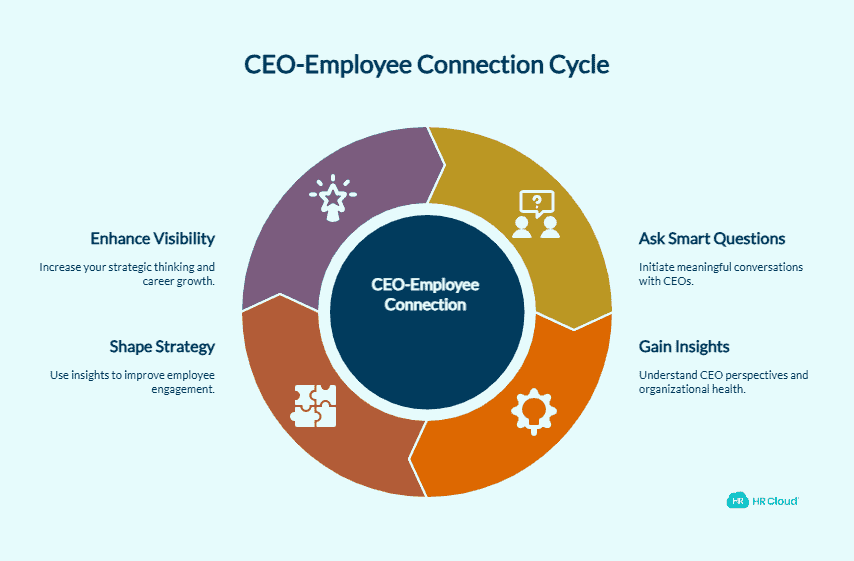
A one-on-one with a CEO is rare. Skip-level meetings, where you sit down with a leader two or more levels above you, are becoming more common as organizations realize that employee engagement requires direct connection between leadership and the front line.
This is where you get specific. The 2025 Edelman Trust Barometer revealed that only 19% of frontline employees trust their CEO to tell the truth about the organization, compared to 52% of executives. One-on-one conversations can start to close that gap, but only if you ask questions that go beyond surface-level check-ins.
Questions about team and organizational health:
- What feedback are you hearing from other parts of the organization about how our team is perceived?
- When you see turnover spike in a department, what's your first instinct about the root cause?
- What's one thing you wish managers at my level understood better about the decisions being made at the top?
- How do you personally stay connected to the experience of employees who don't work at headquarters?
Questions about your own career and contribution:
- What would make someone in my role indispensable to this organization's next chapter?
- Where do you see the biggest skills gap in our leadership pipeline, and how can I help close it?
- What's one area where you think HR (or my function) could have a bigger impact than it currently does?
- If you were building this team from scratch today, what capabilities would you prioritize that we don't have enough of right now?
Questions about how the CEO operates:
- Walk me through the last time you changed your mind on a major strategic decision. What new information moved you?
- What's the most useful piece of pushback you've received from someone below the C-suite?
- When you have to deliver difficult news to the company, what's your communication process?
- What's the one thing that keeps you up at night about this organization that doesn't show up in any dashboard?
Why these work one-on-one: They're too specific for a town hall, but they generate the kind of insight that changes how you do your job. They also signal to the CEO that you're thinking at a strategic level, which matters for your own visibility and growth. If the CEO's answers point to engagement gaps, use those insights to shape your employee engagement strategy.


What CEO Interview Questions Should You Ask If You're Evaluating a Company?
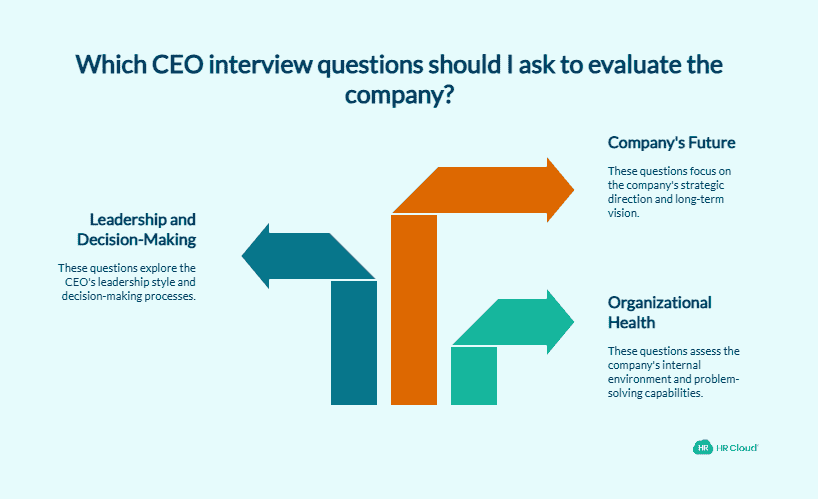
If you're asking questions to a CEO in an interview, the dynamic flips. You're no longer just answering their questions. The conversation becomes your chance to assess whether this organization deserves your time, talent, and trust.
Research from executive search firm Pact & Partners confirms that the strongest CEO candidates are identified by the quality of their questions, not just their answers. The same principle applies when you're the one interviewing: sharp questions signal strategic thinking.
Questions about organizational health:
- What's the most important problem this role was created to solve?
- What does success look like for someone in this position after six months? After a year?
- Can you describe a time the company made an unpopular decision that turned out to be right? What was the internal reaction?
- What's one thing about working here that surprises people after they've been here six months?
Questions about leadership and decision-making:
- When your executive team reaches a deadlock on a major call, what's your process for breaking the tie?
- How much of your week involves direct communication with people outside the C-suite?
- What's one leadership decision you'd make differently if you could redo it, and what did it teach you?
- What's the hardest part of this company's culture to maintain as you scale?
Questions about the company's future:
- Where is the company investing most heavily right now, and why?
- What's the biggest external threat you're managing that most employees don't see?
- If I joined and wanted to understand the real culture here (not the careers page version), who should I talk to?
- What's one thing the company tried in the last two years that didn't work, and how did you communicate that internally?
- How do you think about balancing short-term profitability with long-term bets that may not pay off for years?
Pro tip: PwC's 2026 Global CEO Survey found that CEOs spend 47% of their time on short-term issues (under one year) and only 16% on anything five or more years out. If the CEO you're interviewing can only talk about this quarter's priorities and goes blank on longer-term vision, that tells you something about the organization's strategic maturity.
What Questions Should You Ask a CEO About Communication, Transparency, and Trust?
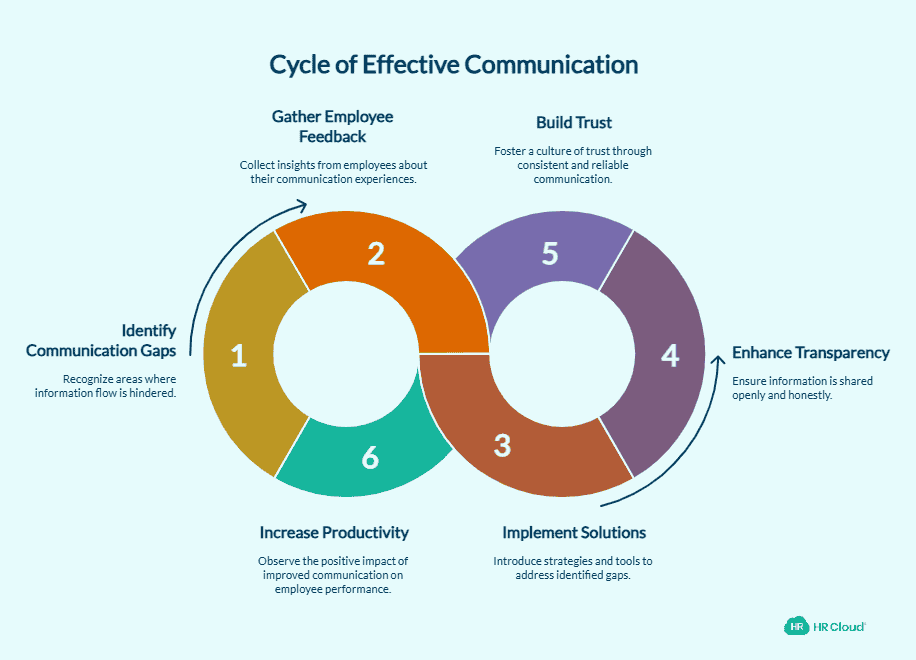
Poor communication isn't just frustrating. It's measurably expensive. Harvard Business Review research shows that employees in high-trust workplaces are 50% more productive than those in low-trust environments. Trust starts with consistent, honest communication from leadership, and it breaks down fast when employees feel like they're the last to know.
- If employees told you they feel out of the loop, where would you guess the breakdown is happening?
- What's your biggest frustration with how information travels through this organization?
- How do you approach communicating during uncertainty when you don't have final answers yet?
- What role should HR or internal comms play in making leadership more visible and accessible?
- How do we make sure frontline employees who don't sit at a desk get the same information as everyone else?
- When was the last time you received feedback from an employee that genuinely surprised you, and what did you do with it?
- If you could redesign how this company communicates from scratch, what would you keep and what would you eliminate?
Why these matter for HR: Communication gaps are often structural, not personal. Maybe the CEO sends updates, but they never reach shift workers. Maybe town halls happen, but no one follows up on the questions raised. A strong internal communication strategy paired with an employee communication platform can close these gaps by making updates, recognition, and feedback loops accessible to every employee, not just those with a laptop.
Download this free PDF and share it with your team to align your internal and external communication strategies.
Download Now
What Questions Help You Understand How a CEO Handles Change and Innovation?
Digital transformation, AI adoption, and restructuring are all generating real anxiety across workforces right now. Most employees don't resist change itself. They resist being surprised by it, excluded from it, or left to figure it out alone. These questions help you understand whether the CEO is leading through change thoughtfully or reacting to it.
- How do you decide when a new technology is worth adopting versus when it's a distraction?
- What's your approach to supporting employees whose roles are being reshaped by automation?
- Can you walk me through a change initiative that didn't go as planned and what you learned from it?
- How do you communicate the reasoning behind big organizational shifts to people who weren't in the room when the decision was made?
- How do you balance moving fast with making sure your people are ready for what's coming?
- When you think about AI's impact on our workforce over the next two years, what are you most optimistic about and what concerns you most?
- What does "successful change management" actually look like at this company? Can you point to a recent example?
- How do you decide which teams or departments get the most investment during a transition period?
Why these matter for HR: Change management questions tell you whether you'll be cleaning up after poorly communicated decisions or partnering with a CEO who builds buy-in before rolling things out. If the CEO can describe a specific change process with real steps and real outcomes, you're working with someone who understands that transformation fails when people aren't brought along.
What Should You Ask a CEO About Belonging, Wellbeing, and Inclusion?
Belonging and wellbeing questions reveal whether leadership treats these as strategic priorities or checkbox exercises. Gallup's State of the Global Workplace data shows that only 32% of U.S. employees feel strongly connected to their organization's mission. That connection doesn't happen by accident. It's built through intentional leadership, honest conversations, and systems that give every employee a voice that actually gets heard.
- What does belonging look like here for someone who doesn't match the demographic majority of the leadership team?
- How do you hold managers accountable for creating environments where people feel safe to speak up?
- What have employee surveys told you about where belonging or inclusion breaks down, and what are you doing about it?
- How do you think about wellbeing as a leadership responsibility, beyond offering an EAP and gym discounts?
- What's one thing you've changed about how the company operates based on feedback about employee experience?
- When someone leaves and cites "culture fit" in their exit interview, what does the leadership team do with that information?
- How do you ensure that employees on the front line (nurses, warehouse workers, field techs) feel as included as people who sit in the corporate office?
- What does your personal involvement in belonging look like beyond signing off on the budget for it?
Why these matter for HR: Belonging questions expose whether the CEO sees inclusion as a CEO-level priority or something delegated entirely to HR. If the CEO can name specific feedback they've acted on, that signals a culture where employee voice actually travels upward. If the answers stay abstract, you know where the gap is. For practical steps on building recognition into your culture, see our employee recognition guide.
Get started on your own employee recognition program using this Recognition Program Starter Kit.
Download Now
What Personal or Rapport-Building Questions Can You Ask a CEO?
Not every CEO conversation needs to be about strategy. Personal questions build trust, create psychological safety, and make future difficult conversations easier. The key is genuine curiosity, not rehearsed flattery.
- What's the best piece of career advice someone gave you that actually changed your behavior (not just something that sounded good)?
- What do you do to recharge when the pressure of the role starts affecting your decision-making?
- Who outside of your direct reports tells you the truth you need to hear, and how did you build that relationship?
- What part of being CEO has been lonelier than you expected?
- What's the most important thing you've unlearned since stepping into this role?
- What's one thing this company has accomplished that you're most proud of, that has nothing to do with revenue?
- If you could sit down with yourself on day one as CEO, what would you warn yourself about?
- What's a skill you had to develop as CEO that your previous roles never required?
Why these work for rapport: Personal questions done well are disarming. They tell the CEO you see them as a person, not just a title. That matters because the quality of your future conversations about difficult topics (budget cuts, restructuring, underperforming teams) depends on the trust you've built in moments like these.
How Do You Turn a CEO's Answers Into Action?
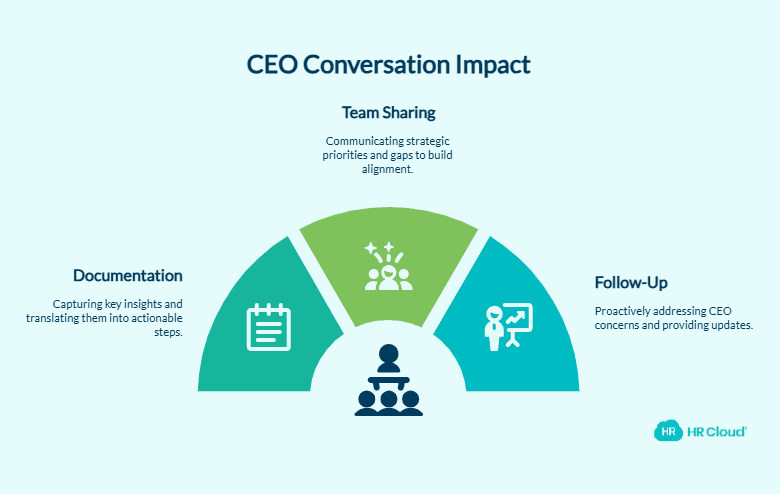
Asking a great question is only half the work. What you do with the answer determines whether the conversation had any lasting impact.
Three things to do within 48 hours of a meaningful CEO conversation:
- Document the signal, not just the soundbite. If the CEO said "our biggest gap is manager communication," write down what that means for your team's priorities. Translate their language into your department's action items.
- Share what you learned with your team. If the CEO shared a strategic priority or acknowledged a gap, bring that context to your direct reports. It builds alignment and shows your team that their leader has access to the people making decisions.
- Follow up on one thing. If the CEO mentioned a problem they're working on, circle back in 30 days with a proposal, a data point, or a progress update. Most people ask questions and disappear. The person who follows up is the one who earns the next conversation. Need a starting point? These employee engagement ideas can give you concrete initiatives to propose.
That's 77 questions across 8 scenarios, plus a framework for constructing your own. The goal was never to hand you a script. It was to make sure you walk into any CEO conversation prepared to ask something worth answering.
Building a workplace where CEO conversations lead to real change takes more than good questions. It takes systems that keep communication flowing, recognition visible, and employee feedback actionable. HR Cloud's Workmates platform helps HR teams turn leadership vision into daily employee experience, with tools for communication, engagement surveys, and peer recognition built for frontline and office teams alike.
Frequently Asked Questions
What are good questions to ask a CEO during a town hall?
Focus on strategic, forward-looking topics that benefit the whole room. Questions about company direction, competitive positioning, upcoming priorities, and how employees can contribute to key goals tend to generate the most useful responses. Avoid anything that applies only to your department or that could embarrass the CEO publicly.
How many questions should you prepare before meeting a CEO?
Prepare five to seven questions, but expect to ask two or three. Prioritize based on what you need most from the conversation, and let the CEO's answers guide your follow-ups naturally. Over-scripting makes the conversation feel like an interrogation.
What questions should you avoid asking a CEO?
Avoid yes/no questions, anything easily found on the company website, and questions that sound like complaints disguised as curiosity. Also skip compensation questions during CEO interviews (save those for the recruiter) and anything designed to put the CEO on the defensive rather than open a dialogue.
Why should HR leaders specifically prepare questions for CEO conversations?
HR sits at the intersection of employee experience and business strategy. A well-placed question from an HR leader can surface engagement gaps, retention risks, and communication breakdowns that other leaders miss. According to Gallup, highly engaged teams show 23% higher profitability, which means the conversations HR drives with leadership have a direct financial impact.
What is the best question to ask a CEO about employee engagement?
One of the most revealing questions is: "How do you personally stay connected to the frontline employee experience?" This forces specificity. If the CEO has a real answer (quarterly skip-levels, reading survey comments, shadowing frontline teams), it signals genuine commitment. If the response is vague, that tells you something too.
How do questions to ask a CEO in an interview differ from questions for your own CEO?
Interview questions focus on evaluating the company and making a career decision. Questions for your current CEO are about influencing outcomes, improving communication, and aligning your team's work with the company's direction. Both require preparation, but the stakes and dynamics are different.
About the author

Keep Reading


Like What You Hear?
We’d love to chat with you more about how HR Cloud® can support your business’s HR needs.
Book Your Free Demo