How to Onboard Travel Nurses Efficiently

Travel nurses have 13-week contracts and zero margin for slow onboarding. Hospitals that get them credentialed, compliant, and shift-ready before Day 1 (using automated workflows, chained tasks, and mobile-first pre-boarding) experience fewer canceled contracts, less HR scramble, and nurses who actually show up confident on day one.
Key Takeaways
- Travel nurse credentialing delays push back start dates and cost both the facility and the nurse real money
- Pre-boarding before the start date is the single highest-leverage thing HR teams can do
- Chained tasks ensure compliance steps happen in the right order, with no step skipped
- Mobile-first onboarding isn't optional. Most travel nurses complete their paperwork outside business hours, on their phones
- I-9 and E-Verify need to be wired into your onboarding workflow before Day 1, not scrambled at orientation
- Automated reminders replace manual follow-up and reduce HR burnout significantly
The 13-Week Clock Starts Before They Walk In the Door
A travel nurse accepts your offer on Tuesday. Her contract starts in two weeks. Somewhere between now and her first shift, she needs to submit her license, upload immunization records, complete your I-9, pass a background check, get a drug screen done, and finish your facility-specific orientation modules. All while probably wrapping up her last assignment in another state.
If your onboarding process requires her to show up on Day 1 to do any of that, you've already lost time.
Credentialing delays are one of the most common reasons travel nursing start dates get pushed back. In some cases, contracts get canceled entirely when agencies or travelers fail to complete requirements by the facility's deadline. For a nurse working a 13-week contract, a week's delay isn't a minor inconvenience. It's a meaningful portion of her assignment gone before she sees a single patient.
The hospitals that onboard travel nurses efficiently don't do it by working harder during orientation week. They do it by starting sooner.
Why Travel Nurse Onboarding Is Its Own Problem
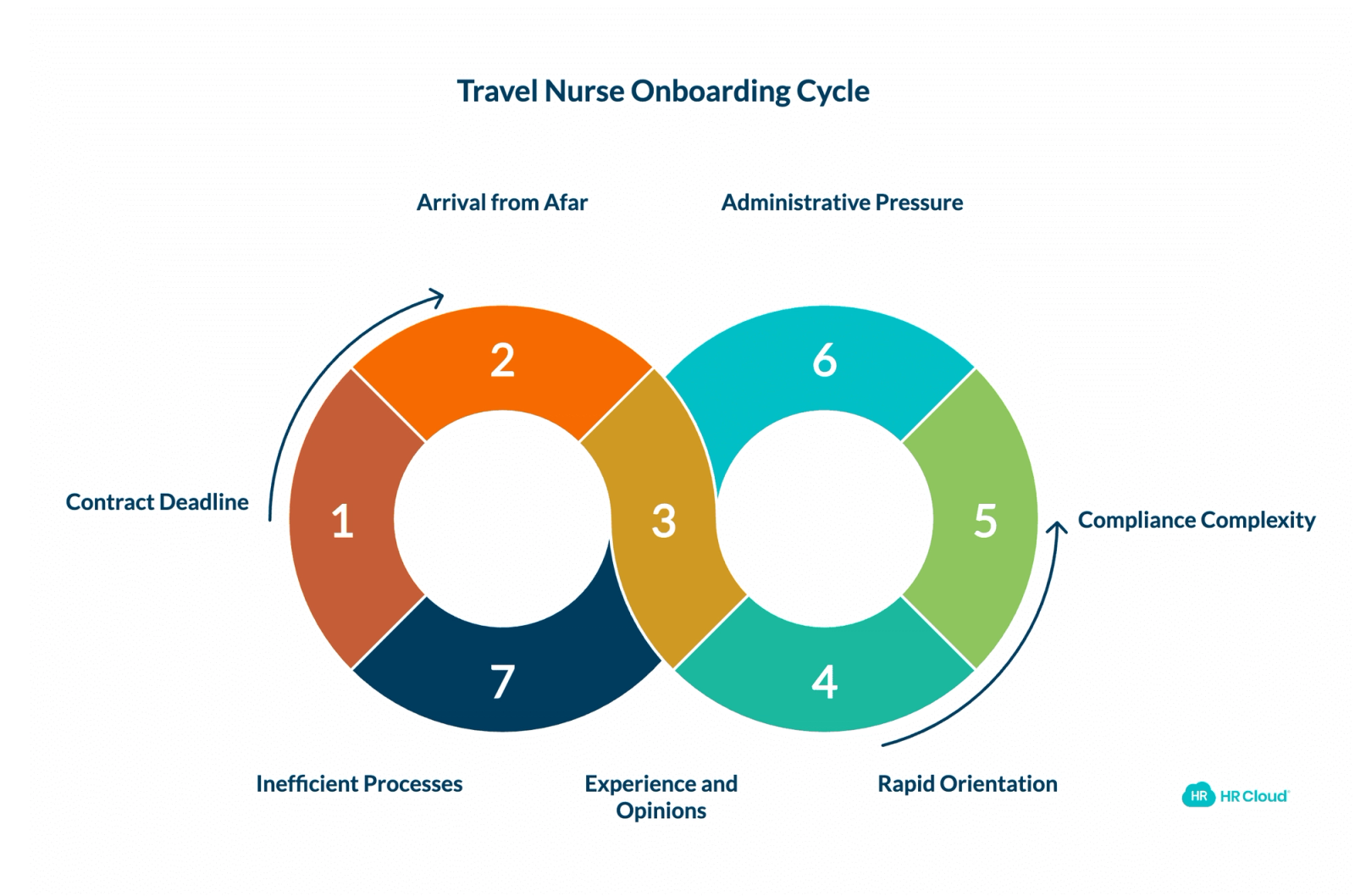
Onboarding a permanent hire and onboarding a travel nurse are structurally different challenges. Both require compliance. Both need credentials verified. But a travel nurse has a contract deadline, not a vague start date. She may be arriving from three states away. She may have done this 15 times before and has strong opinions about how cumbersome your process is compared to every other facility she's worked at.
Travel nurses typically take 13-week assignments at hospitals facing staffing gaps. Continuity of care concerns mean facilities need these nurses oriented and functional within days. There's no six-month runway to get someone settled.
Add to that the compliance complexity. Credentialing involves verifying licenses, certifications, work experience, and health requirements like immunizations, with requirements varying significantly across facilities and states. As of January 2025, 43 jurisdictions have enacted Nurse Licensure Compact (NLC) legislation, which helps with multi-state licensing — but every facility still runs its own credentialing process.
Every facility has its own checklist. Some have online orientation modules that take hours to complete. Others require physical copies of documents on the first day even after digital submissions. For HR teams managing 20, 50, or 100 travel nurse placements at once, this creates real administrative pressure.
Research has found that new employees must complete an average of 54 onboarding activities, including 41 administrative tasks, for each new hire. If you're onboarding 50 travel nurses a month, that's over 2,000 administrative tasks your team is tracking per month.
That math doesn't work on paper-based or email-driven processes.
Start Before Day 1: Pre-Boarding That Actually Works
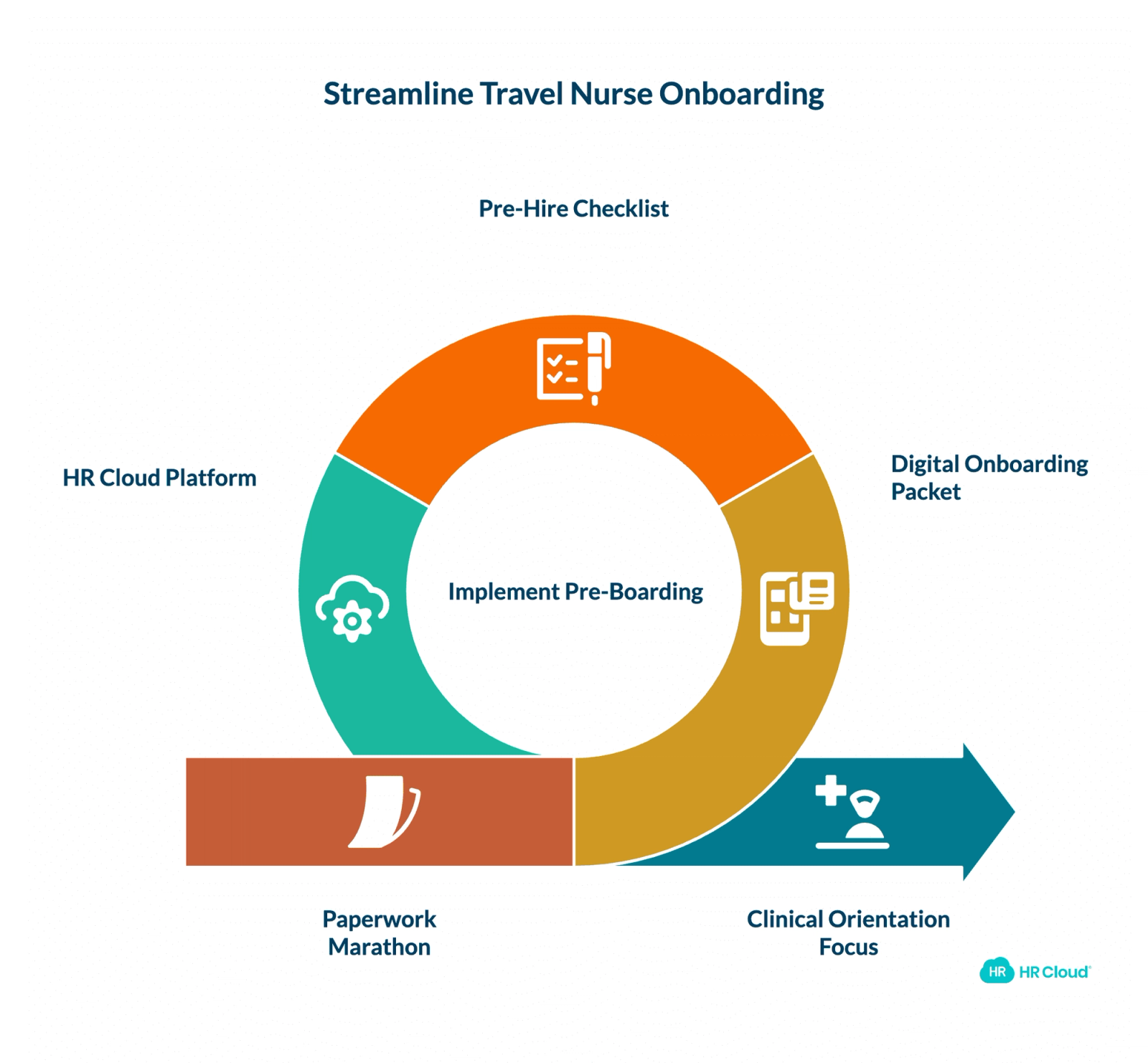
The most practical shift in travel nurse onboarding is moving credential collection and compliance forms out of orientation and into pre-boarding: the period between offer acceptance and the start date.
This isn't radical. It's just organized.
When a travel nurse accepts your offer, she should receive a digital onboarding packet she can complete on her phone, at whatever hour she has time. Her license upload, immunization documents, I-9 Section 1, W-4, and any facility-specific forms can all be collected digitally before she sets foot in your building.
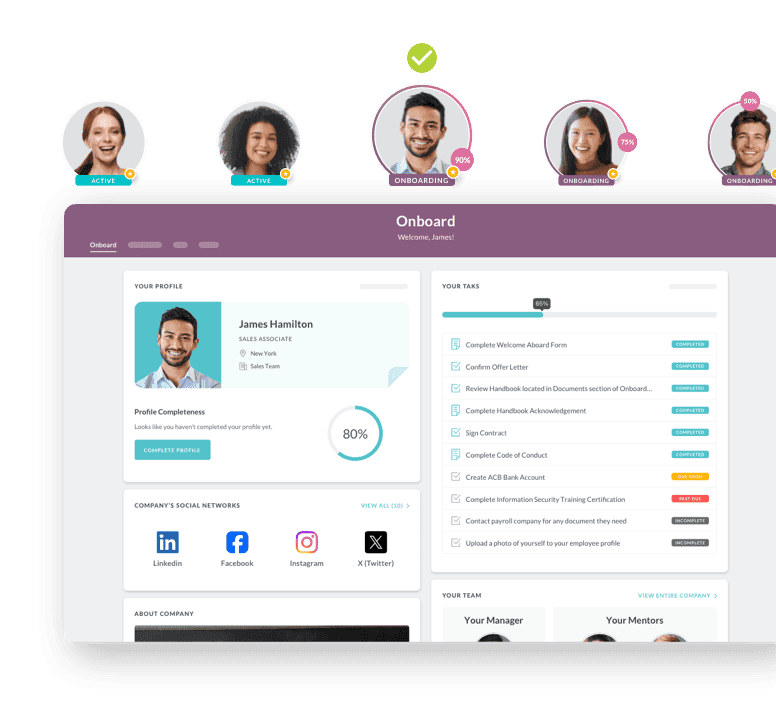
HR Cloud allows HR admins to trigger a pre-hire checklist as soon as an employee is added to the system. The nurse gets her tasks automatically. She can complete them from her phone: uploading documents by photographing them, signing forms with her finger, and watching required training videos directly in the app.
Nurses can finish tasks during breaks, while commuting, or from home. That reduces the paperwork marathon that typically consumes the first hours of orientation day.
The result: Day 1 is about clinical orientation, floor introductions, and EHR walkthrough. Not chasing a stack of forms.
Ready to start pre-boarding travel nurses before their first shift? See how HR Cloud's onboarding platform works for healthcare teams.
The Credentialing Bottleneck
Credentialing is where travel nurse onboarding most commonly breaks down. Not because HR teams don't care, but because the process relies too heavily on manual follow-up, email chains, and memory.
A license expires quietly. A TB test falls outside the facility's accepted 12-month window. A background check hasn't cleared, and nobody realizes it until Monday morning when the nurse is scheduled for a 7 a.m. shift.
One missed expiration date or incomplete verification can cause compliance issues or legal exposure. According to the RN Recruitment Difficulty Index, hospitals take an average of 62 to 103 days to recruit an experienced registered nurse depending on specialty. Manual credentialing processes are a major contributor to those delays, and they give you no early warning system.
The fix isn't hiring a credentialing coordinator (though that helps). It's automating the tracking and reminders so nothing slips through by default.
HR Cloud's checklist-based onboarding uses document request tasks: the nurse uploads credentials directly to her profile, where HR can review and manage them from a single location.HR can configure upcoming and overdue alerts so the system sends reminders before deadlines, not after. Admins set the timing and escalation logic — for example, notifying the nurse when a document is approaching its due date, then flagging the HR admin if it remains outstanding.
For I-9 completion, HR Cloud has integrated E-Verify functionality. Once a nurse completes Section 1, the HR admin completes Section 2 and submits the case to E-Verify directly from within the platform. All past and pending cases are tracked in the E-Verify tab within the Onboard application, creating a complete audit trail.
The I-9 form has a time-sensitivity that matters specifically for travel nurses: if Section 1 isn't completed on the start date, or Section 2 isn't completed within three business days, the form locks. HR Cloud's I-9 unlock feature allows admins to reopen a locked form. Speak with your account team on the specific resend workflow for your configuration — a small but useful capability when schedules shift and start dates move.
Need a complete compliance workflow for travel and per diem nursing staff? HR Cloud's I-9 and E-Verify tools are built for high-volume healthcare hiring.
Chained Tasks: Getting the Order Right
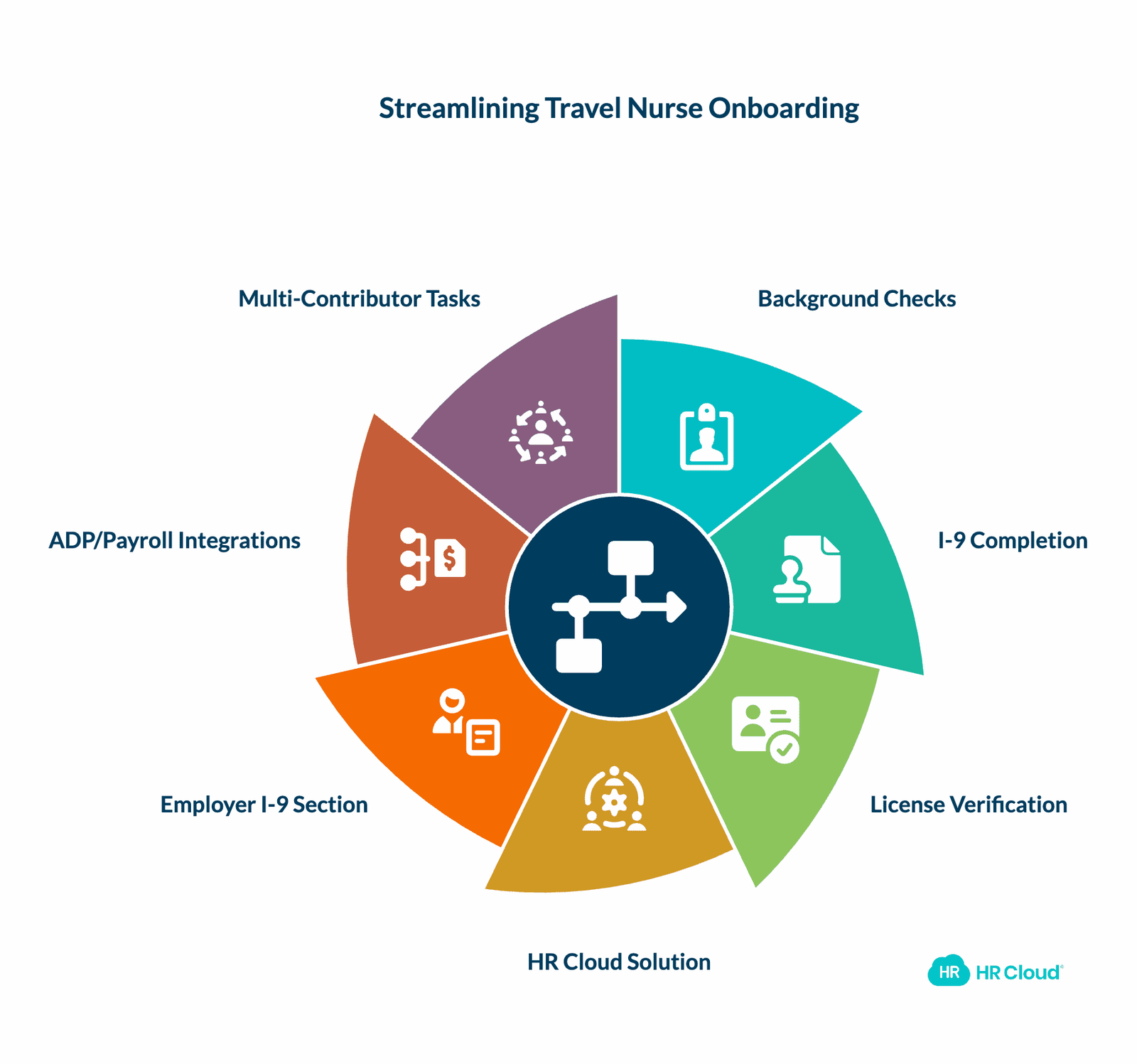
Travel nurse onboarding has dependencies. Background checks need to clear before system access is provisioned. Section 1 of the I-9 needs to be completed before Section 2 can happen. License verification needs to be confirmed before clinical orientation can begin.
When these steps are tracked through email or a shared spreadsheet, the sequencing gets murky fast. Someone provisions access before the background check clears. A nurse shows up for orientation before her license has been verified. These aren't hypothetical failures. They're common ones.
HR Cloud's chained tasks address this. A chained task is a multi-step task where steps are locked in sequence. A nurse or HR admin can't complete Step 2 until Step 1 is done. No ambiguity. No workaround. The system enforces the order.
This is useful for the employer section of the I-9, for ADP or payroll integrations that require employment information before they can be triggered, and for any multi-contributor task where HR, the nurse, and a manager all have distinct roles in completing a single process.
Bulk Onboarding: When You're Managing Volume
Some healthcare facilities onboard one or two travel nurses at a time. Others are managing dozens of 13-week contract turnovers at once. For the latter, setting up each nurse's onboarding individually doesn't scale.
HR Cloud supports bulk onboarding. HR admins can select multiple employees in the People tab of the Onboard app and trigger the onboarding process for all of them at once — for employees whose onboarding hasn't yet been initiated. One action, not fifty.
Checklists can be configured with assignment rules so the right tasks automatically go to the right people based on position, department, and location. A travel ICU nurse gets a different checklist than a travel med-surg nurse, without HR having to manually configure each profile. Everything runs off pre-built templates.
Managing a high volume of travel nurse contracts? See how HR Cloud handles bulk healthcare onboarding.
What a Travel Nurse Onboarding Checklist Should Actually Include
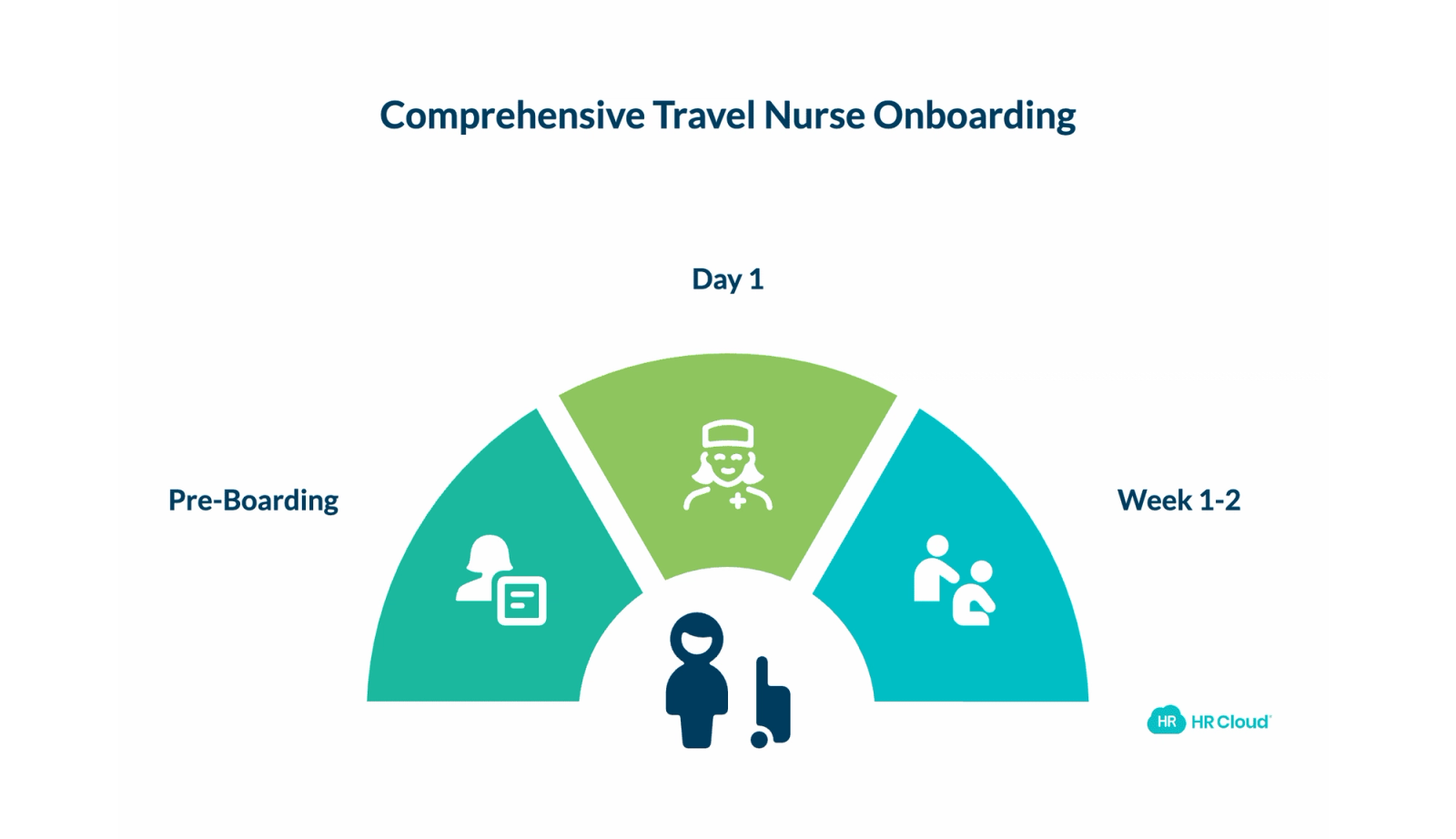
Most travel nurse onboarding checklists focus on compliance: licenses, credentials, forms. That part is necessary. But an efficient checklist also covers the practical and human elements that determine whether a nurse actually functions well in her first week.
Before the Start Date
- Offer letter sent and signed, triggering background check and credential collection
- I-9 Section 1 completed digitally (via the I-9 onboarding checklist)
- License and certification upload (state license, BLS, ACLS if applicable, specialty certifications)
- Immunization records uploaded (Hepatitis B, TB test with current date, MMR, Varicella, flu)
- Drug screening scheduled and completed
- Background check initiated and cleared via Checkr integration
- Direct deposit and W-4 forms completed
- Facility-specific online orientation modules assigned and tracked
- System access and badge provisioned (after background check clears)
- Unit-specific welcome message sent with floor layout, parking information, and who to contact on Day 1
Day 1
- I-9 Section 2 completed by employer (or authorized representative)
- E-Verify case submitted if applicable
- EHR training walkthrough
- Introduction to charge nurse and unit team
- Emergency protocols reviewed
- Unit-specific workflows covered (actual clinical workflows, not the corporate history lecture)
Week 1–2
- 30-day check-in scheduled
- Preceptor or buddy assigned for first week
- Competency assessments completed per facility requirements
- Any outstanding compliance items resolved
This isn't an exhaustive list. Every facility has additional requirements. But the structure matters. Pre-boarding handles the administrative layer so Day 1 is clinically focused.
The Mobile-First Reality
Travel nurses don't sit at desks. They're on their feet for 12-hour shifts, often finishing one assignment on a Friday and starting at your facility the following Monday. They're completing onboarding paperwork from hotel rooms, airports, and car seats.
70–80% of healthcare workers are deskless, yet most healthcare onboarding systems were built for people who sit at desks. That's the mismatch. For travel nurses specifically, it's acute. Their entire working life is mobile.
If your onboarding portal doesn't work cleanly on a phone, you're creating friction at the worst possible time. A nurse who can't upload her documents on mobile will either delay, find a workaround, or decide your facility is disorganized. None of those outcomes help you.
HR Cloud's onboarding portal for nurses works on mobile devices. Document uploads, form completion, e-signatures, and video tasks all work on a phone. The system sends task notifications that link directly to the action needed, so there's no hunting around for where to submit something.
Reducing HR Burden Without Dropping Standards
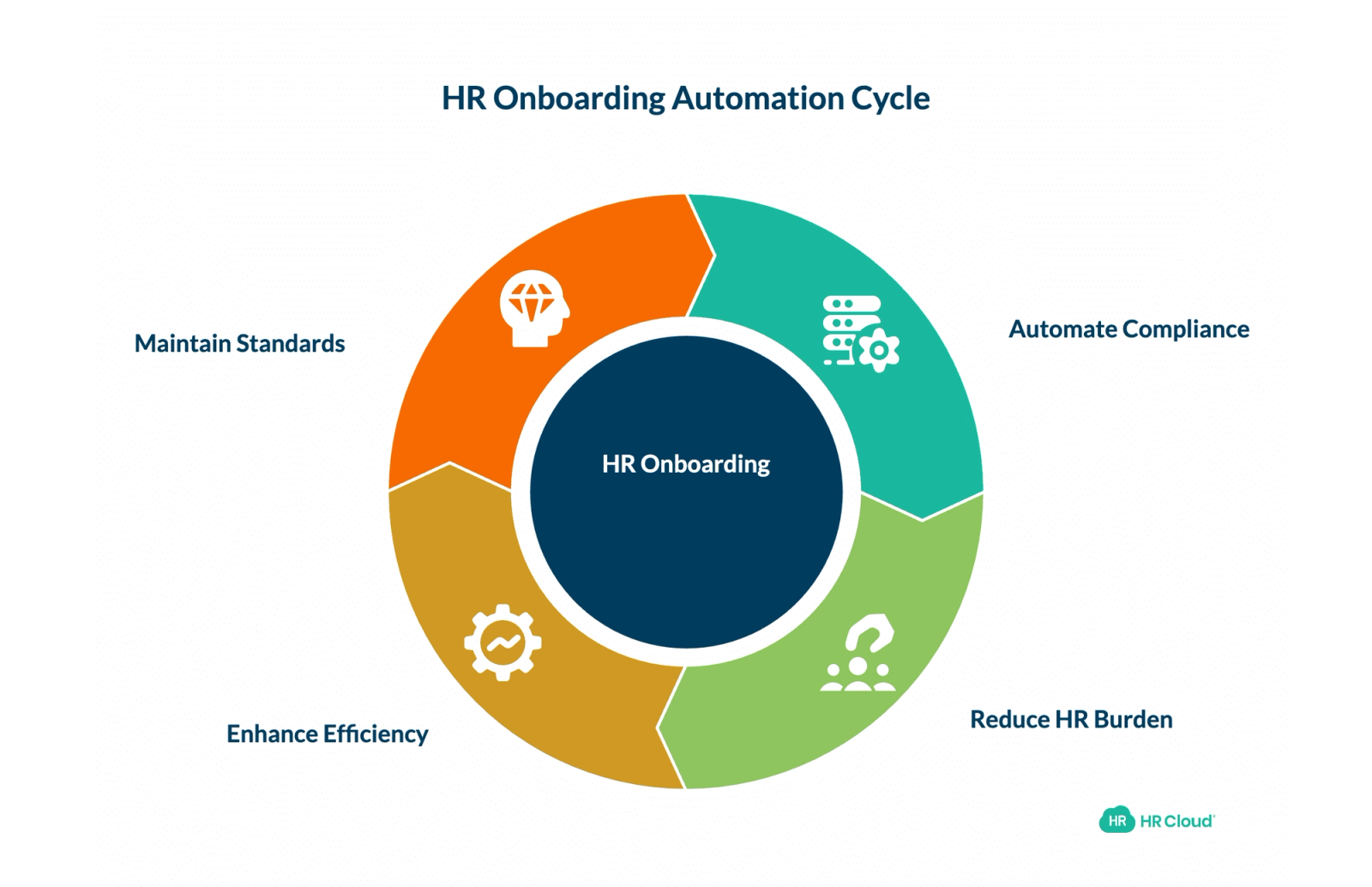
There's a version of "efficient onboarding" that just means doing less. That's not what this is about. Every compliance requirement covered earlier in this article — the I-9, E-Verify, background checks, credentialing — still applies. None of it is optional because a contract is short.
What automation does is take the follow-up burden off HR. Instead of an HR admin manually emailing nurses to remind them about missing documents, the system does it. Instead of checking a spreadsheet every morning to see what's outstanding, the HR admin gets a view showing exactly where every nurse is in her onboarding checklist.
HR Cloud Onboard supports bulk onboarding, chained tasks, I-9/E-Verify, and customizable portals by role and location. Healthcare organizations can automate compliance workflows while building role-specific experiences for travel nurses, PRN staff, and permanent hires within the same system.
The HR team still oversees everything. They still complete Section 2 of the I-9. They still review uploaded credentials. But they're not chasing paper. They're managing exceptions.
That's a fundamentally different job. And a more sustainable one.
Summary: What Efficient Travel Nurse Onboarding Requires
| Element | What It Looks Like in Practice |
|---|---|
| Pre-boarding | Digital packets sent immediately after offer acceptance |
| Credential collection | Document request tasks with automated due dates and reminders |
| I-9 and E-Verify | Integrated into onboarding checklist, completed pre-start |
| Task sequencing | Chained tasks enforce the right order |
| Bulk processing | One-click onboarding initiation for multiple nurses |
| Mobile access | Full onboarding available on smartphone |
| Notifications | Automated upcoming and overdue alerts, not manual follow-up |
| Role-specific workflows | Travel nurses get a different checklist than permanent hires |

Discover how our HR solutions streamline onboarding, boost employee engagement, and simplify HR management
Book Your Free DemoFrequently Asked Questions
How early should travel nurse onboarding start?
As soon as the offer is signed. Most of the credentialing and compliance work (license uploads, immunizations, background checks, I-9 Section 1) can and should be completed before the start date. Waiting until Day 1 creates unnecessary pressure for both the nurse and the HR team. See the full travel nurse onboarding checklist framework for a pre-boarding timeline.
What documents does a travel nurse need to submit during onboarding?
Typically: state nursing license, BLS certification, specialty certifications (ACLS, PALS, etc.), immunization records (TB, Hep B titers, MMR, Varicella, flu), a completed I-9, W-4, direct deposit form, and any facility-specific compliance documentation. Requirements vary by facility, specialty, and state. The I-9 onboarding checklist covers the federal compliance layer in detail.
What happens if a travel nurse's I-9 isn't completed on time?
The I-9 locks if Section 1 isn't completed on the start date or if Section 2 isn't completed within three business days. HR can unlock the form through the onboarding platform and resend access to the nurse without restarting the process. Learn more about I-9 compliance in healthcare.
How do chained tasks help with travel nurse onboarding?
Chained tasks enforce sequential completion. A nurse or HR admin can't move to the next step until the previous one is done. This prevents situations like system access being provisioned before a background check clears, or orientation starting before license verification is complete.
Can the same onboarding system handle both travel nurses and permanent staff?
Yes. HR Cloud allows different checklists and onboarding portals to be configured by employment type, position, department, and location. Travel nurses and permanent hires run through entirely different workflows within the same system, each seeing only what's relevant to them.
What's the biggest reason travel nurse start dates get delayed?
Incomplete credentialing. A missing immunization record, an expired TB test, an unverified license, or an incomplete I-9 can push a start date back, sometimes by weeks. Automated reminders and pre-boarding checklists address this by surfacing gaps well before the deadline. Read more on credential tracking software for healthcare.
How does travel nurse onboarding differ from standard nurse onboarding?
The primary difference is timeline urgency. A permanent hire has weeks or months of onboarding runway. A travel nurse has 13 weeks total, and her assignment can't start until she's fully credentialed. That compresses everything. Pre-boarding, automated reminders, and role-specific checklists are more critical for travel staff than for any other hire type. For a broader comparison, see HR Cloud's nurse onboarding checklist for hospitals.
Managing travel nurse onboarding at scale? HR Cloud's onboarding platform helps healthcare organizations automate compliance workflows, reduce credentialing delays, and get travel nurses shift-ready before their first day. Book a free demo to see it in action.
About the author

Keep Reading


Like What You Hear?
We’d love to chat with you more about how HR Cloud® can support your business’s HR needs.
Book Your Free Demo