Best Ashby Alternatives in 2026: Compare Features, Pricing & HR Capabilities

The best Ashby alternatives in 2026 depend on which problem you are trying to fix. If you want another recruiting-first platform with similar depth, compare Greenhouse and Lever. If you want hiring, onboarding and HR records in one system, compare HR Cloud, BambooHR and HiBob. If you want published entry prices and a free trial, look at Workable.
Ashby is an all-in-one recruiting platform. Its pricing page describes a product that combines sourcing, outreach, applicant tracking, analytics and scheduling automation. Dover's 2026 review puts its best fit at growth-stage teams of 50 to 1,000 employees with at least one dedicated recruiter. It is a strong product, and this guide does not try to talk you out of it.
The useful divide is not standalone ATS versus HR suite. It is recruiting optimization versus workforce readiness. Ashby is built to make recruiting operations better. For many employers, the harder problem starts after a candidate says yes: documents to collect, an I-9 to complete, site or credential requirements to clear, managers to prompt and payroll to set up, often for people who live on a phone rather than at a desk. That is where companies begin to look for an Ashby alternative, and where the search for ATS alternatives usually turns into a search for something that reaches past the offer.
HR Cloud is one of the seven options below, and it is our product, so weigh our view accordingly. HR Cloud is a modular HR platform with a Recruit ATS, onboarding, an HRIS, performance, time tools and employee engagement, built for frontline-heavy teams that keep the payroll provider they already run. We will say plainly where Ashby is the stronger recruiting tool. Product claims in this guide link to the vendor's own page or to a labeled third-party source, so you can check us.
What Is Ashby?
Ashby is a recruiting platform aimed at high-growth companies. Dover describes it as an applicant tracking system built for engineering-led startups and scale-ups. The sections below walk through what Ashby's own pages say each part does, so you can see what you would be replacing or keeping.
ATS
Ashby's plan comparison on its pricing page lists a full applicant tracking workflow: customizable interview plans and structured interviewing, candidate reviews, bulk actions, auto-reject rules, offers with e-signature, approval workflows, EEOC and diversity surveys, and fraudulent candidate detection. Dover adds scorecards, stage-level feedback forms and a careers page builder.
Ashby also offers AI-Assisted Application Review, where a team defines criteria for a job and AI analyzes inbound applications against them. Ashby is careful about the limits of that feature. Its AI page says the AI never ranks or gives numerical ratings to applicants, that a human must always be involved in decision-making, that PII is redacted from resumes sent to AI models, and that Ashby does not train models on customer data. The same page says Ashby partnered with a third-party auditor, FairNow, on a bias audit, and that it conducted a bias audit meeting the requirements of New York City's Local Law 144 while not considering its tooling an automated employment decision tool under that law's definition. Those are Ashby's statements, not independent findings, but they matter to employers subject to automated-hiring rules.
CRM
The CRM and sourcing layer is a core part of Ashby's design. The pricing page lists multi-touch, multi-channel outreach sequences, a sourcing Chrome extension, sourcing projects that organize prospects into talent pools, AI candidate search, AI outreach personalization, reply tracking and AI talent rediscovery. Foundations includes 200 sourcing email lookups, and extra lookups are a paid add-on.
Ashby's AI page says customers see a lift of roughly 46% in reply rate from outreach campaigns that use AI personalization, and cites its own Talent Trend Reports as the source. That is a vendor figure, not an independent benchmark. The practical question for a buyer is whether you source proactively at all. A talent acquisition team that builds pipelines before roles open gets real value from sourcing, outreach and applicant data in one system. A two-person HR team that fills recurring hourly openings from inbound applicants will use much less of it.
Scheduling
Ashby's plan comparison lists direct booking links, candidate availability links, visual scheduling, interviewer limits, reminders and automatic Slack channels per candidate. Heavier automation, including the AI auto-scheduler, scheduling requests, calendar holds and automated interviewer training, sits behind an Advanced Scheduling add-on on Plus and is included in Enterprise. Ashby's own AI page notes the auto-scheduler is part of the add-on or included in Enterprise.
Plan for setup time as well. Dover says the scheduling section alone involves considerable configuration across multiple settings layers.
Recruiting Analytics
Analytics is the reason many teams choose Ashby. The pricing page lists pre-built core and job dashboards, a report template library, drilldowns, AI report interpretations, an AI-assisted report builder, alerts, an interactive recruiting planner and full-funnel diversity reporting, with custom dashboards, scheduled delivery and calculated fields listed as unlimited on Plus and Enterprise. Ashby also sells Ashby Analytics on its own for organizations with 100 or more employees that keep an existing ATS, priced on usage.
Dover says Ashby's analytics lead the category and adds that full value requires recruiting-ops expertise to set up. If funnel conversion, source effectiveness and time-to-fill drive your weekly leadership review, Ashby is built for that job. HR Cloud does not claim to match this depth, and the comparison later in this guide says so directly.
AI Recruiting Capabilities
Ashby's AI page describes AI across the recruiting workflow. The list from that page and the pricing page includes:
AI-Assisted Application Review, described above.
AI Candidate Assistant, which answers questions about a candidate from resumes, notes, emails, feedback and interview transcripts.
AI Content Assistant, which drafts job descriptions, email templates, candidate emails and sequences.
AI Talent Rediscovery, which surfaces past candidates who fit an open role.
AI Notetaker, which records, transcribes and summarizes interviews. The pricing page lists it as a paid add-on on every plan.
Ashby Assistant and custom agents, which answer questions and take actions across pipelines, candidates and jobs, plus an MCP server that connects tools such as Claude and ChatGPT to Ashby data.
Ashby's documentation says most AI features are free to use without limit, but three consume AI credits: AI-assisted application review, candidate fraud detection and AI talent rediscovery. Foundations includes 1,500 credits per month. Extra credits cost $100 per 1,000 on month-to-month Foundations plans and $500 per 5,000 on annual plans, and credits do not roll over to the next contract year. Ask Ashby how many credits your applicant volume will use.
Pricing Model
Ashby pricing is partly public. The pricing page lists three all-in-one plans. Foundations covers up to 100 employees, loads at $400 per month, offers monthly and yearly payment terms and lists a 10% discount for annual commitments. Plus is described as best for 101 to 1,000 employees, with pricing based on company size, usage and commitment. Enterprise is for 1,000 or more employees and uses a predictable pricing model. Ashby Analytics for an existing ATS is listed separately.
The $400 headline in Ashby pricing may not be your price. The Foundations calculator on that page lets you pick a company size band of 1 to 10, 11 to 25, 26 to 50, 51 to 75 or 76 to 100 employees, and one third-party index reports the five band prices as $300, $400, $500, $700 and $900 per month. Treat those band prices as third-party until you have a quote.
The plan comparison shows where add-ons sit. On Foundations, candidate texting includes 1,000 outbound messages per month with extra messages at $90 per 1,000, and SSO is listed at $100 per month. AI Notetaker is a paid add-on everywhere. Advanced Scheduling is a paid add-on on Plus.
Ashby prices on company size rather than recruiter seats. Truffle's pricing review says a 250-person company with three recruiters pays for 250 employees, and that the per-employee model can produce mid-contract true-ups as headcount grows. On real contract values, Dover cites Vendr data across 59 deals at an average of $22,048 per year and SpendHound data from 160 customers at about $17,909 for SMBs and $64,688 for enterprises. Buyer data varies widely, so use those figures as ranges and request a written quote at your headcount.
Why Companies Look for Ashby Alternatives
The reasons buyers consider Ashby competitors usually sit around the recruiting tools, or in cost as headcount grows. Five come up most often.
A Recruiting-Centric Platform
Ashby is designed around the hiring funnel, which is why its analytics and sourcing run deep. It also means its core scope is recruiting. Ashby's plan comparison covers offers and e-signatures, but it does not list employee onboarding, core HR records or payroll, so those jobs typically move into another system once a candidate is hired.
That handoff is easy to underestimate. A candidate marked "Hired" is not ready for a first shift. Someone still has to collect documents, confirm site-specific requirements, know what is missing, move the right data into payroll, chase the manager and reach an employee who may never check a corporate inbox. If your HR team spends more time on that work than on sourcing, a recruiting-centric platform covers the smaller half of your workload. Dover's review notes that Ashby's depth assumes staff who own recruiting operations, which is a different team from a two- or three-person HR group that also runs benefits questions and time off.
Limited Broader HR Functionality
Ashby's listed capabilities are sourcing and CRM, ATS, scheduling, offers, reporting and integrations. Core HR records, time off, performance reviews, time tracking and employee communication are not in the plan comparison. Ashby connects to other systems for those functions. Its pricing page lists a 250+ integration marketplace and a two-way Workday integration, Dover lists Workday and BambooHR, and a third-party index adds Rippling, Gusto and Deel.
Integration is a legitimate architecture. It does mean you maintain a second vendor relationship, a second admin console and a second data model for anyone who moves from candidate to employee. Teams that want one login and one employee record look for Ashby alternatives that include those functions.
No Native Payroll
Ashby's plan comparison does not include payroll. That is a category boundary, not a flaw. The real question is whether the alternative you pick works with the payroll provider you already run.
That question decides many purchases. Companies on ADP, UKG, Paylocity or Paycor usually do not want to change payroll to change their ATS. HR Cloud's help center documents integrations with ADP Workforce Now, TotalSource, RUN and Vantage, plus UKG, Paylocity, Paycor, Dayforce, SAP and QuickBooks Online. HR Cloud describes its ADP integration as one where data transfers into ADP Workforce Now after HR approval, so ADP stays the system of record. Payroll stays where it is.
Need for Onboarding and Employee Experience
The stretch between a signed offer and a productive first day is where hiring data often gets retyped. Federal forms, company documents, equipment requests, role-specific compliance tasks and manager check-ins all sit between the ATS and the HRIS.
For frontline employers the stakes are higher. HR Cloud's homepage describes construction crews moving from accepted offer to site-ready without a desk or company email, and field technicians receiving mobile forms, safety tasks and reminders without a company email address. An onboarding flow built for that reality is a different product from a candidate pipeline built for knowledge-worker hiring.
Companies Wanting One HR Platform Instead of Recruiting-Only Infrastructure
The final reason is consolidation. Some companies would rather buy one platform for recruiting, onboarding, HR records, performance, time off and engagement than assemble five tools with integrations between them. That trades some depth in each area for a single record, a single support relationship and a single contract.
It is a fair trade for some companies and a poor one for others. Recruiting-first teams with dedicated staff and analytics needs give up the most by consolidating. HR teams where recruiting is one duty among many give up the least. The rest of this guide helps you decide which company you are.
7 Best Ashby Alternatives
The seven options below are recruiting software alternatives to Ashby. Greenhouse and Lever are closest to Ashby's recruiting-first design, Workable is the free-trial option with published entry prices, and HR Cloud, BambooHR and HiBob put recruiting inside a broader HR platform. SmartRecruiters is the enterprise option, and the last entry also covers JazzHR for very small teams. Feature and current-price claims link to each vendor's own pages. Where a vendor does not publish a price, the figure is labeled as buyer-reported and linked to its source. Software pricing changes often, so confirm any number with the vendor before you budget.
HR Cloud
HR Cloud is where the workforce-readiness argument gets concrete. Its Recruit ATS page lists branded job boards with screening questions, applicant records that keep messages, notes, files and status together, custom hiring stages with owners and deadlines, interview scheduling with Teams or Zoom links, and offer letter templates. HR Cloud's help center documents the same workflow, including SMS templates for applicants, offer letters, applicant tasks and an applicant portal.
Recruit also includes AI and video features. AI job descriptions draft a posting from a role and requirements for a recruiter to edit. Asynchronous video interviews let candidates record answers on their own time, with AI-generated transcripts beside the video. QR code job ads turn a posting into a scannable image for storefront windows, flyers and break-room boards. On the candidate side, HR Cloud's AI Applicant Assistant lives in the applicant portal, lets candidates check status, see pending tasks and ask recruitment questions, answers from recruitment documents an admin uploads, and keeps conversations for up to 30 days. HR Cloud's AI Hiring Agent post adds a My Applications view that shows candidates where they stand.
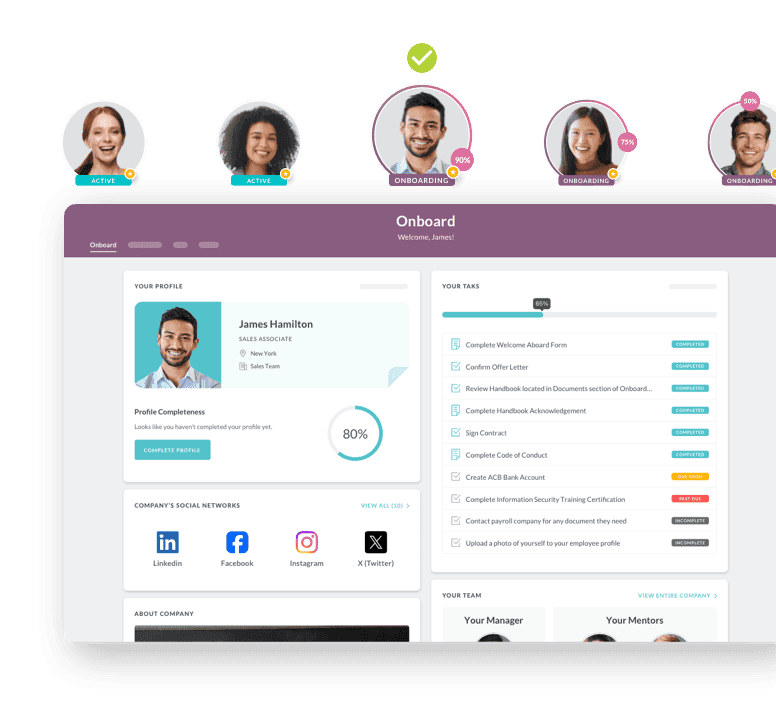
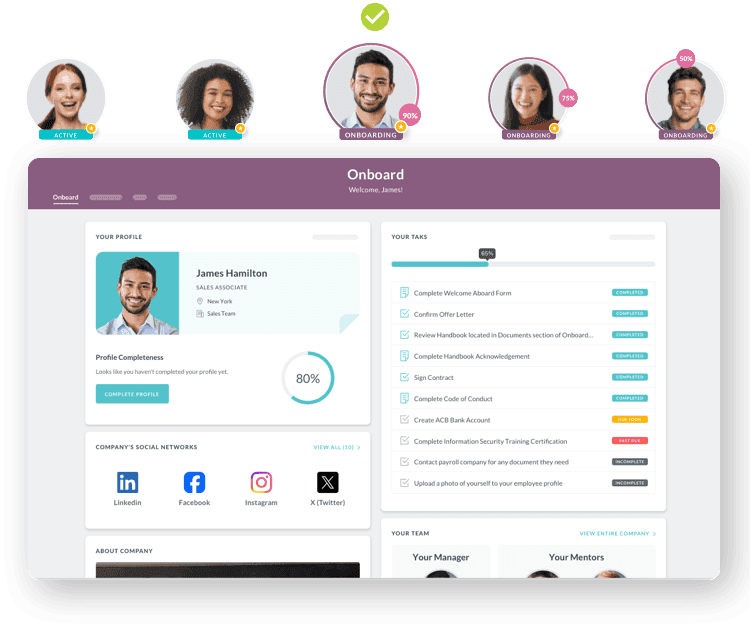
The difference from Ashby shows up after the offer. Per the ATS page, Recruit and Onboard share a single database, so an accepted candidate moves into Onboard, which assigns forms, I-9 and W-4 requirements, tasks, approvals and reminders. HR Cloud's Maya onboarding agent delivers those steps by text message, with no portal login. HR Cloud says SMS-based onboarding sees 89% task completion versus 52% for portal-based onboarding. That is a vendor figure, but it explains the design: reach people on the phone they already carry. The HRIS, performance, time off, time clock, shift planning and Workmates engagement modules sit on the same platform.
HR Cloud does not run payroll. It connects to the provider you already use, and its integration directory lists more than 180 integrations. HR Cloud is a Platinum ADP Marketplace Partner, per its homepage.
Where HR Cloud is weaker than Ashby: recruiting depth. Ashby's sourcing sequences, AI application review, interview notetaker and custom analytics go well beyond what Recruit offers. HR Cloud's help center documents two recruiting reports, an applicant pipeline report and an applicant source report, both filterable and exportable to CSV. That is not a custom report builder. If hiring is your main competitive lever, the gap is real.
HR Cloud publishes package prices for companies under 250 employees. Its small-business pricing page lists Professional HR, the package that includes applicant tracking, at $595 per month for up to 50 employees, $995 for 51 to 100 and $1,495 for 101 to 250, with annual billing saving 20%. Beyond 250 employees, its main pricing page describes a fixed annual license quoted to your organization, with no per-seat fees and a 12-month minimum term. There, Recruit sits in the HR Suite, and Employee Engagement, Assets and Time Clock are add-ons. It suits frontline-heavy employers on ADP, UKG or a similar payroll provider with a small HR team.
Greenhouse
Greenhouse is the long-standing structured-hiring platform. Its pricing page shows Core includes Sourcing & CRM, structured interview kits and scorecards, an AI Notetaker, scheduling, reporting and analytics, SSO and talent matching. Plus adds AI report filters, a BI connector, sourcing automation, texting and fraud and spam detection. Pro adds unlimited CRM events, an audit log, a developer sandbox and enterprise-level data configuration and security.
Greenhouse does not publish prices. Its page says pricing is customized to your hiring needs, so the numbers you will see elsewhere are buyer-reported. Pin's 2026 analysis cites buyer data ranging from $5,100 to $70,000 or more per year with a $12,250 median, and reports that renewal increases of 8% to 15% are typical, citing Vendr. Pin sells competing recruiting software, so use its figures as a reference range, then ask Greenhouse for a cap in writing.
Against Ashby, Greenhouse leans toward structured process and governance for large hiring operations. If you are leaving Ashby over cost, Greenhouse may not save money. If you are leaving because you want a long-established structured-hiring standard, it is the nearest comparison. Dover associates it with companies of roughly 250 or more employees.
Lever
Lever's own site describes LeverTRM as ATS and CRM in one platform, with analytics, and its UKG Marketplace listing says Lever is part of Employ, alongside JazzHR and Jobvite. That ATS-plus-CRM design overlaps most directly with Ashby's sourcing layer, and it appeals to teams that nurture candidates over long cycles. The ADP Marketplace listing notes a connector that syncs new hire data from Lever to ADP Workforce Now.
Lever does not publish prices either. Pin, citing AvaHR data from 2025, lists Advanced Analytics at $9,000 to $16,000 per year for a 500-person company and an EU data center add-on at $3,000 to $5,000. Those are reported figures to confirm in a quote. The lesson holds either way: compare total cost against the analytics and scheduling you need, not the base plan, because Ashby's all-in-one plans bundle more of that up front.
Workable
Workable is the free-trial option with published entry prices. Its pricing page lists Standard at $299 per month ($3,588 per year), Premier at $599 ($7,188 per year) and Enterprise at $719 ($8,628 per year) for the 1 to 20 employee band, and advertises a 20% saving for annual billing. Treegarden, which sells a competing ATS, reads those figures as annual-billing rates, so confirm the monthly price for your band. It lists nine employee bands up to 1,000 or more, but shows dollar figures only for the first, so larger teams need a quote.
On Standard, Texting+ is $89 per month, Video interviews+ is $109 and Assessments+ is $59, and Premier and Enterprise include them. Workable sells Recruiting and HR packages, and its HR side lists an HR information system, employee onboarding, time off, time tracking and payroll preparation. The page also lists a 15-day free trial. Workable's help center says pricing is tailored to the number of employees, so confirm your band. It shows a number before you talk to sales at the smallest size, and it does not match Ashby's analytics depth. Dover says the same of lighter alternatives, in its Ashby review.
BambooHR
BambooHR reverses Ashby's order: HR first, hiring inside it. BambooHR's applicant tracking page describes job posting to boards such as Indeed and ZipRecruiter, candidate tracking, automated candidate emails, custom permissions, 150+ integrations and customizable new-hire packets that carry a hire into onboarding. Its homepage says pricing varies by number of employees and the features you select, and it does not publish a price list.
On payroll, BambooHR's payroll page says BambooHR Payroll is designed to pay US-based employees, with local payroll integrations, global payroll partners or an Employer of Record option outside the US. HR Cloud makes the same point in its own BambooHR alternatives guide, where you can also see how it compares side by side.
If hiring volume is modest and HR administration is the bigger job, that order can make sense. It is a US-leaning fit for companies that hire a few roles at a time and want core HR and recruiting together.
HiBob
Some comparisons still describe HiBob as needing a separate ATS. It has a native one. It launched Bob Hiring on April 16, 2024, and its current hiring page calls it an all-in-one AI-powered ATS. That page lists customizable hiring pipelines, AI-powered CV matching, AI-generated evaluation scorecards, candidate self-scheduling, AI-generated job descriptions, access to more than 2,300 job boards, a branded career page with built-in referrals, a candidate portal, real-time hiring dashboards, source effectiveness and time-to-hire monitors, and a hiring assistant.
So the honest comparison with Ashby is depth and orientation. HiBob's hiring module sits on the same platform as its HR data, workforce planning and onboarding, and its page says that connection is the point. Ashby's plan comparison lists more recruiting-specific tooling, such as outreach sequences, interview automation and custom dashboards, while HiBob's advantage is the shared employee record. HiBob's pricing page says pricing is customized to company size and modules and is generally per employee, so get a quote at your headcount.
HiBob suits mid-market companies that want hiring, HR and planning data in one system and are less focused on outbound sourcing.
Others Based on Target Market
SmartRecruiters is the seventh main option among these ATS alternatives, aimed at large employers. SAP completed its acquisition of SmartRecruiters on September 11, 2025, and says customers can keep using SmartRecruiters with SAP or other HCM systems while it integrates with SAP SuccessFactors. SmartRecruiters describes itself as an AI-powered hiring platform built for enterprises. Because ownership and licensing are in transition, ask for current terms in writing.
JazzHR is an additional option for very small teams. Its pricing page lists Hero at $1,000 per year with job postings starting at three per month, Plus at $3,480 per year with up to 200 active jobs, and Pro at $5,508 per year with offers and e-signatures and a custom reports builder. JazzHR is an Employ brand, alongside Lever, per its own plans page. Confirm current plans before you budget.
For a wider view of hiring tools that connect to onboarding, HR Cloud's list of the best employee onboarding software is a useful companion. Whatever you shortlist, ask each vendor for a written quote at your current headcount and at 30% growth. Ashby, Workable and others price on headcount, so growth changes the bill.
Ashby vs HR Cloud Feature Comparison Table:
The table below is an Ashby vs HR Cloud comparison across the eleven areas most buyers ask about. It reflects each vendor's own pages as of September 2026: Ashby's pricing page and AI page, and HR Cloud's Recruit page, Maya page and pricing page. Where a capability is not in a vendor's listed scope, the cell says so rather than implying a defect. Depth differs by row, so read each cell for how far the capability goes, not just whether it exists.
| Capability | Ashby | HR Cloud |
|---|---|---|
| ATS | Full ATS: interview plans, candidate reviews, auto-reject rules, offers with e-signature, approvals, fraud detection, AI-assisted application review. | Core ATS workflow: branded job boards, custom hiring stages, scheduling, offer letter templates, applicant portal. Less configurable than Ashby. |
| Recruiting | Deepest option in this comparison: sourcing sequences, Chrome extension, talent pools, AI search and rediscovery, AI Notetaker (add-on). | Job posting, AI job descriptions, async video interviews with AI transcripts, QR job ads, applicant SMS templates. Not equivalent to Ashby's sourcing CRM or custom analytics. |
| Onboarding | Not in Ashby's listed scope. Hired candidates pass to your HRIS or onboarding tool. | Onboard: forms, I-9 and W-4 tasks, approvals, reminders. Maya delivers steps by SMS. Recruit hands off through a shared database. |
| Core HR | Not in Ashby's listed scope. | People HRIS: records, directory, org chart, self-service. |
| Employee engagement | Not in Ashby's listed scope. | Workmates: recognition, rewards, surveys, polls, announcements (add-on). |
| Performance | Not in Ashby's listed scope. | Performance management and goal tracking. |
| Workforce management | Not in Ashby's listed scope. | Time Off, Time Clock (add-on), Shift Planner. |
| AI | Extensive recruiting AI: assistant and custom agents, MCP server, Notetaker, content assistant, application review, report builder. Three features use metered credits. | Recruiting and onboarding AI: job descriptions, video transcripts, applicant assistant, Maya on SMS. Narrower than Ashby in recruiting analytics and sourcing. |
| Integrations | 250+ marketplace integrations, two-way Workday, API access. | 180+ integrations, including ADP, UKG, Paylocity, Paycor, Slack, Microsoft 365 and other ATS tools, including Ashby. |
| Payroll integrations | No native payroll. Connects through HRIS and payroll integrations. | No native payroll. ADP Workforce Now, TotalSource, RUN and Vantage, plus UKG, Paylocity, Paycor, Dayforce, SAP and QuickBooks Online. |
| Pricing | Foundations listed at $400 per month by default, with five size bands. Plus and Enterprise quoted. Monthly or yearly terms. | Published packages up to 250 employees (Professional HR, with ATS, from $595 per month for up to 50). Above 250, a quoted fixed annual license with no per-seat fees. No self-serve free trial. |
Two notes on reading the table. First, an entry for HR Cloud in recruiting does not mean parity with Ashby on sourcing or analytics. It means the workflow exists and connects to the rest of the platform. Second, the pricing row compares models, not totals. A monthly plan for a 90-person company and a fixed annual license for a 900-person company are different purchases, and only a quote at your headcount gives a real comparison.
What the table shows in practice is a split. Ashby leads on recruiting operations: sourcing, analytics and interview tooling. HR Cloud is built for the work that starts after the offer is accepted: getting a new hire's paperwork, requirements and records complete, often over SMS on a personal phone, so the person is ready to work. Which side of that split holds more of your daily effort is the whole decision.
Which Companies Should Consider HR Cloud Instead of Ashby?
HR Cloud is a better fit than Ashby in specific situations and a worse fit in others. Use the profiles below to test yourself. If none of the first five describe your company, stay with Ashby or move to Greenhouse or Lever, the closest recruiting software alternatives to Ashby. Treat this Ashby vs HR Cloud section as a fit test, not a ranking.
Frontline and deskless employers. If most of your hires work in clinics, stores, restaurants, job sites or warehouses, the hiring process has a different shape. Volume is high, applicants often apply from a phone, and new hires may have no desk and no company email on day one. A recruiting workflow designed around recruiter desktops handles the first half of that well. The second half, getting a person ready to work, is a different operational problem.
Here is the sequence HR Cloud describes for that second half. A candidate accepts an offer in Recruit. Per the ATS page, the record moves into Onboard, which assigns forms, I-9 and W-4 requirements, tasks, approvals and reminders. Maya then walks the new hire through those steps by text message on a personal phone. HR sees completion progress on a dashboard instead of chasing people. After HR approval, the data transfers into ADP Workforce Now for employers on that system, and the ADP integration supports Workforce Now, TotalSource, Vantage and RUN. The point is that "hired" and "ready" are two separate states, and someone has to own the gap between them.
The industry pages show what that gap looks like in practice. On the Maya page, HR Cloud says healthcare employers use it to collect license and credential documentation by text before day one and to surface completion gaps to HR before the first shift. For manufacturing it lists OSHA safety acknowledgments, equipment and PPE sign-offs and emergency contact collection, delivered in the worker's preferred language. For retail and hospitality it lists I-9 collection, direct deposit setup, uniform policy acknowledgment and scheduling confirmations. HR Cloud's homepage describes the construction version as moving crews from accepted offer to site-ready on any phone before the start date, and the customer listing includes a Veolia case study on mobile-first onboarding for more than 10,000 field employees.
Interim HealthCare Sioux Falls used HR Cloud Onboard to replace paper employee files across three offices, and its case study reports 85% employee satisfaction with onboarding on its 2025 employee survey and easier state audits. HR Cloud's pricing page attributes a six-week rollout from kickoff, 97% monthly active usage and a 60% HR efficiency improvement to an Interim HealthCare franchise owner. These are customer-reported results, not guarantees. The ATS page also says Recruit is used by Interim Healthcare and AristaCare Health Services for healthcare hiring.
QR code job ads are a small feature with a clear frontline use. A scannable code linked to the live job page can go on a storefront window or a break-room board, which meets hourly applicants where they already are.
Companies running ADP, UKG or Paylocity payroll. If your payroll provider is settled, you want an ATS and onboarding layer that works with it. HR Cloud does not run payroll and says so. Its help center documents integrations with ADP Workforce Now, TotalSource, RUN and Vantage, UKG, Paylocity, Paycor, Dayforce, SAP and QuickBooks Online, and HR Cloud lists itself as a Platinum ADP Marketplace Partner. The same help center still documents steps for adding a new hire to ADP, so ask for a walkthrough of your specific ADP product rather than assuming a zero-touch handoff.
Ashby also connects to HRIS and payroll tools, so integration alone is not the deciding factor. The deciding factor is how many separate systems a new hire's record passes through before it lands in payroll. With Ashby, that is typically the ATS, an HRIS or onboarding tool, and payroll. With HR Cloud, Recruit and Onboard share a database, so one step drops out.
Small HR teams where recruiting is one job among many. Dover's review says Ashby's configuration depth assumes recruiting-ops experience and offers limited utility to small teams without dedicated recruiting headcount. That is a fit test, not a criticism. If your HR function is two or three people who also run onboarding, benefits questions, time off and employee communication, a broader platform reduces the number of tools each person must learn. HR Cloud's small-business pricing page publishes packages for companies with up to 250 employees.
Teams that want predictable pricing as headcount changes. Ashby pricing follows company size, so a hiring surge raises the bill even if your recruiting team stays the same. Truffle reports that Ashby's model can produce mid-contract true-ups as headcount grows, and Ashby's pricing page says Plus is priced on company size, usage and commitment. HR Cloud's pricing page describes a fixed annual license by headcount band with no per-seat fees, so adding users through the year does not trigger an upsell.
The tradeoffs are a 12-month minimum on the main license (the small-business page offers monthly billing), no self-serve free trial and a quote-only process above 250 employees. The main page says a one-time fee starting at $750 may apply to certain integrations, and the small-business page says a one-time $500 implementation fee applies unless you prepay 90 days. Ask for those line items in writing.
Companies that want employee engagement next to hiring. HR Cloud's Workmates module adds recognition, rewards, surveys, polls, announcements and an employee feed as an add-on. For employers focused on early turnover, having onboarding, recognition and communication in one system keeps the new-hire experience consistent after day one. Ashby's plan comparison does not list these functions.
Who should stay with Ashby. Some buyers should not switch to any of these Ashby alternatives. Stay with Ashby, or look at Greenhouse or Lever, if any of these are true:
Your recruiting team is dedicated, and hiring analytics drive weekly decisions.
You rely on outbound sourcing, outreach sequences and talent rediscovery.
You want AI notetaking, AI application review and AI report interpretation in the ATS.
Your HRIS, onboarding and payroll are already settled and working.
Your hiring volume sits in the range Dover describes, with 50 to 1,000 employees and a dedicated recruiter.
A middle path exists. HR Cloud's help center documents an Ashby integration. It imports newly hired candidates from Ashby into HR Cloud on a daily automatic import at 12 AM PST, or through a webhook so new hires arrive without triggering the import. Only candidates with the Hired status are sent, and HR Cloud does not import later updates. Your HR Cloud account manager enables it, and an admin adds an Ashby API key. A company that likes Ashby's recruiting tools can keep them and use HR Cloud for onboarding, HR records and engagement.
A five-question test. Answer these before you request a demo:
What share of your HR team's week goes to recruiting versus everything after the offer?
Are most of your hires hourly, deskless or spread across locations?
Which payroll provider do you run, and do you plan to keep it?
Does your workforce grow or shrink by more than 20% in a year?
Would you rather run one platform with good recruiting or a specialist ATS with integrations?
If your answers lean toward everything after the offer, hourly workers and keeping your payroll, a broader platform is worth a serious look. If they lean toward a dedicated recruiting function with analytics needs, Ashby stays on your shortlist.
Final Considerations
The best Ashby alternative depends on where your hiring problem ends and your readiness problem begins. Ashby is a strong recruiting platform with deep analytics, sourcing and AI. Among the Ashby alternatives here, Greenhouse and Lever are the nearest recruiting-first Ashby competitors. Workable is the free-trial option with published entry prices. Among ATS alternatives, BambooHR and HiBob put hiring inside an HRIS. HR Cloud puts hiring next to onboarding, HR records and text-based new-hire tasks, for frontline teams that keep their payroll provider.
Before you commit, run the same test on every shortlisted vendor. Bring one real requisition and one real new hire, and ask each vendor to show you:
How a role gets posted, screened and scheduled, and how many steps that takes.
What happens the minute an offer is accepted: which documents are requested, by what channel, and who is alerted when something is missing.
How a new hire without a company email completes onboarding.
How the record reaches payroll, which fields transfer, and which steps still need a person.
Which AI features are included on the quoted plan and which use metered credits.
A written quote at your current headcount and at 30% growth, plus renewal terms and any integration or setup fees.
Implementation time matters too. HR Cloud's homepage outlines a six-week go-live plan: connect in weeks 1 and 2, configure in weeks 3 and 4, then pilot and launch in weeks 5 and 6. A third-party index reports that Ashby Foundations customers can be running in under a week, while Plus and Enterprise rollouts take four to eight weeks with full team setup. Timelines depend on scope, so get a written plan from any vendor you pick. Migration deserves its own question: ask how candidate history, open requisitions and hired-employee data move in, and who does the work.
What you are really comparing is not two software products. It is where the workflow breaks between recruiting, onboarding, readiness and payroll, and which tool closes that break for the employees you actually hire. If you want an Ashby vs HR Cloud walkthrough on your own hiring workflow, book one.

Discover how our HR solutions streamline onboarding, boost employee engagement, and simplify HR management
Book a DemoFAQ’S
What is the best Ashby alternative?
The best Ashby alternative depends on your reason for leaving. Greenhouse and Lever are the closest recruiting-first options. Workable offers published starting prices and a free trial. HR Cloud, BambooHR and HiBob suit companies that want hiring inside a broader HR platform. Match the tool to whether your bigger problem is recruiting depth or everything after the offer.
Who are Ashby's main competitors?
Ashby competitors include Greenhouse, Lever, Workable and SmartRecruiters in recruiting software, plus HRIS platforms with hiring modules such as BambooHR, HiBob and HR Cloud. Recruiting-first competitors compete on analytics and sourcing. HRIS-based competitors compete on bundling hiring with onboarding, records, performance and time tools.
How much does Ashby cost?
Ashby pricing is partly public. Its pricing page lists the Foundations plan for up to 100 employees at $400 per month by default, with a size-band selector, monthly and yearly terms and a 10% discount for annual commitments. Plus, for 101 to 1,000 employees, and Enterprise, for 1,000 or more, are quoted based on company size, usage and commitment. Add-ons such as the AI Notetaker cost extra.
Is HR Cloud an alternative to Ashby?
Yes, for companies that want recruiting inside a broader HR platform. HR Cloud offers a Recruit ATS, onboarding, an HRIS, performance, time tools and employee engagement. It is not a like-for-like replacement for Ashby's sourcing CRM and custom analytics, so it fits best where hiring is one part of a larger HR workload.
Does HR Cloud have an ATS?
Yes. HR Cloud Recruit is an applicant tracking system with branded job boards, custom hiring stages, interview scheduling through Teams or Zoom, offer letter templates, pipeline and source reports, AI job descriptions and built-in asynchronous video interviews with AI transcripts. Accepted candidates move into HR Cloud Onboard. Recruit is included in the HR Suite, per HR Cloud's pricing page, and in Professional HR on its small-business pricing page.
What is the difference between Ashby and HR Cloud?
Ashby is a recruiting platform with deep sourcing, scheduling and analytics. HR Cloud is a modular HR platform that includes an ATS plus onboarding, HRIS, performance, time tools and engagement. Ashby leads on recruiting depth. HR Cloud is built for what happens after the offer, especially for frontline-heavy teams onboarding people by text on personal phones.
Does Ashby include payroll or core HR?
No. Ashby's plan comparison lists sourcing, ATS, scheduling, offers, reporting and integrations, and it does not list payroll, core HR records or employee onboarding. Those live in other systems, which Ashby connects to through integrations such as Workday. If you need one system for hiring and HR records, compare an HRIS with a built-in ATS or a modular platform like HR Cloud.
Does HR Cloud have native payroll?
No. HR Cloud does not run payroll. It integrates with the payroll provider you already use, including ADP Workforce Now, TotalSource, RUN and Vantage, UKG, Paylocity, Paycor, Dayforce, SAP and QuickBooks Online, per its help center. The aim is fewer manual handoffs between hiring, onboarding and payroll, while payroll stays in the system you trust.
Does HR Cloud integrate with Ashby?
Yes. HR Cloud's help center documents an Ashby integration that imports candidates with the Hired status into HR Cloud, on a daily automatic import or through a webhook. Later updates to those candidates are not imported. Your HR Cloud account manager enables the integration, and an admin adds an Ashby API key to connect it.
Does HR Cloud have AI recruiting features?
Yes. HR Cloud Recruit includes AI job descriptions, AI-generated transcripts of recorded video interviews and an AI Applicant Assistant that answers candidate questions about status, tasks and next steps. HR Cloud's AI Hiring Agent post also describes a My Applications status view for candidates. After an offer, Maya guides onboarding by text. Ashby's recruiting AI is deeper in sourcing, notetaking and analytics.
What are the best recruiting software alternatives to Ashby for small businesses?
Among ATS alternatives for small businesses, Workable publishes starting prices and promotes a free trial, and JazzHR lists low annual plans. BambooHR bundles a hiring module into an HRIS, and HiBob does the same on a per-employee model. HR Cloud publishes packages for companies up to 250 employees. Compare quotes at your current headcount and confirm what each plan includes.
About the author

Keep Reading


Like What You Hear?
We’d love to chat with you more about how HR Cloud® can support your business’s HR needs.
Book Your Free Demo