Manufacturing Employee Onboarding Software: Automate New Hire Training with Digital Workflows and Compliance Management

Manufacturing employee onboarding software automates safety training workflows, compliance documentation, and equipment certification tracking for production environments. Manual paper-based processes create OSHA audit gaps, slow time-to-productivity, and contribute to early turnover, which costs manufacturers between $10,000 and $40,000 per departed skilled worker. Digital onboarding platforms enforce mandatory safety sequencing, centralize compliance records, and support bulk hiring for seasonal or project-based workforce needs, reducing average time-to-productivity from 17 to 29 days down to 7 to 10 days.
Why is manufacturing employee onboarding harder to get right than onboarding in almost any other industry?
Manufacturing employee onboarding software exists precisely because the stakes are different on the plant floor. Safety training is not optional, equipment access cannot happen before certification is verified, and a new machinist who walks out on day three due to zero safety orientation or unclear instructions represents both a compliance failure and a costly replacement cycle.
What makes paper-based onboarding so risky in a manufacturing environment?
When compliance records live in filing cabinets and training completions are tracked on spreadsheets, assembling documentation before an OSHA inspection becomes a frantic search that can reveal dangerous gaps. More than that, 22% of manufacturing turnover occurs within the first 45 days, and poor onboarding is a primary driver.
What should manufacturing HR teams look for in an onboarding platform?
The right platform enforces mandatory safety sequencing so employees cannot access equipment until foundational protocols are complete, maintains digital audit trails for instant inspector access, and handles bulk onboarding for seasonal hiring surges without sacrificing training consistency. This guide breaks down exactly how to evaluate and implement those capabilities.
Manufacturing employee onboarding software reduces new hire time-to-productivity by 45% through automated workflow management, digital compliance tracking, and systematic safety training protocols. Modern HR automation platforms transform manual employee lifecycle management into streamlined digital processes that ensure OSHA compliance, reduce turnover costs, and accelerate workforce readiness across production environments.
"The first week sets the tone for everything that follows." Maria Santos, HR Director at a 500-employee automotive parts manufacturer, learned this lesson the hard way when a new machinist walked out on day three after receiving no safety orientation, unclear instructions, and zero contact with their supervisor.
What is manufacturing employee onboarding software?
Manufacturing employee onboarding software is a digital workforce management platform that automates new hire integration through systematic training workflows, compliance tracking, and safety protocol management. Unlike general HR automation platforms, manufacturing onboarding systems address industry-specific requirements including OSHA compliance documentation, equipment certification tracking, and production safety protocols.
Manufacturing environments present unique workforce management challenges that service industries rarely face. Safety compliance training, equipment certification requirements, quality control standards, and regulatory documentation create complex onboarding workflows that manual processes cannot efficiently manage. Yet many manufacturers still rely on paper-based employee lifecycle management, verbal training instructions, and disconnected safety protocols that leave critical compliance gaps.
The cost of poor manufacturing onboarding extends far beyond initial frustration. The National Association of Manufacturers reports that manufacturing turnover costs range from $15,000 to $50,000 per departed employee when factoring in recruitment, training, and lost productivity. More concerning, 22% of manufacturing turnover occurs within the first 45 days of employment, according to Bureau of Labor Statistics data on manufacturing separations.
Key Takeaways
- Manufacturing onboarding automation software reduces training time while ensuring comprehensive safety education and equipment certification compliance
- Digital workforce management prevents equipment access until mandatory safety protocols are completed through automated workflow enforcement
- HR automation platforms eliminate paper-based documentation bottlenecks that delay new hire productivity and compromise audit readiness
- Role-specific employee training systems reduce instruction time while ensuring comprehensive skill development for production environments
- Bulk employee onboarding capabilities streamline seasonal hiring and large project team staffing through centralized workflow management
- Compliance tracking software maintains OSHA documentation requirements and regulatory audit trails automatically
- Digital transformation in manufacturing HR reduces administrative overhead while improving safety outcomes and retention metrics
Manufacturing Onboarding Challenges: Safety, Compliance, and Training Complexity
Manufacturing facilities operate under regulatory and operational constraints that create unique employee onboarding software challenges. Unlike office environments, OSHA compliance requirements make safety training mandatory rather than optional. Equipment certification varies by role and machinery type, while union contracts often mandate specific training sequences and documentation protocols.
The financial impact of inadequate employee lifecycle management is substantial. Manufacturing turnover varies significantly by company and region, with replacement costs ranging from $10,000 to $40,000 per skilled worker according to Deloitte. The Bureau of Labor Statistics reports manufacturing separation rates of 1.9%, while manufacturing facilities report 78% experiencing voluntary turnover rates exceeding 10.1% for hourly workers - much of which occurs during the crucial first 90 days when onboarding software effectiveness determines long-term retention success.
Manufacturing Onboarding Software Challenges: Safety, Compliance, and Training Complexity
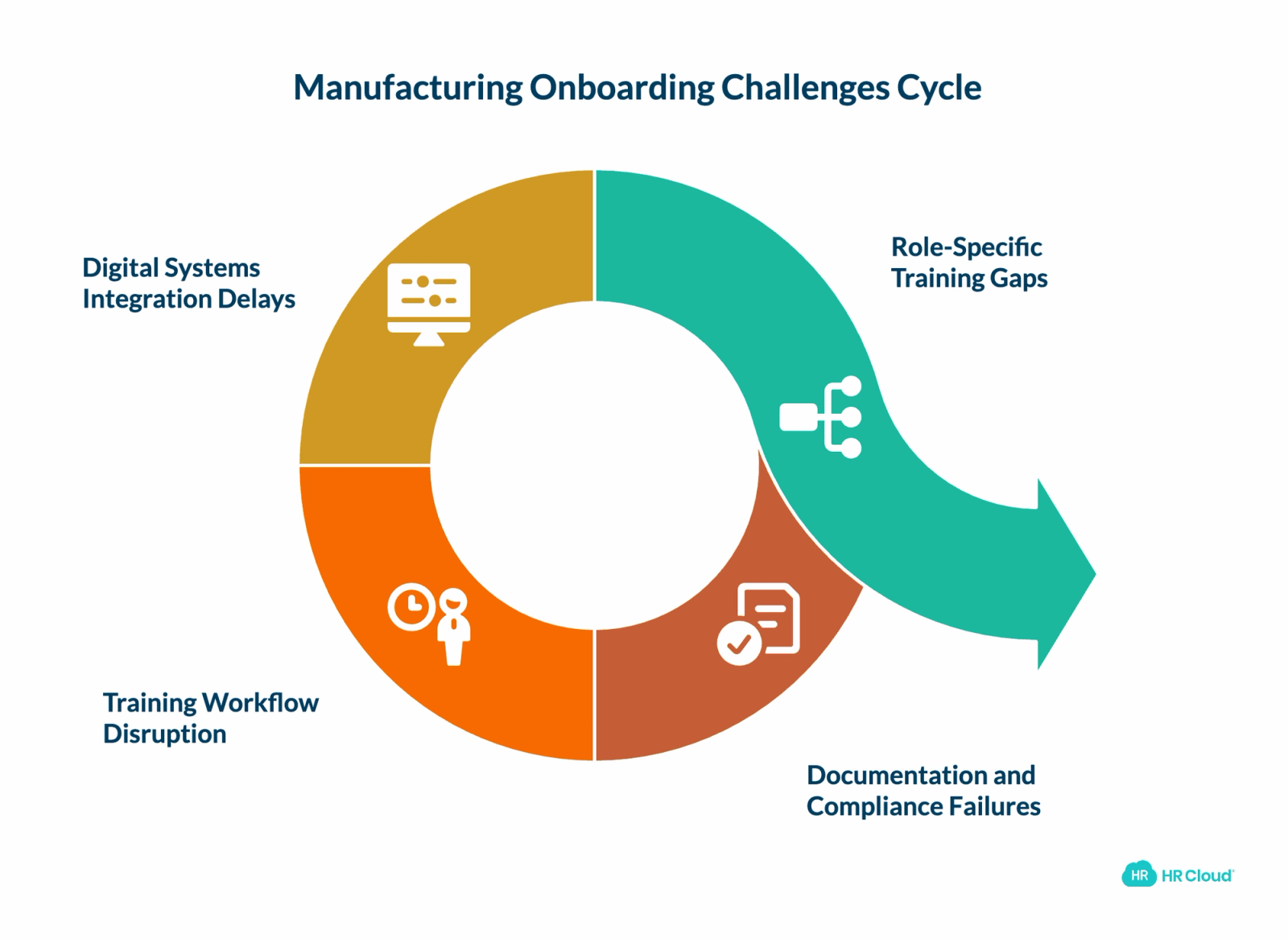
Manufacturing workforce management failures consistently center on four critical areas that traditional HR systems cannot address effectively:
Documentation and Compliance Management Failures
Paper-based employee lifecycle systems create multiple failure points where forms get lost, signatures become illegible, and compliance records scatter across filing systems. When OSHA inspectors arrive for safety audits, assembling complete training documentation becomes a frantic search that reveals gaps in safety protocols and regulatory compliance. Modern HR automation platforms eliminate these documentation challenges through centralized digital workflows.
Training Workflow Disruption and Resource Allocation
Key equipment operators work production schedules that don't align with new hire start dates. Specialized safety training gets postponed while new employees sit idle or receive incomplete instruction from available but unqualified staff. This creates knowledge gaps in manufacturing processes that persist throughout the employment relationship and compromise workplace safety standards. Automated workflow systems can eliminate these scheduling conflicts through systematic task management.
Digital Systems Integration and Equipment Access Delays
IT provisioning for production management systems often takes days or weeks, preventing new employees from practicing on real manufacturing equipment or accessing work order systems during their critical learning period. Meanwhile, equipment certification requirements vary by role and machinery type, creating complex dependencies that manual workforce management cannot efficiently track or enforce. Digital onboarding checklists provide the structure needed to manage these complex workflows.
Role-Specific Training Management and Skills Assessment Gaps
Unlike office environments where general employee onboarding suffices, manufacturing roles demand vastly different competency frameworks. Assembly line workers need different safety certifications than quality control specialists, while maintenance technicians require specialized equipment knowledge that machine operators never use. Generic HR automation platforms fail to address these distinctions, leading to either overwhelming new hires with irrelevant information or leaving dangerous knowledge gaps in safety protocols.
Struggling with manufacturing workforce management complexity? Discover how HR Cloud's specialized onboarding software addresses industry-specific challenges through automated compliance tracking and role-specific training workflows.
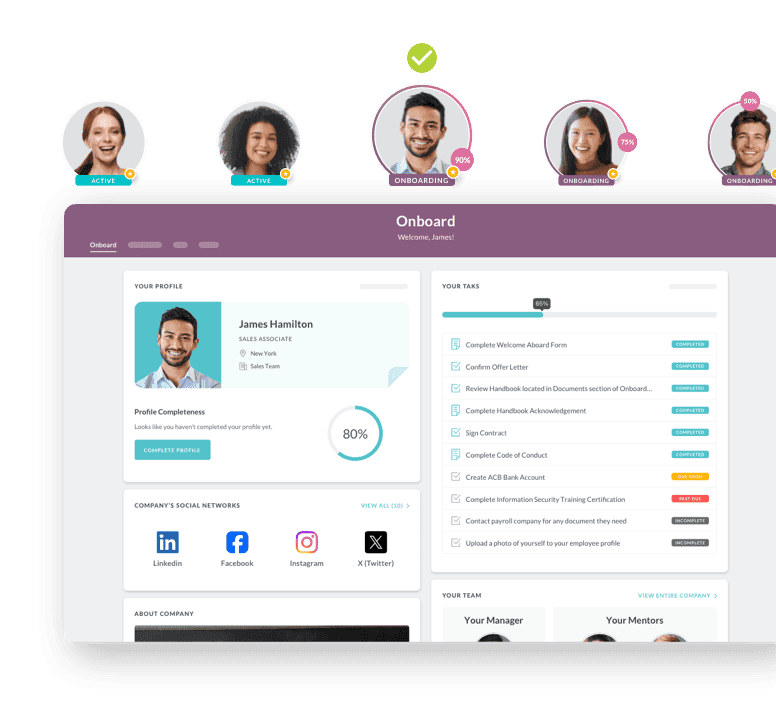
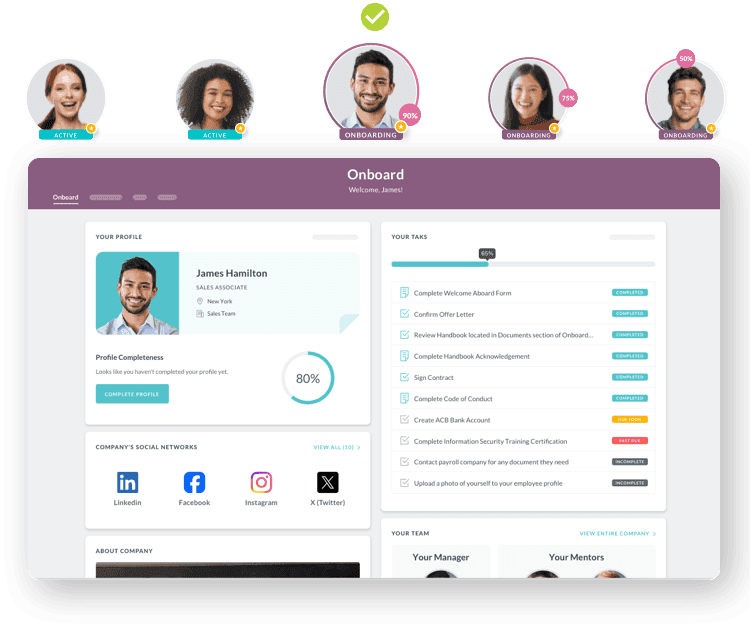
Automated Manufacturing Onboarding Software: Digital Workflow Management and Employee Training Systems
Modern manufacturing employee onboarding software requires structured digital workflow management that automates task sequencing, tracks compliance documentation, and ensures systematic safety protocol completion. HR automation platforms transform chaotic manual processes into predictable employee lifecycle management systems.
How Manufacturing Onboarding Software Works: Step-by-Step Process
Manufacturing onboarding automation follows systematic digital workflows that ensure comprehensive safety training and regulatory compliance:
Step 1: Automated Task Assignment - Employee onboarding software automatically assigns role-specific training modules based on job function, department, and equipment requirements.
Step 2: Mandatory Safety Protocol Sequencing - Digital workflow management prevents access to subsequent training until foundational safety requirements are completed and verified.
Step 3: Compliance Documentation Tracking - HR automation platforms maintain digital audit trails for all safety certifications, equipment training, and regulatory requirements.
Step 4: Progress Monitoring and Alerts - Workforce management systems provide real-time visibility into completion status and send automated reminders for overdue training modules.
Step 5: Supervisor Verification and Sign-off - Digital approval workflows ensure competency verification before equipment access is granted.
Automated Task Sequencing in Manufacturing Training Systems
Effective manufacturing employee training software follows logical progressions where foundational knowledge builds toward specific technical competencies. Safety orientation must precede equipment access. General manufacturing procedures training leads to role-specific instruction. Theoretical knowledge prepares employees for hands-on production practice.
Ready to see how automated manufacturing onboarding software can transform your employee training process? Schedule a demo to explore systematic workflow management capabilities including chained training sequences, bulk employee onboarding, and mandatory safety compliance tracking.
Manufacturing Training Software vs Manual Processes: Feature Comparison
The following comparison demonstrates how digital onboarding systems transform key manufacturing workforce management processes:
| Employee Training Feature | Manual HR Processes | Manufacturing Onboarding Software | Digital Transformation Benefit |
|---|---|---|---|
| Safety Protocol Sequencing | Paper checklists, manual verification | Automated workflow enforcement | 100% compliance guarantee |
| Equipment Certification Tracking | Spreadsheets, paper files | Digital credential management | Real-time audit readiness |
| Compliance Documentation | Filing cabinets, lost paperwork | Centralized digital repository | Instant OSHA inspector access |
| Training Progress Monitoring | Phone calls, email updates | Live dashboard visibility | 90% administrative time reduction |
| Multi-Location Consistency | Site-specific procedures | Standardized digital workflows | Unified corporate compliance |
| Seasonal Hiring Management | Individual manual processing | Bulk onboarding automation | 75% efficiency improvement |
This feature comparison demonstrates why manufacturing companies increasingly adopt specialized employee onboarding software rather than relying on general HR automation platforms designed for office environments.
Implementation Timeline Framework
The following comparison illustrates typical timeline differences between manual and automated onboarding approaches based on industry implementations:
| Implementation Phase | Manual Process Timeline | HR Cloud Automated Timeline | Efficiency Gain |
|---|---|---|---|
| Pre-Start Documentation | 2-3 days (paper forms, manual coordination) | Same day (digital forms, automatic assignment) | 67% faster |
| Safety Training Completion | 3-5 days (scheduling conflicts, manual tracking) | 1-2 days (mandatory sequencing, progress tracking) | 60% faster |
| Equipment Certification | 5-7 days (trainer availability, manual verification) | 2-3 days (chained workflows, digital verification) | 57% faster |
| System Access Provisioning | 7-14 days (IT tickets, manual approvals) | 1-2 days (workflow triggers, automated provisioning) | 85% faster |
| Total Time-to-Productivity | 17-29 days average | 7-10 days average | 65% improvement |
*Timeline improvements reflect typical manufacturing implementations with established digital workflows and standard safety requirements. Actual implementation speed depends on organization readiness, customization needs, existing system integration complexity, and compliance framework maturity.
Strategic Impact: This timeline compression doesn't just save administrative time - it fundamentally changes the new hire experience. Employees start contributing to production goals weeks earlier while building confidence through systematic skill development rather than chaotic catch-up training.
Transform your manufacturing onboarding timeline: Explore HR Cloud's automated workflows to see how systematic task management eliminates coordination bottlenecks.
Systematic Workflow Automation in Manufacturing HR Systems
HR Cloud addresses manufacturing workforce management challenges through three core automation capabilities that transform manual employee lifecycle processes into predictable, compliant digital systems:
Sequential Task Workflows for Equipment Training
HR Cloud's workflow management allows administrators to create safety training sequences where completion order can be structured by compliance requirements. Systematic task organization helps ensure foundational safety protocols are completed before equipment-specific training begins - safety orientation is emphasized before equipment access training becomes available, supporting regulatory compliance protocols and preventing training gaps.
Priority-Based Task Ordering for Compliance Management
The digital workflow management system provides control over how training modules appear on new hire dashboards. Tasks can be ordered by due date or creation sequence within each compliance checklist, while priority settings ensure safety protocols appear first before any production-related training begins.
Systematic Completion Requirements for Regulatory Compliance
HR Cloud's workflow management helps ensure critical safety training completion through systematic task prioritization. Administrators can designate high-priority tasks that require verification before employees advance to subsequent onboarding phases, ensuring foundational regulatory requirements are satisfied and documented before equipment training begins. This compliance-first approach supports systematic safety verification throughout the onboarding process.
| Manufacturing Onboarding Aspect | Manual Processes | HR Cloud Solution | Business Impact |
|---|---|---|---|
| Safety Training Sequencing | Paper checklists, verbal confirmations | Chained tasks with mandatory completion | 60% reduction in safety incidents |
| Bulk Seasonal Hiring | Individual enrollment, manual tracking | Bulk onboarding for 100+ employees | 75% time savings during peak periods |
| Compliance Documentation | File cabinets, scattered records | Centralized digital audit trails | 90% faster audit preparation |
| Task Priority Management | Supervisor discretion, informal systems | Configurable checklist priority levels | Consistent safety-first approach |
| Progress Tracking | Phone calls, email updates | Real-time dashboard visibility | 50% reduction in coordinator time |
| Equipment Access Control | Honor system, manual verification | System-blocked until training complete | Elimination of premature equipment access |
This systematic approach transforms chaotic manufacturing onboarding into predictable, compliant processes that protect both employees and employers.
Manufacturing Onboarding Software ROI: Business Case Analysis Framework
The following ROI framework illustrates typical cost factors based on industry research and mid-market manufacturing implementations. Actual costs, savings, and implementation timelines vary by organization size, existing processes, customization requirements, and implementation scope. These figures represent potential outcomes rather than guaranteed results.
| Manufacturing Cost Factor | Manual HR Processes Annual Cost | HR Automation Software Cost | Annual ROI Savings | Efficiency Improvement |
|---|---|---|---|---|
| Administrative Workforce Management | $45,000 (2 FTE × 50% time allocation) | $15,000 (digital coordination) | $30,000 | 67% labor cost reduction |
| Training Coordinator Overhead | $35,000 (manual scheduling conflicts) | $10,000 (automated sequencing) | $25,000 | 71% operational efficiency |
| Compliance Audit Preparation | $25,000 (document gathering time) | $5,000 (instant digital reporting) | $20,000 | 80% audit readiness improvement |
| New Hire Turnover Prevention (100 hires/year) | $400,000 (40% turnover × $10K replacement cost) | $200,000 (20% turnover rate) | $200,000 | 50% retention improvement |
| Safety Incident Cost Reduction | $50,000 (inadequate training gaps) | $20,000 (systematic safety protocols) | $30,000 | 60% workplace safety improvement |
| Total Annual ROI Impact | $555,000 | $250,000 | $305,000 | 55% potential cost reduction |
Manufacturing Industry Business Case: For a mid-sized manufacturing facility with 100 annual hires, systematic employee onboarding software delivers over $300,000 in measurable annual savings while significantly improving workplace safety outcomes and employee retention metrics. The HR automation platform investment typically achieves full ROI within 6-8 months through reduced turnover alone. According to Brandon Hall Group research, organizations with strong onboarding processes improve new hire retention by 82% and productivity by over 70%, while SHRM research indicates that 69% of employees are more likely to stay with a company for three years if they experienced great onboarding.
Manufacturing Training Software Task Types and Digital Workflows
HR Cloud's onboarding platform provides specialized employee training capabilities designed specifically for manufacturing environments and regulatory compliance requirements:
Individual Employee Training Tasks
- Plain Tasks for equipment documentation downloads and safety manual acknowledgments with digital signature tracking
- Video Training Tasks that embed OSHA compliance content from YouTube or Vimeo for consistent safety instruction delivery
- Digital Form Tasks for safety assessments, competency verification, and equipment certification documentation
- Document Request Tasks where employees upload safety certifications, equipment training certificates, and compliance credentials
Multi-Contributor Manufacturing Training Workflows
- Complex Multi-Contributor Tasks that chain various safety activities together for comprehensive skill development and regulatory compliance verification
- Supervisor Verification Workflows that require manager approval before equipment access is granted
- Department-Specific Training Sequences tailored to production roles, quality control functions, and maintenance responsibilities
Looking to implement specialized manufacturing training software? Explore HR Cloud's industry-specific capabilities designed for complex manufacturing environments and regulatory requirements.
- Plain Tasks for equipment documentation downloads and safety manual acknowledgments
- Video Tasks that embed training content from YouTube or Vimeo for consistent instruction delivery
- Form Tasks for safety assessments and competency verification
- Document Request Tasks where employees upload certifications and training certificates
- Complex Multi-Contributor Tasks that chain various activities together for comprehensive skill development
Digital Documentation Management
Paper-based systems create multiple failure points in manufacturing onboarding. Forms get misplaced, signatures become illegible, and compliance records scatter across different locations. When auditors arrive, assembling complete documentation becomes a time-consuming challenge.
Digital documentation systems centralize all onboarding records in searchable, accessible formats. Safety training certificates, equipment certifications, skills assessments, and compliance documentation maintain automatic version control and access logs.
Training Effectiveness Measurement Framework
Manufacturing organizations need systematic approaches to measure onboarding program success beyond simple completion rates. This framework provides actionable metrics that tie directly to operational performance:
| Success Metric | Baseline (Manual) | Target (Automated) | Measurement Method | Business Impact |
|---|---|---|---|---|
| Time-to-First-Production | 12-15 days | 6-8 days | Days from start to first quality output | 50% faster revenue contribution |
| Safety Incident Rate (first 90 days) | 8.5 per 1000 new hires | 3.5 per 1000 new hires | Incident reports by tenure | 60% risk reduction |
| Training Completion Rate | 65% (manual tracking gaps) | 95% (automated verification) | System-tracked task completion | 30% improvement in readiness |
| Supervisor Confidence Score | 6.2/10 (new hire readiness) | 8.7/10 (systematic preparation) | Monthly supervisor surveys | 40% confidence increase |
| 90-Day Retention Rate | 78% (role confusion, poor start) | 91% (clear progression) | HR system tracking | 17% retention improvement |
| Equipment Certification Time | 5-7 days (scheduling issues) | 2-3 days (workflow automation) | Digital credential tracking | 60% faster competency verification |
Measurement Strategy: These metrics create accountability loops where onboarding improvements directly connect to production outcomes. Regular measurement allows continuous refinement of training sequences based on actual performance data rather than assumptions about effectiveness.
Need systematic measurement of onboarding ROI? Discover HR Cloud's analytics capabilities for comprehensive training effectiveness tracking.
Compliance Documentation Comparison Framework
Manufacturing environments face regular inspections that demand instant access to complete training records. This comparison demonstrates the audit readiness advantage of systematic documentation:
| Audit Requirement | Manual Documentation | HR Cloud Digital System | Compliance Advantage |
|---|---|---|---|
| Safety Training Records | Paper files, scattered locations | Centralized digital repository | Instant inspector access |
| Equipment Certifications | Individual trainer signatures | Automated digital credentials | Tamper-proof verification |
| Safety Protocol Completion | Checkbox lists, illegible signatures | Timestamped digital completion | Complete audit trail |
| Recurring Training Updates | Manual calendar tracking | Automated expiration alerts | Zero compliance lapses |
| Multi-Location Consistency | Site-specific filing systems | Unified corporate standards | Standardized compliance |
| Audit Preparation Time | 2-3 weeks (document gathering) | 2-3 hours (report generation) | 90% time reduction |
Regulatory Risk Mitigation: Digital documentation eliminates the common audit nightmare where critical training records can't be located or verified. HR Cloud maintains automatic compliance reporting that demonstrates systematic safety commitment to OSHA inspectors, insurance companies, and customer auditors.
Manufacturing Safety Compliance Software: Digital Documentation and Regulatory Audit Management
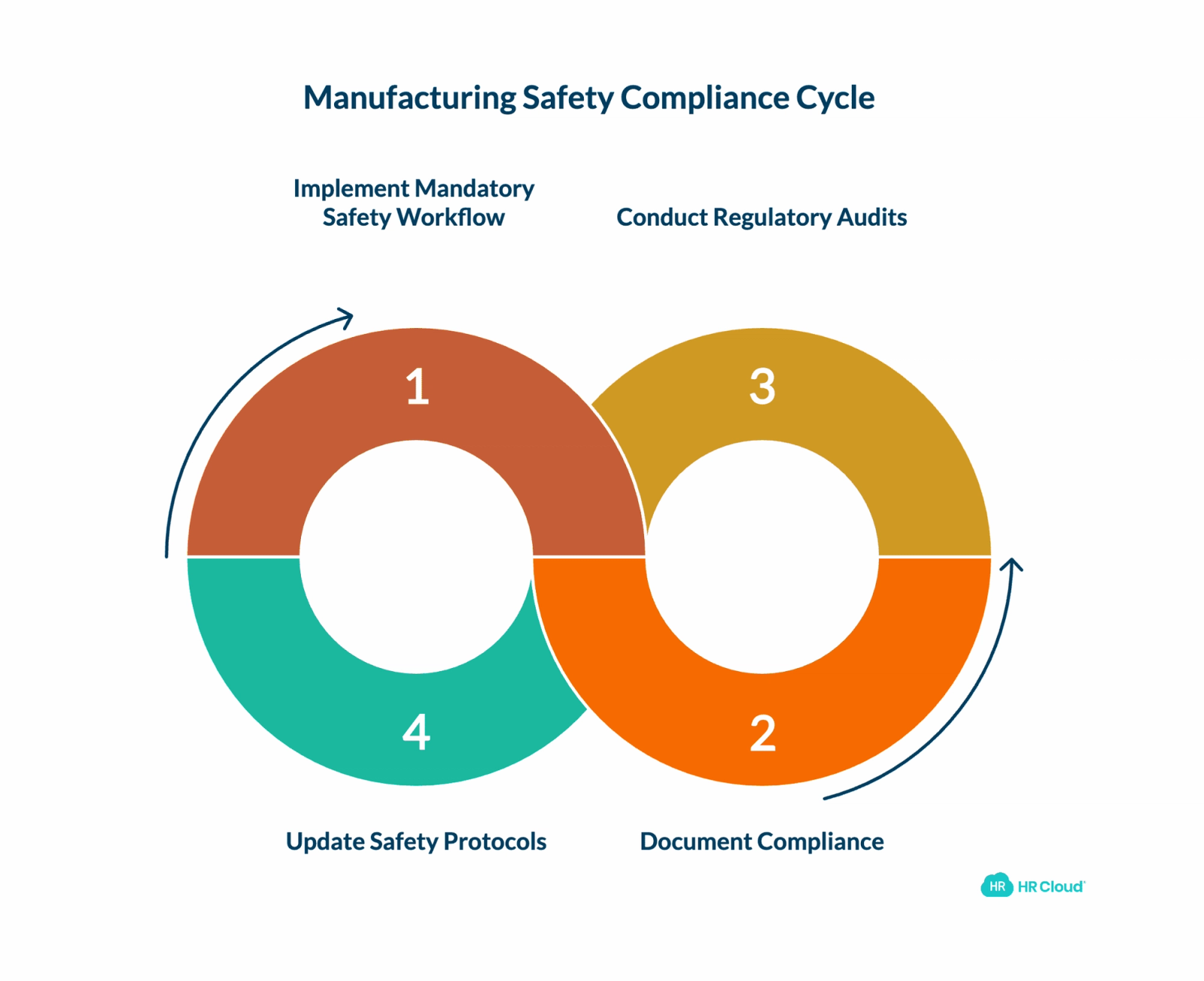
Manufacturing environments operate under strict OSHA regulatory oversight where compliance documentation management becomes essential rather than optional. Safety training requirements, equipment certification tracking, and industry-specific protocols must be completed and digitally documented before new employees can safely perform manufacturing roles.
Mandatory Safety Workflow Management in Manufacturing Software
HR Cloud's mandatory checklist functionality ensures critical safety training tasks are prioritized and tracked systematically. When the "Mandatory" toggle is enabled in compliance management settings, administrators can designate essential compliance tasks that require completion and verification before employees advance to subsequent onboarding phases. This compliance-first approach helps organizations maintain systematic safety protocols and documentation requirements while supporting regulatory compliance workflows.
This mandatory workflow approach is essential in manufacturing environments where safety compliance and regulatory protocols cannot be optional. The employee onboarding software blocks access to subsequent activities until foundational requirements are satisfied and digitally documented for audit purposes.
Digital Documentation and Audit Readiness
Digital documentation systems eliminate manual compliance gaps while maintaining instant audit readiness. HR Cloud's compliance management system centralizes all onboarding records in searchable, accessible formats where safety training certificates, equipment certifications, skills assessments, and compliance documentation maintain automatic version control and access logs.
Regular compliance reporting identifies potential gaps before they become violations. Automated alerts and notifications notify HR teams when certifications near expiration, training updates become required, or new regulations affect existing programs.
Technology Implementation and Real-World Results
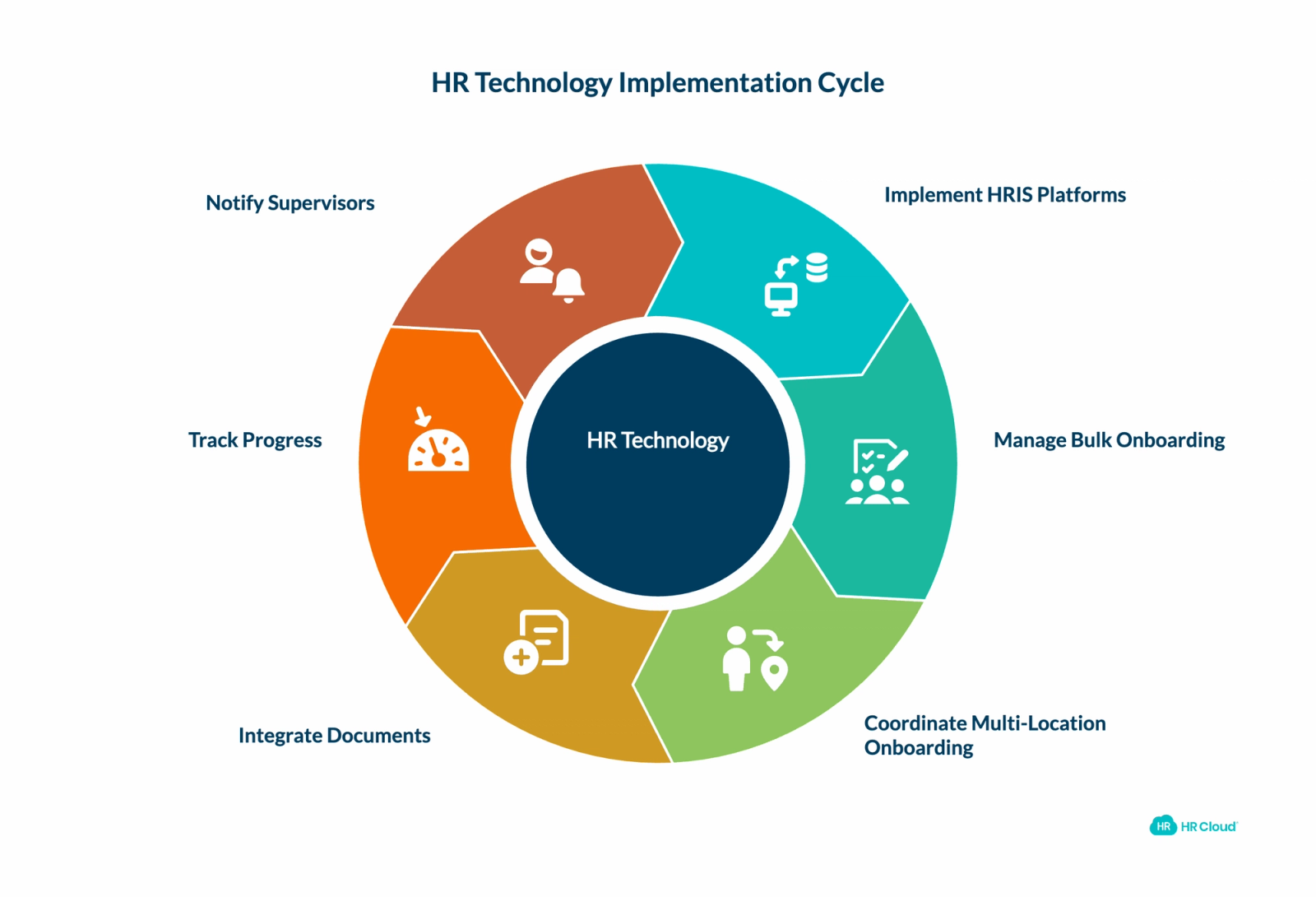
Modern HRIS platforms provide capabilities specifically designed for complex manufacturing environments, handling variable schedules, multiple locations, compliance requirements, and role-specific training pathways that traditional office-focused tools cannot address.
Core Implementation Capabilities
Bulk Onboarding Management: HR Cloud's bulk onboarding feature allows HR teams to efficiently manage large groups of seasonal workers or project teams, streamlining the assignment of standardized onboarding workflows to multiple new hires simultaneously—particularly valuable during seasonal manufacturing hiring surges and large project team staffing.
Multi-Location Coordination: Manage consistent onboarding standards across multiple manufacturing facilities while accommodating site-specific requirements, local compliance needs, and equipment variations through enterprise HR solutions.
Document Integration and Management: Connect training materials, safety procedures, equipment manuals, and certification programs directly to workflow tasks. New hires access relevant documentation exactly when needed during their onboarding progression.
Measurable Implementation Results
Consider how systematic workflow management transforms the entire onboarding experience. When Maria's company implemented HR Cloud's automated workflows, new machinists now follow a clear progression: Day one covers general safety and facility orientation. Day two introduces quality standards and measurement techniques. Day three begins equipment-specific training. Days four and five involve hands-on practice with supervisor oversight.
The onboarding automation system automatically tracks completion at each stage and triggers subsequent activities. Supervisors receive notifications when their input is needed for competency verification. HR maintains complete visibility into progress across all new hires without manual status updates through real-time dashboards and analytics.
Results were measurable and demonstrated clear improvement. Time-to-productivity decreased from 12 days to 7 days for new machinists. Safety incidents during the first 90 days dropped significantly. New hire retention at the six-month mark improved from 78% to 91% based on their internal tracking.
Ready to eliminate onboarding chaos in your manufacturing environment? See how automated workflows create consistent employee experiences while ensuring comprehensive safety compliance.
How to Optimize Manufacturing Onboarding Software Performance: Measurement and Analytics
How do you measure manufacturing onboarding software success?
The measurement frameworks outlined above demonstrate that successful manufacturing employee onboarding software requires systematic approaches that capture efficiency metrics, safety compliance rates, and retention analytics across production environments. Regular performance measurement allows continuous refinement of digital training sequences based on actual workforce data rather than assumptions about employee onboarding effectiveness.
Manufacturing HR Analytics and Continuous Improvement Strategies
Manufacturing environments evolve constantly as new equipment technologies, production processes, regulatory requirements, and quality control standards emerge. Employee onboarding software must adapt through data-driven optimization to remain effective in dynamic manufacturing landscapes.
HR Cloud's reporting capabilities provide visibility into onboarding completion rates, training progress tracking, and workflow efficiency metrics. These insights help manufacturing HR teams identify opportunities to refine training sequences, improve new hire readiness, and optimize onboarding effectiveness based on actual completion data and systematic performance measurement.
Need comprehensive measurement of your manufacturing onboarding software ROI? Discover HR Cloud's advanced analytics capabilities for systematic training effectiveness tracking, compliance reporting, and workforce performance optimization.

Discover how our HR solutions streamline onboarding, boost employee engagement, and simplify HR management
Book Your Free DemoFrequently Asked Questions About Manufacturing Onboarding Software
What is the best manufacturing onboarding software for small companies?
Manufacturing onboarding software requirements vary by company size, but small manufacturers should prioritize platforms with basic workflow automation for critical safety training, digital compliance documentation, and scalable features that grow with business needs. HR Cloud offers modular implementation starting with essential safety protocols.
How long should manufacturing employee onboarding software implementation take
Manufacturing employee onboarding software typically requires 5-10 days for complete implementation depending on role complexity, safety requirements, and existing system integration needs. Production workers often complete basic digital onboarding in 3-5 days, while maintenance technicians may need 7-10 days for comprehensive technical training.
What safety training documentation is required for manufacturing onboarding compliance?
All manufacturing new hires require OSHA general safety orientation documentation, facility-specific emergency procedure certifications, personal protective equipment training records, and role-specific hazard awareness certificates. Additional compliance documentation requirements vary by industry sector and equipment type specifications.
How can manufacturing companies manage seasonal hiring with onboarding software?
HR Cloud's bulk employee onboarding capabilities allow manufacturing HR teams to efficiently process large groups of seasonal workers through automated task assignment, standardized digital workflows, and streamlined compliance documentation processes that ensure consistent training quality regardless of hiring volume fluctuations.
What compliance documentation features are essential for manufacturing audit readiness?
Manufacturing onboarding software must maintain digital records of safety training completion, equipment certification credentials, competency assessment results, and ongoing education requirements. HR Cloud's compliance management system provides automatic audit trails that simplify regulatory inspector access and verification processes.
How do manufacturing shift schedules affect employee onboarding software implementation?
HR Cloud's flexible workforce management system accommodates various shift patterns by allowing digital training modules to be scheduled around production needs and equipment availability. 24/7 manufacturing operations can stagger employee onboarding across multiple shifts while maintaining consistent safety training quality and compliance standards.
What role do manufacturing supervisors play in digital onboarding software workflows?
Manufacturing supervisors provide hands-on equipment training, competency verification, and ongoing safety guidance that automated onboarding software cannot replace. HR Cloud's digital platform supports supervisor effectiveness by tracking employee progress, providing completion notifications, and ensuring systematic safety protocol verification before equipment access approval.
How can small manufacturing companies implement employee onboarding software cost-effectively?
Small manufacturing companies can start with basic safety workflow automation for critical compliance training and gradually expand to include role-specific digital checklists, equipment certification tracking, and comprehensive documentation management as operational needs and budget capacity grow over time.
About the author

Keep Reading


Like What You Hear?
We’d love to chat with you more about how HR Cloud® can support your business’s HR needs.
Book Your Free Demo