Onboarding 500 Nurses a Year: Lessons from High-Volume Hospital HR Teams

High-volume nurse recruitment requires a fundamentally different approach than traditional hiring. This guide covers the "Industrialized Empathy" framework for onboarding 500+ nurses annually, including funnel math calculations, cohort-based start dates, real-time tracking dashboards, pre-boarding engagement strategies to prevent ghosting, and integrated tech stack requirements.
Learn how leading hospital systems achieve 82% retention improvement while processing thousands of clinical hires without sacrificing the human touch that keeps nurses from walking away.
Hiring 5 nurses can be done off-the-cuff. But hiring 500 is a logistics operation by itself.
If you try to use "hire 5 nurses" tactics for a “hire 500 nurses” exercise, your team is bound to drown.
The talent acquisition team is bound to burn out trying to give every one of your 500 annual nursing hires the white-glove treatment they gave when hiring 50. Despite the good intent, practicality can be brutal. And midway the cracks will start showing—missed background checks, unsigned I-9s, new hires ghosting on day one because nobody reached out during their three-week notice period.
But high-volume hiring doesn't mean you have to sacrifice the human experience. It means you have to engineer it differently. The hospitals doing this well have figured out what you can call "industrialized empathy"—building human-first onboarding systems that scale while still making every nurse feel like they matter.
Let us explore how you can do the same for your own organization.
The Funnel Math Nobody Wants to Talk About
Before we get into tactics, let's do some quick maths to gain visibility into what you are actually dealing with when you set about hiring 500 nurses.
The healthcare industry averages a 54:1 applicant-to-hire ratio. That means for every nurse you successfully bring on board, you're processing 54 applications. For 500 hires that amounts to 27,000 applications flowing through your system annually. About 2,250 per month. Over 100 per working day.
Now factor in interviews. The interview-to-hire conversion rate in healthcare runs about 27%. Which means to hire 500 nurses, you're conducting roughly 1,850 interviews. That's 35 interviews per week, every week, for 52 weeks straight.
And here's where it gets really fun: the NSI National Healthcare Retention Report found that it takes an average of 86 days—nearly three months—to recruit a single experienced RN. The harder-to-fill specialties like OR and critical care? Even longer.
So you're managing 27,000 applications, 1,850 interviews, and 86-day recruitment cycles. Simultaneously.
While also handling onboarding for the nurses who actually accepted offers.
And also trying to keep your current staff from leaving.
What your talent acquisition has is not a skills problem but a volume problem that requires volume solutions.
Here's my take: If you're still running high-volume nurse recruitment like it's a series of individual conversations, you're setting everyone up to fail. Your team. Your candidates. Your floor managers are waiting on staff.
You need systems.
And those systems need to be ruthlessly efficient at the administrative stuff so your humans can focus on the human stuff.
Cohort Onboarding: Why Fixed Start Dates Change Everything
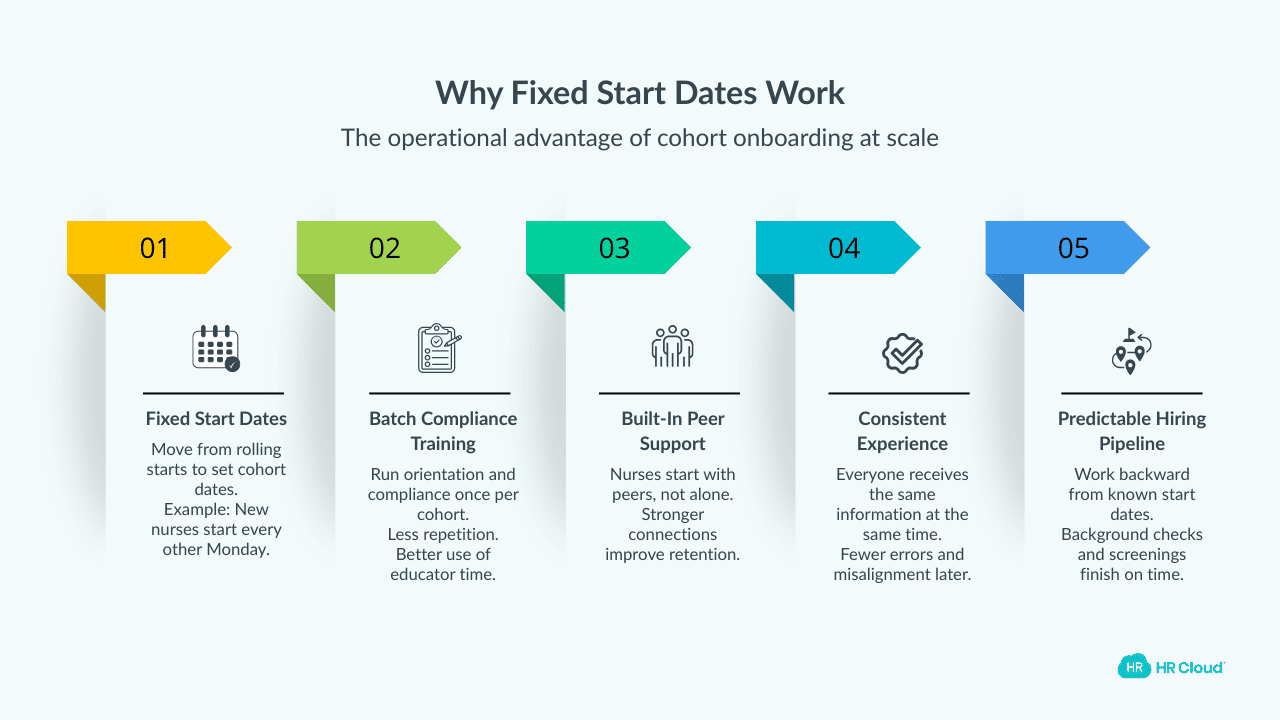
One of the most powerful shifts high-volume hospital systems can make is moving from "start whenever" to "start dates are fixed."
Instead of nurses trickling in on random Mondays throughout the month—each one requiring their own orientation session, their own IT setup, their own compliance paperwork review—successful high-volume operations batch new hires into cohorts.
Here's how it works in practice: New nurses start every other Monday. Period.
If you accept an offer on Tuesday and could technically start the following week? You're waiting until the next cohort date.
If your notice period ends mid-week? You're starting the Monday after.
I know what you're thinking. "We can't make nurses wait. We need them on the floor yesterday."
And yes, the nursing shortage is real. The average hospital is carrying a 9.6% RN vacancy rate right now—that's roughly 47 open nursing positions per facility. The pressure to fill those gaps immediately is immense.
But here's what the data actually shows: The time you "save" by starting nurses on random dates gets eaten (and then some) by the inefficiency of one-off orientations, repeated compliance sessions, and the chaos of trying to track 47 different onboarding timelines simultaneously.
Cohort onboarding lets you:
- Batch your compliance training: Instead of running HIPAA orientation 47 times for 47 individual nurses, you run it once for a cohort of 20. Your clinical educators aren't repeating themselves constantly. Your conference rooms aren't perpetually booked. And the new hires have someone who is in the same boat as them to talk to.
- Create peer connections from Day 1: Nurses who start together have built-in colleagues. They text each other questions. They grab lunch together. They form the support networks that research shows dramatically improve first-year retention. (SHRM data shows nurses with strong onboarding connections are 69% more likely to stay for three years or more.)
- Standardize the experience: When everyone goes through the same orientation at the same time, you can actually quality-control what's being communicated. No more "Well, that's not what they told me in my orientation" conversations six weeks later.
- Predict your pipeline: When you know nurses start on, say, the 1st and 15th of every month, you can work backward to ensure background checks, credentialing, and health screenings are completed in time. You're not constantly reacting to "Oh, she wants to start Monday" emergencies.
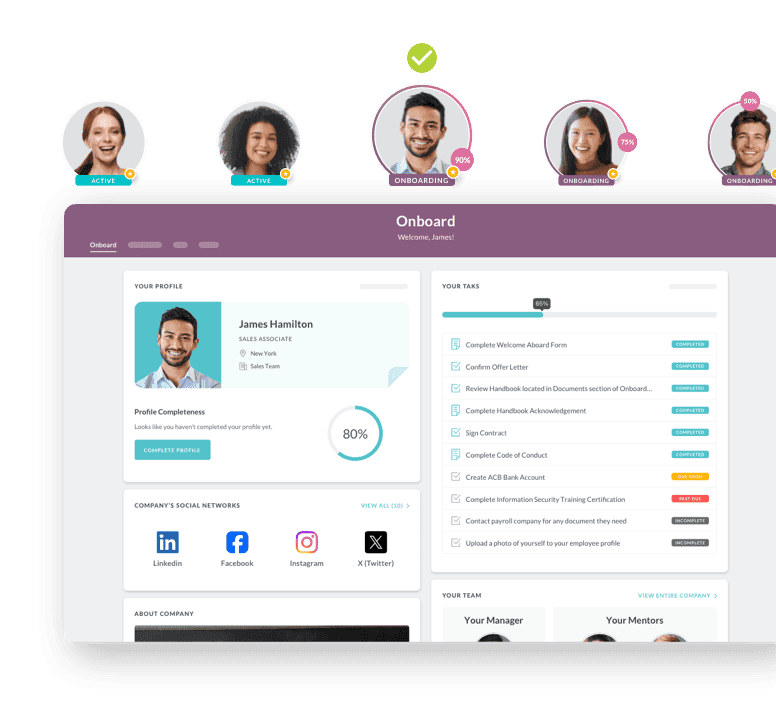
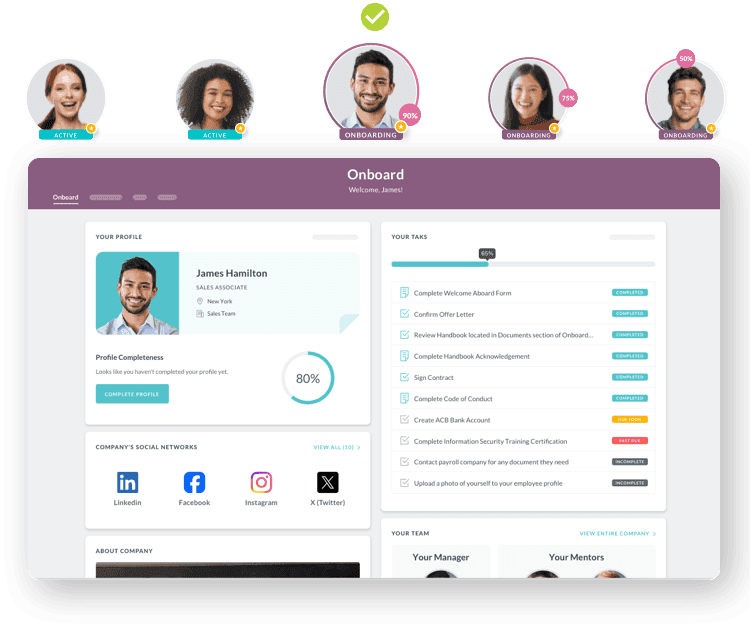
The hospitals doing this well typically run bi-weekly or monthly cohorts, depending on volume. A system hiring 500 nurses annually might run cohorts of 20-25 nurses twice a month. Larger systems might run weekly cohorts.
The key is consistency.
Pick your dates and hold them. The short-term "delay" of waiting for the next cohort is more than offset by the long-term efficiency of predictable, batch-processed onboarding.
The "Ready-to-Start" Dashboard: See Everything at a Glance
Is this a scenario you come across more times than you would want: A nurse accepted an offer six weeks ago. Her start date is Monday. On Friday afternoon, someone realizes her background check never came back. Or her TB test was never scheduled. Or her nursing license verification is sitting in someone's inbox, unprocessed.
Cue the scramble. The frantic calls. The "Can we push her start date?" conversations that frustrate everyone involved.
This happens because most high-volume operations don't have visibility into where each candidate actually is in the pipeline. Information is scattered in email threads, spreadsheets, and the institutional memory of whoever happens to be managing that particular hire.
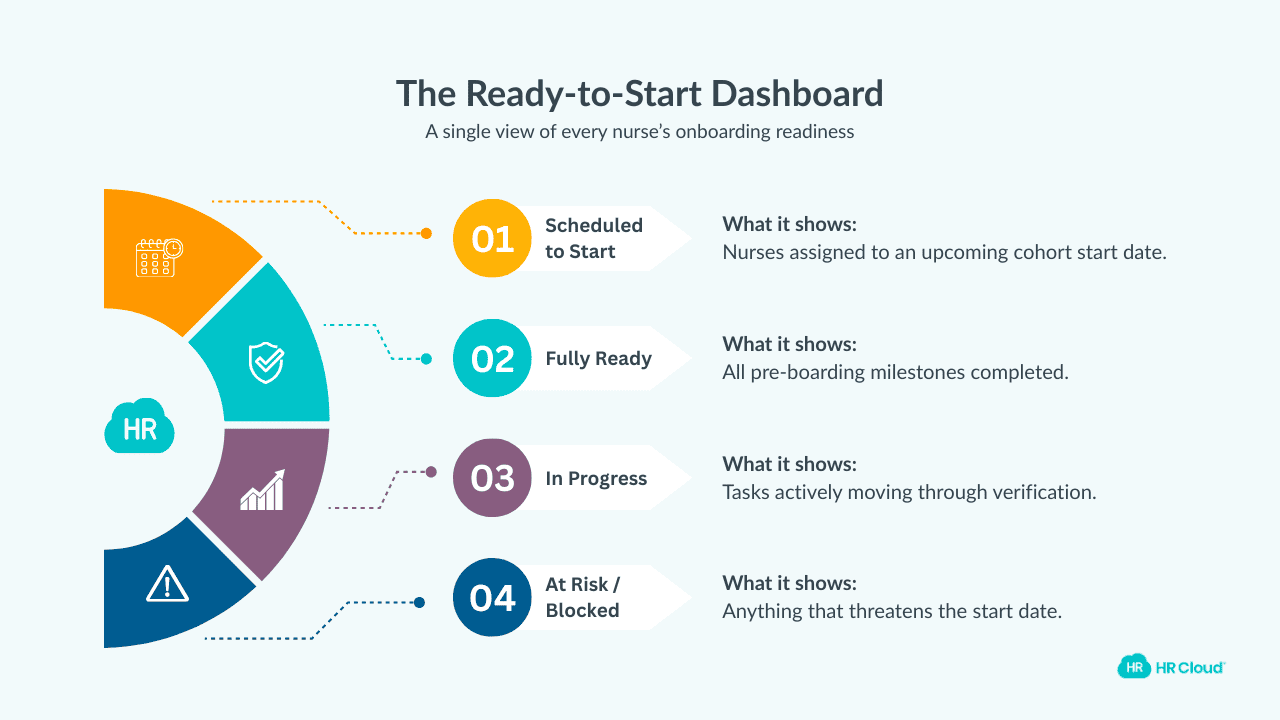
What you need is a "Ready-to-Start" dashboard—a single view that shows exactly where every incoming nurse stands across every pre-boarding milestone.
A good dashboard answers critical information, such as these, at a glance:
- Background check status. Submitted? In progress? Cleared? Flagged for review?
- Health screening completion. TB test scheduled? Completed? Immunization records verified? Drug screen cleared?
- Credentialing status. Nursing license verified? Specialty certifications confirmed? BLS/ACLS current?
- Compliance documents. I-9 completed? E-Verify processed? Tax forms signed? Direct deposit set up?
- IT provisioning. Email created? Badge ordered? EHR access requested?
When you can see all of this in one place—ideally filtered by cohort start date—bottlenecks become obvious. You can see that 18 of your 22 nurses starting on the 15th are fully cleared, but four are stuck waiting on background checks. Now you know exactly where to focus your attention.
Research has found that organizations with this kind of real-time visibility into onboarding progress achieve 54% greater new hire productivity and 50% better retention compared to those flying blind.
The dashboard can also enable easy escalation:
- Set alerts for milestones that should be complete by certain dates.
- Background check not returned 10 days before start? Automatic flag.
- Health screening not scheduled 14 days out? Email to the recruiter.
This proactive tracking prevents Friday afternoon crises.
Here's what matters most: The dashboard isn't just an HR tool. Share it with hiring managers. When the nurse manager can see that their incoming nurses are on track, they stop pestering your team for updates. When they can see a bottleneck, they can help remove it.
Visibility creates partnership instead of friction.
Pre-Boarding Engagement is Necessary So They Don't Ghost
45% of healthcare job seekers admitted to ghosting an employer during the interview process in recent surveys. That's nearly half of your candidates potentially vanishing into thin air.
And it gets worse. One in five new hires who accept a job offer never show up on day one. They accept your offer, sign your paperwork, maybe even complete some onboarding tasks—and then they simply don't appear when their start date arrives.
Why?
Well, the typical hiring process goes like this: Candidate accepts offer. HR sends a pile of paperwork. Candidate enters a black hole of waiting—waiting for background check clearance, waiting for their notice period to end, waiting for their start date. During those three to four weeks, they hear... nothing.
Meanwhile, other hospitals are calling. Other recruiters are texting. Their current employer might even make a counter-offer to keep them. And your candidate, sitting in silence, starts to wonder if they made the right choice.
Pre-boarding engagement fills that silence with connection.
Here's what high-volume operations that don't lose candidates to ghosting are doing:
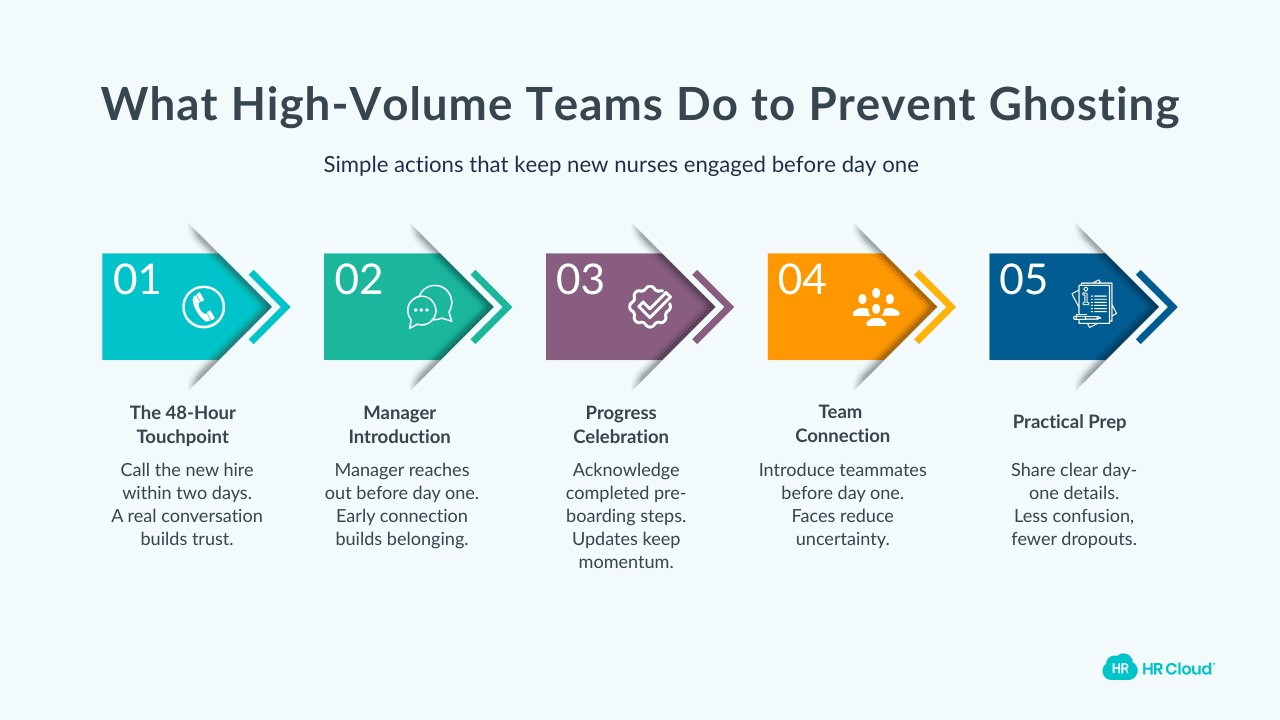
- The 48-hour touchpoint: Within two days of offer acceptance, someone calls the new hire. Not an automated email but a phone call. "We're so excited you're joining us. Here's what happens next, and here's my direct number if you have any questions." This single call dramatically reduces early dropout.
- The manager introduction: Before day one, the new nurse hears from their actual manager. Even a brief email or voicemail: "I saw you're joining our team on the 15th. I wanted to welcome you personally and let you know I'm looking forward to working with you." This creates belonging before the badge is even printed.
- Progress celebration emails: As candidates complete pre-boarding tasks, acknowledge them. "Great news—your background check cleared! You're one step closer to your start date." This creates momentum and keeps the process feeling active rather than stagnant.
- Team connection opportunities: Some hospitals invite incoming nurses to virtual meet-and-greets with their future colleagues before Day 1. Others send team photos with names so new hires can put faces to the people they'll be working with.
- The practical prep package: Send information that actually helps: Where to park on day one. What to wear. Where to go and who to ask for. What the first day agenda looks like. Reducing uncertainty reduces the anxiety that leads to second-guessing.
Research from Brandon Hall Group found that organizations with strong pre-boarding engagement see 82% improvement in new hire retention. The difference between engaged pre-boarding and radio silence is nearly double the retention rate.
For high-volume operations, this engagement needs to be systematized.
You can't personally call 500 nurses, but you can build workflows that trigger the right touchpoints at the right times.
The goal is making automation feel personal—templated messages that still carry warmth, scheduled touchpoints that don't require manual tracking.
Nurses who feel wanted before they start are nurses who actually show up. And nurses who feel wanted on day one become nurses who stay past year one.
The Tech Stack Truth: Integration Is Non-Negotiable
I've saved this for last because it's both the most technical and the most critical piece of the high-volume puzzle.
Your applicant tracking system, your onboarding platform, and your payroll system need to talk to each other. Seamlessly. Automatically. Without your team manually copying data from one system to another.
Here's what happens when they don't:
A nurse accepts an offer in your ATS. Someone manually enters her information into your onboarding system. Someone else manually enters it again into payroll. Three systems, three data entry points, three opportunities for error.
Her name is spelled differently in payroll than in the ATS. Her start date got updated in one system but not the others. Her direct deposit information was entered in onboarding but never made it to payroll. On her first payday, her check is wrong.
Half of all workers would start looking for a new job after just two payroll errors. You've spent 86 days recruiting this nurse, thousands of dollars on background checks and credentialing, weeks of onboarding investment—and you lose her because systems that should have talked to each other didn't.
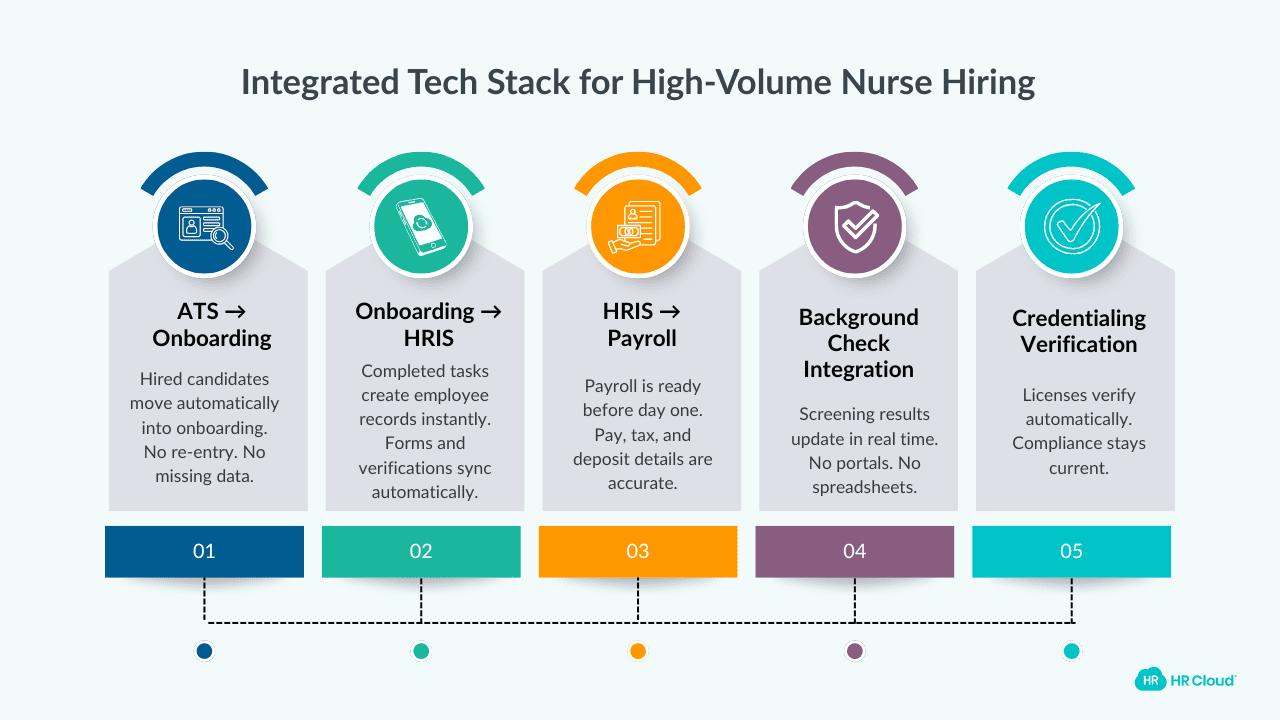
The integrated tech stack for high-volume nurse hiring looks like this:
- ATS → Onboarding: When a candidate is marked "hired" in your applicant tracking system, their information automatically flows into your onboarding platform. No re-entry. No gaps. Name, contact information, position, start date, manager—all transferred instantly.
- Onboarding → HRIS: When onboarding tasks are complete—I-9 verified, direct deposit set up, tax forms signed—that data flows automatically into your HR information system. The new hire's employee record is created without anyone manually creating it.
- HRIS → Payroll: When the nurse starts work, payroll already has everything it needs. Correct pay rate, correct withholdings, correct direct deposit routing. First paycheck is accurate. Trust is maintained.
- Background check integration: Your background check vendor sends results directly into your system, updating the dashboard automatically. No one checking a separate portal and manually updating a spreadsheet.
- Credentialing verification: License verification services confirm nursing credentials and populate your compliance records without manual lookup.
For high-volume operations, this level of tech integration can be the difference between a team that can handle 500 annual hires and a team that burns out trying.
Organizations with integrated HR systems save recruiters 15+ hours per week that would otherwise be spent on manual data entry and status checking. That's 15 hours your team can spend on actual recruiting, candidate engagement, and retention activities.
Integration also enables the analytics that drive continuous improvement.
When all your systems talk to each other, you can answer questions like these with just a few mouse clicks:
- What's our average time-to-start from offer acceptance?
- Where are candidates getting stuck in pre-boarding?
- Which hiring sources produce nurses who stay longest?
The Reality Check: High Volume Nurse Hiring Isn't Magic
Nursing shortage is going to get acute and competition for talent fierce. Even with (nearly) perfect systems, some candidates will ghost. Some nurses will leave in their first year despite your best onboarding efforts. Some background checks will come back problematic at the worst possible time.
A well-planned process that scales doesn’t eliminate challenges. But still makes the challenges manageable at scale.
They turn "We have no idea where anything stands" into "We can see exactly what needs attention today."
Rather than someone scrambling to find out if anyone reached out to the nurses starting Monday, you have automated touchpoints that ensure every nurse heard from you at every pre-boarding milestone.
And research confirms the impact of getting this right: companies with strong onboarding processes improve retention by 82%. Considering that NSI report shows that every nurse you retain saves $61,000+ in replacement costs, the math is compelling.
So how to start building and scaling industrialized empathy?
Where to Start This Week
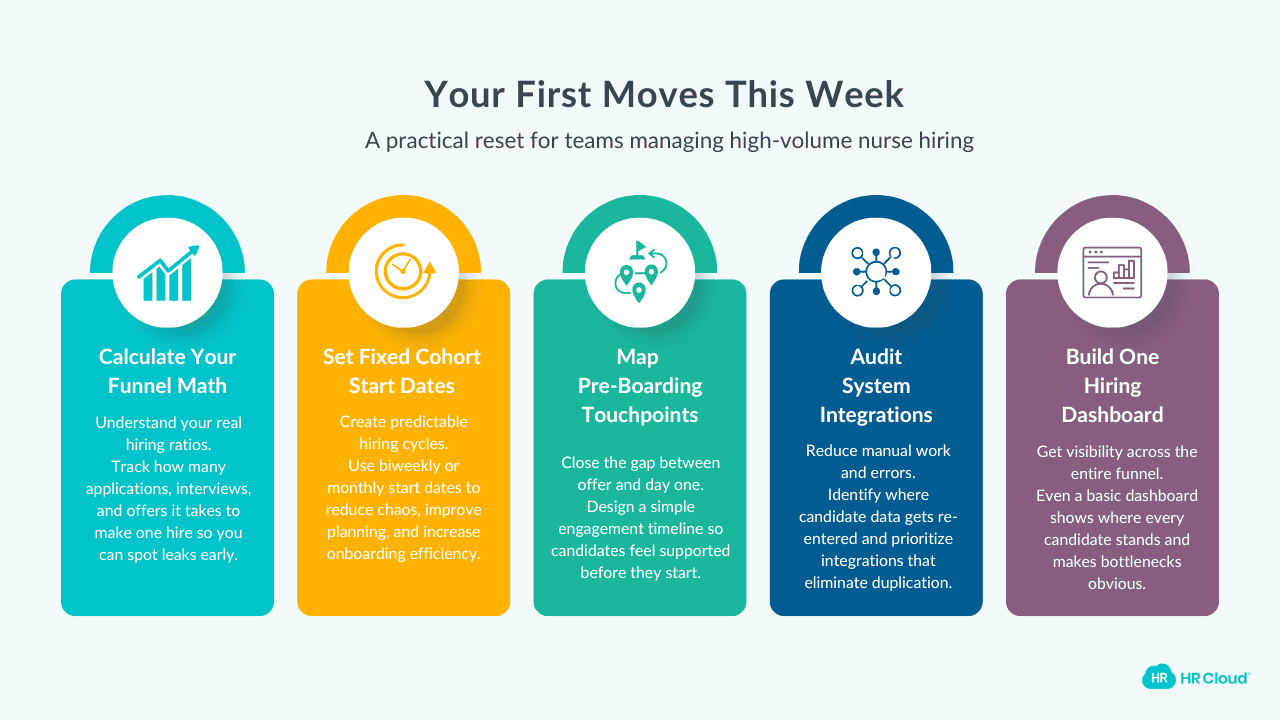
If you're currently drowning in high-volume nurse hiring, here's how to find your footing:
1. Calculate your actual funnel math: How many applications, interviews, and offers does it take for you to make one hire? Knowing your real numbers lets you plan realistically and identify where your funnel is leaking.
2. Propose fixed cohort start dates: Pick a schedule—biweekly, monthly, whatever makes sense for your volume—and get leadership buy-in to test it for one quarter. Measure the efficiency gains.
3. Map your pre-boarding touchpoints: From offer acceptance to day 1, what does a candidate currently experience? Where are the gaps? Build a simple engagement calendar that fills those gaps.
4. Audit your system integration: How many times is candidate data manually entered across your systems? Every manual handoff is a failure point. Prioritize the integrations that will eliminate the most re-entry.
5. Build your dashboard: Even if it starts as a spreadsheet, create a single view of where every incoming nurse stands. Once you have visibility, bottlenecks to be managed become obvious.
High-volume nurse onboarding requires systems that scale without sacrificing the human experience. The right infrastructure—cohort-based start dates, real-time visibility dashboards, proactive pre-boarding engagement, and integrated technology—transforms chaotic hiring into sustainable talent acquisition.

Discover how our HR solutions streamline onboarding, boost employee engagement, and simplify HR management
Book Your Free DemoFAQs
What is cohort onboarding and why do hospitals use fixed start dates?
Cohort onboarding batches new nurse hires into groups that all begin on predetermined dates, such as every other Monday or the 1st and 15th of each month. Instead of starting nurses whenever their notice periods end, hospitals wait until the next cohort date. This approach enables batch compliance training, creates peer support networks from day one, standardizes the orientation experience, and allows predictable pipeline management. Research shows nurses with strong onboarding connections are 69% more likely to stay for three years or longer.
How can hospitals reduce nurse ghosting before the start date?
Effective pre-boarding engagement prevents nurse ghosting through: 48-hour post-acceptance phone calls, personal manager introductions before day one, progress celebration emails when milestones clear, team connection opportunities, and practical information packages about parking, dress code, and first-day logistics. Organizations with strong pre-boarding see 82% better retention rates.
What should a nurse onboarding dashboard track?
An effective nurse onboarding dashboard provides single-view visibility into every incoming hire's status across background check completion, health screening progress (TB tests, immunizations, drug screens), credentialing verification (nursing license, specialty certifications, BLS/ACLS), compliance documents (I-9, E-Verify, tax forms), and IT provisioning (email, badge, EHR access). You should be able to filter by cohort start date to identify bottlenecks early. Set automated alerts for milestones that should complete by certain dates. For instance, background checks not returned 10 days before start trigger immediate escalation.
How long does it take to hire an experienced nurse?
According to the NSI National Healthcare Retention Report, recruiting an experienced registered nurse takes an average of 86 days—nearly three months. Certain specialties present even greater challenges, with medical/surgical, operating room, critical care, step-down, and telemetry nurses being the most difficult to recruit. This extended timeline makes pipeline management critical for high-volume operations. Hospitals must maintain multiple cohorts in various stages of pre-boarding simultaneously to ensure consistent staffing levels.
Why do hospital HR systems need to integrate for high-volume nurse hiring?
When applicant tracking, onboarding, and payroll systems don't communicate, data must be manually entered multiple times, potentially creating errors that damage new hire experience. Research shows half of all workers would start job searching after just two payroll errors. Integrated systems automatically transfer candidate information from ATS to onboarding to HRIS to payroll without re-entry. This eliminates spelling discrepancies, missed start date updates, and payroll problems that cost hospitals the nurses they spent 86 days and thousands of dollars recruiting.
What is the cost of nurse turnover?
The NSI National Healthcare Retention Report calculates the average cost of turnover for a single bedside RN at $61,110. This includes recruitment costs, background checks, credentialing, orientation and training, productivity loss during ramp-up, and overtime costs for existing staff covering vacancies. With first-year nurse turnover rates ranging from 13% to 31%, ineffective onboarding creates substantial financial impact. The same research found that every nurse successfully retained—rather than replaced—saves the organization approximately $79,100.
How can hospitals scale nurse onboarding without losing the human touch?
Via “industrial empathy.” Industrialized empathy describes building high-volume hiring systems that scale efficiently while preserving meaningful human touchpoints. This means automating administrative processes (document collection, compliance tracking, status updates) so recruiting teams can focus on personal connections that matter—phone calls after offer acceptance, manager introductions, team meet-and-greets. The discipline requires fixed cohort start dates, real-time visibility dashboards, systematized pre-boarding engagement, and integrated technology. When done well, 500 nurses receive consistent, personalized experiences that feel human.
About the author

Keep Reading


Like What You Hear?
We’d love to chat with you more about how HR Cloud® can support your business’s HR needs.
Book Your Free Demo