




- What Is Proof of Medical Coverage?
- What Documents Count as Proof of Medical Coverage?
- When Do Employers Request Proof of Medical Coverage?
- What Information Does Proof of Medical Coverage Typically Include?
- How Does Proof of Coverage Relate to ACA Compliance?
- How Should HR Teams Manage Proof of Coverage Documents?
- How HR Cloud Supports Benefits Compliance
- Frequently Asked Questions
What Is Proof of Medical Coverage?
Proof of medical coverage is a document that verifies an individual has active, qualifying health insurance. It confirms the type of plan, coverage dates, and the insured parties. HR departments request it during open enrollment, onboarding, and life events such as marriage, divorce, or the birth of a child.
The document serves both administrative and legal purposes. It protects employees during insurance transitions and helps employers meet federal reporting obligations under the Affordable Care Act (ACA).
What Documents Count as Proof of Medical Coverage?
Several documents satisfy this requirement depending on the context. The table below outlines the most common types:
|
Document Type |
Issued By |
Common Use Case |
|---|---|---|
|
IRS Form 1095-B |
Health insurer or employer |
Tax filing, ACA compliance verification |
|
IRS Form 1095-C |
Applicable Large Employers (ALEs) |
ACA employer mandate reporting |
|
Certificate of Creditable Coverage |
Prior insurer |
Special enrollment, HIPAA portability |
|
Insurance ID card/summary |
Health plan carrier |
Dependent verification, open enrollment |
|
Letter of coverage |
Employer HR department |
Court orders, government benefits programs |
The IRS Form 1095-B and 1095-C are the most widely recognized forms for ACA compliance. More information is available on the IRS health coverage forms page.
When Do Employers Request Proof of Medical Coverage?
HR teams most commonly collect proof of medical coverage in four situations:
• Special enrollment periods: an employee adds a dependent after a qualifying life event and must verify the dependent was previously covered or lacks other coverage
• ACA compliance audits: applicable large employers must demonstrate they offered minimum essential coverage to full-time employees
• Dependent verification: employers audit benefit rolls to confirm enrolled dependents are eligible under the plan terms
• Coordination of benefits: when an employee or dependent carries coverage under two plans, both insurers require documentation to determine which pays primary
A well-structured benefits administration process includes a defined timeline for collecting and storing these documents during each enrollment cycle.
What Information Does Proof of Medical Coverage Typically Include?
While formats vary by issuer, a valid proof of coverage document generally contains:
• Name of the insured individual and any covered dependents
• Name and contact information of the health plan or insurer
• Policy or member ID number
• Coverage start and end dates
• Type of coverage (individual, family, employer-sponsored, government plan)
SHRM's guidance on health plan documentation recommends that HR teams verify all five data points before accepting a document as valid proof.
How Does Proof of Coverage Relate to ACA Compliance?
Under the ACA, applicable large employers (ALEs) with 50 or more full-time equivalent employees must offer minimum essential coverage or face a penalty. Employers use IRS Forms 1094-C and 1095-C to report coverage offers and employee enrollment. These forms also serve as proof for employees when filing their own tax returns. HR Cloud's guide to ACA compliance for employers covers reporting timelines and deadlines in detail.
Employees who were uninsured for part of the year may need a Certificate of Creditable Coverage from a prior insurer to avoid gaps in coverage counting under HIPAA portability rules. The HHS summary of HIPAA portability provisions explains how prior coverage affects waiting periods and preexisting condition rules.
How Should HR Teams Manage Proof of Coverage Documents?
Collecting proof of coverage creates a document retention obligation. Most compliance attorneys recommend keeping health-related employment documents for at least six years after the plan year ends. HR teams using HR Cloud's document management features can automate collection requests, track submission status, and store documents securely against employee records.
Best practices for managing proof of coverage include:
• Sending collection requests 30 days before the enrollment deadline
• Storing documents in an HRIS with role-based access controls, not shared drives or email folders
• Confirming document validity with the issuing insurer when authenticity is in question
• Establishing a clear retention and destruction schedule aligned with ERISA and IRS recordkeeping requirements
How HR Cloud Supports Benefits Compliance
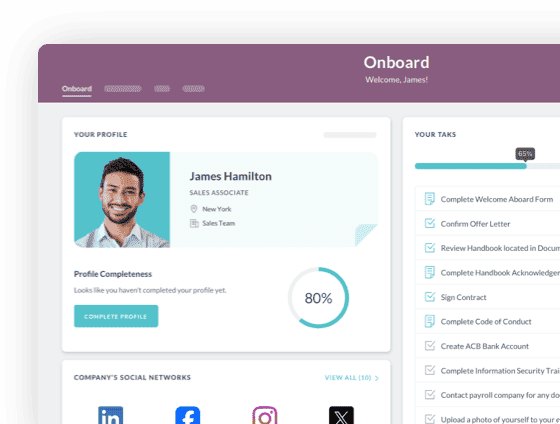
HR Cloud's Workmates platform helps HR teams centralize benefits documentation, automate enrollment workflows, and maintain audit-ready records. Teams handling dependent verification or ACA reporting use built-in task tracking to ensure no employee file is missing required documentation.
Explore HR Cloud's benefits administration tools or learn how our onboarding software collects and stores compliance documents from day one.
 Discover how our HR solutions streamline onboarding, boost employee engagement, and simplify HR managementBook Your Free Demo
Frequently Asked Questions
Q: Is a health insurance ID card sufficient proof of medical coverage?
A: In many cases, yes. An insurance ID card showing the plan name, member ID, and coverage dates is accepted for dependent verification and enrollment purposes. For ACA tax filing, IRS Form 1095-B or 1095-C is required.
Q: How long does an employer need to keep proof of coverage documents?
A: ERISA requires health plan records to be kept for at least six years. Many legal advisors recommend retaining ACA-related forms for seven years to align with IRS audit windows.
Q: What happens if an employee cannot provide proof of coverage for a dependent?
A: The employer may remove the dependent from the health plan until valid documentation is provided. Policies vary by carrier and employer, so HR should communicate deadlines clearly and document all outreach.
Q: Does proof of medical coverage differ from proof of insurance?
A: The terms are often used interchangeably for health coverage. In auto or property insurance contexts, proof of insurance refers to different documents. For HR and benefits purposes, both phrases typically mean documentation of active health plan enrollment.
Q: Can an employee use a prior employer's 1095-C as proof of coverage for a new employer?
A: A prior year 1095-C can verify past coverage but does not prove current active enrollment. A new employer requiring proof of current coverage should request a current insurance ID card, summary of benefits, or a letter from the prior carrier.
Keep Reading
AI in HR: The 2026 Opportunities, Challenges, and Implementation Playbook
According to Deloitte's 2026 Global Human Capital Trends report, which surveyed 9,000+
Why New Hires Still Feel Lost on Day One (And How an AI Onboarding Agent Fixes the Problem)
Only 12% of employees strongly agree their organization does a great job onboarding them.
7 Signs Your Employee Onboarding Process Is Costing You New Hires
Why do new hires who seemed like a great fit leave within 60 to 90 days?
In most cases,
Ready to streamline your onboarding process?
Book a demo today and see how HR Cloud can help you create an exceptional experience for your new employees.