AI-First HR Infrastructure: The Complete Guide to Building HR That Runs on Intelligence, Not Effort

You bought the AI add-on. You sat through the demos. You approved the budget. And now, six months later, your HR team is still drowning in the same onboarding paperwork, the same scheduling conflicts, and the same compliance checklists that never quite get done on time.
The problem isn't the AI. The problem is that you tried to bolt AI onto infrastructure that was never designed for it.
According to Deloitte's Modernizing HR research, HR professionals spend up to 57% of their time on administrative tasks — not because they lack tools, but because their tools were built for a different era. AI-first HR infrastructure is the discipline of rebuilding the underlying systems so AI-assisted workflows can actually function: the data pipelines, the workflow triggers, the role-specific guided agents, and the cross-function integrations that turn "AI-enabled" from a marketing claim into a measurable operational reality.
This guide defines that discipline. It maps the six infrastructure layers every mid-size HR team needs to get right, identifies where most organizations stall, and shows what genuine AI-first HR looks like in practice — not in a pitch deck.
Key Takeaways
- AI-first HR infrastructure is not a software purchase — it is a deliberate rebuild of six interdependent layers: data, workflow, agents, onboarding, scheduling, and compliance.
- According to a December 2025 Gartner survey of 197 senior executives, only 27% have a comprehensive AI strategy and just 20% believe their workforce is truly AI-ready — meaning most organizations are deploying AI on infrastructure that cannot support it.
- The most common failure point is Layer 1: organizations deploy AI before their HR data is clean, connected, or structured enough for AI-assisted workflows to act on reliably.
- AI agents are the bridge between infrastructure and outcomes — they guide employees, surface exceptions, and route tasks to the right people.
- Healthcare HR teams face a specific infrastructure challenge — onboarding and shift scheduling must be connected, not run in parallel.
- The Six Layers table maps each layer to its function, failure risk, and the AI capability it enables — use it as a diagnostic before your next technology decision.
- HR Cloud helps teams bring onboarding tasks, employee records, reminders, documents, credentials, and manager visibility into trackable workflows — across all key layers.
What "AI-First HR" Actually Means (and Why the Standard Definition Falls Short)
Most definitions of AI-first HR focus on mindset: leadership commitment, cultural openness to automation, willingness to experiment. That framing isn't wrong. It's just incomplete — and incomplete definitions lead to incomplete implementations.
AI-first HR, in practice, is an infrastructure decision. It means designing the systems, processes, data flows, and technology connections that HR runs on so that AI-assisted workflows can execute reliably — not occasionally, not in demos, not in one department — but consistently, at scale, across the full employee lifecycle.
Here is what distinguishes an AI-first HR operation from an organization that has simply added AI tools:
An organization with AI tools uses AI to assist individual tasks — drafting offer letters, summarizing survey results, generating onboarding content. The AI acts as a smarter writing assistant. The underlying workflows, handoffs, and data structures remain unchanged.
An AI-first HR operation has rebuilt the workflows themselves. New hire data flows automatically from the ATS into the onboarding platform. Compliance tasks trigger based on role and location, not on someone remembering to check a spreadsheet. Shift schedules connect to onboarding completion status so scheduling managers can see at a glance whether a new hire is cleared for a given role. AI-assisted workflows keep the process moving by triggering approved steps, surfacing exceptions, and helping HR intervene before work stalls.
The gap between those two states is not a mindset gap. It is an infrastructure gap.
Why this framing matters for HR leaders: The organizations stalling on AI ROI are not stalling because their people resist AI. A July 2025 Gartner survey of 2,986 employees found that 65% are excited to use AI at work, and a separate Gartner survey from October 2025 found that 77% take AI training when offered. The stall happens because the infrastructure cannot support the AI being deployed. Bad data, disconnected systems, and undefined workflow triggers produce unreliable outputs — and unreliable outputs erode trust faster than manual processes ever did.
Why Most HR Teams Are Not Infrastructure-Ready for AI
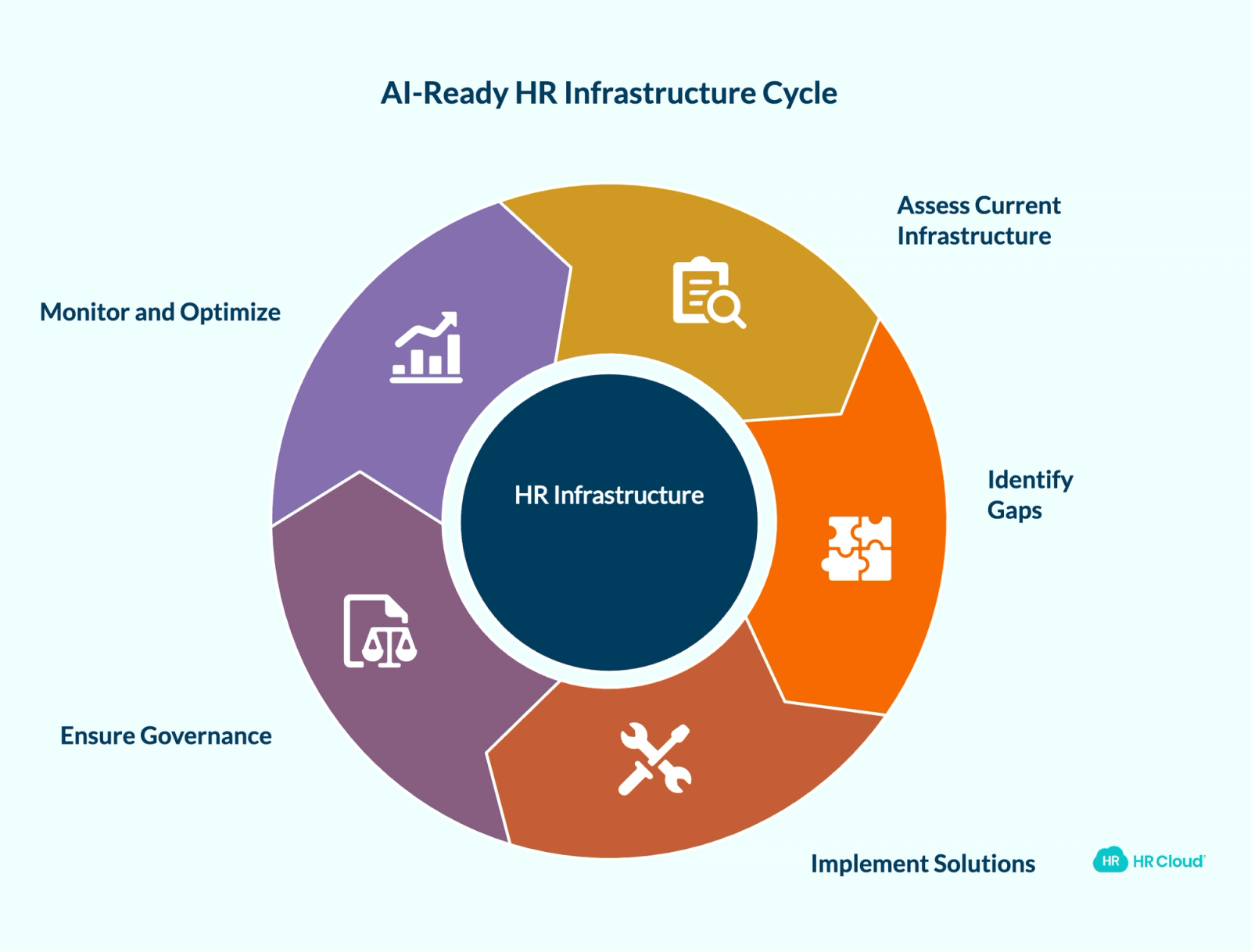
Before mapping the six layers, it is worth naming the structural gap honestly — because most AI-in-HR conversations skip this part.
The HR technology landscape was largely built between 2005 and 2018 on assumptions that no longer hold: that HR would remain primarily administrative, that compliance would remain jurisdiction-stable, that employee journeys would follow predictable linear paths, and that the primary bottleneck was data storage, not data intelligence.
AI-assisted workflows require the opposite. They require clean, connected, real-time data. They require workflow logic precise enough to execute without constant human re-entry. They require integration layers that pass context — not just records — between systems. And they require governance structures that define what AI can surface and route, what it flags for human review, and what a human must always decide.
According to ADP's 2025 internal analysis, "How Companies Do HR", governance for generative AI exists in only 20% of small businesses, roughly half of midsized companies, and about two-thirds of large enterprises. That means the majority of organizations deploying AI tools are doing so without the governance layer that makes AI-assisted outputs trustworthy.
This is the core infrastructure problem: AI is being deployed before the infrastructure conditions for reliable AI exist.
The six-layer framework below is a diagnostic. It helps HR leaders identify exactly which conditions are in place, which are partial, and which are missing — so the path to AI-first HR becomes an engineering decision rather than a hope.
Why Frontline HR Makes AI Infrastructure Harder
Most AI-first HR content is written as if every employee sits at a desk, checks email, and logs into a portal. The reality for healthcare workers, manufacturing teams, field crews, school staff, and retail and hospitality employees is fundamentally different — and it makes the infrastructure challenge harder at every layer.
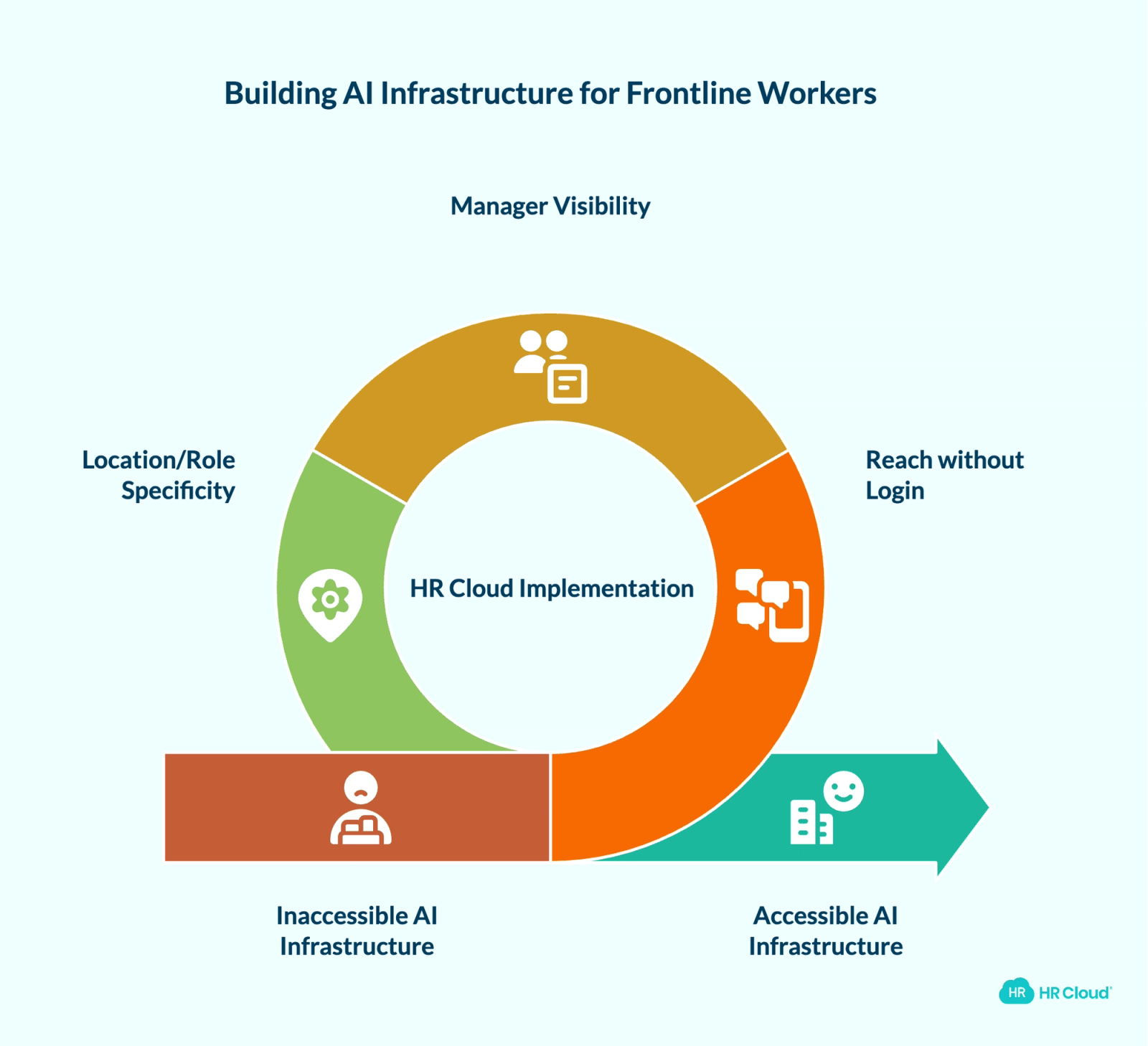
A nurse doesn't open onboarding tasks from a desktop inbox. A construction crew member doesn't check a portal for their shift assignment. A food service employee starting a 5 AM shift doesn't have IT help available if they can't access a link. For these workforces, AI-first HR infrastructure has to solve three additional problems that desk-based implementations don't face:
Reach without a login. Onboarding, reminders, document collection, and task completion need to work via SMS or mobile — not through portal URLs that assume email access and device setup that hasn't happened yet.
Manager visibility without system access. Floor managers, shift supervisors, and site leads need to know who is cleared to work, who has outstanding compliance tasks, and who has a scheduling conflict — often from a mobile device, without navigating a full HRIS.
Location and role specificity at every step. A healthcare worker in a cardiac unit has different credential requirements than one in a general ward. A construction worker on a federal project has different compliance documentation than one on a commercial site. AI-assisted workflows have to reflect those differences automatically — not rely on HR coordinators manually routing the right checklist to the right person.
This is the operational reality HR Cloud is built for. It is also why generic AI-in-HR implementations fail in frontline industries: the infrastructure layers look the same on paper but require fundamentally different execution on the ground.
Why frontline infrastructure failures are immediately visible: When a nurse starts a shift without completing required unit training, or a construction worker shows up without verified site certifications, the consequences are operational and compliance-affecting — not just administrative. That urgency is what makes getting the infrastructure right non-negotiable in these industries.
The Six Infrastructure Layers of AI-First HR
The Framework at a Glance
| Layer | Core Function | Common Failure Point | AI Capability Enabled |
|---|---|---|---|
| 1. Data Architecture | Clean, connected, real-time HR data | Fragmented HRIS, manual data entry | Accurate routing, workflow triggers |
| 2. Workflow Logic | Codified, conditional process rules | Tacit knowledge locked in people's heads | Guided routing, exception visibility |
| 3. AI Agents | Role-specific guided task execution | Generic chatbot on top of old processes | Onboarding guides, compliance reminders, scheduling alerts |
| 4. Onboarding Integration | New hire journey connected to downstream systems | Onboarding treated as an isolated event | Day-1 readiness, compliance task delivery, downstream triggers |
| 5. Scheduling & Workforce Coordination | Shift planning informed by HR state | Scheduling in a separate system from HR data | Role-aware, compliance-informed scheduling visibility |
| 6. Compliance & Governance | Continuous task monitoring with human review | Compliance treated as a periodic audit | Deadline alerts, missing-doc flags, organized audit records |
Layer 1: Data Architecture
No AI layer produces reliable outputs without reliable inputs. This is the layer most organizations underinvest in — and the one that most consistently limits results.
An AI-first HR data architecture has three properties:
Connected: Employee data moves automatically between systems. When a candidate moves to "hired" in the ATS, the HRIS record is created without manual re-entry. When a job title changes, compliance requirements and scheduling visibility update in tandem. When a shift is assigned, it connects to attendance and scheduling history in real time.
Clean: Data quality is actively governed, not periodically audited. Duplicate records are merged. Outdated fields are flagged. Standard taxonomies are enforced across systems so AI-assisted workflows see consistent inputs.
Real-time: Workflows acting on stale data surface the wrong exceptions and miss the right ones. Real-time data architecture means the system reflects current state — not last night's export.
Why this layer fails in frontline organizations: Frontline workers are frequently onboarded across multiple sites, with records created in different systems by different managers. The result is duplicate employee profiles, missing compliance history, and scheduling data that doesn't match HR records. Any AI-assisted workflow built on top of that data will reflect the same fragmentation.
Pro tip: Before evaluating any AI tool, audit your integration architecture. If new hire data requires manual entry in more than one system, Layer 1 is not ready. Fix the plumbing before adding the intelligence.
Layer 2: Workflow Logic
AI-assisted workflows can only automate processes that have been precisely defined. The second infrastructure layer is the discipline of codifying HR workflow logic — making explicit the rules, conditions, and decision trees that experienced HR professionals currently carry in their heads.
This is harder than it sounds. Ask ten HR coordinators "what happens when a new hire doesn't complete I-9 paperwork by Day 3?" and you'll get several different answers — a reminder goes out, the manager is notified, it depends on the state, it depends on the role. That variation is normal in a human-driven process. It is a blocker for AI-assisted automation.
An AI-first workflow layer requires clear trigger conditions (when does this process start?), defined actors (who does what?), explicit exception handling (what happens when the standard path breaks?), and documented decision rules (what criteria determine the outcome?).
For frontline workforces, workflow logic also has to account for communication channel. "Send a reminder" means something different when the employee has no corporate email — it needs to go via SMS, with a mobile-first completion path, not a portal login link.
Healthcare HR teams discover the complexity of workflow logic most sharply when trying to connect onboarding to shift scheduling — two processes that look simple individually but contain dozens of conditional rules when combined. That specific challenge is explored in depth here: How Healthcare HR Teams Connect Employee Onboarding and Shift Scheduling.
Why this matters for scaling: Organizations that invest in workflow codification don't just enable AI-assisted workflows — they also reduce HR manager variability and the institutional knowledge risk that comes from experienced staff leaving.

Struggling to Onboard Frontline Healthcare Staff?
See how healthcare HR teams streamline onboarding from day one.
- Standardize onboarding, training, and compliance
- Keep deskless staff informed without relying on email
- Improve readiness, retention, and time-to-productivity
Layer 3: AI Agents
AI agents are the execution layer — specific AI-assisted tools assigned to perform defined tasks within the workflow logic established in Layer 2. They are not a generic chatbot. They are role-specific, task-specific, and accountable to defined outcomes.
The distinction matters because the most common AI-in-HR failure is deploying a general-purpose AI assistant on top of unreconstructed workflows. General AI assistants are excellent at drafting, summarizing, and answering questions. Purpose-built HR agents are designed to guide — surfacing the next task for a new hire, flagging a missing document to an HR coordinator, alerting a scheduling manager before a compliance gap becomes a shift conflict.
In an AI-first HR operation, agents are assigned to specific functions:
- An onboarding agent guides new hires through their first 30 days — delivering tasks, answering role-specific questions, collecting documents, and alerting HR when a new hire stalls. HR Cloud's Maya AI onboarding agent is built specifically for this function, reaching employees via mobile and SMS — not just portal.
- A compliance reminder agent tracks task deadlines, surfaces missing documentation to the right HR owner, and organizes records for review — with HR making the final compliance judgment at every step.
- A scheduling visibility agent shows managers, before publishing shifts, whether assigned employees have completed required training and have no open compliance blockers.
Each agent operates within guardrails defined by Layer 2 — and routes exceptions to human reviewers for all decisions that require judgment. That governance structure is what separates trustworthy AI-assisted workflows from unpredictable ones.
For a detailed breakdown of how AI agents function inside HR software, where they add the most value, and where human oversight is essential: AI Agents for HR Software.
Why this layer is where AI-first HR becomes visible: When a new hire says "I always knew exactly what I needed to do next," or a manager can publish a shift schedule without manually calling HR to verify onboarding status, that is Layer 3 working correctly.
Layer 4: Onboarding Integration
Onboarding is the highest-stakes HR process for AI infrastructure — because it is the intersection point of every downstream system. A new hire's onboarding record connects to benefits enrollment, compliance documentation, payroll setup, role-specific training, IT provisioning, and — in industries like healthcare and manufacturing — shift scheduling and credential verification.
In most organizations, these handoffs are manual and sequential. HR completes onboarding. IT gets a ticket. Benefits enrollment is sent by email. The new hire starts their first shift having completed general onboarding paperwork but not the role-specific training their unit compliance requires.
An AI-first onboarding infrastructure changes the architecture: onboarding is not a phase that ends. It is a continuous data state that downstream systems read from. When an onboarding milestone is completed, the relevant downstream trigger fires automatically — benefits eligibility opens, credential verification initiates, the scheduling manager sees the new hire's cleared status update in the shift planner.
Here is what this looks like when the connection is in place: in organizations running connected platforms, scheduling managers no longer have to manually verify each new hire's onboarding status before assigning shifts. That verification happens through the system — the shift planner reflects onboarding completion state in real time. The manual check-and-call loop between HR and operations disappears.
For frontline organizations where that loop currently happens via text message, phone call, or whiteboard, the operational impact of removing it is immediate.
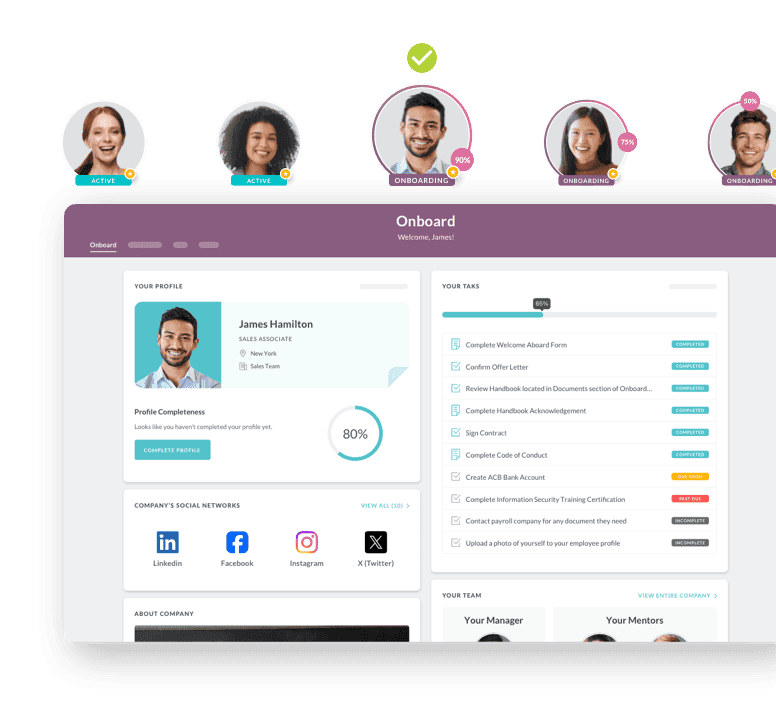
HR Cloud's employee onboarding platform is built with downstream integration in mind — connecting the new hire journey to the systems that need to act on it, rather than treating onboarding as a document-collection event with a defined end date.
The infrastructure test: If your onboarding system does not update downstream systems automatically when milestones are completed, you do not have AI-first onboarding infrastructure. You have a digital version of a paper process.
Download Comprehensive AI Onboarding Checklist
Most onboarding checklists tell you what to do. This one also tells you who does it, and when, so that nothing falls through the cracks.
Download Now
Layer 5: Scheduling and Workforce Coordination
Scheduling is the most underestimated HR infrastructure problem — particularly for industries with frontline, shift-based, or credentialed workforces. Healthcare, manufacturing, construction, retail, and food service organizations often run capable HRIS systems alongside scheduling tools that have no data connection to them.
The result is predictable: new hires get scheduled before their onboarding is complete, employees are assigned to roles requiring credentials that haven't been verified, and overtime accumulates because managers don't have real-time visibility into hours already logged across the organization.
An AI-first scheduling layer requires three things working together:
HR state visible to scheduling. The shift planner can show — before a shift is published — whether an employee is onboarded, credentialed, and cleared for their assigned role. This is not automated enforcement. It is visibility that helps managers make better decisions faster.
Role and location rules built in. Different roles, sites, and jurisdictions have different compliance requirements. Those rules should be reflected in the scheduling system automatically, not checked manually against a separate policy document.
Exception alerts before the shift runs. Overtime thresholds, credential gaps, and scheduling-law requirements surface before they become payroll or compliance problems — while there is still time to act.
HR Cloud's Shift Planner is designed to work alongside HR Cloud's onboarding and HRIS data — giving scheduling managers the employee status visibility they need without requiring a separate system-check call to HR.
The scheduling-to-onboarding connection is especially critical in healthcare, where unit-specific training and patient-ratio regulations mean a deployment error has direct operational consequences. Full breakdown:How Healthcare HR Teams Connect Employee Onboarding and Shift Scheduling
Layer 6: Compliance and Governance
Most organizations treat compliance as a destination — an audit you prepare for — rather than a continuous state the system actively tracks. That framing is both operationally expensive and increasingly risky as regulatory complexity grows across jurisdictions.
An AI-first compliance layer is always tracking, not periodically reviewing. It means:
- Compliance tasks trigger automatically based on role, location, and employment type — not based on an HR coordinator remembering to add them to a checklist
- Missing or expiring documentation is flagged to the right HR owner before it becomes a violation — with a human responsible for resolution at every step
- Records are organized in a reviewable, audit-ready format as a byproduct of normal workflow, not assembled under pressure before each audit
- AI surfaces the risk; HR owns the decision
For healthcare organizations, credential tracking sits at the center of this layer. License expirations, unit-specific certifications, and background check requirements need continuous monitoring — not annual audits.
The governance dimension of this layer is where many AI-in-HR implementations fail. According to a Gartner survey of infrastructure and operations leaders published April 2026, poor data quality and skills gaps are the two most common causes of AI project failure. In compliance contexts, those failures carry legal and financial consequences — which is why defining exactly where AI surfaces a risk and exactly where a human must decide is foundational, not optional.
HR Cloud's HR automation tools support this layer by automating the task-routing and reminder workflows — while keeping HR in control of every compliance decision.
The governance boundary: AI should surface, organize, and alert. HR should review, decide, and document. That boundary, clearly defined, is what makes AI-assisted compliance trustworthy.
Industry-Specific Infrastructure Considerations
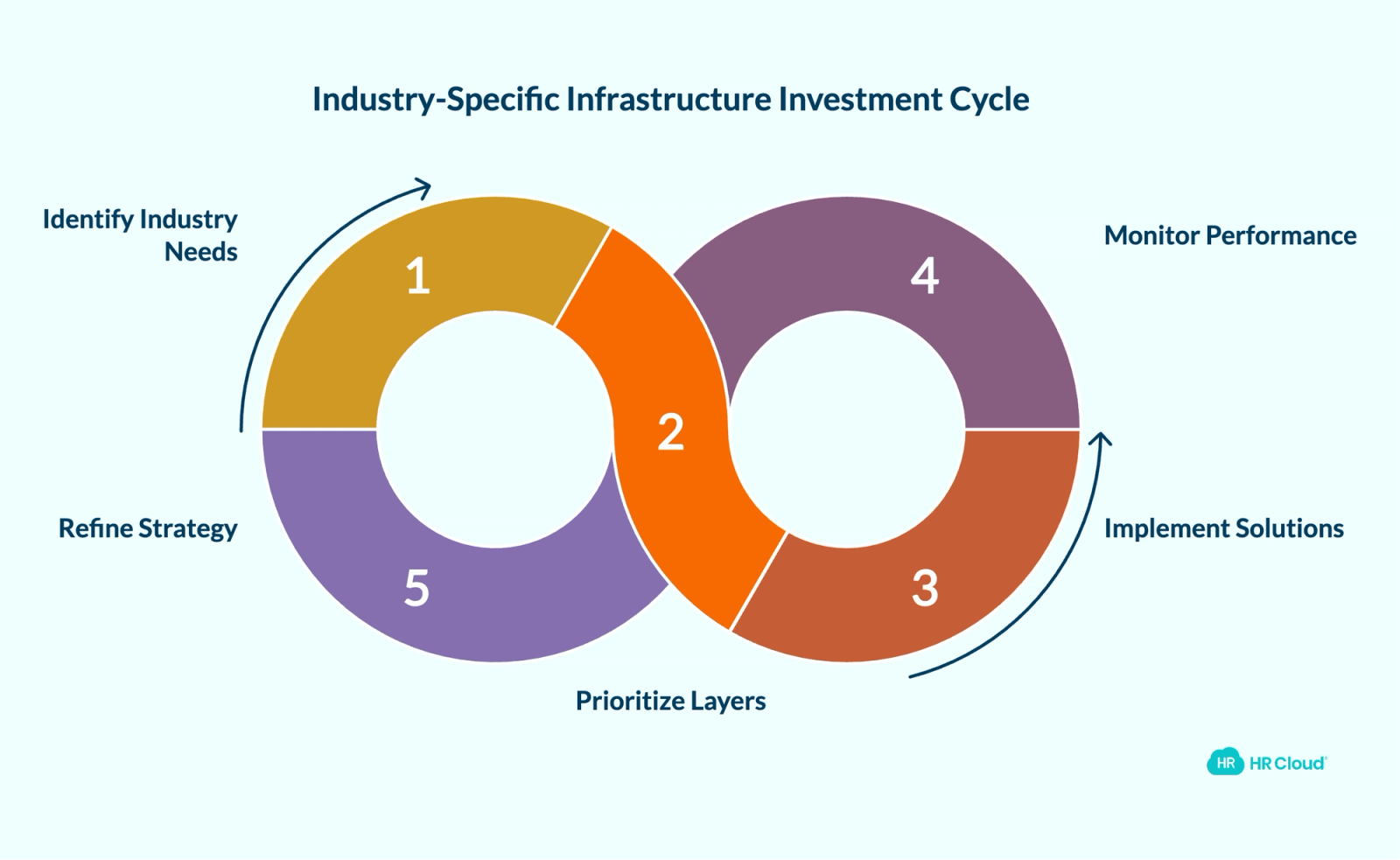
Not all six layers require the same depth of investment across industries. The industries with frontline, shift-based, or credentialed workforces face the steepest infrastructure challenges — because the consequences of disconnected systems are immediately operational.
Healthcare: The onboarding-to-scheduling connection is mission-critical. Credential verification, unit-specific compliance, and patient-ratio regulations mean a new hire cannot be deployed without completing specific onboarding milestones — and that status needs to be visible to scheduling in real time, not confirmed by phone call.
Manufacturing: Layer 2 (workflow logic) and Layer 6 (compliance) carry the most weight. Role-specific safety certifications, OSHA documentation requirements, and shift-based workforce planning create compliance complexity that manual processes consistently fail to maintain at scale.
Construction: Workforce composition changes frequently — subcontractors, project-based hires, multi-site crews. Layer 1 (data architecture) is the primary challenge: employee records are often duplicated or incomplete across projects, making AI-assisted workflows unreliable without a foundational HRIS rebuild first.
Retail and Food Service: Layer 5 (scheduling) is the highest-impact entry point. Labor law compliance across states, high hourly workforce turnover, and predictive scheduling requirements make scheduling visibility the fastest path to measurable operational improvement.
Education: Layer 3 (AI agents) and Layer 4 (onboarding integration) matter most. Seasonal hiring waves, high adjunct and substitute turnover, and credential requirements for different roles make automated onboarding task delivery — especially via mobile — a practical necessity, not a luxury.
The 3 Mistakes That Stall AI-First HR Infrastructure Programs
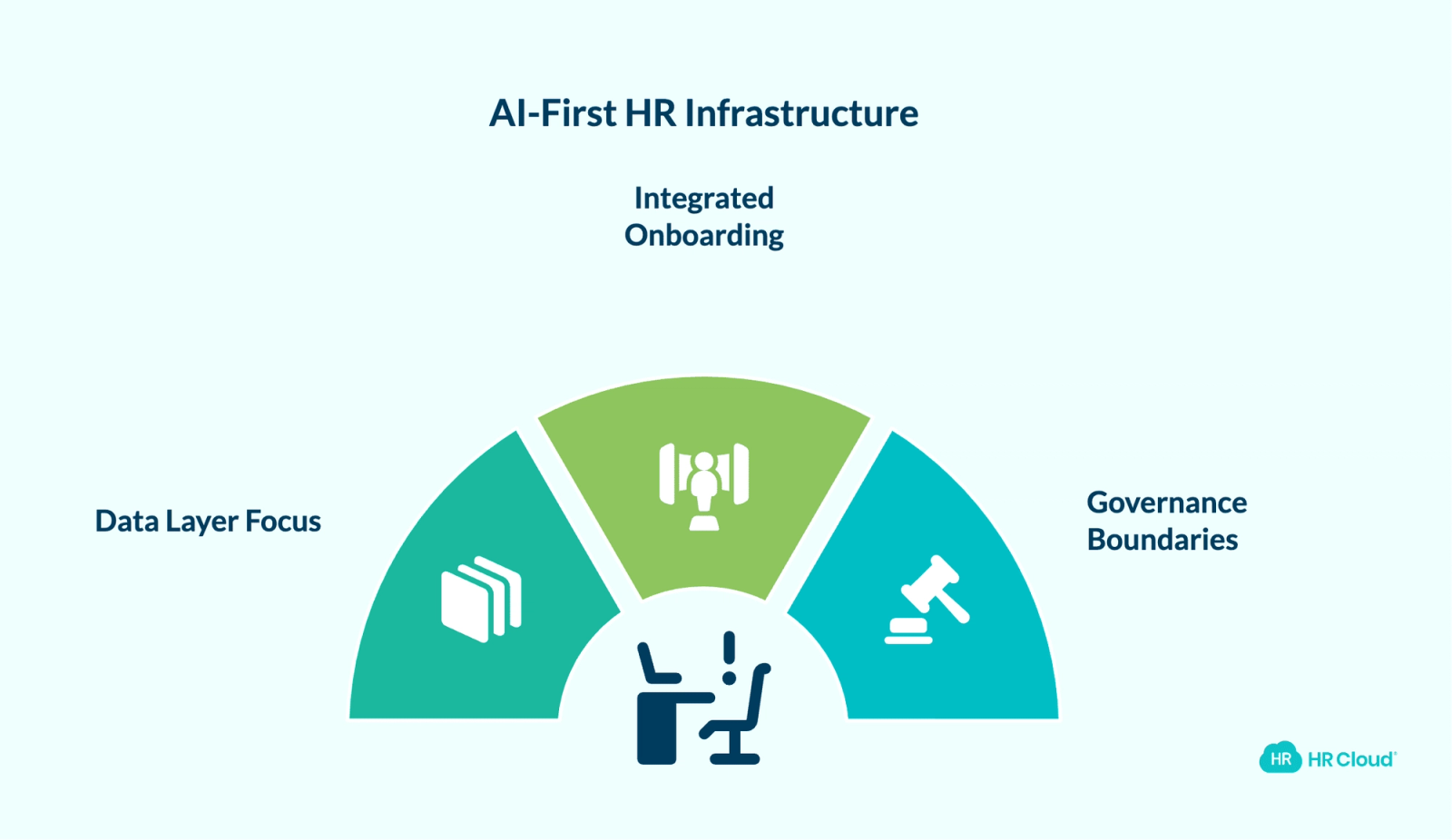
Mistake 1: Starting with the AI layer instead of the data layer
Every AI-first HR project that stalls follows the same arc: a promising AI tool is deployed, produces inconsistent results because the data feeding it is fragmented, erodes trust among HR staff who catch the errors, and gets quietly abandoned. The discipline reversal — cleaning data and defining workflow logic before deploying agents — is uncomfortable because it doesn't produce a demo-ready outcome quickly. But it produces outcomes that last.
Mistake 2: Treating onboarding as a standalone process
Onboarding that isn't connected to downstream systems is digital paperwork. The investment in onboarding technology compounds only when onboarding data becomes the source of truth for scheduling, compliance, and benefits systems. HR teams that evaluate onboarding tools in isolation — without mapping the integrations those tools need to support — often find themselves rebuilding 18 months later. Use HR Cloud's Onboarding ROI Calculator to understand the full cost of your current disconnected approach before making a platform decision.
Mistake 3: Deploying AI without governance boundaries
The organizations most likely to lose trust in AI-first HR are the ones that deployed AI without defining what it can surface independently and what a human must always review. When an AI-assisted workflow makes a routing decision that turns out to be wrong in a compliance context — without a human in the loop — the failure becomes a long-term case against AI adoption in that organization. Build the governance boundaries first. They don't slow AI-assisted workflows down. They make them trustworthy.
Measuring AI-First HR Infrastructure: The Metrics That Matter
Most organizations measure AI in HR by adoption metrics — sessions logged, tasks completed, features used. Adoption is not ROI. These are the metrics that indicate whether the infrastructure is working:
| Metric | What It Measures | What to Track |
|---|---|---|
| Time-to-productivity for new hires | Onboarding infrastructure effectiveness | Trend vs. pre-platform baseline; look for consistent reduction |
| HR admin time as % of total HR hours | Workflow automation effectiveness | Track quarterly; Deloitte benchmarks current state at 57% for most organizations |
| Compliance task completion rate before deadlines | Compliance layer effectiveness | Track unresolved exceptions by age, owner, and severity |
| Scheduling fill rate without manual HR escalation | Scheduling layer effectiveness | % of shifts confirmed without manager calling HR to verify onboarding status |
| Onboarding task completion rate by Day 3 / Day 7 | Agent and onboarding layer effectiveness | Track completion velocity, not just final completion rate |
| Cross-system data consistency | Data architecture effectiveness | Measure mismatch rate between HRIS, onboarding, and scheduling records monthly |
The most useful single diagnostic is this: can HR leadership answer, right now, "which active employees have open compliance tasks past their deadline?" In an AI-first infrastructure, that answer takes seconds. In a traditional operation, it takes hours — and the answer is always slightly out of date.
How to Turn AI-First HR Infrastructure Into Action
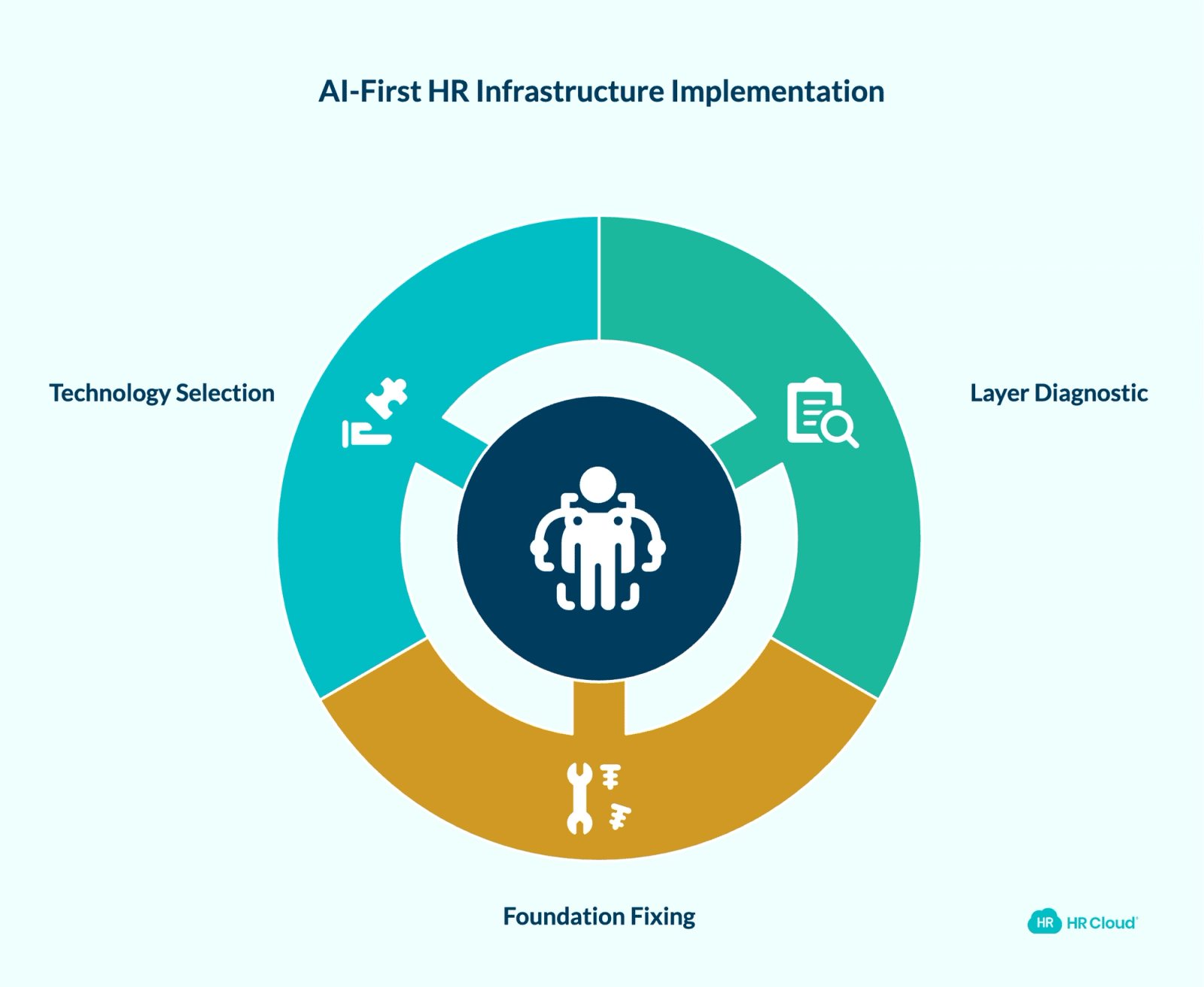
Step 1: Run a Layer Diagnostic in the Next Two Weeks
Use the six-layer table in this guide as an audit template. For each layer, score your current state: Not in place / Partial / Functional / AI-ready. Be specific. "We have an HRIS" does not mean Layer 1 is AI-ready. "Our HRIS updates in real time when a new hire completes onboarding and that status is visible in our shift planner" is Layer 1 progress. The diagnostic tells you exactly where to invest first — and which layers to stabilize before adding AI-assisted tools on top of them.
Step 2: Pick One Layer and Fix the Foundation Properly
The most common mistake is trying to upgrade all six layers simultaneously. The most consistent successful pattern is picking the layer that is both highest-impact and most practically fixable in 90 days — typically Layer 1 or Layer 2 — and completing it. For most mid-size organizations, that means auditing data connections between core HR systems and closing the manual handoff gaps. The test: could a new hire reach Day 3 without any HR staff manually re-entering their information into a second system?
Step 3: Choose Technology That Connects the Layers, Not Just One of Them
The real test is not whether a vendor says "integrated." It is whether a manager can see, before publishing a shift, whether that employee is actually cleared to work. Ask every vendor you evaluate that specific question. The ones who can answer it with a live demo have built the infrastructure. The ones who redirect to feature lists have not.
The Infrastructure Is the Strategy
Most HR leaders know what they want AI to do. They want onboarding to keep moving without someone chasing every missing document. They want scheduling managers to stop calling HR to ask if a new hire is cleared. They want compliance to be a continuous state their system tracks, not a quarterly fire drill. They want their team focused on the work that requires judgment — not the work that requires someone to remember to send an email.
None of that happens with an AI tool bolted onto legacy infrastructure. It happens when the infrastructure is designed — deliberately, layer by layer — to support the intelligent workflows you're trying to run.
See how HR Cloud helps HR teams turn scattered onboarding, scheduling, document, and compliance tasks into workflows they can actually track — before Day 1, on mobile, without portal dependency. Book a Free Demo

Discover how our HR solutions streamline onboarding, boost employee engagement, and simplify HR management
Book Your Free DemoFrequently Asked Questions
What is AI-first HR infrastructure?
AI-first HR infrastructure is the system design underlying an HR operation — the data architecture, workflow logic, integration layers, and governance structures — that enables AI-assisted workflows to execute HR tasks reliably at scale. It is distinct from adding AI tools to existing HR systems: it requires rebuilding the underlying infrastructure so AI-assisted processes can act on clean, connected, real-time data rather than producing inconsistent outputs from fragmented inputs.
How is AI-first HR different from HR automation?
HR automation typically refers to rule-based process execution — sending a welcome email, generating a compliance report on a schedule, or routing a form to the right approver. AI-first HR goes further: it uses intelligent agents to handle variable conditions, surface the right exception to the right person, personalize the onboarding task sequence for each role, and flag scheduling conflicts before they become payroll problems. Automation removes manual steps; AI-first infrastructure adds guided intelligence within those steps.
What does an AI-first HR organization look like in practice?
In a mature AI-first HR operation, a new hire's onboarding completion status is visible to scheduling managers in real time. Compliance tasks fire automatically based on role, location, and employment type. Scheduling managers can see which employees are cleared to work before publishing shifts — without calling HR. New hires in frontline roles receive onboarding tasks via SMS, not portal email. HR professionals spend the majority of their time on judgment-intensive work because the infrastructure handles the routing, reminders, and exception-flagging.
How long does it take to build AI-first HR infrastructure?
The timeline depends on the current state of data architecture and system integration. Organizations starting from a highly fragmented technology stack typically need 12–24 months to establish Layers 1 and 2 before AI-assisted workflows produce reliable results. Organizations already on integrated platforms with clean data can see meaningful operational improvement in the first quarter after deployment. The right diagnostic question is not "how fast can we add AI?" but "how connected and clean is the data our AI will act on?"
What HR functions benefit most from AI-first infrastructure?
The highest-ROI functions are typically onboarding (faster time to productivity, automated compliance task delivery), scheduling (reduced manual verification, better fill rates), and compliance monitoring (continuous task tracking rather than periodic audits). These three functions are high-frequency, high-consequence, and directly visible to operations — making them the strongest candidates for AI-first infrastructure investment.
How do I know if my HR technology vendor is truly AI-first?
Ask three questions. First: "Does your platform make onboarding completion status visible to scheduling managers in real time — or does that require a manual check or export?" Second: "Do you have purpose-built AI agents for specific HR tasks, or a general AI assistant layer?" Third: "What governance controls determine when AI routes or alerts autonomously versus when a human must confirm?" Vendors with genuine AI-first architecture will answer all three specifically. Vendors with AI-adjacent marketing will redirect to feature lists.
About the author

Keep Reading


Like What You Hear?
We’d love to chat with you more about how HR Cloud® can support your business’s HR needs.
Book Your Free Demo