
100 Icebreaker Questions for Work That Build Lasting Team Connections

Your Monday all-hands is two minutes away. Thirty-one people on the call. Three cameras on. Someone's kid is yelling in the background. You open with "How was everyone's weekend?" and get back exactly what you deserve: one "Good," one thumbs-up emoji, and twenty-nine people staring at their second monitor.
We've all been in that meeting. And we've all concluded the same thing: icebreakers don't work.
Except that's wrong. Bad icebreakers don't work. The right question, asked at the right moment, does something no team-building offsite or Slack emoji can replicate. It makes people feel like they're working with actual humans.
Gallup's research puts a number on this. According to their Q12 engagement research, employees without a best friend at work have a 1 in 12 chance of being engaged in their job. One in twelve. Meanwhile, Gallup's 2025 State of the Global Workplace report shows global engagement has fallen to just 21%, costing the world economy $438 billion in lost productivity last year alone.
You can't force friendships. But you can create the conditions where they form. That starts with better questions.
This guide gives you 100 of them, sorted by exact use case, plus the five mistakes that make icebreakers backfire, and practical advice on using tools like HR Cloud's Workmates to keep those connections alive between meetings.
Why Building Team Connections Is a Business Problem, Not a Vibes Problem
Skip the motivational poster version. Here's the business case in plain language.
Gallup's Q12 engagement survey has tracked millions of employees across decades. "I have a best friend at work" is one of twelve items on the survey, and it's consistently one of the strongest predictors of performance, retention, and safety outcomes. Not "I have a friend." Not "I get along with people." A best friend. The extreme wording is intentional. Gallup tested softer versions ("close friend," "good friend") and they didn't predict performance the way "best friend" does.
That tells you something important: surface-level pleasantries between colleagues don't move the needle. Actual relationships do.
And those relationships pay for themselves. Research from SHRM and Bersin by Deloitte shows organizations with strong recognition cultures, which almost always include consistent team-connection practices, see 31% lower voluntary turnover. If your average turnover replacement cost is $35,000 per employee, a 100-person team saving even 5 departures per year keeps $175,000 in the budget.
This isn't about making work "fun." It's about building the psychological safety that makes honest feedback, faster onboarding, and real collaboration possible. Icebreaker questions are the lowest-cost, lowest-effort way to start.
5 Icebreaker Mistakes That Actually Damage Team Trust
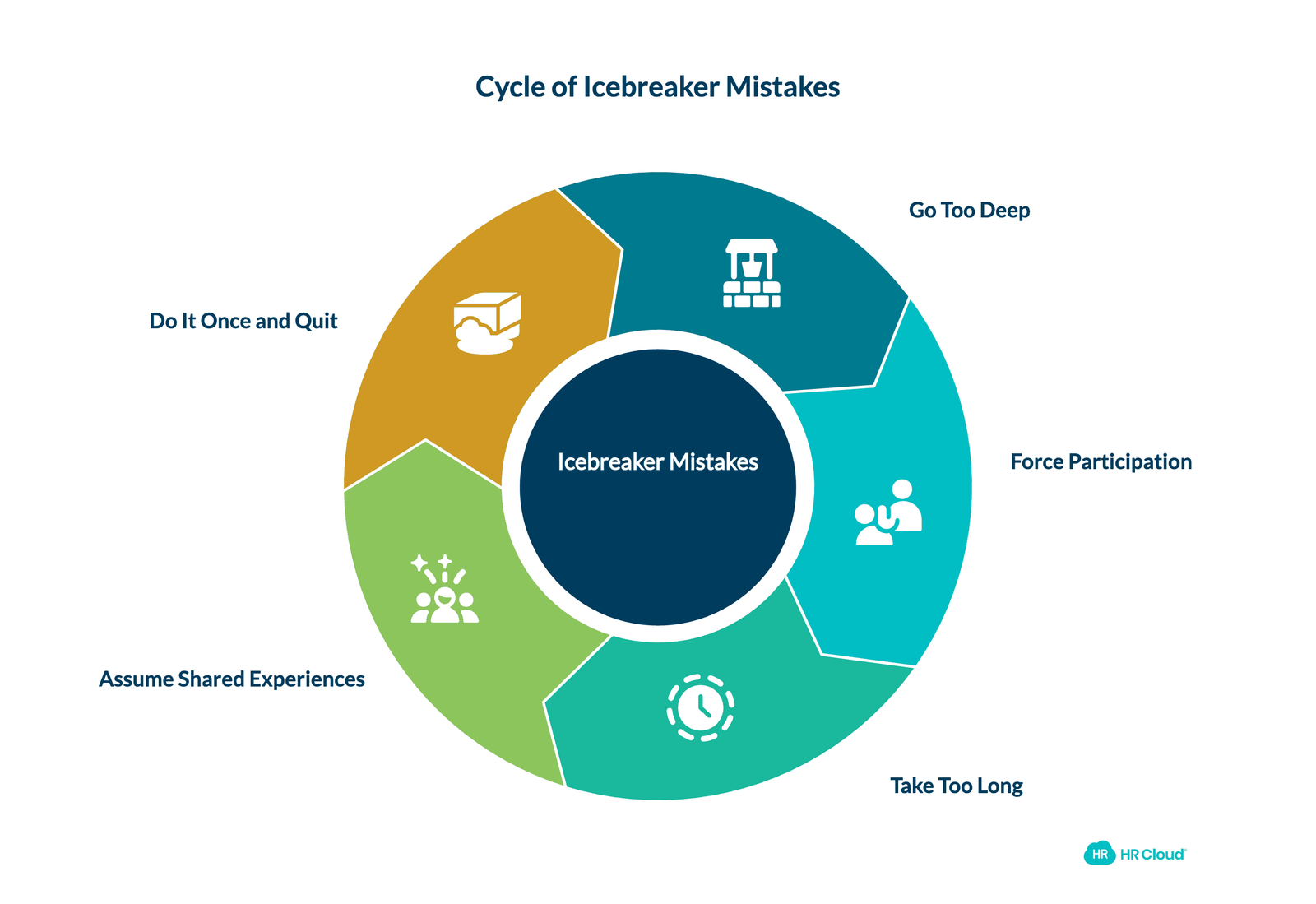
Before we get to the 100 questions, let's talk about what goes wrong. Because a bad icebreaker doesn't just waste time. It actively erodes trust. If your team groans when they hear the word "icebreaker," one of these is probably why.
Mistake 1: Going Too Deep, Too Early
"What's your biggest fear?" is not an appropriate question for a Tuesday standup with people you met two weeks ago. Depth requires trust. Trust requires time. Match the question to the level of relationship that already exists. New teams get either/or preferences. Teams with six months of shared work can handle reflection questions. Save the vulnerable stuff for established groups in dedicated settings.
Mistake 2: Forcing Participation
The moment icebreakers become mandatory, they stop building connection and start building resentment. Introverts aren't broken. Not everyone processes out loud. Offer written alternatives, make verbal sharing optional, and never cold-call someone who hasn't volunteered. The goal is an open door, not a shove through it.
Mistake 3: Taking Too Long
The 10% rule works well here: your icebreaker should take roughly 10% of total meeting time. A 30-minute meeting gets 3 minutes of icebreaker. A 60-minute meeting gets 5 to 8. If your icebreaker takes 20 minutes in a 45-minute meeting (yes, this happens), people aren't connecting. They're waiting.
Mistake 4: Asking Questions That Assume Shared Experiences
"What's your favorite Super Bowl snack?" excludes anyone who didn't grow up watching American football. "What's your family's holiday tradition?" can feel loaded for people with complicated family dynamics. The best icebreakers are universal: anyone can answer them, and no answer feels "wrong." Every question in the list below passes this test.
Mistake 5: Doing It Once and Quitting
One icebreaker at the annual offsite doesn't build culture. It fills five minutes. Connection is a practice, not an event. Weekly consistency, even with a 30-second rapid-fire question, compounds into something real over months. Teams that commit to icebreakers for 12 weeks see measurably different communication patterns. Teams that try it twice and stop see nothing.
100 Icebreaker Questions to Build Team Connections (Sorted by Use Case)
New Employee Onboarding (Questions 1-10)
First-week energy is fragile. These help new hires introduce themselves as people, not just job titles, without being put on the spot.
1. What caught your attention about this role when you first saw the posting?
2. What's one thing you want to accomplish in your first 90 days?
3. How do you prefer to receive feedback: real-time, scheduled, or written?
4. Describe your ideal way to collaborate on a project.
5. What's a project from your previous role that you're most proud of?
6. What type of work gives you the most energy?
7. What should the team know about how you do your best thinking?
8. If you could develop one new professional skill this year, what would it be?
9. What does a realistic work-life balance look like for you?
10. What about this team made you say yes to the offer?
How to use these: Build them into your automated onboarding workflows as a pre-boarding checklist item. New hires answer on their own time, and their responses get shared with the team before day one. By the time they log on, they've already been introduced as a person. Not a headcount.
Virtual and Hybrid Team Meetings (Questions 11-20)
Remote workers miss the casual hallway moments that naturally build connection. You have to create those moments intentionally, or they don't happen.
1. What's one thing in your workspace that tells a story?
2. Dream remote setup vs. current reality. How big is the gap?
3. What's the best part of working from home that nobody talks about?
4. Does your coffee mug have a backstory? Show us.
5. What's the most random object within arm's reach right now?
6. If you could work from any city for one month, where?
7. What's the biggest remote work challenge you've actually solved?
8. Introduce your office assistant: pet, plant, or desk mascot.
9. What's your non-obvious trick for staying focused at home?
10. What would the team know about you if we all shared an office?
How to use these: Post one question per week in a dedicated channel on your employee engagement platform so people across time zones can respond when they have a minute. This works especially well for frontline healthcare and manufacturing teams who can't drop into a video call mid-shift.

30-Second Questions for Daily Standups (Questions 21-30)
No prep. No thinking time. Just enough to remind everyone there's a real person behind the Slack avatar.
1. Coffee or tea?
2. Early bird or night owl?
3. Sweet tooth or savory snacker?
4. Beach trip or mountain cabin?
5. Pancakes or waffles? (This will divide your team.)
6. Dog person, cat person, or neither?
7. Learn from books or podcasts?
8. Sunrise or sunset?
9. For a quick question: call, message, or email?
10. Work with music or work in silence?
Why these work: They cost zero meeting prep and almost zero time, yet they consistently surface surprising common ground. We've seen the "pancakes or waffles" question generate more Slack engagement than planned team activities.
Deep Questions for Team Offsites (Questions 31-40)
You've blocked the calendar. People flew in. Use the time for questions that build the kind of trust that makes hard conversations easier for months afterward.
1. What professional setback shaped how you approach your work now?
2. Who changed the direction of your career, and what did they do?
3. What's a mistake that taught you something you couldn't have learned any other way?
4. When a project hits a wall, what's the thing that keeps you going?
5. What would you tell your five-years-ago self about work?
6. What goal are you chasing right now that has nothing to do with your job title?
7. Describe a moment in your career where you felt like you were doing exactly what you were meant to do.
8. How do you personally define success in your current role?
9. What's a belief about work you held strongly a year ago that you've since questioned?
10. If you could apprentice under anyone, any field, who?
How to use these: After someone shares a challenge, invite the room to send peer-to-peer recognition acknowledging what they went through. It takes a good conversation and turns it into something people remember.
Lighthearted Energy Boosters (Questions 41-50)
For the meetings where everyone clearly needs a reset before anything productive can happen.
1. What's your karaoke song? And would you actually perform it for us right now?
2. Dinner with any fictional character. Who are you choosing and what are you ordering?
3. What TV show consumed your entire childhood?
4. If you could become world-class at any hobby overnight, which one?
5. What food combination do you love that other people find disturbing?
6. You get one superpower, but it only works for boring everyday tasks. What is it?
7. What fashion choice from your past do you most regret?
8. One cuisine, rest of your life. What is it and why?
9. What's your most strongly held opinion about something that genuinely does not matter?
10. If animals could talk, which species would be the most insufferable?
Why humor matters: Shared laughter is the fastest shortcut to psychological safety. It's also the quickest way to flatten hierarchy. When the VP admits their karaoke song is "Dancing Queen" and their regrettable fashion choice was a fedora phase, something shifts in the room. People stop performing and start being present.
Work-Style Questions That Improve Actual Collaboration (Questions 51-60)
These aren't hypothetical. The answers change how you work together starting tomorrow.
1. What's the single best piece of career advice you've received?
2. Regular check-ins, async updates, or co-working sessions: how do you prefer to collaborate?
3. Describe your perfect meeting: length, format, time of day.
4. When you're stuck on a problem, what's your first move?
5. What work win from this quarter are you most proud of?
6. How does your team currently celebrate wins? How should it?
7. What's one condition you need to do focused work?
8. If you could change one thing about how this team collaborates, what would it be?
9. What productivity tool or hack has actually changed how you work?
10. When you're overwhelmed, what helps you come back to baseline?
How to use these: Take the answers seriously. If someone says they need two hours of uninterrupted focus time in the morning, protect it. Use these insights to personalize your recognition and rewards too. Knowing what someone values makes every acknowledgment land with more weight.
Personal Connection Questions (Questions 61-70)
These invite people to share something about who they are outside of work. Always voluntary. Always.
1. What hobby or interest has your full attention right now?
2. Tell us about a trip that changed how you see something.
3. Recommend one book, podcast, or show to the team. Go.
4. What's something that would surprise most people who know you professionally?
5. Who has had the single biggest influence on who you are?
6. What are you looking forward to in the next three months?
7. If you could wake up tomorrow with one skill you don't currently have, what would it be?
8. What's a tradition, ritual, or routine that's meaningful to you?
9. What's your "fun fact" that actually surprises people?
10. What does your ideal Saturday look like, start to finish?
Boundary note: Not everyone has the same comfort level with personal disclosure, and that's fine. The best icebreakers create space. They don't assign homework.
Reflection Questions for Performance Conversations (Questions 71-80)
These shift 1:1s and quarterly reviews from evaluation mode to growth mode. Big difference in what you hear back.
1. What have you learned about yourself as a professional this quarter?
2. What project or task gave you the most energy recently? Why that one?
3. What skill feels like the highest-leverage one for you to develop next?
4. How have your priorities shifted since we last had this conversation?
5. Where do you need more support that you're not getting?
6. What piece of feedback has been most useful to you recently?
7. How do you want your role to look different a year from now?
8. What's working well that we should actively protect?
9. If you could redesign one aspect of your daily work, what would you change?
10. What does "a great year" look like for you from where you're sitting right now?
Manager tip: Answer first. Every time. When leaders go first with honest reflection, it signals that vulnerability is expected, not penalized. Pair this with performance management tools that capture these conversations so the insights don't vanish when the meeting ends.
Creative Questions for Brainstorming Sessions (Questions 81-90)
When you need fresh thinking, sometimes the best entry point is a question that seems totally unrelated to the problem.
1. If you could fix one problem in our industry, what would it be?
2. What's an idea you've been sitting on but haven't brought to the team?
3. What practice from a completely different industry should we adopt?
4. What risk do you think this team should take that we haven't?
5. If you could invent one tool to eliminate your most repetitive task, what would it do?
6. What trend or technology in our space are you most curious about right now?
7. Unlimited budget, one initiative. What do we fund?
8. What assumption does our team operate on that might actually be wrong?
9. If you could redesign one of our processes from scratch, which one?
10. What idea from completely outside our world has stuck with you lately?
How to use these: Don't let good ideas die in the meeting. Post them in a dedicated communication channel where people can build on each other's thinking. The best insights often come from the quiet person who thinks of something 48 hours later.
“We highly recommend Workmates as it gives us the ability to communicate and connect our workforce.”

— Andrea Bermudez, Organizational & Talent Development Manager

Inclusive and Cultural Questions (Questions 91-100)
Celebrate the range of experiences on your team. Never tokenize. Always voluntary.
1. What's a tradition or holiday you enjoy sharing with people outside your culture?
2. Teach the team one word or phrase from another language. What are you picking?
3. What's a dish from your family or culture that everyone should try at least once?
4. What's something about where you grew up that shaped how you see the world?
5. If you could take the team on a trip to experience your culture firsthand, where?
6. What value from your background shows up in how you work?
7. What's a common misconception about your culture that you'd set straight?
8. Share a memory from a celebration or tradition that means something to you.
9. What's something you value about working with people from different backgrounds?
10. If you could give the team one experience from your heritage, what would it be?
Inclusion note: The point is celebration, not education. Never ask someone to be the spokesperson for their entire culture or background. Create space. Don't assign roles.
How to Build Team Connections That Last Beyond the Meeting
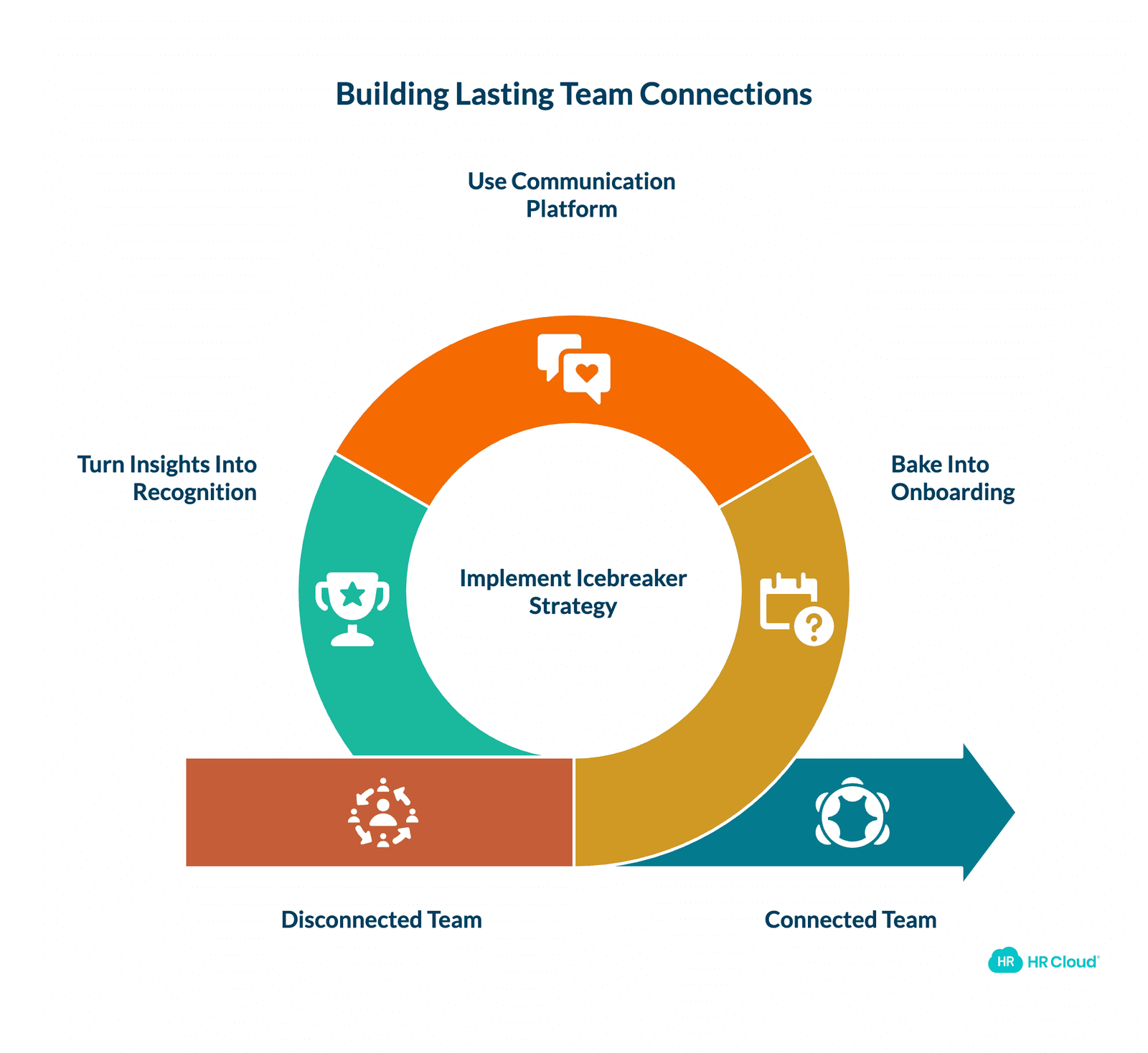
Asking good questions once changes nothing. Making them part of how your team operates changes everything. Here's what that actually looks like.
Bake Icebreakers Into Onboarding From Day Minus Seven
The best onboarding experiences don't wait for the start date. With automated onboarding workflows, you can send three icebreaker questions a week before day one. New hires respond at their own pace. Their answers get shared in the team channel. By the time they show up, they've already been introduced as a real person. Not a headcount on the org chart.
Include an icebreaker task in the onboarding checklist itself: "Record a 60-second video answering: What should this team know about how you do your best work?" Pair each new hire with a buddy and give them three specific questions to discuss in their first week that go beyond logistics.
Use Your Communication Platform to Scale It
One icebreaker in one meeting creates one moment. A platform like Workmates turns that moment into a daily habit.
What works:
- When icebreakers reveal shared interests, create interest-based channels. Someone mentioned trail running? Start #runners. Let it grow organically.
- Post a weekly question in team channels for asynchronous participation. This matters most for frontline workers in healthcare, manufacturing, and construction who can't join live video calls.
- Use mobile-first tools. If the icebreaker only works on desktop, you're connecting the people who need it least and missing the ones who need it most.
- Connect icebreaker insights to recognition. You learned a colleague cares about mentorship? Call it out publicly the next time they take 30 minutes to help a junior team member.
What It Looks Like in Practice
Here's what Daniella Nickerson, Human Resources at Toyota Material Handling, said after rolling out Workmates across their teams:
"One of the biggest benefits from using Workmates platform is that our associates are more connected to both the company and each other. Associates can comment, react, and provide feedback directly through the platform from their smartphone or desktop devices."
That's the outcome. Not forced fun. Not awkward silence. A platform where the connections that start in icebreaker moments keep growing through daily interaction, recognition, and real communication.
Turn Icebreaker Insights Into Better Recognition
This is where most teams leave value on the table. Everything you learn about colleagues through icebreakers is exactly what makes recognition and rewards more personal.
Generic praise ("Great job!") is white noise. Specific, personal recognition ("Your attention to the compliance details on this project was exceptional. I know thoroughness matters to you.") actually sticks. Use what icebreakers teach you to make every acknowledgment feel like it came from someone who was paying attention. Because it did.
Personalize rewards the same way. Someone training for a marathon gets fitness gear options. Someone who recommended a great book to the team gets a bookstore gift card. The math is simple: know people, appreciate them well.
How to Know If Your Icebreakers Are Working
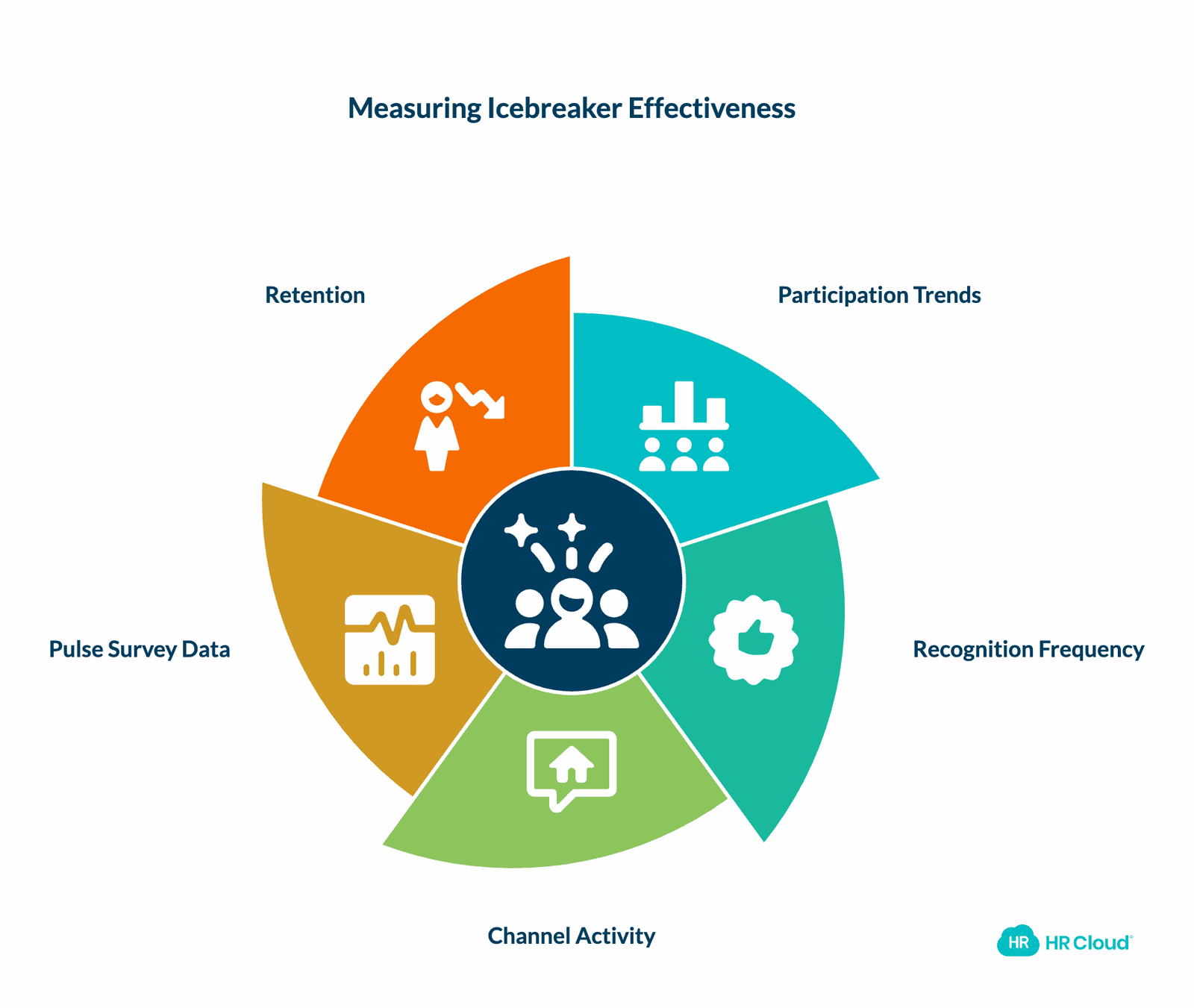
You don't need a complex dashboard. Track five things:
- Participation trends: Are more people engaging over time, or fewer? Declining participation means the questions aren't landing, the timing is wrong, or there's a trust problem underneath.
- Recognition frequency: Teams that know each other recognize each other more often. If peer kudos increase after consistent icebreaker use, that's a direct signal.
- Channel activity: More comments, reactions, and voluntary sharing in team channels equals stronger bonds. It's that straightforward.
- Pulse survey data: Add one question about team connection to your engagement surveys. Track it quarterly. One question, repeated, gives you a trendline.
- Retention: Teams with strong connection practices show measurably lower voluntary turnover over 12+ months. This is the number your CFO cares about.
Platforms like Workmates already track interaction patterns, recognition frequency, and channel engagement. The data is there. You don't need a separate analytics project.
Build Team Connections That Outlast the Meeting
Good questions open the door. The right systems keep it open.
HR Cloud's Workmates gives your team the communication channels, peer recognition, and mobile-first tools to turn one-time icebreaker moments into daily connection. Whether your people work in corporate offices, hospital floors, manufacturing plants, or construction sites.
Onboard builds connection into day one. Automated welcome workflows, icebreaker tasks in onboarding checklists, buddy programs, and team introductions that make every new hire feel like they belong before they've finished their first coffee.
Ready to see it in action? Book a free demo and see how HR Cloud helps teams build real connections at scale.

Experience how Workmates can transform communication and strengthen culture—all in one powerful platform
Book Your Free DemoFrequently Asked Questions
What are the best icebreaker questions for work?
Context decides everything. A question that kills in a brainstorm will fall flat in a Monday standup. For new teams, stick with preference-based questions (coffee or tea?) that require no vulnerability. For established teams, go deeper with reflection questions. The 10 categories in this post are organized by exact use case so you can match questions to moments instead of guessing.
How often should teams use icebreaker questions?
Weekly, at minimum. One question at the start of one meeting per week, five minutes max, builds more trust over a quarter than a single two-hour team-building event. Daily standups can include a 30-second rapid-fire question. Quarterly offsites deserve deeper questions with more time. The research is consistent: regular brief touchpoints outperform infrequent marathon sessions every time.
Do icebreaker questions actually work for remote teams?
They're arguably more important for remote teams. In-person teams get micro-connections for free: walking to a meeting, grabbing coffee, overhearing a conversation. Remote teams get none of that. Asynchronous icebreakers in team channels let people across time zones participate without scheduling conflicts. Video-based icebreakers (workspace tours, pet introductions) bring a bit of each person's real life into the work context, and that context is exactly what remote teams are missing.
What if employees refuse to participate?
Good. That means they feel safe enough to opt out, which is actually a sign of psychological safety. Never force participation. Offer written alternatives. Let people observe for the first few rounds. The ones who stay quiet at first often become the most engaged participants once they see that nobody gets judged for their answers. If resistance is widespread, that's feedback. Ask what's not working instead of pushing harder.
How do you keep icebreakers from feeling forced?
Three rules. First: match depth to trust. Light questions for new groups, deeper ones for established teams. Second: keep it short. The 10% rule (icebreaker takes 10% of meeting time) prevents the "are we done yet" feeling. Third: leaders answer first. When the boss goes first with a real answer, everyone else relaxes. If your icebreaker feels like a team-building exercise from 2003, your questions are wrong, your timing is off, or both.
Can icebreaker questions actually reduce turnover?
Not alone. But as part of a broader strategy that includes recognition, effective onboarding, transparent communication, and career development, they absolutely contribute. Gallup's "best friend at work" data is clear: employees with strong workplace friendships are significantly more engaged and less likely to leave. Icebreakers are where those friendships start. They create the foundation of psychological safety that makes every other retention strategy more effective. Cut the icebreakers, and you're making the rest of your engagement investments work harder for less return.
About the author

Keep Reading


Like What You Hear?
We’d love to chat with you more about how HR Cloud® can support your business’s HR needs.
Book Your Free Demo