What Is an AI Recruiting Agent? The 2026 Guide for Healthcare HR Teams

You have 83 nursing applications accumulated in your ATS from the past two weeks. Your team has manually reviewed 12 of them. Six out of them are still waiting on credential verification, tracked via lengthy email threads. And two of the candidates you were most excited about accepted offers elsewhere while your process was still catching up.
To be honest, this isn't a talent shortage problem even though healthcare industry does have an acute staffing crisis. In 2025, the U.S. was already short over 250,000 registered nurses alone, and that gap is widening, but the reason those two candidates walked away wasn't supply. It was speed. Or rather lack of it.
Your process wasn't built to move at the pace clinical talent demands.
An AI recruiting agent solves exactly that. It takes over the work that shouldn't require a recruiter in the first place: screening, follow-up, scheduling, credential flagging, HRIS handoff.
Your recruiters stay focused on judgment calls. The agent handles the pipeline.
By the time you finish this article you'll know what an AI recruiting agent actually does, how it differs from the ATS you're running now, and what to look for when you're evaluating one for a healthcare environment.
What is an AI recruiting agent?
An AI recruiting agent is an autonomous software system that executes multi-step recruiting tasks: sourcing candidates, screening applications, communicating with candidates, scheduling interviews, and handing off to your HRIS. No human needed to initiate each action in the sequence.
That definition matters more than it sounds. AI recruiting has become one of those umbrella terms covering everything from a chatbot that answers FAQs to a system managing your entire pre-employment pipeline autonomously. If you've been in a vendor demo recently, you know exactly how blurry that line has gotten.
Here's how the evolution actually looks.
A traditional ATS is a passive database. It stores applications, organizes candidate information, records pipeline movement, but only when a human navigates it. The ATS waits for you to act.
First-generation recruiting automation added rule-based triggers: if a candidate reaches stage X, send email Y. But still reactive. And still dependent on rigid logic that breaks the moment a scenario falls outside the pre-set rules.
By contrast, an AI recruiting agent is goal-directed and adaptive. You give it an outcome ("I need to fill this nursing role in the next three weeks") and it works through every step required:
• evaluating applications,
• flagging credential gaps,
• sending personalized communication sequences,
• asking for your intervention when needed,
• scheduling interviews, and finally
• handing completed candidate records to your onboarding system.
And the best part is that it does it all without waiting for a human to trigger the next move.
The term "agent" means it's a system that pursues a goal across multiple steps, adapts based on what it learns, and operates across connected platforms. That's what separates it from a chatbot or a rule-based automation script.
(For the full picture on what agentic AI means across all of HR, HR Cloud's guide to agentic AI in HR covers the broader context well. This post stays focused on the recruiting stage: from first application to offer accepted.
The Healthcare High-Volume Recruiting Playbook
How to fill clinical roles faster, stay compliant, and stop losing new hires between offer and Day 1.
Download Now
AI recruiting agent vs. traditional ATS: key differences
The traditional ATS was built for a world where applications arrived by mail, screening was manual, and candidate communication happened by phone.
Most modern ATS platforms are faster versions of that original design. They track candidates through a pipeline. But they don't move them.
Here's how the comparison looks across the dimensions that actually matter for healthcare recruiting:
| Dimension | Traditional ATS | AI recruiting agent |
|---|---|---|
| Core function | Stores and organizes applications | Executes recruiting tasks autonomously |
| Screening method | Keyword matching | Contextual evaluation plus credential flag logic |
| Candidate communication | Email templates sent manually | Automated SMS sequences, no login portals required |
| Scheduling | Manual coordination | Autonomous calendar management |
| Healthcare compliance | Manual checklist, recruiter-dependent | Credential flags built into screening logic |
| HRIS handoff | Manual data re-entry | Automated sync, preboarding triggered automatically |
| Frontline worker access | Email or portal only | SMS-native, no login required |
| Adaptability | Rule-based (if/then) | Goal-directed, learns from recruiter behavior |
The compliance row is worth a pause. Most ATS platforms on the market were designed for non-clinical corporate environments. They don't handle credential verification workflows, state nursing board requirements, Joint Commission documentation standards, or HIPAA acknowledgments as part of the recruiting pipeline. When those gaps exist in recruiting, they surface as onboarding emergencies on Day 1.
And look, this is a real cost.
Every day a nursing shift goes unfilled while credential paperwork is being chased can cost hundreds of dollars per shift in agency fees and overtime differential. And that compounds fast across a team with multiple open roles. Catching credential gaps in recruiting rather than onboarding is where you are cutting costs.
How an AI recruiting agent works: the 5-stage pipeline
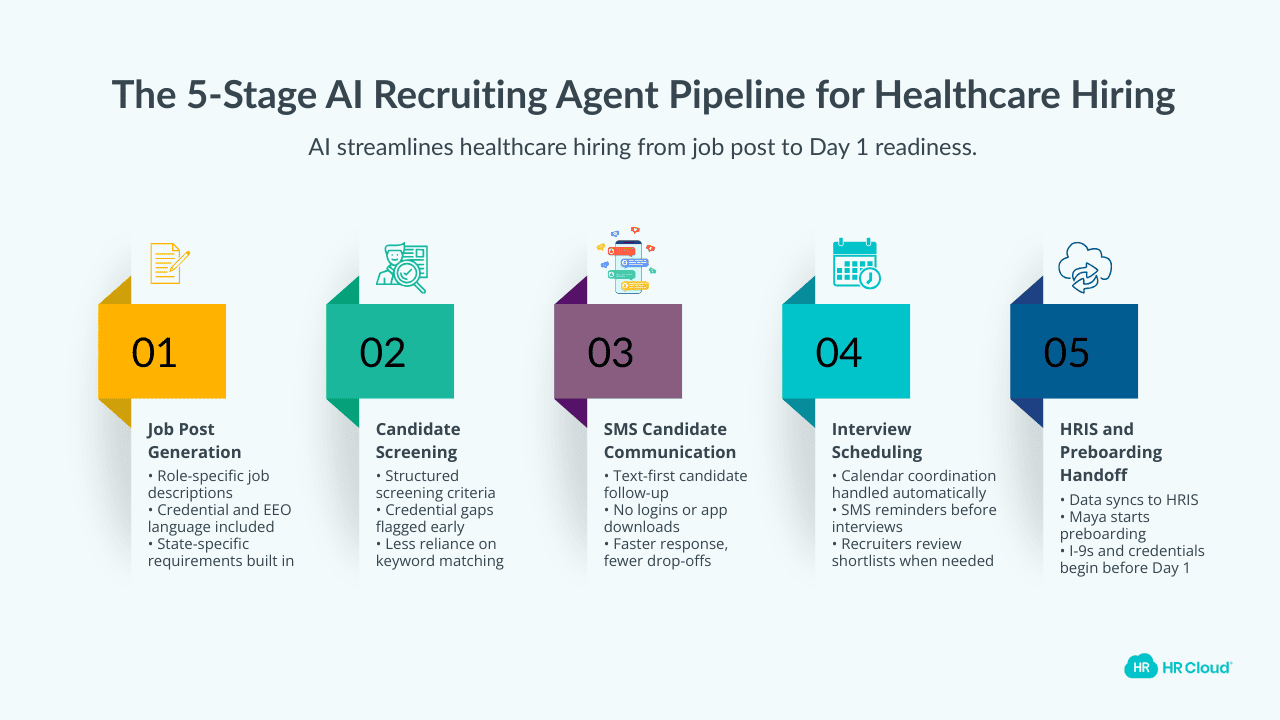
Understanding what an AI recruiting agent does is easier when you see it as a pipeline. Here's what that pipeline looks like for a healthcare organization.
Stage 1: Job post generation
The agent drafts a role-specific, compliant job description from a structured brief, including credential requirements, essential functions, physical demands, Equal Employment Opportunity (EEO) language, and state-specific nursing board requirements. What used to take a recruiter two to four hours per posting is generated in minutes, with compliance logic built in from the start rather than bolted on afterward.
Stage 2: Candidate screening
Applications are evaluated against structured criteria, not keyword matching. (Keyword matching is why so many qualified candidates get filtered out by legacy systems that can't tell the difference between "RN with ICU experience" and the way a candidate actually phrases that on a resume.)
For healthcare specifically the screening engine includes credential flag logic. Candidates missing required licenses or certifications are flagged before a recruiter reviews the file.
Before the offer. Not on Day 1.
Stage 3: Candidate communication
This is where frontline healthcare hiring breaks down most visibly.
Nurses and CNAs are typically not in the habit of checking their emails since they don’t have a desk-bound job. So, expecting them to frequently check their emails during the hiring process is a stretch. So, if your recruiting communication depends solely on emails or portal logins, your process will likely miss the candidates you're trying to reach.
SMS-native AI recruiting agents meet candidates where they are.
HR Cloud's Recruit platform uses the same approach as Maya for onboarding: an 89% SMS task completion rate compared to 52% for portal-based workflows. No logins. No app downloads. Just a text message with a clear action.
Industry research consistently shows frontline candidates are significantly more likely to drop out when response time exceeds 48 hours. An AI agent doesn't have a 48-hour delay.
Stage 4: Interview scheduling
Once a candidate clears screening, the agent manages scheduling autonomously — coordinating calendars, sending reminders, and handling rescheduling. If your process requires it, your HR team can review the candidate shortlist before scheduling is confirmed — that human checkpoint is available. Automated SMS reminders the night before and day of each interview are what bring no-show rates down; when candidates confirm directly by text, they're more committed to showing up.
Here's what that time saving actually looks like.
A team scheduling 150 interviews a month at 15 minutes per scheduling task is spending 37 hours a month on calendar coordination alone. That's nearly a full work week, every month, just moving time slots around. AI recruiting agent releases that time for more meaningful work.
Stage 5: HRIS handoff
Here's the part most ATS platforms skip entirely.
When a candidate accepts an offer, the agent triggers preboarding. Candidate data syncs to your HRIS. Maya activates. The new hire receives their I-9 via SMS along with compliance documents, credential upload requests, direct deposit setup, and equipment sign-off, all before Day 1.
No data re-entry. No preboarding gap. No nurse arriving for their first shift with incomplete paperwork.
Most ATS platforms treat offer accepted as the finish line. AI recruiting agents treat it as the handover point.
What tasks can an AI recruiting agent handle?
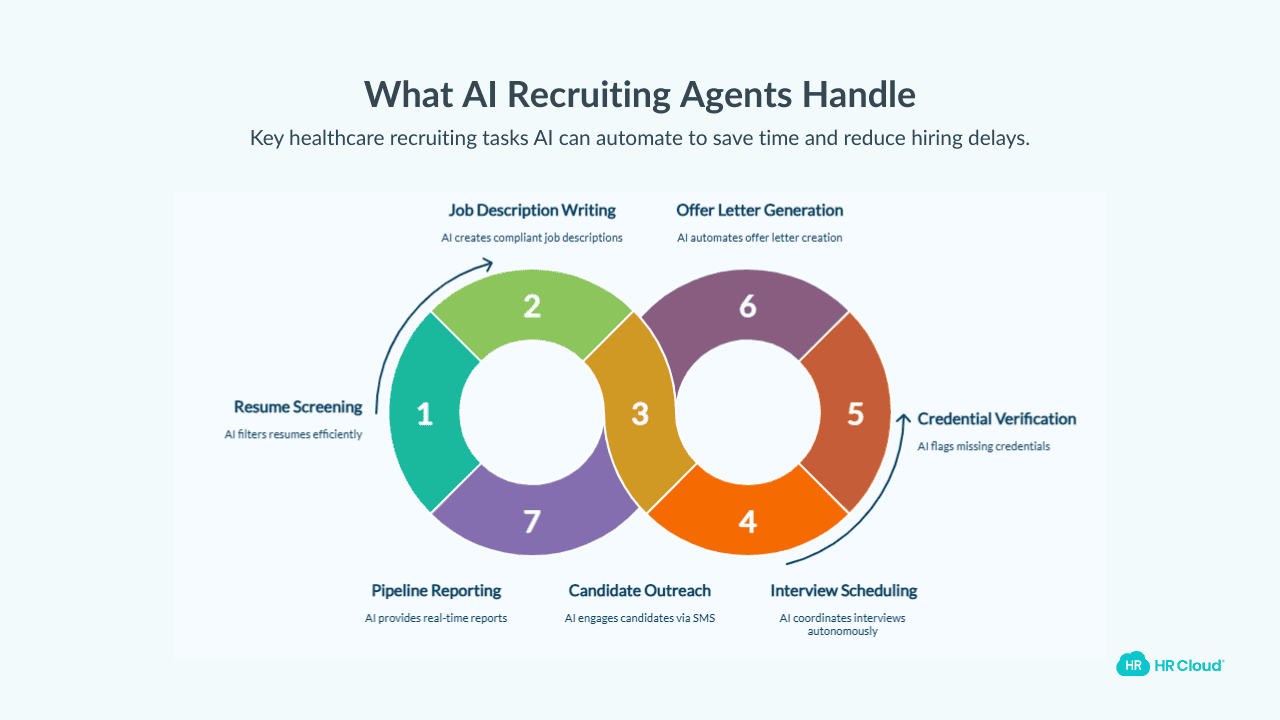
Here's what healthcare HR directors need to know before building their business case: what specifically does the agent do, and how much time does it save?
• Resume and application screening: reduces review time by 75%, saving roughly 23 hours per open role (per industry research on AI in talent acquisition)
• Job description writing: 2 to 4 hours saved per role, with compliance-consistent output including credential requirements and physical demands language
• Candidate outreach and follow-up: removes manual sequences entirely; 89% SMS response rate with automated stage-gate updates keeping candidates informed
• Interview scheduling and reminders: autonomous calendar coordination, with SMS reminders cutting no-show rates by up to 40%
• Credential verification flagging: missing licenses caught during screening, not during onboarding
• Offer letter generation: e-signature workflow triggered automatically at the right pipeline stage
• Pipeline reporting: real-time recruiter dashboard, not a manually updated spreadsheet
Here's what the numbers confirm: organizations using AI recruiting platforms report 35% faster hiring times and 50% improvement in quality of hire. In healthcare, that translates directly to fewer agency nurse bookings and lower per-shift costs.

Ready to simplify hiring from job post to offer?
Track candidates, customize hiring stages, schedule interviews, and connect recruiting to onboarding in one easy-to-use ATS.
Explore Recruit ATS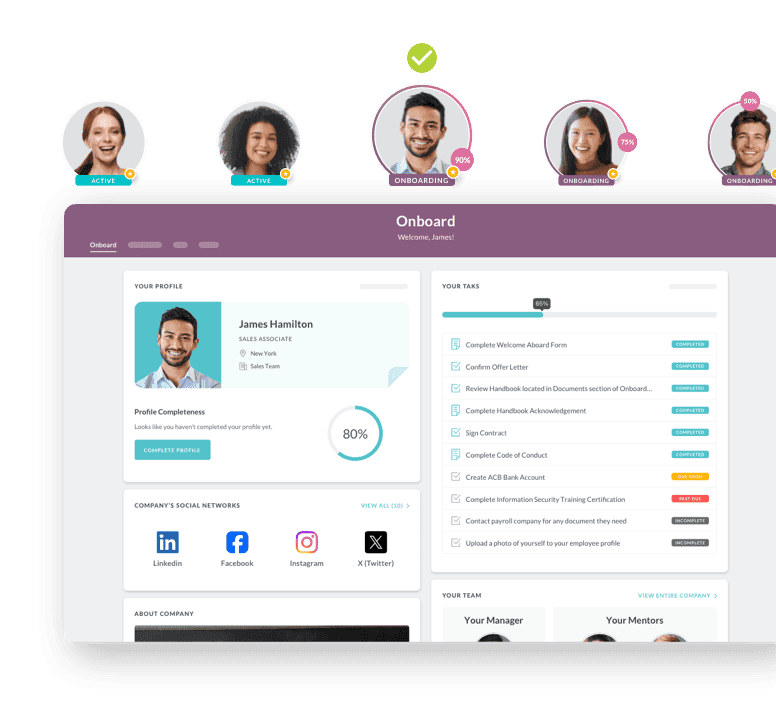
What the agent does not replace
No AI Agent can replace recruiter judgment at final hiring decisions, relationship-building for hard-to-fill senior roles, the candidate experience moments that determine whether a great nurse chooses your organization over a competitor.
AI handles the pipeline. Humans handle the decisions. That boundary matters, and it's worth being fully transparent with your team about this distinction before you roll anything like this out.
Who should use an AI recruiting agent?
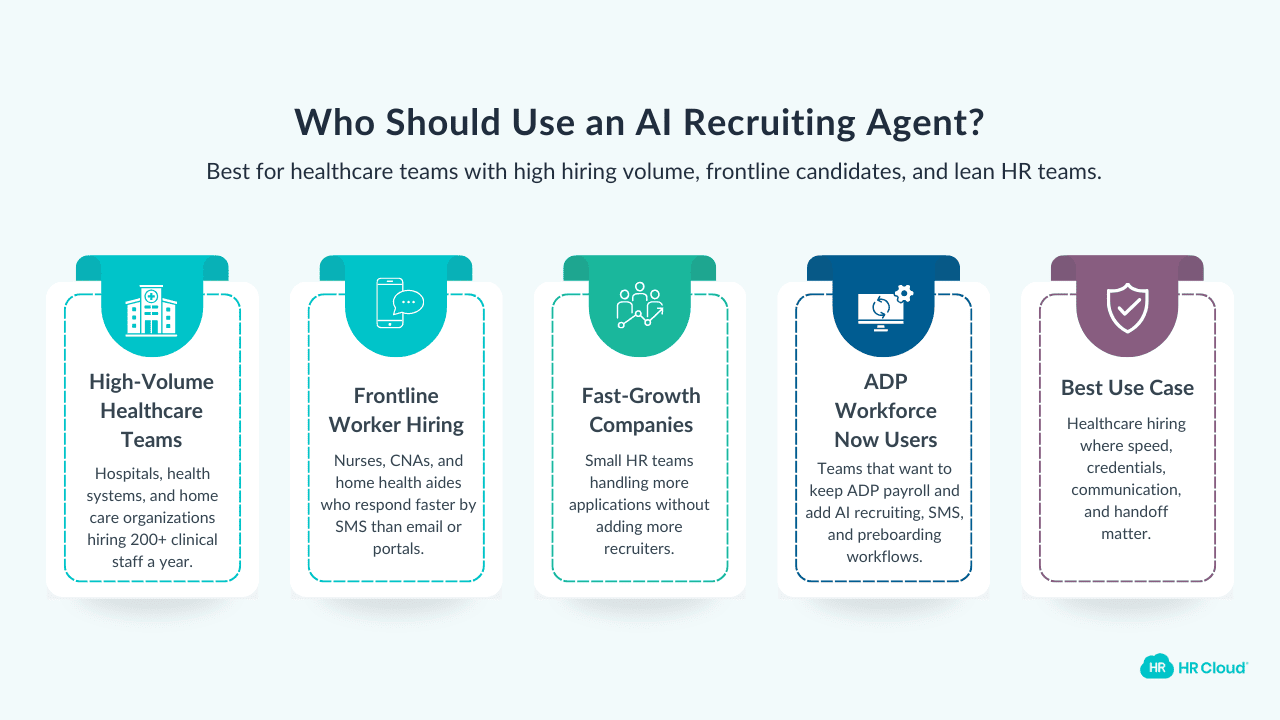
Not every organization needs one. Here's where it makes the most sense.
High-volume healthcare organizations are the clearest case.
Hospitals, health systems, and home care organizations hiring 200 or more clinical staff annually face a numbers problem that manual processes can't fix. A 3-person HR team processing 500 applications a month is managing 167 applications per recruiter, and that's before the credential follow-up, scheduling coordination, and preboarding paperwork. At that scale, AI isn't a nice-to-have but a no-brainer.
Frontline workers — nurses, CNAs, home health aides — don't typically use emails. Their work schedules and working style doesn’t support frequently checking a portal. If your recruiting process requires a login to move forward, you're creating drop-off at the most critical stage of the funnel. SMS-native recruiting meets them where they actually are.
Fast-growth companies with small HR teams face a different version of the same problem.
When you're scaling quickly and your HR team hasn't scaled with you, the gap between applications received and applications reviewed grows every week. The agent handles the volume. Your recruiters focus on the candidates who actually advance.
ADP Workforce Now users also have a specific gap worth addressing.
ADP Recruiting Management is an add-on module that handles basic applicant tracking but doesn't offer AI screening, SMS-native communication, credential verification logic, or automated preboarding handoff.
HR Cloud's ADP Platinum Marketplace integration means you can keep payroll in ADP and add AI recruiting capability alongside it — getting what ADP Recruiting Management doesn't provide without migrating your payroll. No rip-and-replace.
What to look for when choosing an AI recruiting agent (a 7-point framework)
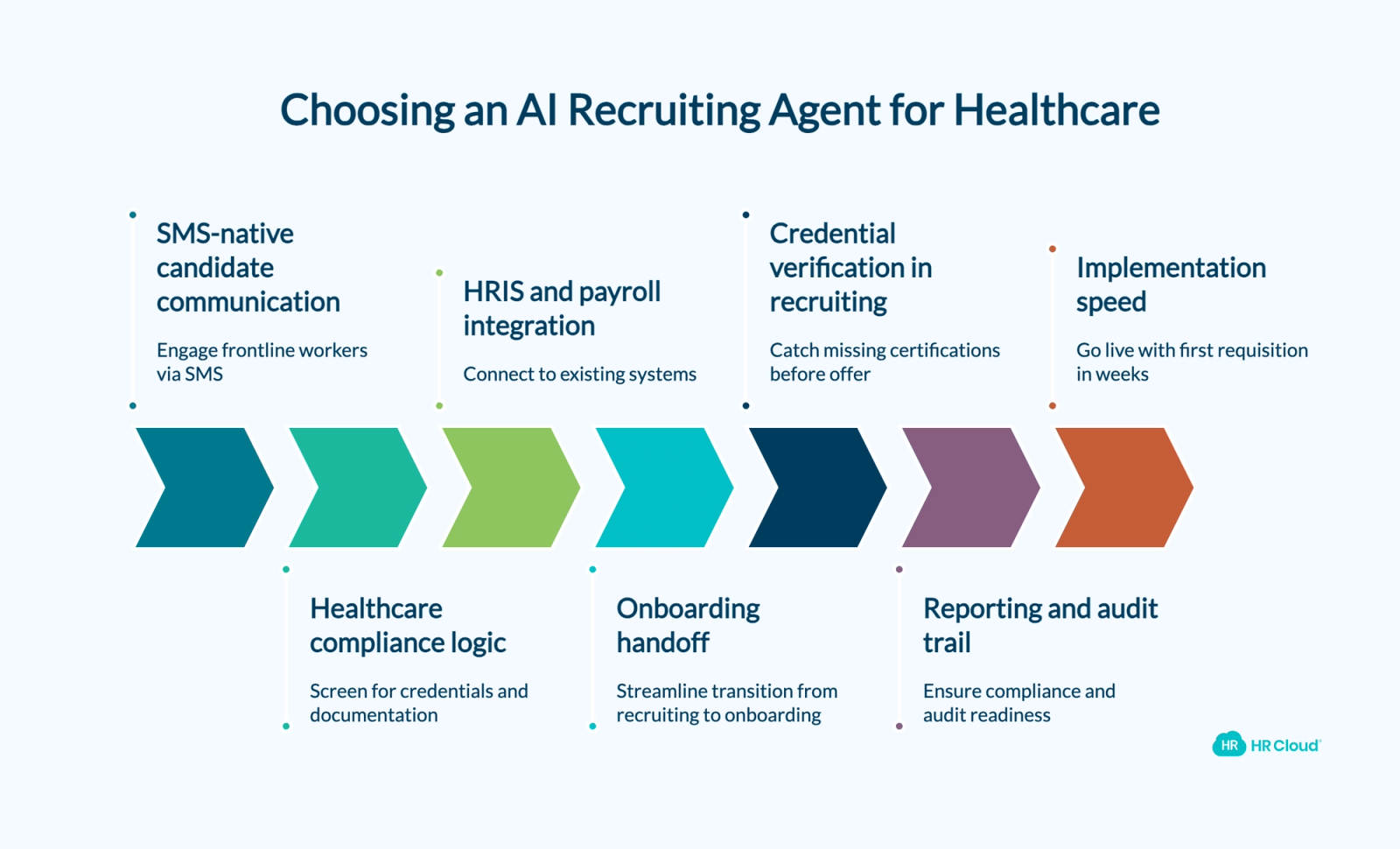
Most healthcare HR directors evaluate recruiting platforms on features visible in a demo: the dashboard, the pipeline view, the reporting.
But here's what is more useful — the seven capabilities that determine whether the tool actually works for healthcare hiring at scale.
1. SMS-native candidate communication, not just email. If the platform's candidate engagement depends on portal logins and email open rates, it's not built for frontline healthcare workers. Ask specifically: does the system communicate via SMS without requiring a portal account or app download?
2. Healthcare compliance logic. Does the screening engine include credential flag logic? Does it handle Joint Commission documentation requirements, HIPAA acknowledgment workflows, and state nursing board certification tracking? Push for a demo of a nursing role screening with a missing credential before you buy.
This Healthcare HR Challenges guide outlines what healthcare compliance in HR actually requires.
3. HRIS and payroll integration. Does it connect to ADP Workforce Now, UKG, Paylocity, or your current payroll system, without custom development work? Many platforms offer multiple integrations; confirm they can connect to your specific setup. Integration complexity is where implementation timelines double and ROI projections fall apart.
4. Onboarding handoff. What happens after "offer accepted"? The handoff between recruiting and onboarding is where data gets re-entered manually, where preboarding communication falls through cracks, where new hires arrive on Day 1 with incomplete paperwork. Ask the vendor to walk you through the exact workflow from offer acceptance to Day 1 readiness. If the answer is "that's handled by your onboarding system separately," that's the gap.
5. Credential verification as part of recruiting, not a post-hire process. The credential verification workflow should be embedded in the recruiting pipeline so that missing certifications are caught before an offer is extended, not after the candidate has passed their drug test and accepted the role.
6. Reporting and audit trail. Can you pull a compliance report showing every hiring action, screening criterion applied, and candidate communication sent? These are essential for EEOC compliance and Joint Commission audit preparation. So if the reporting is dashboard-only and can't export a timestamped audit log, that's a compliance risk you probably can't afford.
7. Implementation speed. Ask specifically about the typical time from contract signature to your first live requisition. The answer should be weeks, not quarters.
How HR Cloud's AI recruiting works
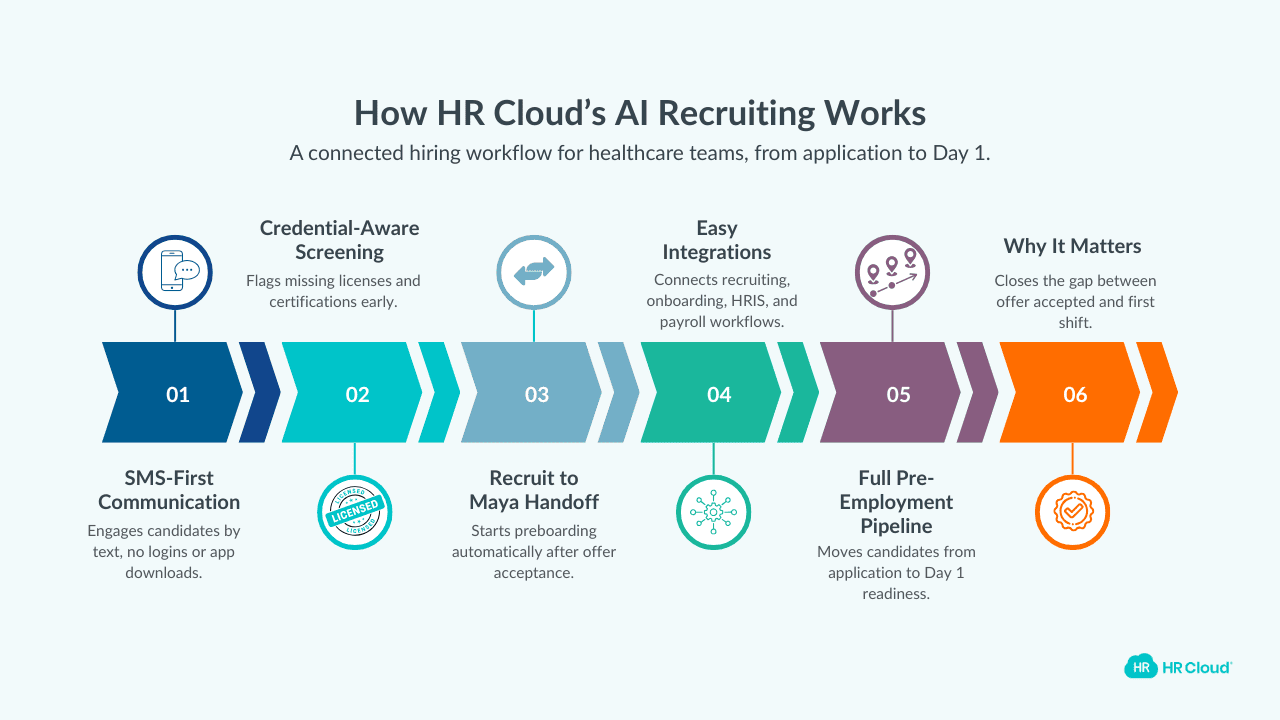
HR Cloud's Recruit ATS was built for the organizations the big platforms overlook: high-volume, frontline-heavy, and healthcare-specific environments where the recruiting process is anything but simple.
Here's what makes it specific to this context.
SMS-first candidate communication
The same technology powering Maya's 89% SMS completion rate in onboarding is applied to the recruiting stage.
Candidates receive text-based communication from application through offer, no portal login, no app download, no email inbox required. For nurses and CNAs, this is the difference between a candidate who stays engaged and one who accepts the next offer that reaches them first.
Credential-aware screening logic
HR Cloud Recruit's screening engine includes healthcare-specific credential requirements. Missing certifications are flagged automatically before a recruiter reviews a file. That doesn't eliminate the need for human judgment. It eliminates the specific failure mode where a credential gap is discovered during onboarding rather than during recruiting.
Easy integrations
Maya integration happens from offer to Day 1 automatically. When a candidate accepts an offer in Recruit, Maya activates. The new hire receives their I-9, compliance documents, credential upload requests, direct deposit setup, and equipment sign-off, all via SMS, all before Day 1. No data re-entry. No gap in the preboarding window.
Why the full lifecycle matters
Research on healthcare retention consistently shows that 30% of new hires quit within 90 days, and most of that turnover originates in the recruiting and preboarding window. The gap between offer accepted and first productive shift is where new hires get lost. HR Cloud closes it.
HR Cloud handles the entire pre-employment pipeline, from first application to first productive shift, in one connected system. The Maya AI Onboarding Agent is the second half of that pipeline.
Read our guide to what an AI onboarding agent does to have the full picture.
Download Comprehensive AI Onboarding Checklist
Most onboarding checklists tell you what to do. This one also tells you who does it, and when, so that nothing falls through the cracks.
Download Now
Ready to compete for clinical talent at the pace it moves?
The AI recruiting agent changes what's possible. It takes over the work that shouldn't require a human in the first place, freeing your recruiters for the decisions that actually need them.
Healthcare organizations are already short over 250,000 registered nurses today. HRSA projects that gap will grow to nearly 700,000 physicians, RNs, and LPNs combined by 2037. The 45-day average time-to-fill for nursing roles isn't improving. Frontline candidates aren't engaging with portal-based recruiting tools. At that scale, manual processes have already broken down. What the AI recruiting agent provides is a structural fix, not an efficiency tweak.
Here's my take: if you're still manually screening applications and chasing credential paperwork via email in 2026, you're not competing for clinical talent. You're hoping it finds you.
An AI recruiting agent gives your team the speed and compliance infrastructure to compete, while the human judgment your recruiters bring stays exactly where it belongs: at the decisions that actually matter.
See how HR Cloud's AI recruiting works for high-volume healthcare hiring
Book a demo and we'll walk you through the full pipeline, from first application to Day 1 readiness, in your environment.
Discover how our HR solutions streamline onboarding, boost employee engagement, and simplify HR management
Book Your Free DemoFrequently asked questions
What is the ROI of using an AI recruiting agent?
The ROI comes from three places: time saved per hire, reduced agency spend, and lower compliance risk. On time alone, AI recruiting platforms reduce screening time by 75% and eliminate scheduling admin — roughly 23 hours per open role saved. For a healthcare team filling 50 roles a year, that's over 1,100 recruiter hours recovered. Reduced agency spend is the bigger number: every hire made through a faster internal process rather than a staffing agency avoids hundreds of dollars per unfilled shift in fees and overtime differential. And catching credential gaps in recruiting rather than onboarding prevents the compliance cost of a hire that can't start on time.
Can an AI recruiting agent handle healthcare credentialing requirements?
Some can, most don't. Many ATS platforms on the market don't include credential verification workflows or Joint Commission documentation logic — they were designed for non-clinical hiring environments. Healthcare-specific AI recruiting platforms flag missing credentials during the screening stage, before an offer is made, rather than discovering the gap on Day 1. Before you buy, ask any vendor to demo a nursing role screening with a missing certification. That test will tell you exactly what the platform can and can't do.
Are AI recruiting agents compliant with EEOC and employment discrimination law?
Yes, when built correctly. Compliant AI recruiting agents use structured, documented evaluation criteria, generate audit trails for every screening decision, and apply consistent language in job descriptions and communications. A note for organizations hiring internationally: Europe's AI Act, effective August 2026, classifies AI used in recruiting as "high-risk," requiring documentation, transparency disclosures, and human oversight at decision points. Evaluate vendors on their compliance documentation practices if this applies to you.
How do AI recruiting agents communicate with frontline candidates who don't have corporate email?
SMS-native agents communicate via text message, no portal login, no email address required. This is essential for nursing, CNA, and home health aide candidates who are often between positions and not monitoring a work inbox. HR Cloud's onboarding data shows 89% SMS task completion versus 52% for portal-based workflows — the same communication pattern that works in onboarding holds true in recruiting: candidates who receive a text respond. Candidates who receive a portal link often don't.
What does an AI recruiting agent cost?
Pricing varies significantly by platform and organization size. Most enterprise-grade platforms structure pricing per recruiter seat or per hire, with SaaS-based options offering faster and less expensive implementation than legacy enterprise systems. Evaluate cost against current recruiter hours per hire, agency spend on unfilled shifts, and the compliance risk of a credential gap discovered on Day 1. Model the full picture before comparing vendor quotes.
Can an AI recruiting agent replace human recruiters?
No, and it shouldn't. AI recruiting agents handle volume-intensive, repetitive tasks: screening, scheduling, follow-up, credential flagging, reporting. That frees human recruiters to focus on building candidate relationships, exercising final hiring judgment, and managing the experience moments that determine whether a great nurse chooses your organization over a competitor. AI handles the pipeline. Humans handle the decisions.
About the author

Keep Reading


Like What You Hear?
We’d love to chat with you more about how HR Cloud® can support your business’s HR needs.
Book Your Free Demo