How to Improve ADP Workforce Now Onboarding: A Complete Guide for HR Teams

According to Gallup, only 12% of employees strongly agree their organization does a great job of onboarding. That means 88% of new hires walk into their first week feeling somewhere between underwhelmed and abandoned.
If you're running your onboarding through ADP Workforce Now, you're not starting from zero. You've got a capable platform handling compliance paperwork and payroll data routing. But here's what I've seen again and again with mid-market HR teams: they assume the native ADP onboarding module covers the full employee experience. Well, it doesn't. Because it was never designed to.
And the stakes are getting higher. Gallup's 2026 State of the Global Workplace report shows global employee engagement has dropped to just 20%, the lowest since 2020.
What does that gap look like in practice?
New hires complete their I-9 forms but receive zero cultural onboarding. Managers can't see where someone stands on Day 5 or Day 15. And your frontline staff? They're excluded from digital onboarding entirely because the workflows assume everyone sits at a desktop with a corporate email.
This guide walks you through where your ADP Workforce Now onboarding process ends, which improvements deliver the highest retention ROI, and how to extend your onboarding without replacing the platform you've already invested in.
What ADP Workforce Now's Native Onboarding Actually Covers
Before we diagnose what's missing, let's give credit where it's due.
ADP Workforce Now is a powerful HCM platform. Its onboarding module handles several critical functions well. If you're going to improve the process, you need to know exactly what you're building on top of.
Core Capabilities of ADP's Onboarding Module
ADP Workforce Now serves organizations ranging from 50 to 1000s of employees. It's recognized as a Leader in the Forrester Wave for HCM Solutions, Q4 2025, and for good reason.
The native ADP onboarding module:
- Collects tax withholding details and W-4 information
- Sets up direct deposit before day one
- Completes I-9 Section 1 digitally
- Customizes welcome messages for each new hire
- Assigns checklists, buddies, and neighborhood maps
- Captures emergency contacts and policy acknowledgments
These are essential compliance and data collection functions. If your only goal was paperwork completion, you'd be in decent shape. But think, when was the last time a new hire stayed because the W-4 process was seamless? No, they want a bit more than seamless paperwork.
Where the ADP Workforce Now Scope Was Designed to End
Here's my take: ADP's onboarding module was built for data collection and compliance routing. It wasn't built for onboarding experience design, employee engagement, peer recognition, or a structured Day 1 through Day 90 journey. And mind you, these are intentional scope decisions.
And ADP isn't alone in this. According to SHRM, 58% of organizations focus their onboarding primarily on processes and paperwork rather than people. Most teams are running compliance-first onboarding and calling it done.
If you want to check whether your onboarding is people-first or compliance-first, ask yourself just these two questions:
- Does your ADP onboarding workflow end after the first week?
- Do new hires hear from anyone after their paperwork is submitted?
If the answer to either one is "Yes" or even "I'm not sure," you've already found your first gap.
But the real question is: what's that gap actually costing you?
The Real Cost of an Incomplete Onboarding Experience
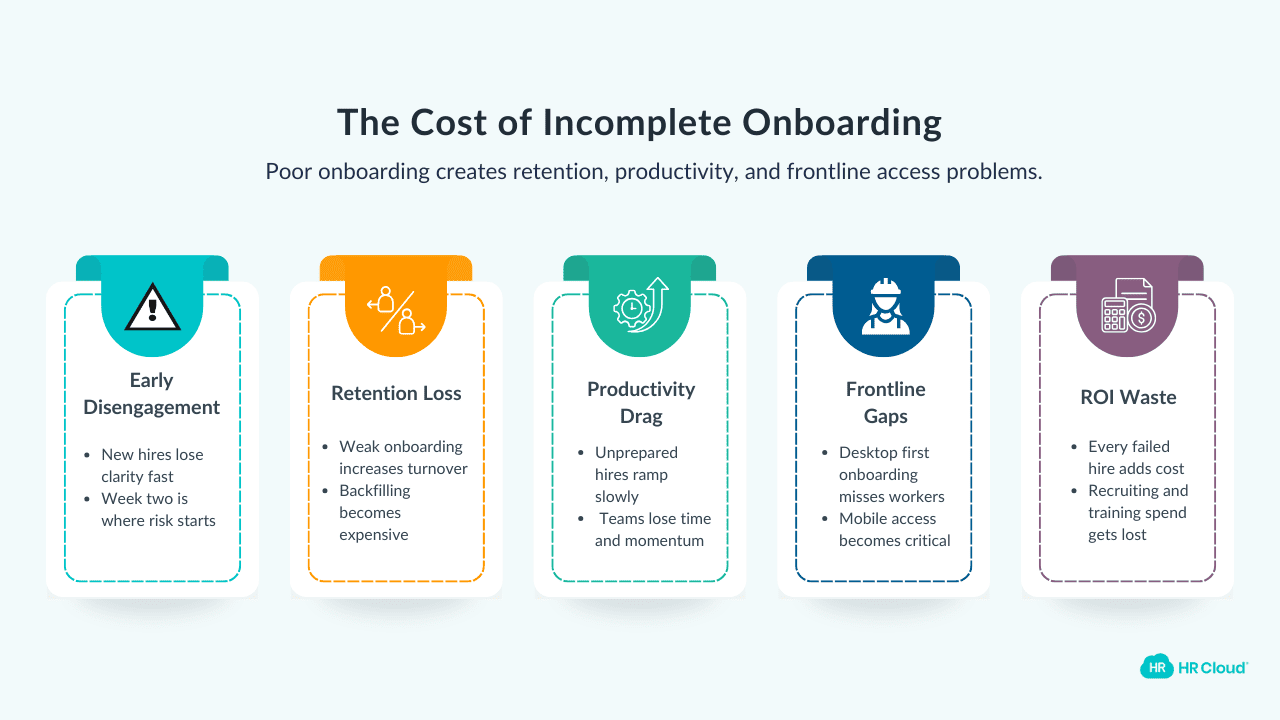
Most articles about ADP onboarding give you a feature list or a set of tips. Fewer will tell you what incomplete onboarding actually costs your organization in dollars. So let's do the math because this is where the business case starts.
Here's the macro picture. Gallup's 2026 State of the Global Workplace report found that low employee engagement cost the world economy approximately $10 trillion in lost productivity last year — roughly 9% of global GDP. Onboarding isn't the only driver of engagement, but it plays a more direct role than most HR leaders realize.
A new hire's first 90 days determine three things:
- Do they understand their role clearly?
- Do they feel connected to their team?
- Do they believe they made the right choice?
When onboarding is incomplete in terms of missing structure, delayed access, or no human follow-through, those questions stay unanswered. And disengagement starts in week two.
Retention and Productivity Impact
Research from the Brandon Hall Group found that organizations with a strong onboarding process improve new hire retention by 82% and boost productivity by over 70%. Those aren't marginal gains — they're the difference between a team that stabilizes and one that's constantly backfilling.
Now consider the other side.
According to Gallup, only 29% of new hires feel fully prepared and supported to excel in their role after onboarding. And the Work Institute found that 20% of all voluntary turnover occurs within the first 45 days.
With SHRM estimating the average cost per hire at roughly $4,700, every employee who leaves in their first 90 days represents a compounding loss — recruiting costs, lost productivity, wasted training, and team disruption.
And that's not a one-time hit either. When early attrition becomes a pattern, you're essentially funding a revolving door instead of a functioning team.
The Hidden Cost for Frontline and Deskless Teams
Here's where it gets worse for many ADP Workforce Now users. The platform's onboarding architecture assumes corporate desktop access. For healthcare workers, manufacturing teams, and field operations staff, that assumption excludes a massive portion of your workforce.
If you are trying to fathom how massive that is, consider this: according to BCG, roughly 70% to 80% of the global workforce is deskless.
If your onboarding portal or workflow doesn't work on a phone, your frontline new hires complete onboarding paperwork by hand. If that's happening in 2026, your frontline staff feel like an afterthought — and they respond accordingly.
Quick ROI Math: What One Failed Onboarding Costs Your Organization
Average cost per hire ($4,700) × early turnover rate = your annual onboarding waste.
For a mid-market company hiring 200 people per year with 20% first-year turnover, that's nearly $200,000 in avoidable loss, before you even account for lost productivity.
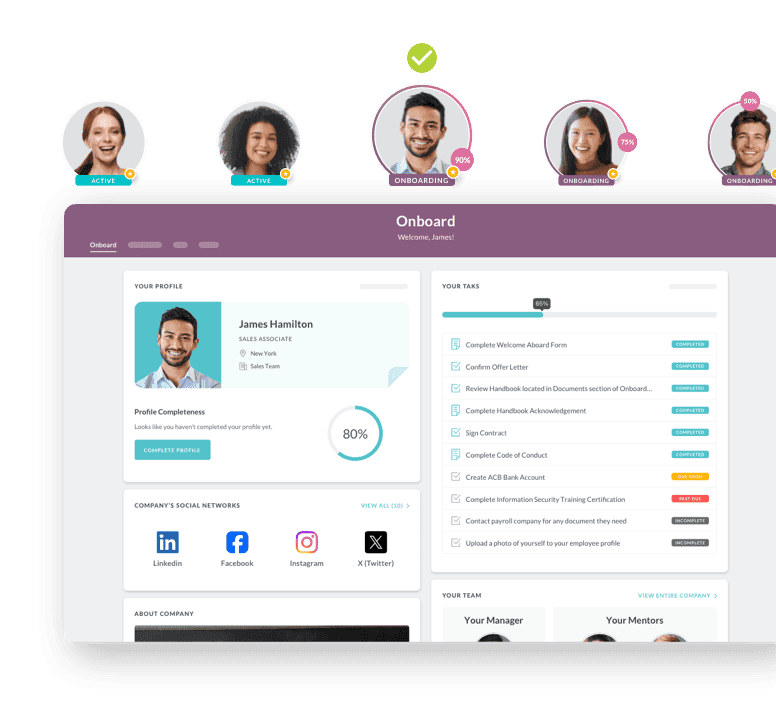
HR Cloud's Onboard module was built specifically for mobile-first, frontline-accessible onboarding workflows. Organizations like Veolia (10,000+ field employees) and Behavioral Progression Inc. have used it to reduce onboarding time significantly while keeping data in sync with ADP Workforce Now.
Now that you know where the gaps are and what they cost, let's talk about how to close them.
6 Ways to Improve Onboarding for ADP Workforce Now Users
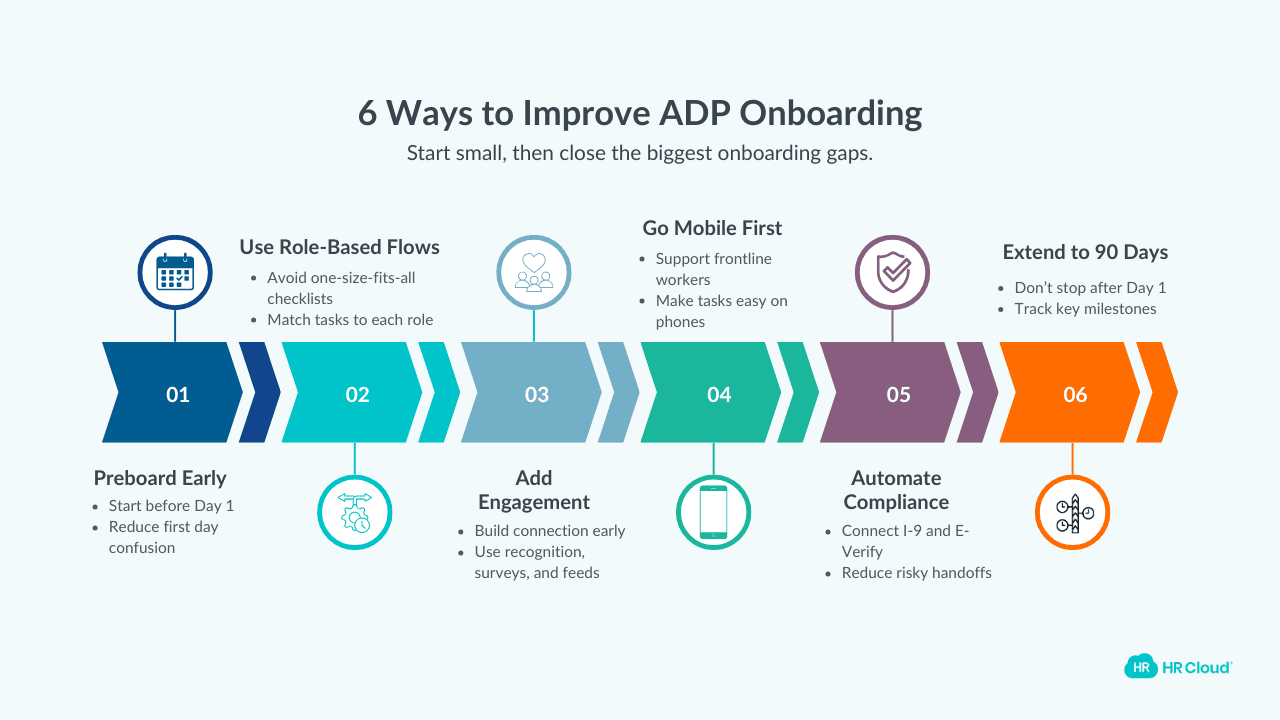
Each of these improvements addresses a specific gap in the native ADP Workforce Now onboarding process. They're sequenced from easiest to implement to most structurally significant so that you can start small and scale from there.
1. Start Onboarding Before Day One with Structured Pre-boarding
ADP's native module allows welcome messages, but it doesn't support a full preboarding portal with video content, team introductions, and pre-completed profile setup. That matters more than most teams realize.
Here's what you need to know: the period between offer acceptance and start date is when scope for engagement is highest because anxiety is building. According to a 2025 Enboarder survey of HR leaders, 65% of organizations start some activities before Day 1, yet 62% say the overall process wraps up within a single week. That gap between pre-boarding activity and sustained follow-through is where their new hires are disengaging.
Structured pre-boarding reduces Day 1 administrative burden and gives new hires confidence before they walk through the door. HR Cloud's Onboard supports branded pre-boarding portals with personalized welcome content, video, and profile self-service, accessible from any device before the start date.
In fact, HR Cloud is launching its AI Onboarding Agent Maya soon, which will guide the new hires through their onboarding step-by-step without needing to login or download apps.
2. Build Role-Based Onboarding Workflows, Not One-Size-Fits-All Checklists
ADP allows some customization by employee profile, including custom welcome messages, checklists, and document packages. But many users report that workflows become rigid when you need department-specific or location-specific sequences.
Should a nurse starting in a hospital follow the same onboarding checklist as a marketing coordinator joining the corporate office? Obviously not. Yet that's what happens when workflows are limited to basic profile-based customization. A good onboarding checklist varies by role, department, location, and employment type. If your current workflow can't accommodate those differences, it's worth evaluating tools on the ADP Marketplace that offer conditional logic and branching workflows within the onboarding sequence.
Download your free employee onboarding checklist
Using this checklist ensures that you are not scrambling to make the new employees feel welcomed, prepared, and set up for long-term success.
Download Now
3. Add an Engagement Layer That ADP Wasn't Designed to Provide
Compliance gets new hires into your system. Engagement keeps them in your organization. ADP handles the first part well. What it wasn't designed to cover is peer recognition, pulse surveys, social introductions, and culture-building activities during the first 90 days — the activities that build connection and commitment.
It could be the difference between a new hire counting down to their first paycheck and one counting on a long career with your organization.
HR Cloud's Workmates module fills this gap with peer recognition (Kudos), pulse surveys, a company feed, and team directories — all integrated with ADP Workforce Now via SSO and two-way data sync.
4. Ensure Mobile-First Access for Frontline Workers
Remember the deskless workforce stat from earlier? If 70–80% of the global workforce doesn't sit at a desk, why would you design onboarding for a desktop browser?
That's why this one is non-negotiable for healthcare, manufacturing, logistics, and any organization with deskless staff. Mobile onboarding means forms that work on a 5-inch screen, kiosk mode for shared-device completion in break rooms, and SMS-based task reminders for workers who don't check email.
Are you selecting employee onboarding software designed for deskless populations from the start — or adapting desktop-first software after the fact? The distinction matters more than you'd think. So be intentional about mobile-first onboarding when choosing your onboarding tool.
5. Automate I-9, E-Verify, and Compliance Workflows End-to-End
ADP handles I-9 Section 1 and offers eI-9 (electronic format of I-9) as an add-on module. But compliance gaps still emerge when submission, verification, and tracking aren't unified in a single workflow.
Federal law requires new hire reporting within 20 days of start date, and several states impose shorter deadlines. If your process involves manual steps between I-9 collection, E-Verify submission, and compliance dashboard updates, you're introducing risk at every handoff.
End-to-end compliance automation means new hires complete I-9 forms electronically from any device, E-Verify runs in-app, and your compliance dashboard updates in real time with alerts for overdue items. That's the standard your ADP onboarding integration should meet.
6. Extend Onboarding Beyond Day 1 — Map the First 90 Days
Here's the thing nobody wants to hear: if your onboarding ends after the first day or even the first week, it's not really onboarding. It's orientation with paperwork.
According to OC Tanner research, 43% of companies complete onboarding in just one day. For a process that SHRM recommends should last a minimum of 90 days with structured milestones.
A strong 90-day framework for ADP Workforce Now users should include milestones at Day 1 (orientation and compliance), Day 15 (role clarity), Day 30 (pulse survey and manager review), Day 45 (peer integration), and Day 90 (retention checkpoint). Can you track these inside your current ADP onboarding workflow? If not, you need a system that can.
So what does it look like when all six of these improvements work together inside your ADP environment?
How HR Cloud Extends ADP Workforce Now Onboarding
Everything discussed above — preboarding, role-based workflows, engagement, mobile access, compliance automation, and 90-day tracking — sits outside ADP Workforce Now's native onboarding scope. HR Cloud was designed to fill exactly these gaps, without replacing ADP.
The foundation is a two-way ADP integration. HR Cloud syncs employee data bidirectionally with ADP Workforce Now. Personal information, employment details, direct deposit, and org structure flow between systems automatically without duplicate entry. You can review the full field list on the ADP Marketplace.
On top of that data layer, HR Cloud adds the experience layer your new hires actually feel. Custom-branded welcome portals carry your company logo, colors, and fonts. New hires access welcome messages, training content, handbooks, and fillable e-forms from any device, including mobile phones and shared kiosks.
For compliance, I-9 submission, E-Verify, and automated tracking with real-time alerts all happen in-app. No manual handoffs between systems.
For frontline teams without corporate email, HR Cloud supports onboarding from any device, including shared kiosk stations for high-volume hiring. And the Workmates module brings engagement into the ADP environment from Day 1 — peer recognition, pulse surveys, a company feed, and team directories, all connected via SSO.
What about implementation speed?
HR Cloud's typical deployment is two to three weeks from kickoff to go-live. That’s a meaningful difference when you're trying to improve onboarding for next month's cohort, not next quarter's.
Organizations including Toyota, Veolia, and Interim Healthcare have used HR Cloud alongside ADP Workforce Now. Kaylee Collins, HR Analyst at Osmose Utilities Services, noted that time savings, improved data accuracy, and stronger compliance were the deciding factors for her team.
How to Get Started: A 4-Step Implementation Plan
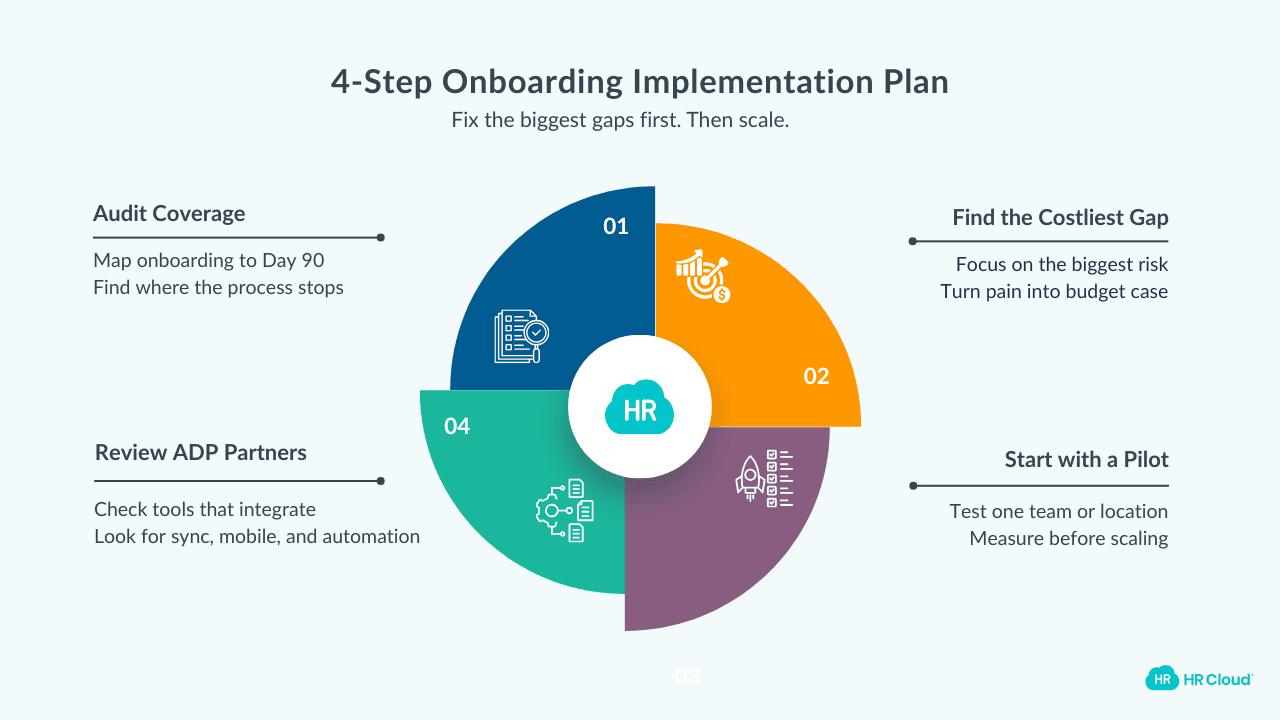
Knowing what to fix is one thing. Knowing where to start is another. You don't need to overhaul everything at once. Here's a sequenced approach that works.
Step 1: Audit your current onboarding coverage
Map every step of your ADP Workforce Now onboarding workflow from offer acceptance to Day 90. Which steps are compliance? Which are experience? Note where the process actually ends. Be honest. Most teams discover their onboarding stops far earlier than they thought.
Step 2: Identify your highest-cost gap
Early turnover? Frontline exclusion? Manager invisibility? Compliance near-misses? Prioritize the gap with the clearest financial impact. That's where your budget case starts.
Step 3: Evaluate ADP Marketplace partners
Browse the ADP Marketplace for onboarding solutions that integrate with Workforce Now. Look for two-way data sync, mobile access, compliance automation, and engagement tools. HR Cloud's Onboard for ADP Workforce Now is one option worth evaluating against those criteria.
Step 4: Start with a pilot
Deploy the improved onboarding workflow for one department or location. Measure completion rates, time-to-productivity, and new hire satisfaction at Day 30 and Day 90 before scaling. Pilots reduce risk and give you the data to make the case for organization-wide rollout.
Remember that Gallup stat from the top of this article? Only 12% of employees think their company does onboarding well. That's not a statistic you have to live with. It's one you can change, starting with the platform you already have.
See how HR Cloud can help you roll out an onboarding plan customized to your needs.

Discover how our HR solutions streamline onboarding, boost employee engagement, and simplify HR management
Book Your Free DemoFrequently Asked Questions
Does ADP Workforce Now have built-in onboarding?
Yes. ADP Workforce Now includes an onboarding module for clients with Payroll and Enhanced HR. It covers tax withholding, direct deposit, I-9 Section 1, company policies, and welcome messages. However, it focuses primarily on compliance paperwork and data collection, not on extended onboarding experiences like preboarding portals, engagement programs, or 90-day milestone tracking.
How long should onboarding last for ADP Workforce Now users?
HR experts recommend a minimum of 90 days with structured milestones. A strong framework includes check-ins at Day 1, Day 15, Day 30, Day 45, and Day 90. Organizations that extend onboarding beyond the first week see significantly higher retention rates and faster time-to-productivity compared to single-day programs.
Can I customize onboarding workflows in ADP Workforce Now?
ADP allows some customization by employee profile, including custom welcome messages, checklists, and document packages by role. However, some users report that workflows become rigid for department-specific or location-specific needs. For deeper customization, ADP Marketplace partners like HR Cloud offer dynamic checklists, role-based task sequences, and branded portals.
What onboarding integrations are available on the ADP Marketplace?
The ADP Marketplace offers several onboarding integrations including HR Cloud Onboard, ApplicantStack, Workstream, and Greenhouse. These tools extend onboarding capabilities — from preboarding and custom workflows to compliance automation — while keeping payroll and HR data synced bidirectionally.
How do I improve onboarding for frontline workers using ADP?
Frontline workers often lack corporate email and desktop access, which limits their use of standard ADP onboarding workflows. Improvements include adding mobile-first onboarding portals, enabling kiosk mode for shared-device completion, using SMS task reminders, and selecting ADP Marketplace tools designed specifically for deskless populations.
What's the difference between ADP Onboarding and HR Cloud Onboard for ADP Workforce Now?
ADP's native onboarding module handles compliance forms, tax withholding, and basic welcome content. HR Cloud Onboard extends this with branded preboarding portals, custom e-forms, role-based checklists, I-9 and E-Verify automation, engagement tools, and mobile-first access for frontline teams. Both integrate with ADP Workforce Now and can be used together.
How much does it cost to improve ADP Workforce Now onboarding?
Costs vary by solution and organization size. ADP Marketplace partner tools typically offer subscription pricing. But the more relevant question is the cost of not improving — higher turnover, slower ramp-up, and compliance risk. Most onboarding investments recoup within the first year through reduced turnover alone.
About the author

Keep Reading


Like What You Hear?
We’d love to chat with you more about how HR Cloud® can support your business’s HR needs.
Book Your Free Demo