I-9, E-Verify, and State Clearances: Making K-12 Onboarding Audit-Proof

It's 6:30 a.m. on the first day of school. Your new science teacher started yesterday. Her classroom is ready. Her students are waiting.
But her I-9?
Still sitting incomplete because she couldn't find her passport last week.
And now ICE can fine your district up to $2,861 for that single paperwork violation.
The biggest problem with K-12 onboarding compliance is that it's not one problem but a multitude of problems. Form I-9, E-Verify, and various state clearances create a compliance maze that most district HR teams navigate with spreadsheets and crossed fingers.
This article gives you a clear framework for building an audit-proof K-12 onboarding process that protects your district and ensures every new hire is ready for day 1.
Why K-12 Onboarding Compliance Has Become a Three-Headed Monster
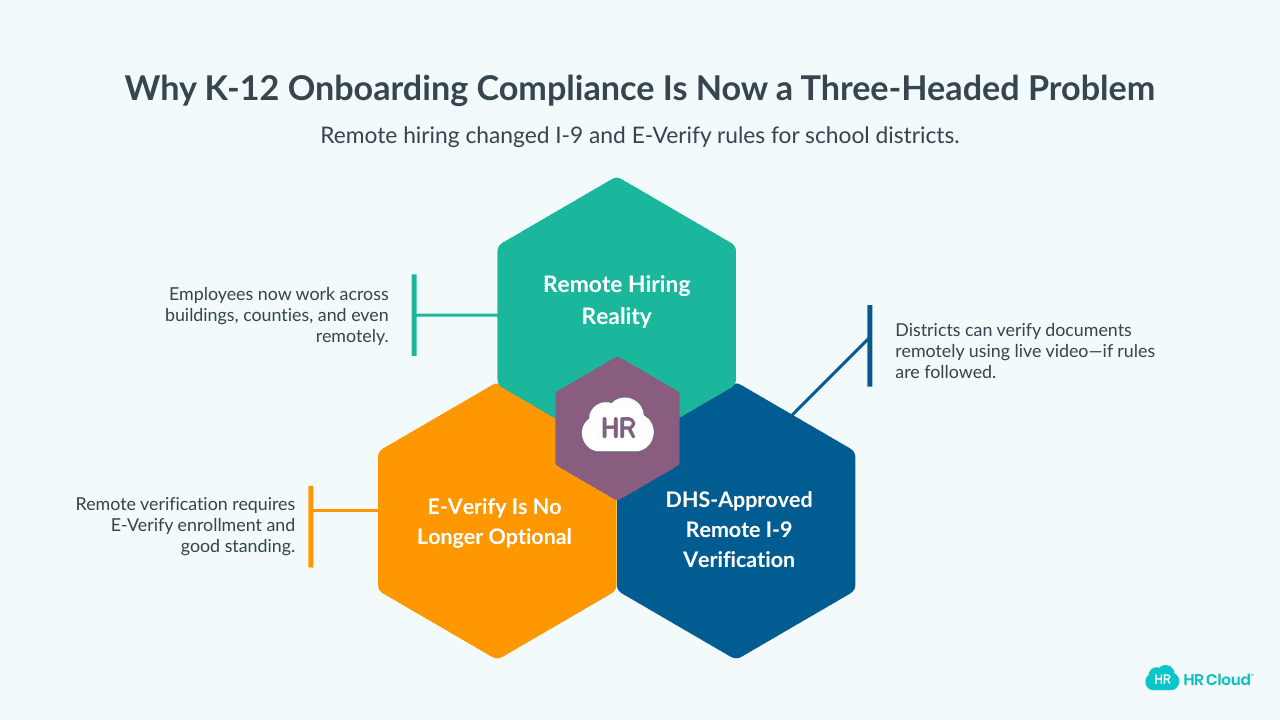
School districts now routinely hire speech therapists who work across buildings, substitutes from neighboring counties, and remote tutors. Traditional I-9 compliance workflows required in-person document examination but remote hiring has changed everything.
#1. The DHS Alternative Procedure for Remote I-9 Verification
The Department of Homeland Security permanently authorized an alternative procedure for remote document examination for E-Verify employers. Qualified districts can verify I-9 documents through live video calls instead of requiring in-person appearances.
The rules are very specific:
1. You must conduct a live video interaction where the employee presents the same documents they transmitted electronically.
2. Examine both sides of two-sided documents.
3. Check the box on Form I-9 indicating you used the DHS-authorized alternative procedure.
E-Verify Requirements for School Districts
Remote verification is only available to employers enrolled in E-Verify and in good standing. Several states—including Alabama, Arizona, Georgia, and Mississippi—mandate E-Verify for all public employers, including school districts. Even without a mandate, enrollment gives you access to remote verification capabilities that streamline E-Verify and I-9 onboarding as your hiring becomes more dispersed.
A speech-language pathologist working remotely across three elementary schools lives 90 miles from your district office. With remote verification, she uploads document copies, your HR specialist examines them via video call, and completes Section 2—all without either party leaving their desk.
The key is consistency. If you offer remote verification at a location, you must offer it to all employees at that location.
How State Background Checks Create the "Waiting Game" in K-12 HR Compliance
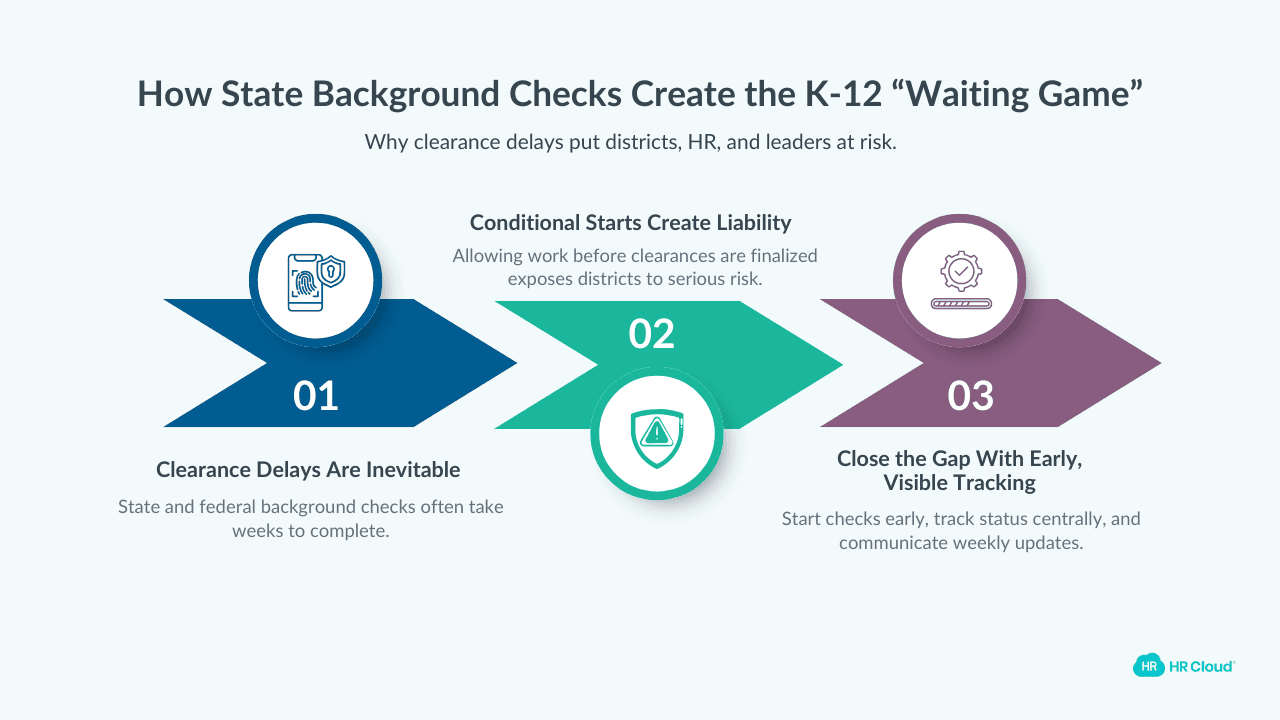
Your principal has a perfect candidate. Students need this teacher yesterday. And you're still waiting on fingerprint background check results submitted three weeks ago.
This waiting game is where K-12 onboarding often breaks down.
The Real Risk of "Conditional Starts"
Pennsylvania's Act 153 clearance requirements illustrate what most states demand: criminal history checks at state and federal levels, plus child abuse history clearances. These teacher clearance requirements aren't optional. They must be completed before someone works with students.
The liability exposure of allowing someone to begin work before state background checks for teachers finalize is the kind of decision that can potentially end careers and makes headlines.
Strategies to Close the Clearance Gap
To ensure you have all the clearances in place, start the clock as early as possible.
The moment a candidate accepts an offer, they should receive detailed instructions for initiating background checks. Build clearance tracking into your school onboarding system, not in a separate spreadsheet. If status tracking is fragmented, things are bound to fall through cracks.
"We're still waiting on clearances" is not a communication strategy.
You need to provide weekly status updates to hiring managers and give new hires a dedicated contact point. Set expectations upfront during the offer process that start dates are contingent on clearance completion.
This transparency is essential for building any comprehensive teacher onboarding checklist.
The Rehire Puzzle: Form I-9 Requirements for Seasonal School Staff
Football coaches work every fall. Summer school teachers return annually. Substitute teachers drift in and out of your system. K-12 employment patterns create I-9 compliance scenarios that don't fit standard frameworks.
To complete form I-9 for such varied scenarios, you need to a flexible system.
When to Complete a New Form I-9 vs. Using Supplement B
According to USCIS guidance, if you're rehiring within three years of the original I-9 completion date, you can complete Supplement B instead of a new form, provided work authorization documentation hasn't expired.
Remember that the three-year window starts from when the original I-9 was completed, not from when they last worked.
Your football coach has been with the district for five years, working August through November annually. When he returns this fall, look at his original I-9 date. If it is more than three years ago, complete a new I-9. If it was within three years with valid documentation, complete Supplement B with his rehire date.
The districts typically do not utilize the flexibility provided by the government. They complete new I-9s for every rehire regardless of timing. This creates audit trail inconsistencies and wastes time your school district HR onboarding team doesn't have.
Your 5-Step Self-Audit Checklist for I-9 Audit Readiness
In January 2025, DHS increased civil penalties for Form I-9 violations.
Paperwork violations now range from $288 to $2,861 per form. Knowingly employing unauthorized workers can cost up to $28,619 per violation. Self-auditing your K-12 onboarding process is a critical risk management activity.
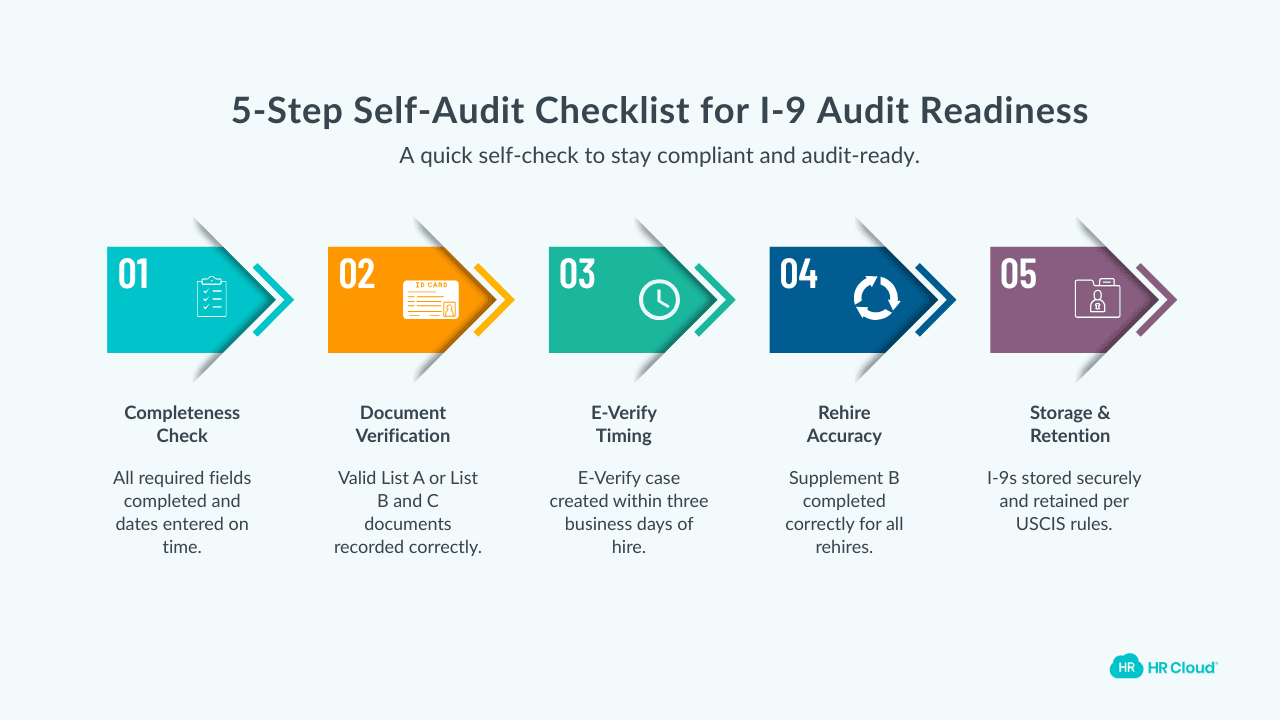
Step 1: Completeness Check. Is every box filled? Are dates logical—Section 1 on or before start date, Section 2 within three business days? Understanding the latest I-9 updates and compliance tracking requirements is essential.
Step 2: Document Check. Did employees present List A documents, or one from List B and one from List C? Are details recorded correctly?
Step 3: E-Verify Timeliness. Was each case created within three business days of the employee's start date? Follow this step-by-step E-Verify initiation guide to ensure consistent compliance.
Step 4: Rehire Records. Are Supplement B entries completed correctly for rehires?
Step 5: Storage and Retention. Per USCIS requirements, retain each I-9 for three years after hire or one year after termination, whichever is later.
K-12 District I-9 Self-Audit Checklist
Ensure hiring compliance, reduce risk, and stay audit-ready
Download Now
How to Correct Errors Without Creating New Problems
It’s really pretty simple.
When you find errors, draw a single line through incorrect information, initial and date the correction, enter correct information nearby.
Never use white-out or backdate entries. Proper correction procedures are what separate audit-proof onboarding from audit nightmares.
Consider Building the "Gatekeeper" Workflow for Audit-Proof K-12 Onboarding
Your HR team is small, your hiring volume is not. You're managing employee onboarding compliance for hundreds of employees using the same resources you had when the district was half this size.
The traditional process—emailing PDFs, hoping they're completed correctly, chasing missing signatures, tracking clearances in spreadsheets—isn't just inefficient but risky too.
Every manual handoff is an opportunity for error. Modern I-9 compliance software solutions eliminate this chase entirely.
How the Gatekeeper Model Protects Your District
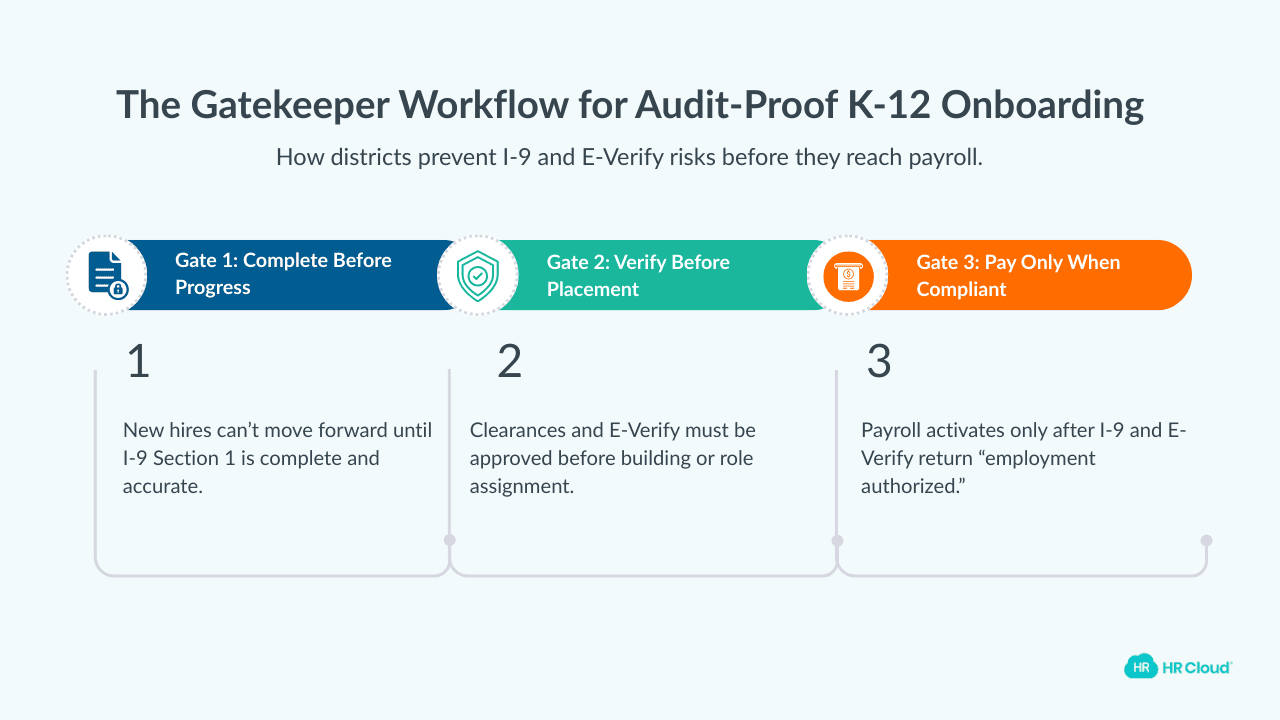
The gatekeeper model builds compliance checkpoints into your workflow. A new hire cannot proceed to benefits enrollment until their I-9 Section 1 is complete. They cannot be assigned to a building until clearances are verified. They cannot appear on payroll until E-Verify returns "employment authorized."
This approach has tradeoffs worth discussing.
It can create bottlenecks when clearances are delayed. It requires buy-in from principals wanting teachers in classrooms. But consider the alternative—hoping manual processes catch every error before ICE arrives with a Notice of Inspection.
The Payroll Connection That Makes Compliance Non-Negotiable
The most powerful gate connects I-9 and E-Verify in onboarding workflows directly to payroll activation.
When employees cannot be paid until their I-9 and E-Verify case are complete, compliance stops being optional. This electronic I-9 and E-Verify made easy approach transforms school district payroll compliance from aspiration to reality.
Why Digital K-12 Employee Onboarding Beats Paper Every Time
Paper I-9s aren't just inconvenient; they're expensive. Storage costs accumulate over years. Retrieval during an I-9 audit becomes a scramble when you have three business days to produce documents. Error rates on paper forms are significantly higher than digital submissions.
When a new teacher's first interaction with your district involves hunting for a working printer and driving across town to drop off forms, you've signaled that their time isn't valued.
A streamlined mobile K-12 employee onboarding experience that takes 15 minutes signals something very different and directly impacts whether that teacher stays.
Making Your K-12 Onboarding Truly Audit-Proof
An audit-proof K-12 onboarding process isn't about luck. It's about building systems that make compliance automatic rather than aspirational. That means understanding Form I-9 requirements for seasonal rehires and remote employees, tracking teacher clearance requirements with audit-level rigor, and connecting automated I-9 and E-Verify compliance to payroll in ways that create accountability.
Ready to make your K-12 onboarding truly audit-proof? Schedule a demo of HR Cloud today and see how K-12 onboarding software transforms your district's compliance from liability to competitive advantage.

Discover how our HR solutions streamline onboarding, boost employee engagement, and simplify HR management
Book Your Free DemoFrequently Asked Questions
What are the I-9 requirements for school employees?
All new school employees, including teachers, substitutes, and administrative staff, must complete a Form I-9 to verify their identity and employment authorization. Section 1 must be completed by the employee on or before their first day of employment, and Section 2 must be completed by the school district within three business days.
Do schools have to use E-Verify?
E-Verify requirements depend on your state. Alabama, Arizona, Georgia, Mississippi, and South Carolina mandate E-Verify for all employers. Many other states require it specifically for public employers and contractors, including school districts.
How long does a teacher background check take?
The timeline for a teacher background check, including fingerprinting and state-specific clearances, can vary widely from a few days to several weeks. Delays often depend on the state agencies' processing times and the complexity of the applicant's history.
Can a teacher start working before their background check clears?
No. It is a significant legal and safety liability for a school district to allow a teacher or any employee with student contact to begin working before all required state clearances and background checks are fully completed and approved.
Do I need a new I-9 for a substitute teacher who works every year?
If rehired within three years of the original I-9 completion date with valid documentation, complete Supplement B. If more than three years have passed, a new Form I-9 is required per I-9 compliance regulations.
What happens if a school district fails an I-9 audit?
Consequences range from warning notices for minor issues to substantial fines for systemic failures. ICE penalties for paperwork violations range from $288 to $2,861 per form. Districts may receive a Notice of Intent to Fine, which they can contest through negotiation or administrative hearing. Multiple violations or patterns of non-compliance can result in reputational damage and heightened scrutiny.
How do I track clearance expiration dates for current employees?
Most state clearances expire every five years but not all on the same date. Create a centralized tracking system that flags upcoming expirations 90 days in advance. Many districts use HR software with automated renewal reminders. Without systematic tracking, employees can inadvertently work with expired clearances, creating liability exposure.
What documents can employees present for I-9 verification?
Employees choose which acceptable documents to present; you cannot specify or request particular documents. List A documents (like a U.S. passport) establish both identity and work authorization. Alternatively, employees can present one List B document (identity, such as a driver's license) plus one List C document (work authorization, such as a Social Security card). The complete list appears on Form I-9.
What should we do if a new hire's E-Verify case returns "Tentative Nonconfirmation"?
A Tentative Nonconfirmation (TNC) means the information doesn't immediately match government records. You must notify the employee in writing and give them the opportunity to contest the finding. The employee has eight federal business days to contact DHS or SSA to resolve the discrepancy. You cannot take adverse action against the employee during this process; they must be allowed to continue working.
About the author

Keep Reading


Like What You Hear?
We’d love to chat with you more about how HR Cloud® can support your business’s HR needs.
Book Your Free Demo