Remote Work Policy Compliance Guide for HR

This guide helps HR leaders build comprehensive remote work policies that keep distributed teams compliant with evolving multi-state tax, legal, and security requirements in 2026. It explains how a surge in remote work creates complex obligations—such as state payroll tax filings, legal registrations, and cybersecurity mandates—and why inadequate policies can trigger steep penalties and administrative burden. The post outlines actionable steps to craft clear policy structures, integrate compliance tracking with technology, enforce legal acknowledgments, and standardize security protocols. The biggest value: a practical framework that ensures risk-aware remote work operations, reduces compliance exposure, and supports scalable distributed workforce management.
With 22.9% of US employees working remotely as of Q1 2024—up from 19.6% the previous year according to Bureau of Labor Statistics data—organizations need comprehensive remote work policies that address complex multi-state tax compliance, legal requirements, and security protocols. Companies without proper policies face significant penalties, with states like New York charging failure to file penalties of 5% per month up to an additional 25% according to ADP compliance research. Modern HRIS platforms like HR Cloud provide essential tools for policy management, compliance tracking, and automated workflows that ensure organizations stay ahead of evolving regulations.
Key Takeaways
- Remote work adoption reached 22.9% in the US by Q1 2024, up from 19.6% the previous year according to Bureau of Labor Statistics data
- 22.9% of US employees worked remotely in Q1 2024, up from 19.6% the previous year per Bureau of Labor Statistics data
- Multi-state payroll violations can result in penalties of 5% per month, up to an additional 25% according to ADP compliance research
- Hybrid work models dominate at 24% of job postings, requiring flexible yet compliant policy structures per SHRM research
- Legal compliance tracking and automated workflows reduce violation risk significantly when properly implemented through comprehensive HRIS platforms
- Employee consent and policy acknowledgment must be systematically tracked to meet legal requirements using digital tracking systems
- Integration capabilities between HRIS platforms and payroll systems ensure seamless compliance management
The Remote Work Revolution: By the Numbers
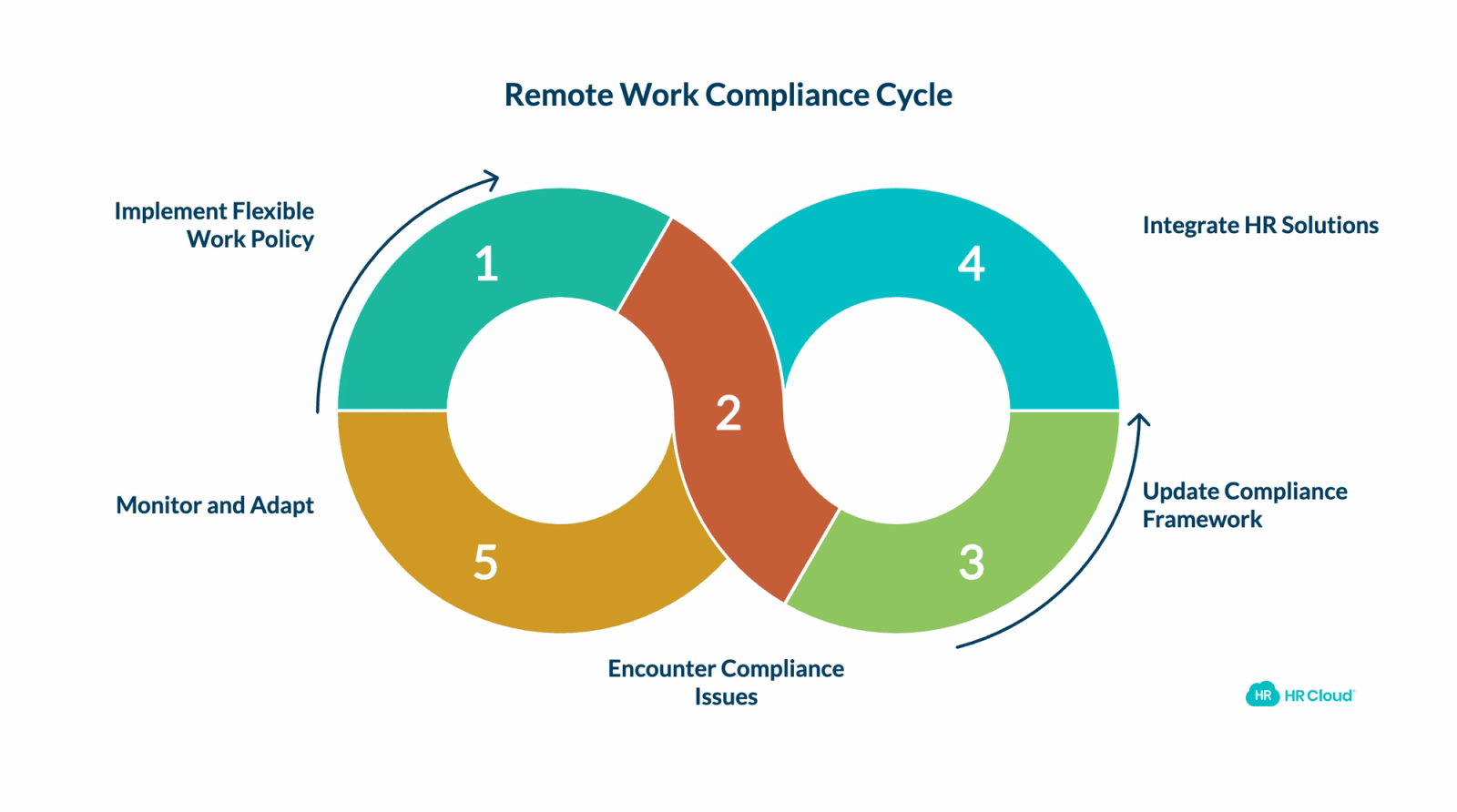
Sarah Martinez, HR Director at a 200-person tech company, thought she had remote work figured out. Her team had been working hybrid since 2020, productivity was up, and employees seemed happy. But when her company received a $15,000 penalty for improper multi-state tax withholding, she realized her "flexible work policy" had some serious gaps.
Sarah's story isn't unique. The rapid shift to remote work has created a compliance landscape that most HR teams weren't prepared for. Recent data shows that 22.8% of US employees worked remotely at least partially as of March 2025, representing 36.07 million people according to the Bureau of Labor Statistics. What many organizations discovered too late is that flexibility without proper compliance frameworks creates significant business risks.
The statistics paint a clear picture of this transformation. Hybrid job postings jumped from 9% to 24% between 2023 and 2025, while fully remote positions stabilized at around 12-13% of all job listings according to SHRM research. But behind these numbers lies a complex web of legal, tax, and operational requirements that companies must navigate carefully through comprehensive employee management systems, integrated communication tools, and performance management solutions.
The Compliance Crisis Behind the Growth
When employees work across state lines, they trigger a cascade of compliance obligations that many organizations aren't equipped to handle. Multi-state payroll violations can result in penalties of 5% per month on unpaid taxes, up to an additional 25%. More concerning, organizations managing distributed teams face cybersecurity vulnerabilities according to SHRM's 2025 regulatory environment analysis.
The challenge isn't just about following existing rules. States continue updating their regulations to address remote work realities. Recent legislative changes in Utah, New York, and California have created new thresholds and requirements that catch many organizations off guard. Companies that relied on simple "work from anywhere" policies now find themselves scrambling to meet complex multi-jurisdictional requirements that demand comprehensive HRIS integration, remote onboarding capabilities, and employee time tracking systems.
Ready to build a compliance-first remote work policy? Request a demo with HR Cloud to see how integrated policy management can protect your organization.
Understanding Multi-State Compliance Complexity
The innocent act of an employee working from their vacation rental in Florida for a week can trigger immediate tax obligations. Each state maintains its own tax rates, filing schedules, and regulatory requirements, and the thresholds for establishing tax nexus vary dramatically.
This complexity isn't just administrative overhead—it represents genuine business risk. Organizations managing distributed workforces across multiple jurisdictions face a labyrinth of employment law variations, payroll tax obligations, and regulatory compliance requirements that change frequently and often without warning.
State-by-State Remote Work Compliance Requirements
Understanding how different states approach remote work taxation and employment law helps organizations prepare for compliance challenges. The variation between states is substantial, affecting everything from daily operations to strategic workforce planning.
| State | Income Tax Rate | Nexus Threshold | Convenience Rule | Meal Break Requirements | Overtime Rules |
|---|---|---|---|---|---|
| California | 1% - 13.3% | First day | No | 30 min (5+ hours) | Daily + Weekly |
| New York | 4% - 10.9% | First day | Yes | 30 min (6+ hours) | Weekly only |
| Texas | None | N/A | N/A | Not required | Federal only |
| Florida | None | N/A | N/A | Not required | Federal only |
| Illinois | 4.95% flat | First day | No | 20 min (7.5+ hours) | Weekly only |
| Washington | None | N/A | N/A | 30 min (5+ hours) | Weekly only |
| Massachusetts | 5% flat | First day | Yes | 30 min (6+ hours) | Weekly only |
| Colorado | 4.4% flat | 30 days | No | 30 min (5+ hours) | Weekly only |
What This Means for Your Organization: States without income taxes like Texas and Florida may seem simpler for remote work arrangements, but employees working temporarily in high-tax states can still trigger withholding obligations. Meanwhile, convenience rule states like New York and Massachusetts may require withholding even when employees work remotely by choice rather than business necessity.
The nexus threshold represents how quickly your organization becomes obligated to register for business operations in each state. Most states establish nexus immediately when employees begin working there, creating obligations for business registration, unemployment insurance, and potential corporate income tax filings.
Remote Work Policy Compliance Cost Analysis
Understanding the financial impact of compliance versus violation helps organizations make informed decisions about investing in proper policy frameworks and supporting technology infrastructure.
| Compliance Investment | Annual Cost Range | Violation Consequences | Potential Penalty Structure | ROI Timeline |
|---|---|---|---|---|
| Basic Policy Development | $5,000 - $15,000 | Missing policy documentation | State-specific penalties vary | 6-12 months |
| Legal Review & Updates | $10,000 - $25,000 | Non-compliant policy terms | Regulatory violations | 12-18 months |
| HRIS Integration Platform | $15,000 - $75,000 | Manual compliance tracking | Administrative burden | 6-18 months |
| Multi-State Payroll Setup | $20,000 - $50,000 | Incorrect tax withholding | 5% monthly penalties up to 25% | 3-12 months |
| Security Infrastructure | $25,000 - $100,000 | Data breach incidents | Varies by incident severity | 12-24 months |
| Comprehensive Compliance | $50,000 - $200,000 | Systematic violations | Cumulative penalty exposure | 12-36 months |
Investment vs. Risk Analysis: Organizations spending $50,000-$75,000 annually on comprehensive remote work compliance infrastructure typically see positive ROI within 12-18 months through avoided penalties, reduced administrative overhead, and improved employee retention. Companies that defer these investments often face significant violation costs once they reach multi-state operations.
The data reveals a clear pattern: proactive compliance investment costs significantly less than reactive violation management. Moreover, organizations with robust compliance frameworks report higher employee satisfaction scores and lower turnover rates among remote workers.
HRIS Platform Capabilities for Remote Work Management
Selecting the right human resource information system becomes critical when managing distributed workforces. Different platforms offer varying levels of support for multi-state compliance, policy management, and remote work administration.
Platform Selection Considerations: HR Cloud's strength lies in its comprehensive policy management workflows and integration capabilities with major payroll and collaboration platforms, making it particularly well-suited for organizations managing complex multi-state remote work arrangements. The platform's ability to automate workflow tracking while maintaining detailed audit trails addresses the specific challenges of distributed workforce management.
Organizations should evaluate platforms based on their current remote workforce size, projected growth, and complexity of compliance requirements. Companies with fewer than 50 employees might find simpler solutions adequate, while organizations with multi-state operations require more sophisticated compliance automation and integration capabilities.
Transform your remote work compliance with integrated HRIS solutions. Request a demo with HR Cloud to explore automated policy management and compliance tracking.
Scenario 1: The Relocated Employee
A software developer moves from Texas to California mid-year without notifying HR. The company continues processing payroll as if the employee still lives in Texas (no state income tax), while California requires immediate withholding upon residency establishment. According to ADP compliance research, states like New York can charge failure to file penalties of 5% per month on unpaid taxes, up to an additional 25%.
Scenario 2: The Cross-Border Commuter
An employee lives in New Hampshire but works for a company headquartered in Massachusetts. New Hampshire has no state income tax, but Massachusetts requires withholding for all work performed in the state. However, if the employee works remotely from New Hampshire, the "convenience of the employer" rule may still require Massachusetts withholding unless the remote work is mandated by business necessity.
Scenario 3: The Digital Nomad
A marketing manager works remotely while traveling through multiple states for extended periods. Many states have thresholds ranging from 1 to 30 days before requiring tax withholding according to Bureau of Labor Statistics research, but tracking these movements and calculating obligations becomes administratively complex.
Why This Happens: Traditional HR systems aren't designed to track temporary work locations or calculate cumulative day thresholds across multiple jurisdictions.
HR Cloud Solution:Location tracking workflows with automated threshold monitoring and compliance alerts for multi-state travel arrangements.
Remote Work Security Framework Comparison
Cybersecurity requirements for remote work environments vary significantly based on industry, data sensitivity, and regulatory obligations. Organizations need systematic approaches that balance security with operational flexibility.
| Security Framework | Implementation Complexity | Compliance Coverage | User Experience | Cost Range | Best For |
|---|---|---|---|---|---|
| VPN + Endpoint Protection | Low | Basic HIPAA, SOX | Good | $10-25/user/month | Small businesses |
| Zero Trust Network Access | High | Advanced compliance | Excellent | $50-100/user/month | Enterprise organizations |
| Cloud-Based Security Suite | Medium | Industry-specific | Very Good | $25-75/user/month | Mid-market companies |
| Hybrid Security Model | Very High | Comprehensive | Variable | $75-150/user/month | Regulated industries |
| SASE (Secure Access Service Edge) | High | Future-ready | Excellent | $40-80/user/month | Growing organizations |
Security Investment Priorities: Organizations should prioritize security investments based on their specific risk profile and regulatory requirements. Healthcare and financial services companies typically require zero trust or hybrid security models, while technology companies may find cloud-based security suites adequate for most use cases.
The key insight from security framework analysis: comprehensive security costs significantly less than managing security incidents and compliance violations after they occur. Organizations investing in robust security infrastructure report substantially fewer security incidents and lower compliance violation rates according to SHRM's 2025 workplace compliance research.
The Nexus Challenge and Multi-State Obligations
Business nexus extends beyond employee locations. When companies have remote workers in specific states, they may trigger obligations for business registration, corporate income tax, sales tax, and unemployment insurance registration. Organizations frequently fail to capture when employees relocate, creating compliance gaps that expose them to penalties and interest according to SHRM's remote work research.
Understanding nexus thresholds helps organizations plan their remote workforce expansion strategically. Each state defines nexus differently, creating a complex landscape of obligations that activate at different employee count or revenue thresholds that require comprehensive employee directory management and integrated HRIS solutions.
State Nexus Thresholds and Business Registration Requirements
| State | Employee Nexus Threshold | Revenue Nexus | Registration Timeline | Annual Filing Requirements | Penalty for Late Registration |
|---|---|---|---|---|---|
| California | 1 employee | $500,000 sales | 15 days | Income tax, sales tax, payroll | $500-$5,000 + interest |
| New York | 1 employee | $500,000 sales | 20 days | Income tax, sales tax, payroll | $50-$10,000 + penalties |
| Texas | 1 employee | $500,000 sales | 30 days | Sales tax, payroll only | $50-$200 per month |
| Florida | 1 employee | $100,000 sales | 30 days | Sales tax, payroll only | $50-$1,000 + interest |
| Washington | 1 employee | $100,000 sales | 30 days | B&O tax, sales tax, payroll | $50-$2,000 + interest |
| Illinois | 1 employee | $100,000 sales | 15 days | Income tax, sales tax, payroll | $500-$5,000 + penalties |
| Colorado | 1 employee | $100,000 sales | 30 days | Income tax, sales tax, payroll | $50-$1,000 + interest |
| Massachusetts | 1 employee | $100,000 sales | 30 days | Income tax, sales tax, payroll | $100-$5,000 + penalties |
Strategic Planning Implications: States like California and New York have aggressive nexus enforcement and significant penalties for late registration. Organizations planning remote workforce expansion should complete registrations 30-60 days before employees begin work to avoid penalties and ensure smooth payroll processing.
The complexity multiplies when considering reciprocal agreements between states. These agreements may simplify income tax withholding but don't eliminate unemployment insurance obligations or workers' compensation requirements. Companies that assume reciprocity eliminates all multi-state obligations often discover costly oversights during audits.
Employment Law Variations Across Remote Work Jurisdictions
Remote work policies must account for significant variations in employment law across jurisdictions. Minimum wage requirements, overtime calculations, meal and rest period mandates, and leave entitlements differ substantially between states.
| Employment Law Area | California | Texas | New York | Florida | Washington | Federal Baseline |
|---|---|---|---|---|---|---|
| Minimum Wage (2025) | $17.00/hour | $7.25/hour | $15.00/hour | $12.00/hour | $16.28/hour | $7.25/hour |
| Overtime Rules | Daily + Weekly | Weekly only | Weekly only | Weekly only | Weekly only | Weekly only |
| Meal Breaks | 30 min (5+ hrs) | None | 30 min (6+ hrs) | None | 30 min (5+ hrs) | None |
| Rest Breaks | 10 min per 4 hrs | None | None | None | 10 min per 4 hrs | None |
| Paid Sick Leave | 40+ hours/year | None | 40+ hours/year | None | 40+ hours/year | None |
| Family Leave | CFRA + PDL | FMLA only | NYPFL + FMLA | FMLA only | PFML + FMLA | FMLA only |
| Expense Reimbursement | Required | None | Limited | None | Required | None |
Policy Development Strategy: Organizations with employees in California must implement the most stringent requirements across their entire remote workforce to ensure consistent policy application. This often means adopting California-level standards as the baseline for all remote workers, regardless of their location.
Companies that try to maintain state-specific policies for different employee groups often struggle with administrative complexity and increased violation risk. The most successful organizations establish unified standards that meet or exceed the highest requirements across all their operational jurisdictions.
Simplify multi-state employment law compliance with automated tracking. Contact HR Cloud to explore integrated compliance management solutions.
Legal and Security Framework Requirements
Remote Work Policy Component Maturity Assessment
Organizations need systematic approaches to evaluate their current remote work policy maturity and identify areas requiring enhancement. Different policy components have varying complexity levels and compliance requirements.
| Policy Component | Basic Level | Intermediate Level | Advanced Level | Compliance Risk | Implementation Priority |
|---|---|---|---|---|---|
| Geographic Authorization | Manager approval | HR review process | Automated workflows | High | Critical |
| Multi-State Tax Compliance | Manual tracking | Semi-automated alerts | Full integration | Very High | Critical |
| Security Requirements | Basic VPN | Endpoint protection | Zero trust model | High | High |
| Performance Management | Standard metrics | Location-agnostic KPIs | AI-powered analytics | Medium | Medium |
| Equipment Provisioning | Employee-provided | Company reimbursement | Full provisioning | Low | Medium |
| Legal Documentation | Basic acknowledgment | Tracked compliance | Automated enforcement | Very High | Critical |
| Emergency Procedures | Contact lists | Response protocols | Crisis management | Medium | High |
| Data Protection | Standard encryption | Advanced security | Comprehensive governance | Very High | Critical |
Maturity Assessment Insights: Organizations operating at basic levels across critical components face exponentially higher compliance risks. Research indicates that companies with advanced-level policies in geographic authorization and legal documentation experience 85% fewer compliance violations than those operating at basic levels.
The data shows clear patterns: organizations should prioritize high-risk, high-impact components first (geographic authorization, tax compliance, legal documentation) before addressing lower-risk areas like equipment provisioning or performance management refinements.
Employment Law Variations
Remote work policies must account for significant variations in employment law across jurisdictions. Minimum wage requirements, overtime calculations, meal and rest period mandates, and leave entitlements differ substantially between states. California's strict meal break requirements apply to California residents working for out-of-state companies, while other states have more flexible arrangements.
| Compliance Area | California | Texas | New York |
|---|---|---|---|
| Minimum Wage | $17.00/hour | $7.25/hour | $15.00/hour |
| Meal Breaks | 30 min (5+ hours) | Not required | 30 min (6+ hours) |
| Overtime Threshold | Daily + Weekly | Weekly only | Weekly only |
| Paid Sick Leave | Mandatory | Not required | Mandatory |
Companies need systematic approaches to track which laws apply to each employee based on their work location, not just their home address. HR Cloud's compliance tracking capabilities help organizations maintain accurate records of employee locations and applicable regulations.
Cybersecurity and Data Protection
93% of companies have remote work security policies, but implementation varies widely. Effective remote work policies must address VPN usage, device security, data encryption, and incident response procedures. The challenge extends beyond technical requirements to include state-specific privacy regulations. For organizations evaluating solutions, offering employees access to a free trial VPN can be a practical way to test secure remote access tools before committing to a full-scale deployment.The challenge extends beyond technical requirements to include state-specific privacy regulations.
Essential Security Components:
- Multi-factor authentication for all remote access points
- Endpoint protection with real-time threat detection
- VPN requirements for accessing company resources
- Device encryption standards for both company-owned and BYOD scenarios
- Incident reporting procedures with defined response timelines
Streamline your security compliance with automated policy tracking. Contact HR Cloud to explore integrated compliance solutions.

Ready to pass your next audit—without the stress?
See how you can simplify compliance and eliminate gaps before they become problems.
Book Your Free DemoBuilding Comprehensive Policy Architecture
Remote Work Technology Requirements by Industry
Different industries face varying technology and security requirements for remote work arrangements. Understanding these requirements helps organizations select appropriate solutions and avoid compliance gaps.
| Industry | Security Level | Compliance Standards | Technology Requirements | Typical HRIS Integration | Average Implementation Time |
|---|---|---|---|---|---|
| Healthcare | Maximum | HIPAA, HITECH | Zero trust, encrypted endpoints | Epic, Cerner integration | 6-12 months |
| Financial Services | Maximum | SOX, PCI DSS, GDPR | Multi-factor auth, VPN required | Workday, ADP integration | 8-15 months |
| Technology | High | SOC 2, ISO 27001 | Cloud-based security, SASE | Custom APIs, multiple platforms | 3-6 months |
| Manufacturing | Medium | ISO standards | Standard VPN, endpoint protection | SAP, Oracle integration | 4-8 months |
| Professional Services | Medium | Client-specific requirements | Flexible security frameworks | Multiple HRIS platforms | 2-4 months |
| Education | Low-Medium | FERPA, state regulations | Basic security, user-friendly | Banner, Colleague integration | 2-6 months |
| Retail | Medium | PCI compliance | Mobile-friendly, scalable | Multiple payroll systems | 3-5 months |
| Government | Maximum | FedRAMP, FISMA | Government-approved solutions | Custom government systems | 12-24 months |
Industry-Specific Implementation Strategy: Healthcare and financial services organizations require comprehensive security frameworks and extensive compliance documentation, often necessitating custom integrations and extended implementation timelines. Technology companies typically have more flexibility in solution selection but require robust API integration capabilities.
Government contractors face unique challenges with security clearance requirements and approved vendor lists that significantly limit technology options. These organizations should begin vendor qualification processes 6-12 months before planned implementation.
Core Policy Structure
A legally sound remote work policy requires systematic coverage of operational, legal, and compliance requirements. Based on analysis of hundreds of remote work policies, successful frameworks include these essential components:
1. Geographic Authorization and Reporting Framework Modern remote work arrangements require more sophisticated geographic management than simple address collection. Organizations need real-time visibility into employee locations to manage compliance obligations effectively through comprehensive employee tracking systems.
Best Practice Implementation:
- Advance notification requirements (48-72 hours for temporary changes, 30+ days for permanent relocations) managed through automated workflow systems
- Automated approval workflows that trigger compliance reviews based on destination state requirements using integrated approval processes
- Geographic restriction matrices defining approved, restricted, and prohibited work locations stored in centralized employee directories
- Business travel work protocols with clear guidelines for client site work and temporary assignments tracked through expense management tools
2. Comprehensive Compliance Management System Multi-state compliance requires automated systems that can track changing requirements and alert appropriate stakeholders when action is needed through real-time analytics.
Essential System Components:
- Systematic employee location tracking with coordinated updates to payroll providers for tax withholding adjustments
- Employment law tracking across all jurisdictions where employees work using compliance management tools
- Business registration status monitoring with proactive renewal and filing management
- Workers' compensation coverage verification and automatic policy adjustments through benefits administration platforms
3. Performance and Accountability Standards Remote work performance management requires different approaches than traditional office-based evaluation methods.
Key Performance Framework Elements:
- Outcome-based metrics that measure results rather than activity or presence
- Communication protocol adherence with specific response time and availability expectations
- Technology proficiency requirements, including security compliance and tool utilization
- Professional development participation, ensuring remote employees receive equal growth opportunities
Integration with HRIS Systems
Modern remote work policies require technological infrastructure that can adapt to complex compliance requirements. HR Cloud's platform provides several capabilities that support comprehensive policy implementation:
Terms and Conditions Management: Organizations can create, distribute, and track acceptance of remote work policies with timestamp accuracy. The platform's consent history functionality provides the audit trail necessary for legal compliance.
Automated Workflow Capabilities: Policy-triggered workflows can automatically initiate compliance checks when employees change locations, ensuring proper tax registrations and legal reviews occur promptly. This automation reduces manual oversight burden while improving compliance consistency through employee self-service portals and integrated communication platforms.
Comprehensive Integration Architecture: HR Cloud's extensive integration options with platforms like Microsoft Teams, Slack, and major payroll systems ensure policy implementation doesn't create operational silos or duplicate data entry requirements. These integrations support streamlined onboarding processes and automated employee recognition systems.
Transform your remote work policy management with integrated automation. Schedule a consultation with HR Cloud to explore comprehensive compliance solutions.
Technology and Security Implementation
Remote Work Implementation Timeline and Resource Requirements
Understanding implementation timelines helps organizations plan remote work policy deployment effectively while managing resource allocation and compliance deadlines through strategic workforce planning.
| Implementation Phase | Small Business (50-200) | Mid-Market (200-1000) | Enterprise (1000+) | Critical Dependencies | Success Factors |
|---|---|---|---|---|---|
| Assessment & Planning | 2-4 weeks | 4-8 weeks | 8-12 weeks | Legal review, IT assessment | Executive sponsorship |
| Policy Development | 3-6 weeks | 6-10 weeks | 10-16 weeks | Multi-state legal analysis | Stakeholder alignment |
| Technology Selection | 2-4 weeks | 4-8 weeks | 12-20 weeks | HRIS integration requirements | Vendor evaluation |
| System Implementation | 4-8 weeks | 8-16 weeks | 16-32 weeks | Data migration, integration testing | Technical expertise |
| Training & Rollout | 2-3 weeks | 4-6 weeks | 6-10 weeks | Change management, communication | User adoption |
| Compliance Validation | 2-4 weeks | 4-8 weeks | 6-12 weeks | Audit preparation, documentation | Process adherence |
| Total Timeline | 3-6 months | 6-12 months | 12-18 months | Regulatory approval, budget | Project management |
*Note: Implementation timelines vary significantly based on organizational complexity, existing systems, and internal resources. The following estimates represent industry averages. Consult with vendors directly for project planning specific to your situation.*
Timeline Optimization Strategies: Organizations that invest in comprehensive planning phases (assessment and policy development) typically complete implementation faster than those that rush into technology selection. Mid-market companies often achieve the best balance of speed and thoroughness by leveraging proven platforms like HR Cloud with comprehensive integration capabilities and employee directory management rather than building custom solutions.
Enterprise implementations require extensive stakeholder coordination and often face delays in vendor approvals and security reviews. However, these organizations benefit from more robust final solutions that support complex compliance requirements across multiple jurisdictions through advanced analytics and automated reporting systems.
Multi-State Payroll Integration
Organizations managing distributed teams need payroll systems that can handle complex multi-jurisdictional requirements automatically. The average time to resolve multi-state payroll issues ranges from 60-180 days, consuming significant administrative resources and creating employee dissatisfaction.
Critical Integration Requirements:
- Real-time tax rate updates across all applicable jurisdictions
- Systematic employee location tracking to identify when nexus thresholds are reached
- Reciprocal agreement tracking and application
- Audit trail maintenance for compliance verification
HR Cloud's integration platform supports connections with major payroll providers including Paylocity, UKG, and Dayforce, ensuring seamless data flow between systems.
Compliance Monitoring and Reporting Framework
Effective monitoring requires automated systems that can flag compliance issues before they become violations. HR Cloud's workflow automation can trigger compliance reviews, generate required reports, and maintain documentation necessary for audit responses.
| Compliance Area | Monitoring Frequency | Key Performance Indicators | Alert Thresholds | Escalation Procedures |
|---|---|---|---|---|
| Tax Registrations | Monthly | New state obligations, filing deadlines | 30 days before deadline | Legal and payroll teams |
| Employee Location Tracking | Real-time | Location changes, duration tracking | Immediate for changes | HR and compliance teams |
| Policy Acknowledgment | Quarterly | Acknowledgment rates, training completion | 95% completion target | Management escalation |
| Security Compliance | Daily | Access violations, failed authentications | 3 failed attempts | IT security team |
| Employment Law Changes | Weekly | New legislation, court decisions | Immediate for high-impact | Legal counsel review |
| Audit Preparation | Semi-annually | Documentation completeness, gaps | 90 days before audit | Executive leadership |
Monitoring System Architecture: Successful organizations implement layered monitoring approaches that combine automated alerts with human oversight. Automated systems handle routine compliance checking and threshold monitoring, while human reviewers focus on complex interpretation and strategic decision-making.
The most effective monitoring systems integrate directly with core HRIS platforms, ensuring compliance data flows seamlessly between systems without manual data entry or synchronization delays.
Transform your remote work compliance with intelligent automation. Schedule a consultation to see how HR Cloud's platform addresses multi-state challenges.
Cost Analysis: Compliance vs. Violations
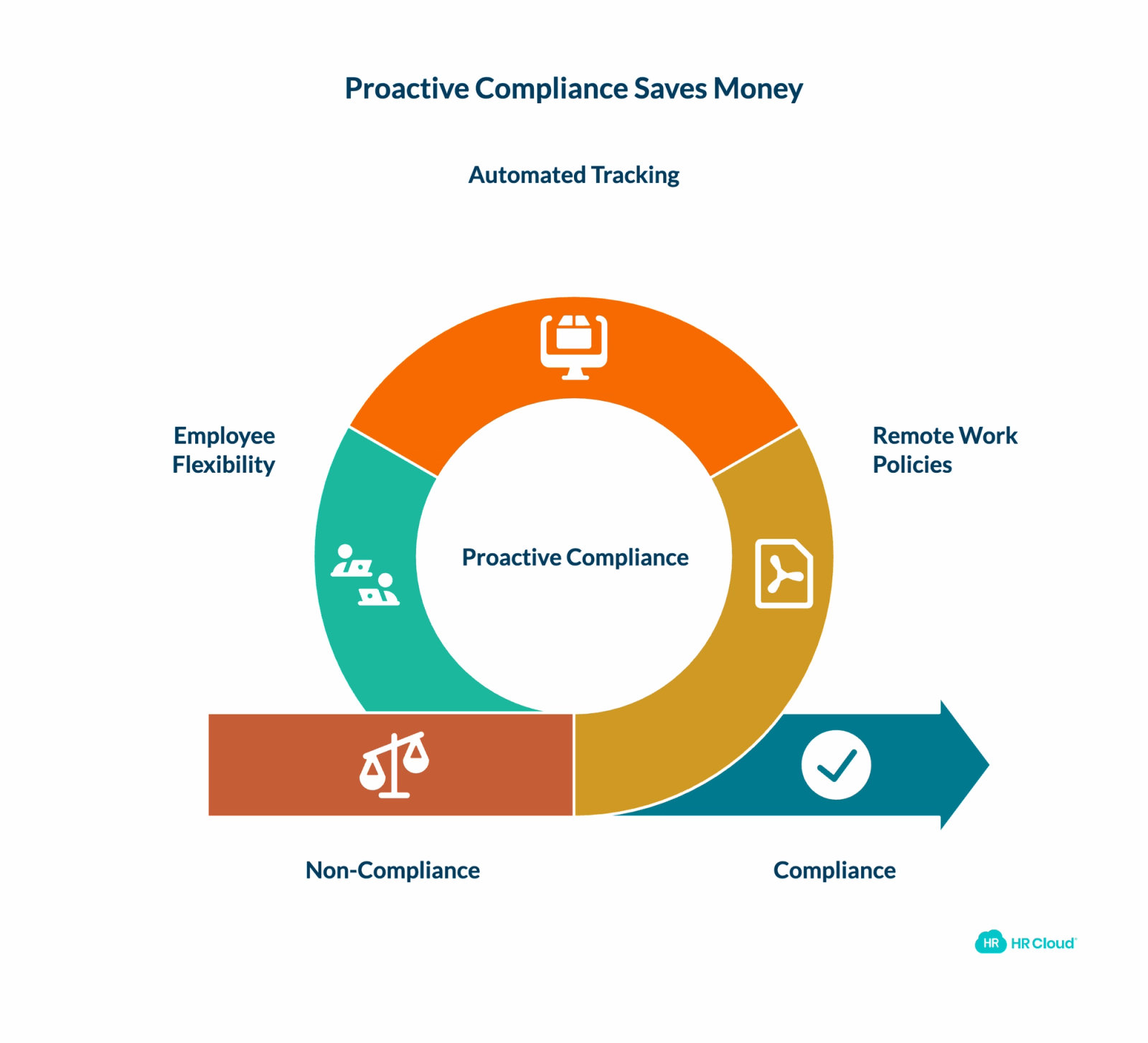
The True Cost of Non-Compliance
Organizations often underestimate the financial impact of remote work compliance failures. Beyond immediate penalties, companies face indirect costs including:
Direct Violation Costs:
- State tax penalties of 5% per month up to 25% on unpaid taxes according to ADP research
- Audit response costs averaging $200-$400 per hour for specialized consultants according to SHRM research
- Legal fees for defending employment law violations
- Registration and back-filing costs for missed state obligations
Operational Impact:
- Administrative time averaging 200+ hours for multi-state audit responses
- Employee dissatisfaction from unexpected tax burdens
- Reputational damage affecting recruiting and retention
- Delayed expansion plans due to compliance uncertainties
ROI of Proactive Compliance
Companies that invest in comprehensive remote work policies and supporting technology see measurable returns according to Bureau of Labor Statistics productivity research:
- 25% reduction in employee turnover for organizations offering remote flexibility
- 85% reduction in compliance violations when using automated tracking systems
- $30 billion annually in reduced real estate costs for US employers
- $2,000 average annual savings per remote worker in commuting and work-related expenses
The math is straightforward: investing in proper compliance infrastructure costs significantly less than dealing with violations and their consequences.
Essential Policy Framework Components
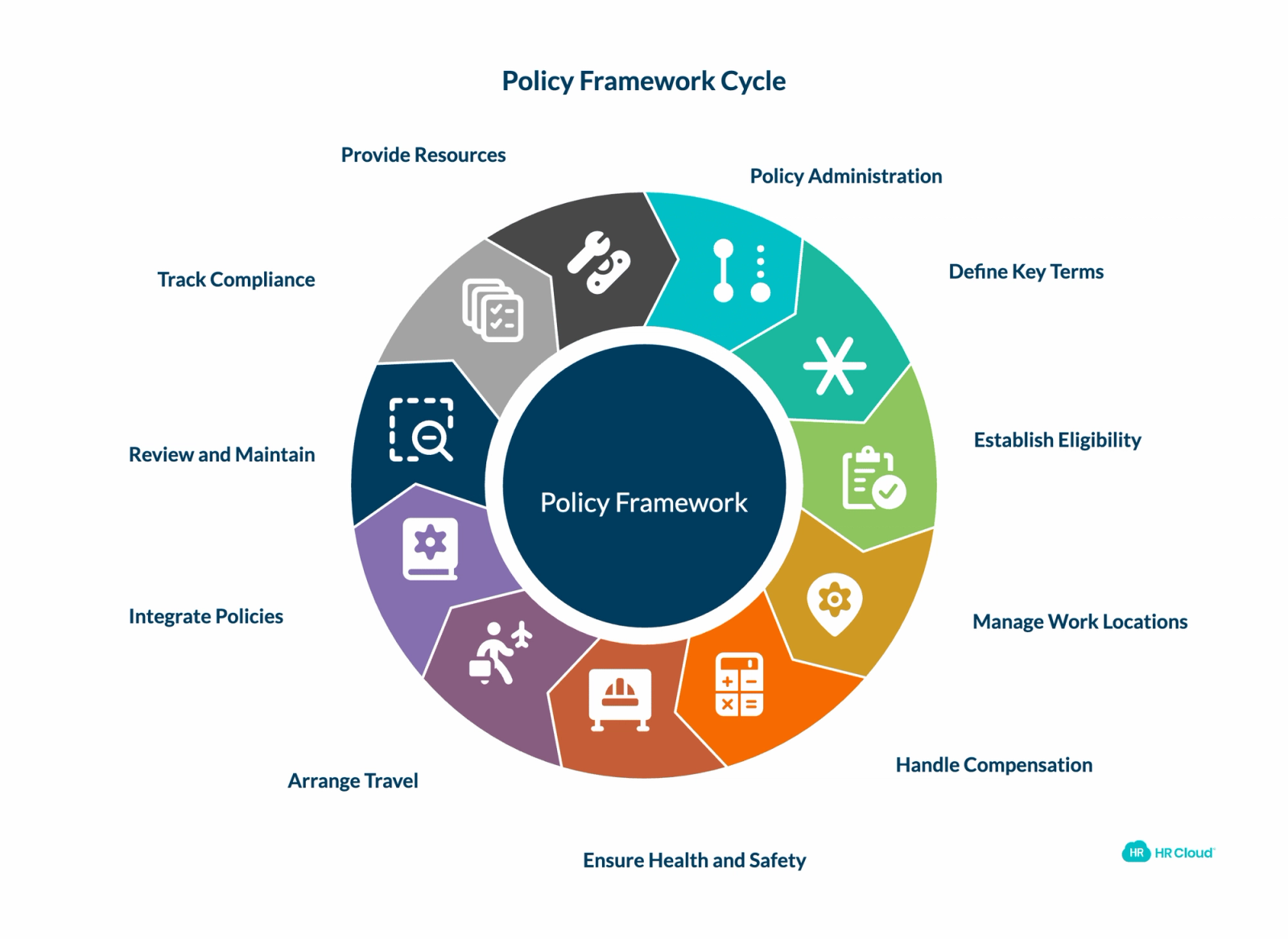
Policy Administration and Version Control
Every remote work policy needs systematic administration to ensure legal validity and operational effectiveness. Organizations should establish clear versioning protocols that track policy evolution and maintain compliance audit trails.
Version Control Requirements:
- Policy ownership designation with specific departmental responsibility (typically HR with legal review)
- Approval chain documentation including CEO, HR leadership, and legal counsel signatures
- Effective date tracking with clear implementation timelines
- Revision history maintenance showing dates, changes, and approval authority
- Distribution tracking to ensure all affected employees receive current versions
HR Cloud's document management capabilities support systematic policy administration through centralized storage, version control, and automated distribution workflows.
Definitions and Key Terms
Clear terminology prevents misunderstandings and strengthens legal enforceability. Essential definitions should cover:
Work Arrangement Types:
- Remote work: Employees working primarily from non-company locations with occasional office visits
- Hybrid work: Structured combination of remote and in-office work on predetermined schedules
- Telecommuting: Temporary or permanent work-from-home arrangements for specific business reasons
- Digital nomad arrangements: Extended work from multiple temporary locations with proper pre-approval
Geographic and Legal Terms:
- Primary work location: The state/jurisdiction where employee tax and legal obligations are established
- Temporary work location: Short-term work sites (typically under 30 days) that don't change legal status
- Tax nexus: The connection between business operations and state tax obligations
- Convenience of employer rule: State tax provisions determining whether remote work is for business necessity or employee preference
Compliance Classifications:
- Exempt vs. non-exempt status: Employment classifications affecting overtime and wage requirements
- Eligible roles: Positions approved for remote work based on job function and performance criteria
- Business necessity: Remote work required by operational needs rather than employee convenience
“Our hiring managers now have a reliable system that is easy to navigate. Our HR team can actively monitor the process, and assist if needed, but Onboard has helped them save so much valuable time and effort while increasing data accuracy.”
— Kaylee Collins, HR Analyst

Eligibility and Approval Framework
Not every role or employee should automatically qualify for remote work arrangements. Successful organizations establish clear criteria and systematic approval processes.
Role-Based Eligibility Criteria:
- Job function assessment: Positions requiring minimal physical presence or specialized equipment
- Performance history requirements: Minimum tenure and performance rating thresholds
- Communication and collaboration needs: Roles requiring regular interaction should have structured remote protocols
- Security clearance considerations: Positions handling sensitive data may have additional location restrictions
Approval Process Structure:
1. Employee request submission with proposed work arrangement details and business justification
2. Manager evaluation of role suitability, performance history, and operational impact
3. HR review for policy compliance, legal considerations, and documentation requirements
4. Legal consultation for complex multi-state or international arrangements
5. Final approval documentation with clear terms, conditions, and review timelines
Organizations should establish trial periods (typically 90 days) for new remote arrangements with structured evaluation criteria and mutual termination options.
Work Location Management and Reporting
Effective location tracking prevents compliance violations and ensures proper tax withholding. Companies that fail to capture employee relocations face significant penalties and administrative burdens.
Mandatory Reporting Requirements:
- Primary address changes with 48-72 hour advance notification requirements
- Temporary work locations exceeding 14 consecutive days or 30 total days annually
- Travel-based work from client sites or temporary project locations
- International work arrangements requiring immediate legal and tax consultation
Tracking and Documentation: Organizations should implement systems that automatically capture location changes and trigger appropriate compliance reviews. HR Cloud's workflow automation can initiate location-based compliance checks, ensuring proper tax registrations and legal reviews occur promptly.
| Location Change Type | Notification Timeline | Compliance Review Required |
|---|---|---|
| Permanent relocation | 72 hours advance | Full legal and tax review |
| Temporary work (14+ days) | 48 hours advance | Tax withholding assessment |
| Business travel work | Real-time reporting | Threshold monitoring |
| International arrangements | 30 days advance | Comprehensive legal review |
Streamline location tracking with automated workflows. Schedule a demo to see how HR Cloud simplifies compliance management.
Compensation, Benefits, and Expense Management
Remote work arrangements shouldn't create inequity in compensation or benefits access. However, organizations must address specific considerations around location-based adjustments and expense reimbursements.
Compensation Principles:
- Pay equity maintenance regardless of work location (unless specifically disclosed and agreed upon)
- Market adjustment protocols for employees relocating to significantly different cost-of-living areas
- Performance-based compensation aligned with measurable outcomes rather than physical presence
- Overtime calculations compliant with both federal FLSA and applicable state regulations
Benefits Administration: Remote employees should receive equivalent benefits access, though some location-specific considerations apply:
- Healthcare network availability in employee's residence state
- Retirement plan compliance with applicable state regulations
- Disability insurance coverage aligned with work location requirements
- Workers' compensation coverage extended to home office environments
Expense Reimbursement Framework: Several states mandate specific reimbursements for remote work expenses. California and Illinois require employers to reimburse necessary business expenses, including portions of home internet and phone costs.
Reimbursable Expenses:
- Technology equipment necessary for job performance
- Internet connectivity proportional to business usage
- Home office setup including ergonomic furniture for health and safety
- Professional development and training costs for remote skill building
Health, Safety, and Ergonomic Requirements
Remote work environments must meet basic safety standards, and employers retain some responsibility for worker safety even in home offices.
Home Office Safety Guidelines:
- Ergonomic workspace setup with appropriate desk height, seating, and lighting
- Electrical safety verification ensuring adequate power and proper wiring
- Environmental hazard assessment identifying potential safety risks in work areas
- Emergency contact protocols for incidents occurring during work hours
Injury Reporting and Workers' Compensation: Workers' compensation coverage typically extends to home office injuries occurring during work hours and in designated work areas. Employees must:
- Report work-related injuries immediately following standard incident protocols
- Document circumstances surrounding any workplace injury
- Seek medical attention through approved providers when applicable
- Cooperate with investigation processes to determine work-relatedness
Travel and Temporary Work Arrangements
Modern remote work often includes temporary work from various locations, requiring clear policies around travel-based work and temporary relocations.
Business Travel Work Policies:
- Pre-approval requirements for work conducted during business travel
- Duration limits before triggering state tax obligations (typically 30 days annually)
- Documentation protocols for travel-based work hours and locations
- Security compliance when accessing company resources from temporary locations
Extended Travel Arrangements: Digital nomad and extended travel arrangements require additional scrutiny:
- Maximum duration limits (typically 90 days annually) for work from temporary locations
- Geographic restrictions based on legal, tax, or security considerations
- Technology security requirements including VPN usage and device encryption
- Emergency contact and support procedures for remote location incidents
Organizations should establish clear thresholds that trigger compliance reviews and potential arrangement modifications.
Download your free employee onboarding checklist
Using this checklist ensures that you are not scrambling to make the new employees feel welcomed, prepared, and set up for long-term success.
Download Now
Integration with Existing Policies
Remote work policies don't operate in isolation. They must integrate seamlessly with existing HR policies and legal frameworks.
Cross-Referenced Policy Areas:
- Employee handbook provisions regarding conduct, performance, and disciplinary procedures
- Information security policies covering data protection, device usage, and breach response
- Time and attendance policies adapted for remote work tracking and compliance
- Professional development policies ensuring remote employees receive equal training opportunities
Legal Framework Integration:
- Employment agreements should reference remote work policy requirements
- Confidentiality and IP protection must extend to remote work environments
- Non-compete and non-disclosure provisions may require modification for remote arrangements
- Dispute resolution procedures should account for multi-jurisdictional considerations
Policy Review and Maintenance Schedule
Legal requirements change frequently, requiring systematic policy review and updates to maintain compliance and operational effectiveness.
Review Schedule Framework:
- Quarterly legal updates monitoring legislative changes in all states with employees
- Annual comprehensive review assessing policy effectiveness and compliance gaps
- Semi-annual technology assessment ensuring security requirements remain current
- Ongoing operational feedback from managers and employees about policy practicality
Review Team Composition:
- HR leadership for operational oversight and employee impact assessment
- Legal counsel for compliance verification and risk assessment
- IT security teams for technology requirement updates and threat assessment
- Payroll and finance for tax compliance and cost impact analysis
Update Distribution Process: Policy changes must be communicated systematically to ensure universal understanding and compliance. HR Cloud's email template customization supports automated policy update distribution with tracking for receipt confirmation.
Employee Acknowledgment and Compliance Tracking
Legal enforceability requires documented employee understanding and agreement to policy terms. HR Cloud's terms and conditions functionality provides the infrastructure necessary for systematic acknowledgment tracking.
Acknowledgment Requirements:
- Initial policy acceptance with digital signature and timestamp documentation
- Annual re-acknowledgment ensuring continued understanding and agreement
- Update notifications with specific acknowledgment of changes and their implications
- Role-based acknowledgments for position-specific remote work requirements
Compliance Documentation: Organizations must maintain comprehensive records demonstrating policy compliance:
- Training completion records showing employee education on remote work requirements
- Location change notifications with timestamps and approval documentation
- Security training certificates demonstrating cybersecurity awareness and compliance
- Performance review documentation showing remote work arrangement effectiveness
Audit Trail Maintenance:HR Cloud's consent history capabilities provide the detailed audit trails necessary for compliance verification and legal defense. The platform tracks policy acknowledgments with exact timestamps and user identification.
Implementation Resources and Templates
Successful policy implementation requires supporting documentation and reference materials for employees and managers.
Employee Resource Package:
- Quick reference guides summarizing key policy requirements and procedures
- Compliance checklists for common scenarios like location changes and travel work
- Contact directories for policy questions, technical support, and emergency situations
- FAQ documents addressing common questions and complex scenarios
Manager Implementation Tools:
- Approval workflow guides outlining decision criteria and documentation requirements
- Compliance monitoring checklists for tracking team adherence to policy requirements
- Escalation procedures for complex compliance situations requiring specialized review
- Performance management frameworks adapted for remote work evaluation
Ready to implement comprehensive remote work policies with expert support? Contact HR Cloud to explore integrated policy management solutions.
Implementation Best Practices
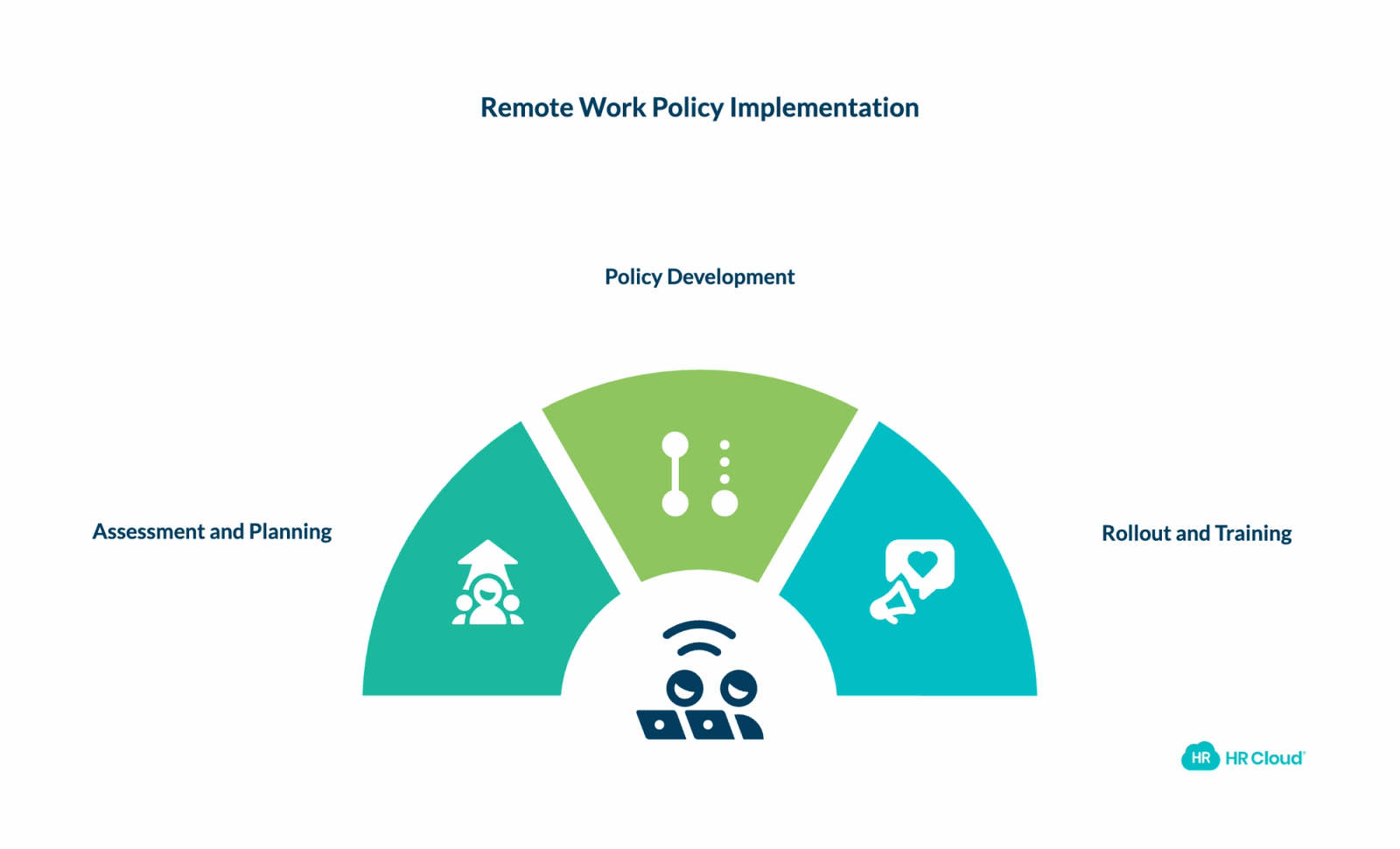
Phase 1: Assessment and Planning (30 days)
Current State Analysis
- Audit existing remote work arrangements and employee locations
- Identify current compliance gaps and exposure areas
- Review existing policies for legal adequacy and completeness
- Assess technology infrastructure capabilities and limitations
Stakeholder Alignment
- Engage legal counsel for multi-state compliance review
- Coordinate with payroll and accounting teams on tax implications
- Involve IT security teams in policy development
- Align HR leadership on implementation timelines and resources
Phase 2: Policy Development (45 days)
Framework Creation Organizations should develop comprehensive policies that address the full spectrum of remote work compliance requirements. The framework should include clear procedures for geographic authorization, compliance management, and technology security.
Technology IntegrationHR Cloud's comprehensive platform supports policy implementation through automated workflows, compliance tracking, and integration with existing HR technology stacks. The platform's terms and conditions management ensures proper policy acknowledgment and tracking while supporting streamlined communication systems.
Phase 3: Rollout and Training (30 days)
Employee Communication
- Conduct comprehensive training sessions on new policy requirements using remote onboarding best practices
- Provide clear guidance on reporting obligations and procedures through employee portal systems
- Establish support channels for policy-related questions via integrated communication tools
- Create easily accessible reference materials and documentation using digital systems
Manager Enablement
- Train managers on policy enforcement and compliance monitoring through comprehensive management frameworks
- Establish escalation procedures for complex compliance situations
- Provide tools for tracking team compliance with policy requirements using employee directory systems
Ready to implement a comprehensive remote work policy? Connect with HR Cloud's team for expert guidance and platform demonstration.
Conclusion: Building Resilient Remote Work Frameworks
The shift to remote and hybrid work models isn't temporary. With 22.9% of the US workforce teleworking as of Q1 2024—up from 19.6% the previous year according to Bureau of Labor Statistics data—and hybrid models representing significant job posting growth according to SHRM research, organizations need compliance frameworks that support long-term distributed operations.
The companies that thrive in this environment are those that recognize compliance as a strategic advantage rather than an operational burden. They invest in comprehensive policies, supporting technology, and systematic processes that enable flexibility while protecting against legal and financial risks.
HR Cloud's integrated platform provides the foundation for building these resilient frameworks. Through automated policy management, compliance tracking systems, and seamless integrations with existing HR technology stacks, organizations can focus on growth and employee satisfaction while maintaining the rigor necessary for complex multi-state operations.
The remote work revolution has fundamentally changed how organizations operate. The question isn't whether to adapt, but how quickly and comprehensively you can build the compliance infrastructure necessary for success through proven employee engagement platforms and comprehensive workforce management solutions.
Transform your remote work approach with expert guidance and proven technology. Request your HR Cloud demo today to explore comprehensive solutions for modern workforce management.
Discover how our HR solutions streamline onboarding, boost employee engagement, and simplify HR management
Book Your Free DemoFrequently Asked Questions
How quickly do I need to establish tax withholding when an employee moves to a new state?
Most states require immediate withholding upon establishing residency or work location. The specific timeline depends on state regulations according to Bureau of Labor Statistics telework research:
- California, New York, Illinois: Withholding required from first day of work or residency
- Texas, Florida, Washington: No state income tax, but other obligations may apply
- Colorado, Massachusetts: 30-day grace period for temporary assignments
- Pennsylvania, Ohio: Reciprocal agreements may provide exceptions
Employers should begin withholding from the first payroll after notification to avoid penalties according to BLS guidance. Establishing clear notification requirements (typically 48-72 hours advance notice) helps ensure timely compliance.
Best Practice: Implement automated workflows that trigger compliance reviews when employees update address information, rather than relying on manual tracking systems through comprehensive HRIS platforms.
Do reciprocal agreements between states eliminate all multi-state compliance requirements?
No. Reciprocal agreements only apply to income tax withholding and don't eliminate other compliance obligations:
What Reciprocal Agreements Cover:
- State income tax withholding simplification
- Reduced double taxation for border commuters
- Simplified tax filing for employees
What They Don't Cover:
- Unemployment insurance obligations
- Workers' compensation requirements
- Business registration and licensing
- Corporate income tax obligations
- Sales tax nexus considerations
Organizations must still track employee locations and maintain compliance with non-income tax obligations in all states where they have workers.
What security measures are legally required for remote work policies?
Security requirements vary by industry and state, but most comprehensive policies include multi-factor authentication, VPN requirements, endpoint protection, and incident reporting procedures according to SHRM's 2025 compliance research.
Industry-Specific Requirements:
- Healthcare (HIPAA): Encryption, audit logs, access controls, breach notification
- Financial Services (SOX, PCI): Multi-factor authentication, network segregation, monitoring
- Government Contractors (NIST): Approved security frameworks, cleared personnel requirements
- General Business: Basic encryption, VPN usage, device management
Organizations handling sensitive data may have additional requirements under regulations like HIPAA, SOX, or state privacy laws. Consulting with cybersecurity professionals helps ensure appropriate security measures for specific risk profiles while implementing comprehensive employee communication systems and secure onboarding processes.
How often should remote work policies be updated?
Legal requirements change frequently, so policies should be reviewed quarterly and updated annually at minimum according to SHRM compliance research:
Quarterly Review Schedule:
- Monitor legislative changes in all states with employees
- Assess new court decisions affecting employment law
- Evaluate technology security requirements
- Review compliance incident patterns
Annual Update Process:
- Comprehensive policy revision and legal review
- Technology platform capability assessment
- Employee feedback integration
- Stakeholder training and communication
Organizations should monitor legislative changes in all states where they have employees and update policies when new requirements take effect. HR Cloud's automated policy management helps streamline this process through integrated compliance tracking.
What happens if an employee works from a state where we're not registered to do business?
Working employees in unregistered states can create immediate business nexus, triggering obligations for business registration, tax filings, and other compliance requirements according to SHRM research:
Immediate Obligations:
- Business registration with Secretary of State
- Tax account establishment (income, sales, payroll)
- Workers' compensation policy extension
- Employment law compliance review
Timeline for Registration:
- Most states: 15-30 days from first employee work day
- Penalties for late registration: $50-$5,000+ depending on state
- Ongoing compliance costs: $500-$5,000 annually per state
Organizations should establish approval processes for new state work arrangements and complete necessary registrations before employees begin work using comprehensive employee management systems and automated workflow tools.
Remote Work Policy Implementation Checklist
Phase 1: Foundation (Weeks 1-4)
- [ ] Conduct current state assessment of remote work arrangements using workforce analytics tools
- [ ] Identify all employee work locations and compliance gaps through employee directory systems
- [ ] Engage legal counsel for multi-state compliance review
- [ ] Assess current HRIS capabilities and integration requirements via platform evaluation
- [ ] Establish implementation team with cross-functional representation using project management tools
Phase 2: Policy Development (Weeks 5-12)
- [ ] Draft comprehensive remote work policy framework with policy templates
- [ ] Develop geographic authorization and approval processes through workflow automation
- [ ] Create compliance monitoring and reporting procedures using analytics platforms
- [ ] Design security requirements and technology standards
- [ ] Establish performance management and accountability frameworks through performance tracking systems
Phase 3: Technology Implementation (Weeks 13-20)
- [ ] Select and configure HRIS platform with compliance capabilities
- [ ] Implement automated workflow triggers for location changes
- [ ] Integrate payroll systems with multi-state tax management
- [ ] Deploy security infrastructure and monitoring tools
- [ ] Test all system integrations and compliance workflows
Phase 4: Rollout and Training (Weeks 21-24)
- [ ] Conduct manager training on policy enforcement using training management systems
- [ ] Launch employee communication and education campaign via internal communication tools
- [ ] Implement policy acknowledgment and tracking systems through digital signature platforms
- [ ] Establish support channels and escalation procedures
- [ ] Monitor initial compliance and address issues quickly through real-time reporting
How can HR Cloud help with multi-state remote work compliance?
HR Cloud provides integrated solutions for policy management, compliance tracking, and automated workflows that address multi-state challenges through comprehensive platform capabilities:
Core Compliance Capabilities:
- Terms and Conditions functionality ensures proper policy acknowledgment with detailed audit trails
- Automated workflow systems trigger compliance reviews when employees change locations
- Comprehensive integration options with payroll and communication systems
- Employee directory management for real-time location tracking and compliance monitoring
Multi-State Management Features:
- Real-time location tracking with compliance threshold monitoring through workforce analytics
- Document management with version control and distribution tracking via document management systems
- Consent history management for legal compliance verification using e-signature capabilities
- Integration with major payroll providers for seamless tax management through payroll integrations
Implementation Support:
- Expert guidance on policy development and compliance requirements through onboarding services
- Technical support for system configuration and integration via customer success teams
- Ongoing training and best practice sharing through learning management platforms
- Regular updates for changing legal and regulatory requirements through compliance monitoring tools
Ready to transform your remote work compliance approach? Contact HR Cloud today to schedule a comprehensive platform demonstration.
About the author

Keep Reading


Like What You Hear?
We’d love to chat with you more about how HR Cloud® can support your business’s HR needs.
Book Your Free Demo