How Mentoring Connections Drive Employee Growth

To reduce turnover and retain the talent you worked hard to attract in the first place, boost your onboarding program with a dose of mentoring. In today's hybrid workplace model, where communication challenges are more prevalent than ever, a structured mentoring approach becomes even more critical.
The first weeks are a "make or break" moment for your new hire. It's the time that most employees decide to stay or go. In fact, according to research from The Wynhurst Group, "22% of staff turnover occurs in the first 45 days of employment, and the cost of losing an employee in the first year is estimated to be at least 3 times salary." The data is convincing, especially as organizations navigate hybrid work arrangements and work from home scenarios.
The onboarding experience is your chance to make a good impression, with a warm welcome and solid footing into the organizational culture. It's also an opportunity to provide a sure foundation for career success and establish effective communication strategies from day one. Incorporating mentoring into your onboarding program is an excellent way to fill the gaps that a typical orientation doesn't cover, particularly around remote work communication and collaboration expectations. Success goes beyond the understanding of how to complete timesheets and filling out benefit forms.
Key Takeaways
- The first 45 days are critical — 22% of staff turnover happens in this window, making a structured onboarding and mentoring program essential from day one.
- Mentoring fills the gaps that standard orientation misses, especially around culture, communication expectations, and remote or hybrid work norms.
- The buddy system gives new hires a safe, low-pressure way to get operational questions answered without feeling awkward in front of a manager.
- Counselors go beyond buddies — they're senior employees who align the new hire with business goals, model strong communication, and support long-term career growth.
- A well-structured onboarding program makes new employees 69% more likely to stay with the organization after three years.
- Mentoring extends the "good feeling" of onboarding well beyond the first few weeks, creating lasting engagement and organizational alignment.
Build a Network
Orientation promotes a sense of togetherness because everyone is there for the same reason. They're all new hires trying to figure out what to do and where to go. They bond with each other and develop a network. After the first day, new hires typically have a group of resources to call at a moment's notice, whether they're working in-office or as part of distributed teams.
In order to promote network-building during orientation, organize new hires around tables or pods. Encourage introductions and discussion through various communication methods. Provide learning and engagement activities that spark interest and collaboration using collaboration platforms and communication tools that your organization relies on. Introduce them to video conferencing etiquette and unified communications systems early in the process. Remind them that this cohort is a resource beyond measure. They may not have all the right answers now, but through varying experiences and business opportunities, they'll begin to share insight and expertise that will be invaluable.
Deploy the Buddy System
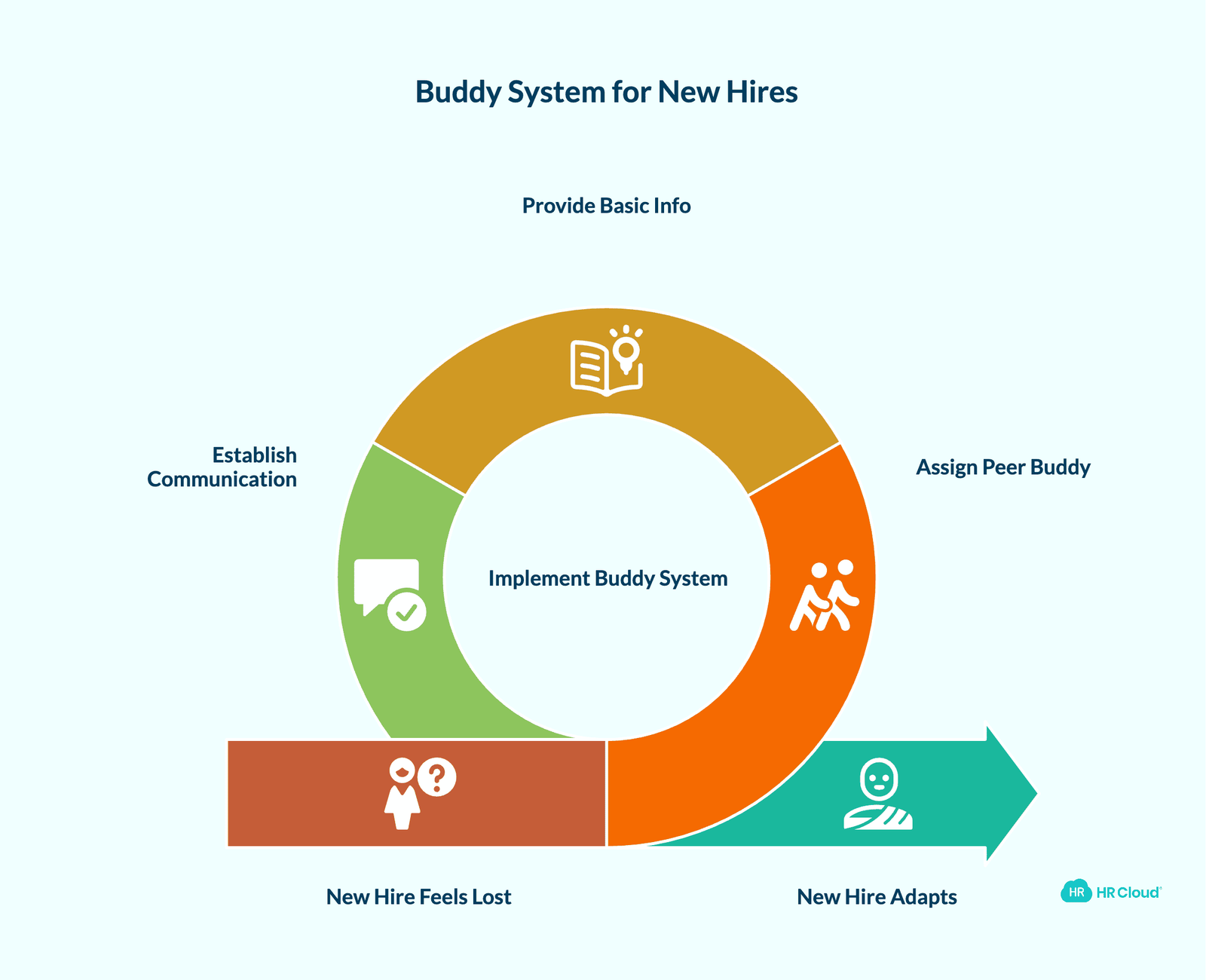
Everyone needs a buddy—a peer that can assist with basic questions regarding timesheets, vacations, parking, and concerns like "I can't remember where my desk is." These are important questions but can leave the new hire feeling a bit awkward in the presence of a manager. With the buddy system, a new hire can email their assigned buddy and get questions answered while retaining their "first day" dignity. The buddy system is designed to provide basic, operational information that helps the new hire adapt to the organizational culture without feeling "lost," while also establishing clear communication protocols and communication guidelines for both synchronous communication and asynchronous communication.
For a successful match, find a peer in the same business group or department—someone who will be familiar with the work your new hire will perform and possesses strong communication skills. They should also have familiarity with the culture, leadership team, and should possess good interpersonal skills. There's nothing more frustrating than a buddy who is not reachable and appears to ignore questions. Ensure your buddy understands the communication standards expected and has access to the necessary communication tools to stay connected, especially in hybrid work communication scenarios.


Counsel with a Counselor
Finally, consider matching new hires with a counselor. A counselor is similar to that of a mentor but is directly responsible for aligning the new hire with company business goals and establishing effective communication strategies. They are more senior than the new hire and are typically in a different department. This employee has organizational tenure and has shown increasing levels of responsibility and success. They are accountable for
- Making introductions to key team members to facilitate networking across distributed teams,
- Providing career guidance and direction while modeling strong communication skills,
- Evaluating performance and establishing goals,
- Defining organization expectations while helping to adjust culturally, including hybrid workplace model norms; and
- Meeting regularly to discuss progress through various communication methods including video conferencing.
The counseling model is designed to be a long-term mentoring relationship that evolves along the career path. The results for the new hire are as follows:
- A sense of belonging and socialization, even in remote work environments,
- Understanding of the new hire's role within the organization and appropriate communication protocols,
- Aligning the new hire's goals with that of the organization,
- Increasing retention and engagement; and
- Enhancing productivity and creativity through clear communication guidelines.
Incorporating mentoring into your onboarding program takes the new hire experience to the next level. It fills in the gaps with structure, provides organizational alignment, and quickly helps the new hire adjust to the culture while navigating modern communication challenges. Research shows that new "employees who attend a well-structured onboarding program are 69% more likely to stay with the organization after 3 years." Incorporating mentoring ensures that the "good feeling" extends well beyond the initial onboarding period, creating a lasting impression and establishing the foundation for effective hybrid work communication and collaboration.

Discover how our HR solutions streamline onboarding, boost employee engagement, and simplify HR management
Book Your Free DemoFAQ's
1. Why is onboarding critical in the first 45 days?
The first 45 days determine whether a new hire stays or leaves. Research shows that 22% of employee turnover happens during this period, making onboarding a high-impact retention lever.
A structured onboarding process ensures new hires feel supported, understand expectations, and integrate faster. HR Cloud automates onboarding workflows, communication, and task tracking to eliminate early-stage confusion and disengagement.
2. What is onboarding software and how does it work?
Onboarding software automates the process of welcoming and integrating new employees. It handles tasks like document collection, compliance forms, training workflows, and communication.
HR Cloud onboarding software goes further by offering mobile-first experiences, automated reminders, AI-driven workflows, and integrations with systems like ADP to streamline the entire employee journey.
3. How does mentoring improve onboarding outcomes?
Mentoring fills the gaps that traditional onboarding misses, especially around culture, communication, and long-term alignment.
By pairing new hires with buddies or mentors, organizations improve engagement, productivity, and retention. HR Cloud enables structured mentoring programs through automated workflows, task assignments, and communication tools.
4. What features should you look for in onboarding software?
You should look for:
- Automated workflows and task management
- Mobile-first employee experience
- Compliance and document automation
- Integration with HRIS and payroll systems (like ADP)
- Communication and engagement tools
HR Cloud combines all these features into one platform, eliminating the need for multiple disconnected systems.
5. How does HR Cloud onboarding software improve employee retention?
A well-structured onboarding program makes employees 69% more likely to stay for three years.
HR Cloud improves retention by:
- Delivering consistent onboarding experiences
- Reducing manual errors and delays
- Providing clear communication from day one
- Enabling mentoring and engagement programs
This removes the “first-day confusion” that drives early attrition.
6. Can HR Cloud integrate with existing HR systems like ADP?
Yes. HR Cloud integrates with systems like ADP to sync employee data, automate workflows, and reduce duplicate data entry.
You can manage preboarding, onboarding, and employee data in one place while maintaining your existing payroll system.
7. What is the difference between traditional onboarding and AI-powered onboarding?
Traditional onboarding relies on manual processes, emails, and static checklists.
AI-powered onboarding, like HR Cloud’s approach, uses automation and conversational workflows to:
- Guide employees step-by-step
- Answer questions instantly
- Trigger tasks automatically
- Reduce HR workload
This shifts onboarding from reactive to proactive.
8. How quickly can HR Cloud onboarding software be implemented?
Most organizations can implement HR Cloud within a few weeks, depending on complexity.
The platform offers pre-built templates, configurable workflows, and guided setup, allowing HR teams to launch faster without heavy IT involvement.
About the author
Keep Reading


Like What You Hear?
We’d love to chat with you more about how HR Cloud® can support your business’s HR needs.
Book Your Free Demo