Why Companies Are Switching to Cloud HR Software (Data & Trends)

Companies are switching to cloud HR software because manual HR work creates costs in follow-up, rework and delays, and because many employees now expect to finish HR tasks on a phone. Fortune Business Insights reports that hosted and cloud deployment holds a 64% share of the HR software market. It projects the market will grow from $23.68 billion in 2026 to $60.26 billion by 2034, a 12.38% compound annual growth rate. Frontline-heavy organizations face distinct pressures, such as staff with no company email, as the Konzum case below shows. This guide covers seven forces behind the switch. Each statistic carries a source and a date, and each customer result is labeled as customer-reported.
What are the key takeaways on cloud HR software adoption?
- Hosted and cloud deployment led the HR software market at 64%, with on-premise at about 36%, according to Fortune Business Insights.
- Gallup puts the cost of replacing one employee at one-half to two times annual salary.
- Pew Research Center reports that 91% of U.S. adults own a smartphone, so mobile access is a practical way to reach employees, though device access and preferences still need testing.
- Deloitte’s 2026 release states that only 27% of leaders say their organizations manage change well, which makes low-disruption rollouts a real buying criterion.
- Cloud HR software does not have to replace payroll. HR Cloud documents a two-way integration with ADP for companies that keep their payroll provider.
Which seven trends explain the switch at a glance?
The table pairs each trend with a context data point. These figures frame the trend. They do not prove it on their own.
| Trend | Context data point | Source |
|---|---|---|
| Manual HR cost | Replacing an employee costs one-half to two times annual salary | Gallup |
| Mobile-first workforces | 91% of U.S. adults own a smartphone | Pew Research Center |
| Security expectations | Data encrypted with AES256 at rest and TLS 1.2 in transit, documented in HR Cloud’s Security FAQ | HR Cloud help center |
| Legacy system fatigue | 52.7% of EU enterprises bought cloud services in 2025, up from 17.8% in 2014 | Eurostat |
| Low-disruption rollouts | 27% of leaders say their organizations manage change well | Deloitte, 2026 |
| AI in HR work | 67% of CHROs report higher productivity expectations | Gartner, 2026 |
| Pricing predictability | HR Cloud sells a fixed annual license, not a per-seat fee | HR Cloud pricing page |
How big is the move to cloud HR software?
Fortune Business Insights values the HR software market at $21.07 billion in 2025. Its report projects growth from $23.68 billion in 2026 to $60.26 billion by 2034, a 12.38% CAGR for 2026 to 2034. The same report says hosted and cloud deployment led with a 64% market share, and that on-premise HR software represented approximately 36% of the market. The page does not state a year for the deployment split, so read 64% as the report’s current positioning, not a dated measurement.
| Fortune Business Insights metric | Figure |
|---|---|
| HR software market size, 2025 | $21.07 billion |
| Projected market size, 2026 | $23.68 billion |
| Projected market size, 2034 | $60.26 billion |
| CAGR, 2026 to 2034 | 12.38% |
| Hosted and cloud deployment share | 64% |
| On-premise deployment share | About 36% |
Publishers size this market with different methods, so totals differ between sources. Do not use a market forecast as an ROI assumption in your own business case.
Eurostat adds context from outside HR. It reports that 52.7% of EU enterprises used paid cloud computing services in 2025, up from 17.8% in 2014 (Eurostat, February 3, 2026). E-mail (85.2%), office software (71.7%) and file storage (71.5%) were the three most common services. Adoption is uneven: Finland reached 79.2% and Bulgaria 17.8%. Eurostat does not break out HR software, so treat these figures as context for the wider habit of buying software as a service, not as an HR-specific measure.
HR Cloud’s homepage says the company is trusted by 760+ organizations worldwide, and it builds for industries with high turnover, dispersed workforces and site-specific compliance. For a definition of the category and how HRIS, HRMS and HCM relate to it, read What Is HR Cloud Software? A Complete Guide for 2026 and HRIS vs HRMS vs HCM. This article answers a different question: why buyers are making the move now.
Why is manual HR work getting too expensive to keep?
Gallup states that “the cost of replacing an individual employee can range from one-half to two times the employee’s annual salary,” and calls that estimate conservative (Gallup, published March 13, 2019 and last modified May 13, 2025). The same article puts the annual cost of voluntary turnover to U.S. businesses at $1 trillion. It also reports that 52% of voluntarily exiting employees say their manager or organization could have done something to prevent them from leaving.
Run the arithmetic for a 300-person company with a $55,000 average salary. One replacement costs $27,500 at the low end of Gallup’s range and $110,000 at the high end. Ten departures in a year put $275,000 to $1.1 million at stake. That is arithmetic on Gallup’s range, not a forecast for any company.
Onboarding is the part of that cost a company controls on day one. Manual onboarding does not cause turnover by itself. Paper packets, email chains and a spreadsheet status column do cost HR time, and they hide which new hires are stuck.
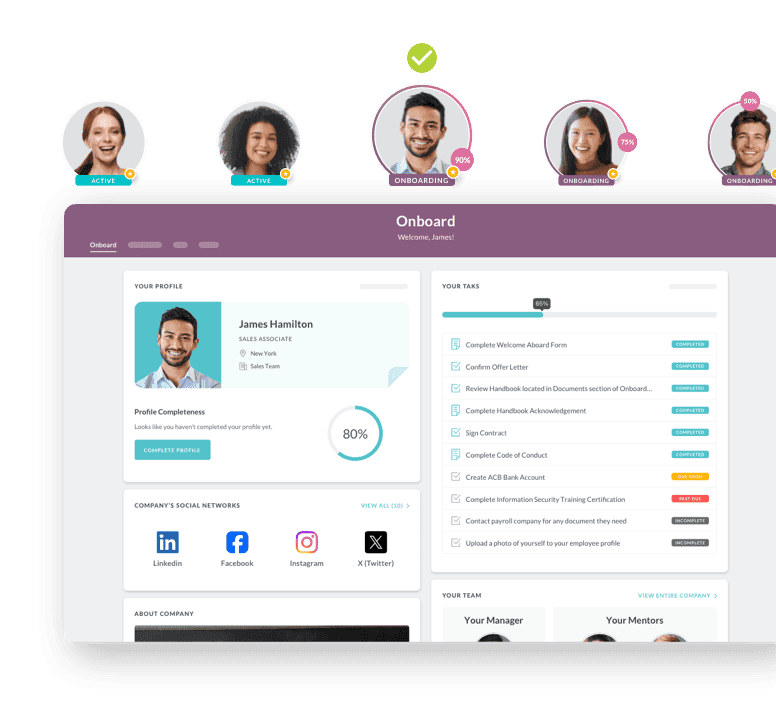
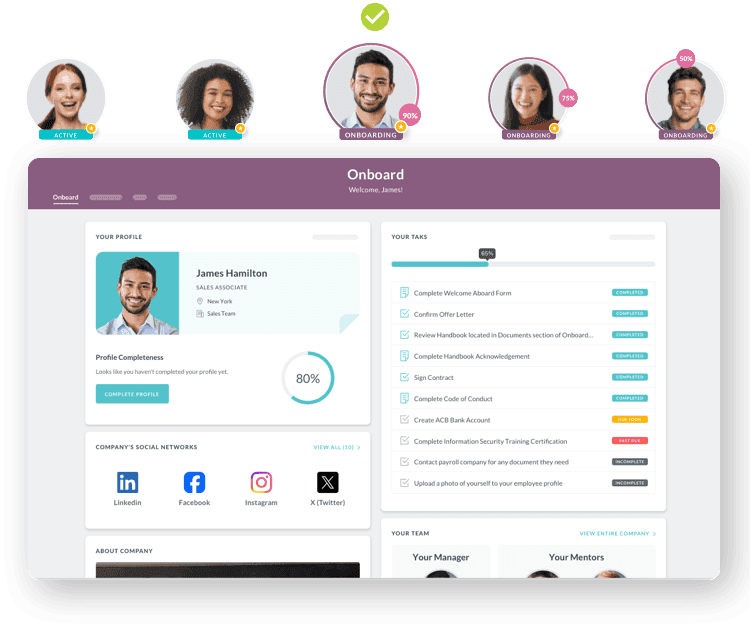
Cloud HR software moves that work into assigned tasks with owners and due dates. HR Cloud’s help center documents the pieces: recurring checklists, mandatory checklists, reminders and overdue alerts, task review, e-form signing and bulk onboarding. The onboarding dashboard shows summary cards for Total Onboardings, Starting in 7 Days, With Overdue Tasks and Unassigned, plus an overdue-task view by task and by assignee. Each card opens a list that can be exported. Browse the full list in the Onboard section of the HR Cloud help center, or read the Onboarding Dashboard Overview.
Two customers describe the effect in their own words. Renaissance Outpatient Rehabilitation Center has 50 employees in five locations and calls its old approach “completely paper-based.” Its CEO, Travis French, says HR Cloud cut onboarding time in half and that the time savings add up to nearly $75,000 per year (customer-reported). Behavioral Progression, a 50-employee healthcare provider in Tampa, moved off Word documents and Google Drive uploads. Its story reports onboarding time falling from four weeks to 2.5 weeks on average (customer-reported). Both figures come from HR Cloud’s published case studies and have not been independently audited.
Field-based teams show a different cost. Osmose Utilities Services inspects utility structures and relies on a high number of field-based employees, so HR onboarded staff outside a central office or any office at all. Its story says onboarding took up to two hours for each new hire before HR Cloud. HR Analyst Kaylee Collins says Onboard has saved “so much valuable time and effort while increasing data accuracy” (Osmose story). The story gives the starting cost and a qualitative result, not a before-and-after percentage, which is worth knowing before you repeat it to your own finance team.
To size your own number, enter your volumes into HR Cloud’s Onboarding ROI Calculator. It asks for annual volume, manual hours per event and staff hourly rate.
Are mobile-first and frontline workforces forcing the switch to cloud HR software?
Pew Research Center reports that 91% of U.S. adults own a smartphone, based on a survey fielded February 5 to June 18, 2025 (Pew Research Center). A desktop-only HR portal reaches employees who sit at desks. It misses crews, clinicians and store teams.
Konzum shows the gap. The Croatian retail chain, part of Fortenova Group, has more than 10,000 employees across 600+ stores. Its story page says it relied on bulletin boards, printed newsletters and memos, and that frontline staff generally lacked company email or mobile devices. It says over 90% of the workforce was disconnected from traditional digital channels and working in shifts. Konzum moved internal communication to Workmates, HR Cloud’s engagement product, so updates now reach all 600+ stores at once (Konzum story).
Deadline-driven hiring is another trigger. MCO set a goal of getting 80% of La Senza’s 2,000 employees across the U.S. and Canada to complete their employee agreements and onboard within five days, which meant hundreds of employees would be using the system each day. Its Product Manager, Ivana Placko, says HR Cloud helped surpass the goal, with 90% of La Senza employees meeting the deadline (MCO story). The figure is customer-reported, and the story ties it to HR Cloud Onboard only.
A mobile-ready platform needs specific features. HR Cloud’s employee app is distributed through the App Store and Google Play. Its product page describes push notifications by company, location, department or group, and read receipts and acknowledgements so administrators can confirm a message was seen. The homepage says employees can read updates, complete tasks and recognize teammates from their phones. Recognition tools sit in Workmates, which lists peer-to-peer and manager recognition with custom awards, badges and company values.
Sign-in matters as much as the app. Many frontline employees have no company email address. HR Cloud’s User Management help center includes guides for signing in with an email address and password and for signing in with a phone number. The Mobile App help center covers customizing the app homepage and sending a download link for a custom mobile app. Ask any vendor how a new hire without a work email gets an account, and test the answer on a personal phone during the demo.

Want to learn how Workmates can transform your organization today?
Want to learn how Workmates can transform your organization today?
Book Your Free Demo
Does cloud HR software protect employee data better than spreadsheets and shared folders?
HR files hold Social Security numbers on tax forms, identity documents for I-9 verification and bank details for direct deposit. In a paper or spreadsheet process, copies of those files can land in inboxes, shared drives and filing cabinets.
Cloud HR software can reduce that sprawl, but only if the vendor documents its controls and you verify them. A certification badge is a starting point. HR Cloud’s published material gives checkable specifics:
- The homepage lists SOC 2 Type II certification, GDPR controls, encryption, role-based access and reviewable audit trails. The security page describes the company’s SOC 2 and data protection approach.
- The help center security FAQ states that data is encrypted at rest with AES256 and in transit with TLS 1.2. It says data is stored in California and Virginia and in AWS S3 (US-East-1), with Rackspace Technology as the hosting partner. Read it in the Security FAQ.
- The same FAQ says HR Cloud ran penetration tests on all products using Akitra, and that the report can be provided under NDA.
- 2-Step Verification is off by default. An administrator asks the account manager or support to enable it, then chooses email codes, an authenticator app or both. Google Authenticator, Duo Mobile and Microsoft Authenticator are named. The setting can be limited to employees who meet set criteria. See 2-Step Verification.
- Single sign-on guides cover SAML, Okta, OneLogin and Office 365, and the User Management help center lists guides for an IP allowlist, an automatic logout timer and forced password resets.
Ask any vendor for the SOC 2 report itself, including its audit period and scope, and for the penetration test summary. Ask where data is stored and who can reach it. Those answers matter more than a badge.
Interim HealthCare Sioux Falls shows the records side of the change. The independently owned franchise has three offices and kept employee records in a physical filing cabinet before HR Cloud Onboard. Its story headlines a move from paper to zero physical employee files and reports 85% employee satisfaction with onboarding on its 2025 employee survey (customer-reported). Its Staffing Manager, Ali, calls HR Cloud “our giant file cabinet, essentially.”
Is it still worth running HR on legacy or on-premise systems?
Fortune Business Insights puts on-premise HR software at approximately 36% of the market in the cited report, against 64% for hosted and cloud deployment. Market share is not a count of companies, but it shows that on-premise deployment has not disappeared.
The difference is who runs the infrastructure. In an on-premise model the company’s IT team installs the software, applies patches and manages backups on hardware the company owns. With cloud HR software the vendor hosts the system and the company signs in through a browser or app. The company still decides who gets access, how single sign-on is configured and what data it loads, so cloud does not remove every responsibility. For a five-person HR team, the question is whether anyone on staff should spend time on servers at all.
Not every switch is planned. Some start when a tool disappears or stops fitting. Livermore Pets, a veterinary group in Livermore, California, moved from Facebook Workplace to HR Cloud’s Workmates in early 2023, according to its story page. The story reports a 98% adoption rate across the workforce (customer-reported).
Other switches replace scattered folders and paper files. Bracken Christian School ran HR for 100+ staff through Google folders, paper files and manual coordination. It now uses HR Cloud Recruit, Onboard and Performance together. Its story describes cleaner processes and less filing, and it gives no numeric result (Bracken story). Not every switch comes with a percentage, and for some teams the gain is that records live in one place. MG Motor Europe, with 56 employees across office and engineering roles, describes the same pattern for recruitment, onboarding and time-off processes (MG Motor Europe story).
A switch moves records, not only users. The pricing page’s Onboard Suite feature list includes bulk data import, import and export of data, employee profiles with custom tabs and fields, and I-9 verification with a connection to E-Verify. Implementation covers setup, configuration, data import and training. Confirm with HR Cloud how E-Verify is configured for your account, because employers remain responsible for their own verification obligations. Before you commit, list the records you need to carry over, such as employee profiles, signed documents and open onboarding tasks, and ask the vendor how each one loads.
A cloud HRIS can give those records one home. HR Cloud’s People HRIS page lists a single source of truth for job, pay and performance data, secure document storage with version tracking, and automated org charts and reporting lines. The platform also covers time off, which has its own help center section for policies and requests.
Do you have to replace payroll to adopt cloud HR software?
No. Deloitte’s 2026 Global Human Capital Trends release says only 27% of leaders report that their organizations manage change well. That figure argues for rollouts that change as little as possible at once. A project that swaps payroll, HRIS and onboarding in one pass multiplies the change an organization has to absorb.
HR Cloud’s homepage frames its position as “Enhance your HR stack. Don’t replace it.” It shows Workday, ADP, UKG, Microsoft 365, Slack, Google and QuickBooks as the tools it connects to. HR Cloud is a Platinum ADP Marketplace Partner, which its ADP integration page describes as ADP’s highest partnership tier.
That page describes a two-way API sync rather than a manual file import, single sign-on with existing ADP credentials, and one-click document push to ADP Document Cloud. It names ADP RUN, ADP Workforce Now, ADP Vantage and ADP TotalSource. Confirm supported fields, document flows and single sign-on for your specific ADP product before you plan the rollout.
The help center adds the detail a payroll administrator needs. The ADP Workforce Now integration details say the integration imports employees and company information, including the data needed to build a company hierarchy. They say it exports state tax forms and W-4 forms from HR Cloud to ADP, and that custom fields from the Personal and Employment sections move in both directions. Employees must exist in HR Cloud before they are sent to ADP. The page also states that the integration does not receive all the data and forms from the HR Cloud employee profile, so review the field mapping documents against your payroll process before you sign.
Other connections have their own guides in the Integrations help center: UKG, Paycor, Paylocity, Dayforce and QuickBooks Online for payroll and accounting; Greenhouse, Lever, iCIMS and Ashby for applicant tracking; Checkr and Verified First for background checks; and Slack, Microsoft Teams, Zoom and Zapier for communication and automation.
On timing, HR Cloud’s homepage lays out a six-week rollout: connect payroll and data in weeks 1 and 2, configure workflows in weeks 3 and 4, and pilot and launch in weeks 5 and 6. Other HR Cloud pages cite shorter timelines, including a 30-day go-live in the site footer. Ask for the schedule that fits your headcount and integrations during the demo.
Rehmann shows what configuration looks like at scale. The accounting and business advisory firm uses Onboard, Recruit and Time Off to manage about 1,200 employees across client accounts at 22 to 24 locations in Ohio, Indiana, Michigan and Florida. Its page lists a partnership with HR Cloud since 2018 (Rehmann story). Each client had its own workflow needs, so the process had to flex per account.
How is AI changing the case for cloud HR software?
Gartner’s October 6, 2026 release reports that in a July 2026 survey of 297 CHROs, only 24% of leadership teams are aligned on who should be accountable for AI agents (Gartner). The same release reports that 67% of CHROs report increased expectations for employee productivity. That figure measures expectations, not productivity gains from AI. Deloitte’s 2026 release adds that 60% of executives use AI in decision-making and only 5% say they manage it well (Deloitte).
Productivity expectations for HR teams are rising, and accountability for AI is unsettled. Buyers of cloud HR software should treat AI features as a governance question as well as a time saver.
HR Cloud documents how its onboarding assistant works. Maya welcomes new hires, introduces the assigned manager and onboarding buddy, presents tasks one at a time with the most urgent first, and answers questions in chat. An administrator turns it on under Settings, AI Settings, AI Assistant Bot, Onboarding Assistant Agent, after it is enabled on the back end. A knowledge space lets the company add its own documents and internal resources, with visibility set per item. When Maya cannot answer, she directs the employee to the HR administrator. Manager and buddy contact details appear only to users with permission to view them. The Maya help center article describes web chat and does not describe other channels.
HR Cloud’s AI page lists AI-parsed resumes with bias-flagged language detection, a chatbot for policy answers, and actions such as PTO balance checks and one-click PTO requests. It states that AI interactions are logged, flagged when needed and organized into reports.
Those descriptions suggest the questions to test in a demo. Can an administrator see what the assistant told an employee? Who can edit its knowledge? What happens when it cannot answer? A vendor that documents the answers is easier to approve internally than one that sells AI as a feature list.
Why does fixed-license pricing matter when headcount keeps moving?
The U.S. Bureau of Labor Statistics reports in its August 2026 JOLTS release, issued September 29, 2026, that total separations were 5.1 million, a rate of 3.2%, with quits at 3.1 million (1.9%) and a hires rate of 3.3% (BLS). Those are monthly national rates. Applied to a 300-person workforce, 3.2% is about 10 separations in a month and 3.3% is about 10 hires. That is national-average arithmetic, not a prediction for any one company.
Headcount moves constantly, so pricing that tracks headcount moves with it. Per-seat contracts can rise with each hiring wave and require true-ups. HR Cloud’s pricing page describes a different model: a fixed annual license, not a per-seat fee, sized to a headcount band.
The page does not publish list prices. It says each customer is quoted directly based on team size, the suite chosen and implementation. The Onboard Suite covers new-hire onboarding, offboarding and People HRIS. The HR Suite adds Recruit ATS, Performance Management and Time Off. Employee Engagement, Assets and Time Clock are add-ons.
| Pricing question | What HR Cloud’s pricing page says |
|---|---|
| Per seat or per company? | Per company. One fixed annual license, not a per-seat fee. |
| How does cost change with headcount? | The license scales with headcount band, and adding users during the year does not trigger surprise upsells. |
| How long is the contract? | 12-month minimum term. Smaller businesses may qualify for monthly contracts, and multi-year agreements are available. |
| Is there an annual discount? | The page says paying yearly saves 20%. |
| Is there a free trial? | No self-serve free trial. A specialist gives a personalized demo and a custom quote. |
| What does implementation include? | Setup, configuration, data import and training. Some third-party integrations may carry a one-time fee. |
| Is support included? | In-house customer support is included in all plans. |
For companies with fewer than 250 employees, the page points to dedicated small-business pricing. Whatever vendor you compare, put quotes on the same basis: ask what happens when headcount crosses a band boundary, which modules sit in the base price, and which integrations carry a fee.
What results do customers report after moving to cloud HR software?
The table collects results from HR Cloud’s published customer stories. HR Cloud selects and publishes these stories, and the figures are customer-reported without an independent audit. Metrics differ by customer, so do not average them.
| Customer | Before | Reported result | Story |
|---|---|---|---|
| Renaissance Outpatient Rehabilitation Center, 50 employees | “Completely paper-based” onboarding | Onboarding time cut in half, nearly $75,000 saved per year | Read story |
| Behavioral Progression, healthcare, 50 employees | Word documents and Google Drive uploads | Onboarding from four weeks to 2.5 weeks on average | Read story |
| Interim HealthCare Sioux Falls, three offices | Paper files in a physical filing cabinet | 85% employee satisfaction with onboarding on its 2025 survey | Read story |
| La Senza (MCO), 2,000 employees | Not stated | 90% onboarded within five days against an 80% goal | Read story |
| Konzum, 10,000+ employees, 600+ stores | Bulletin boards, printed newsletters, memos | Updates reach all 600+ stores at once | Read story |
| Livermore Pets | Facebook Workplace | 98% adoption rate across the workforce | Read story |
Customers starting from paper or spreadsheets report time and satisfaction gains, while the large frontline employers report reach: how many people completed tasks or received updates. Office-based and frontline buyers may define success differently.
Which metrics show whether the switch to cloud HR software worked?
Set baselines before launch, because a before-and-after comparison only works if the before exists. Five measures cover the trends in this article.
- Onboarding cycle time. Count the days from accepted offer to the last required task completed. Behavioral Progression reports four weeks falling to 2.5 weeks on average, which is the kind of change this measure captures.
- Overdue tasks. The HR Cloud onboarding dashboard has a With Overdue Tasks card and an overdue-task view by task and by assignee. A falling count suggests that reminders and task ownership are working.
- Mobile completion rate. Measure the share of new hires who finish required tasks on a phone. The measure tells you whether frontline access works in practice.
- Adoption. Track how many employees sign in each month. Livermore Pets reports a 98% adoption rate, and a platform that employees avoid is unlikely to reduce HR workload.
- HR hours per hire. Use the inputs from the Onboarding ROI Calculator: annual volume, manual hours per event and staff hourly rate. Multiply hours saved by the hourly rate to get a dollar figure that finance can check.
Early turnover belongs on the list, with a caution. Gallup’s range converts a departure into dollars, but many factors drive turnover, so report the trend and avoid crediting the software alone. Review the five numbers at 30, 60 and 90 days against your baseline. Treat the customer examples in this article as context, since your workforce and process differ.
How should you evaluate cloud HR software before you switch?
Start with the failure you most want to remove: slow onboarding, missed communication, scattered records or payroll rekeying. Then score each vendor on the same seven questions.
| Criterion | What to ask | Where HR Cloud documents it |
|---|---|---|
| Security evidence | Can I see the SOC 2 report, audit period and penetration test summary? | Security FAQ |
| Sign-in controls | Is two-step verification available, and does single sign-on work with my identity provider? | 2-Step Verification, Integrations |
| Payroll connection | Which fields sync in each direction, and what does not sync? | ADP Workforce Now details |
| Frontline access | Can an employee without a work email sign in and finish tasks on a phone? | User Management, employee app |
| Rollout timeline | What is the schedule for my headcount, integrations and number of locations? | Homepage rollout plan |
| Pricing model | Is it per seat or per company, and what is the minimum term? | Pricing page |
| Reference customers | Can I speak to a customer with my industry and size? | Customer stories |
HR Cloud’s published customer stories span healthcare, retail, education, construction, environmental services and manufacturing, among other industries. They are vendor-selected, so treat them as leads for reference calls, not as audits. If your team is still deciding between HRIS, HRMS and HCM categories, the HRIS vs HRMS vs HCM guide sorts out which one you are buying, and Benefits of Using HR Software for Growing Teams covers the day-to-day gains.
When should a company wait before switching to cloud HR software?
Waiting is the right call in some cases. A team with low hiring volume, a working records system and no frontline staff may gain little from a new platform this year. A company in the middle of a payroll migration should finish one change before starting another, which is the lesson in Deloitte’s 27% figure. A rollout also needs an owner. If no one has time to configure workflows, load data and train managers, the software will sit unused.
Size is a factor too. HR Cloud’s homepage meta description positions its frontline HR software for teams of 500+ employees, and its pricing page has a separate path for companies under 250. If you fall between the two, ask during the demo which suite fits your headcount and what you would pay for modules you do not need yet.
Finally, check the evidence in this article against your own situation. The market figures describe direction. The customer results are customer-reported. Your numbers come from your own turnover, onboarding hours and payroll process, which is why the calculator and a reference call matter more than any forecast.
What is the bottom line on why companies are switching to cloud HR software?
Companies switch to cloud HR software when their current process cannot answer three questions. Is each new hire ready to work? Who owns the next incomplete step? Can that employee finish what is required without a desk or a company email address? The sources in this article explain the pressure behind those questions: Gallup on replacement cost, Pew on smartphones, Fortune on cloud deployment, Deloitte on change capacity, Gartner on AI accountability and BLS on monthly turnover. They cannot answer the questions for your company. Your own onboarding hours, overdue tasks and completion rates can.
For frontline-heavy teams, the answers depend on mobile access without a work email, onboarding tasks that can be tracked, payroll that stays in place, and controls you can verify.
Estimate your own onboarding cost with the Onboarding ROI Calculator, then book a live 1:1 demo of HR Cloud Onboard to see the checklists, dashboard and payroll integration against your own process. You can also browse customer stories by industry before you talk to anyone.

Discover how our HR solutions streamline onboarding, boost employee engagement, and simplify HR management
Book Your Free DemoFrequently Asked Questions
What is cloud HR software?
Cloud HR software is HR management software hosted by the vendor and accessed through a web browser or mobile app, instead of being installed on company servers. It typically covers employee records, onboarding, time off, performance and engagement, and it is sold as a subscription. The vendor handles hosting and updates.
Why are companies switching to cloud HR software?
Companies switch to cloud HR software to cut manual HR work, reach employees on phones, and keep records in one place with documented security controls. Gallup puts employee replacement cost at one-half to two times annual salary, and Pew reports that 91% of U.S. adults own a smartphone. Those pressures push onboarding and communication into software.
How big is the cloud HR software market?
Fortune Business Insights values the HR software market at $21.07 billion in 2025 and projects growth from $23.68 billion in 2026 to $60.26 billion by 2034, a 12.38% CAGR. The same report says hosted and cloud deployment holds a 64% market share, with on-premise at about 36%.
Is cloud HR software secure?
Cloud HR software can be secure when the vendor documents specific controls and you verify them. Ask for the SOC 2 report with its audit period and scope, the encryption methods, the data storage locations and the penetration test summary. HR Cloud’s help center states AES256 encryption at rest and TLS 1.2 in transit.
Does cloud HR software replace my payroll provider?
No. Cloud HR software can run alongside the payroll provider you already use. HR Cloud documents a two-way API sync with ADP, with employees signing in using existing ADP credentials, and publishes guides for UKG, Paycor, Paylocity, Dayforce and QuickBooks Online. Review the field mapping to see which data syncs.
How much does cloud HR software cost?
Cloud HR software pricing varies by vendor, and models include per-seat, per-employee-band and fixed annual licenses. HR Cloud sells a fixed annual license, not a per-seat fee, quoted by headcount band, suite and implementation. Its pricing page says paying yearly saves 20% and lists a 12-month minimum term.
How long does it take to switch to cloud HR software?
Timelines depend on headcount, number of integrations and how much data you import. HR Cloud’s homepage describes a six-week rollout: connect in weeks 1 and 2, configure in weeks 3 and 4, and pilot and launch in weeks 5 and 6. Ask any vendor for the schedule that fits your company.
Can frontline employees use cloud HR software without a desk?
Yes, if the platform supports mobile access and sign-in without a work email. HR Cloud’s employee app is available on the App Store and Google Play, and its help center documents signing in with a phone number. Test the new-hire sign-in flow on a personal phone during the demo.
What results do customers report after switching to cloud HR software?
Customers in HR Cloud’s published stories report results such as onboarding time cut in half at Renaissance Outpatient Rehabilitation Center, onboarding falling from four weeks to 2.5 weeks at Behavioral Progression, and 90% of La Senza employees onboarding within five days. These results are customer-reported and vendor-published, so treat them as examples, not benchmarks.
Does HR Cloud offer a free trial?
HR Cloud’s pricing page says there is no self-serve free trial. Instead, a specialist gives a personalized demo against your workflows and then prepares a custom quote. You can request a live demo through the HR Cloud demo page.
About the author

Like What You Hear?
We’d love to chat with you more about how HR Cloud® can support your business’s HR needs.
Book Your Free Demo