Not All Onboarding Software Is AI: How to Choose the Real Thing in 2026 (7 AI Onboarding Software Compared)

Only 12% of employees strongly agree their organization does a great job onboarding. Which means 88% of enterprise new hires are starting their jobs feeling underwhelmed. In a market where early attrition is expensive and AI onboarding software finally exists to close the gap, that number has no excuse.
Right now, hundreds of vendors are calling their product "AI-powered." Most mean they automated a few critical workflows. Some added a chatbot. A few simply put "AI" in the product name because it tested well in focus groups. But that's not AI employee onboarding software. That's marketing. And if you can't tell the difference in a vendor demo, neither can your buying committee.
Let’s take a step back and frame the problem first. Here's what your team is likely already dealing with.
Field workers are not completing onboarding at all.
I-9 deadlines are slipping because no system caught them.
New hires disengaging before they've delivered anything meaningful.
None of that is your HR team's fault. It's what happens when software built for 300 desk-based employees gets stretched across a distributed enterprise of 3,000.
This guide gives you three things.
1. A clear definition of what AI onboarding software means.
2. Six criteria to evaluate any platform before you shortlist it.
3. Seven vetted platforms with enterprise proof points behind every entry.
Every platform on this list was evaluated against a real AI threshold.
7 Best AI Onboarding Software for Enterprises: Quick Comparison
If you're evaluating AI onboarding tools for an enterprise rollout, here's where every platform on this list stands across the criteria that matter most.
The full breakdown follows but this table gives you an immediate orientation before you read.
| Platform | AI Type | Best For | Compliance Automation | Mobile/Field Support |
|---|---|---|---|---|
| HR Cloud Onboard | Native | Field/distributed workforce, compliance-heavy enterprise | Yes — I-9, E-Verify, credential tracking | Yes — 75%+ mobile completion, field-first |
| Workday + Paradox | Native (post-acquisition) | Enterprises already on Workday HCM; frontline hiring | Partial — within Workday ecosystem | Partial — frontline capable |
| Enboarder | Native | Experience-led onboarding, culture reinforcement | No | Partial |
| Rippling | Featured (strong) | HR + IT onboarding unified; global workforce | Partial — global compliance | Partial — not field-first |
| Leena AI | Featured | High-volume new hire Q&A; lean HR teams | No | Partial |
| Atomicwork | Native | IT-heavy onboarding; ITSM-integrated enterprises | No | Partial |
| Deel | Featured (strong) | Global and cross-border onboarding | Yes — 150+ countries | Partial |
What Is AI Onboarding Software (And What Is Not)?
Let's start with the definition because getting this wrong can derail the complete process.
AI onboarding software is a platform that uses artificial intelligence — large language models, machine learning, or agentic AI workflows — to actively manage, personalize, and improve the employee onboarding experience.
Not just to digitize a checklist.
Not just to send a reminder at a scheduled time.
But to make decisions, adapt to individual needs, and take action without a human trigger for every step.
AI-Native vs. AI-Enabled: The Distinction That Matters
| Feature | AI-Native | AI-Enabled |
|---|---|---|
| Architecture | Built ground-up on LLMs or agentic AI — intelligence is the foundation | Traditional platform with AI modules added on top of a rule-based core |
| How AI Is Used | AI decides, adapts, and acts autonomously across workflows | AI assists and enhances — useful, but the underlying system still executes rules |
| What Breaks If You Remove the AI | The platform stops functioning as designed | The platform continues to work — AI-enhanced features are absent |
The market offers two fundamentally different categories of intelligent onboarding software. The difference between them is the difference between a tool that works for you and one that requires you to work it.
AI-native platforms are built ground-up on large language models or agentic AI.
The intelligence is the architecture. Remove the AI, and the platform ceases to function as designed.
HR Cloud's Onboard AI onboarding agent, Enboarder's intelligent journey builder, and Atomicwork's Atom agent are examples of this category.
AI-enabled platforms are traditional onboarding or HRIS tools that have added AI modules — typically a chatbot, a recommendation engine, or AI-generated content.
The underlying system is still rule-based. The AI is genuinely useful, but it's additive, not foundational.
Why does this distinction matter for enterprise buyers?
Gartner projects that by the end of 2026, 40% of enterprise applications will use task-specific AI agents to orchestrate work across systems.
McKinsey data shows 78% of organizations now use AI in at least one business function, up from 55% in 2023.
But when evaluating AI onboarding software, you need to ask this: is the AI making decisions or just executing them in these instances? And that's an answer you need before you see a demo, not after.
Regardless of how the vendor positions it, these do not qualify:
- Basic task reminders.
- Sophisticated rule-based workflow automation.
- A chatbot that pulls answers from a static FAQ document.
- Employee onboarding automation software built entirely on triggers and rules.
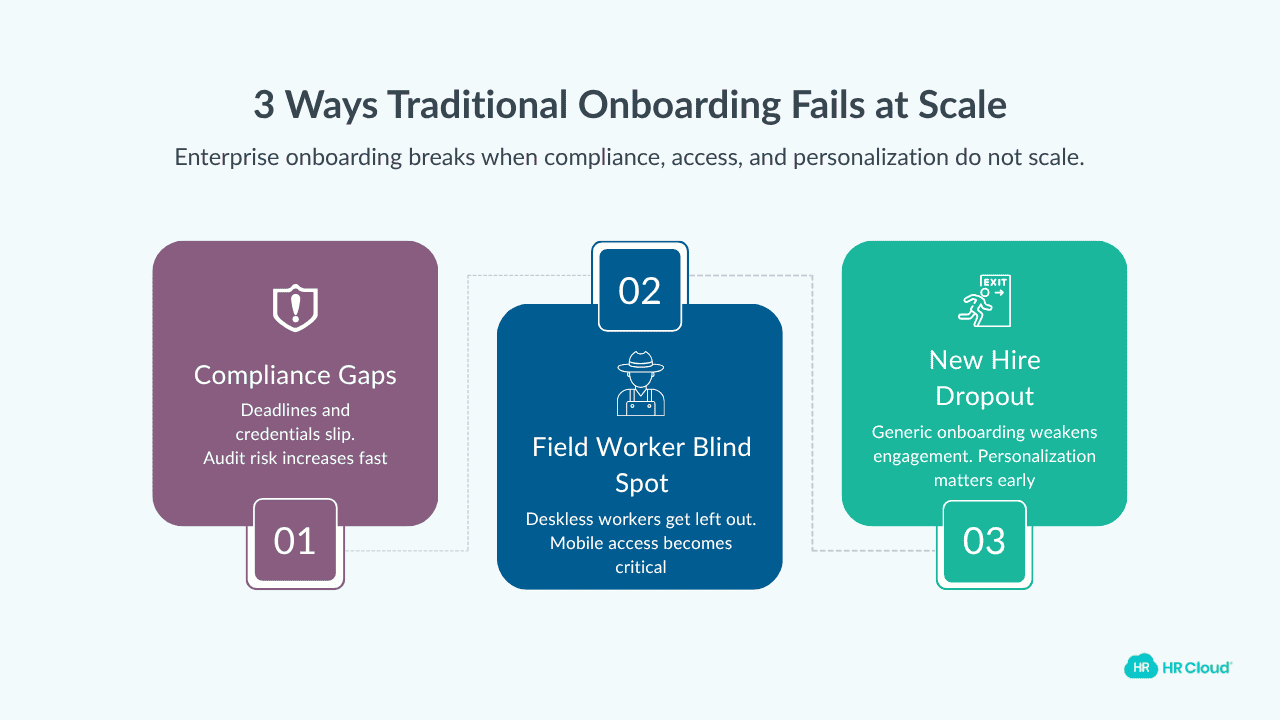
3 Ways Traditional Onboarding Fails at Enterprise Scale
Failure Mode 1: The compliance gap
At enterprise hiring volume, routine tasks such as I-9 deadlines, E-Verify windows, and credential tracking expiration dates slip through rule-based systems. A reminder engine does not catch what it wasn't explicitly programmed to watch.
In regulated industries — healthcare, utilities, financial services, etc. — a missed compliance window isn't just an admin embarrassment. It's an audit risk with real legal and financial exposure. And this is challenging because the complexity often scales faster than your team does.
Failure Mode 2: The field worker blind spot
Research estimates there are more than 2.7 billion deskless workers globally. Unfortunately, most onboarding software assume your employees have a desk, a laptop, and a corporate email address.
For field-heavy enterprises — utilities, environmental services, home healthcare, logistics, etc. — that assumption means your onboarding doesn't reach your workforce effectively. They're completing forms on a 3-inch screen at 10 p.m. Worse, they're not completing them at all.
Take Veolia, a global environmental services company managing more than 10,000 field employees across North America. According to HR Cloud customer data, Veolia onboarded that entire distributed workforce through Onboard's mobile-first AI workflows. That's what it looks like when onboarding is actually designed for the real-world workforce.
Failure Mode 3: The new hire dropout
SHRM research indicates that structured onboarding programs can reduce turnover by up to 82%. But most enterprise onboarding programs are structured in name only — a fixed sequence of tasks that treats every new hire the same way, regardless of role, location, or prior experience.
Generic onboarding drives disengagement before the new hire finishes their first week.
AI-native onboarding journeys close that gap by personalizing the experience in real time, not on a schedule someone configured six months ago.
Here's what AI changes in all three of these failure modes. An AI onboarding agent doesn't wait for a human to check the dashboard. It monitors, flags, and acts before the gap becomes a problem.
How to Evaluate AI Onboarding Software: 6 Criteria Enterprise HR Teams Should Apply
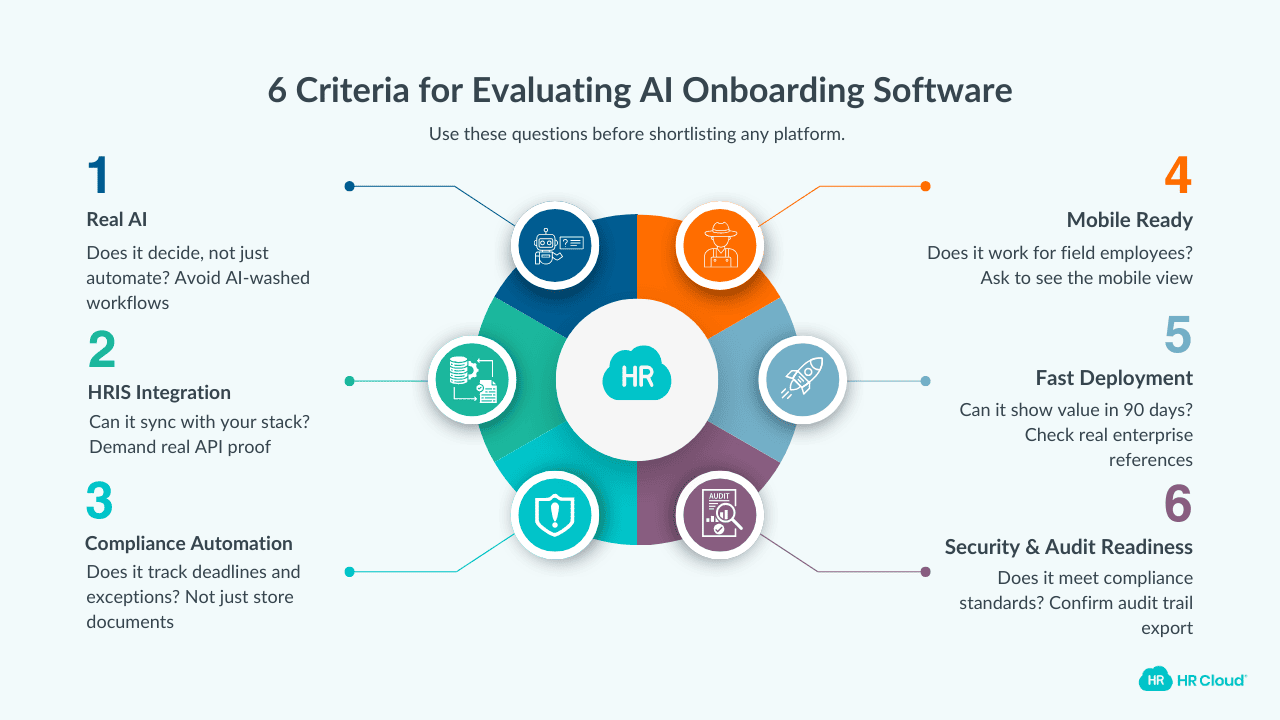
Before you build a shortlist, you need a framework for shortlisting. Here are the six questions that separate platforms worth evaluating from ones worth declining after the first demo. These aren't the only criteria but they're the ones that enterprise buyers in complex, compliance-sensitive organizations consistently identify as make-or-break.
1. Does the AI Qualify? Agentic Decision Making vs. Automation
The most important question you can ask any vendor is this: what does your AI decide on its own? If the honest answer is "nothing" — if every AI action is triggered by a pre-configured rule — you're looking at an automation tool with an AI label.
That's not inherently bad. But it means you're not buying AI onboarding software. You're buying workflow automation, and you should price and evaluate it accordingly.
2. Integration Depth with Your Existing HRIS Stack
AI onboarding creates value only when it has access to real-time employee data. A platform that can't pull from your ATS at hire, push to your HRIS on Day 1, and confirm with your payroll provider by the end of week is working with incomplete information. And incomplete information produces incomplete onboarding.
Ask every vendor for their full API documentation before you shortlist them.
Not a slide deck. The actual documentation.
3. Compliance Automation — Not Just Compliance Features
There's a real difference between a platform that stores your compliance documents and a platform whose AI actively tracks I-9 deadlines, triggers E-Verify re-verification windows, and flags exceptions before they reach your audit.
One keeps your records organized. The other keeps you out of regulatory trouble.
HR Cloud's Onboard module includes automated I-9 and E-Verify workflows as a native capability, not an add-on.
4. Mobile-First and Field-Ready Architecture
If any portion of your workforce works without a dedicated desk, verify that the mobile experience is a full-featured application. A stripped-down companion app designed for desktop-primary users.
Ask the vendor to show you the mobile experience exactly as a field employee sees it. Then ask: does it work offline?
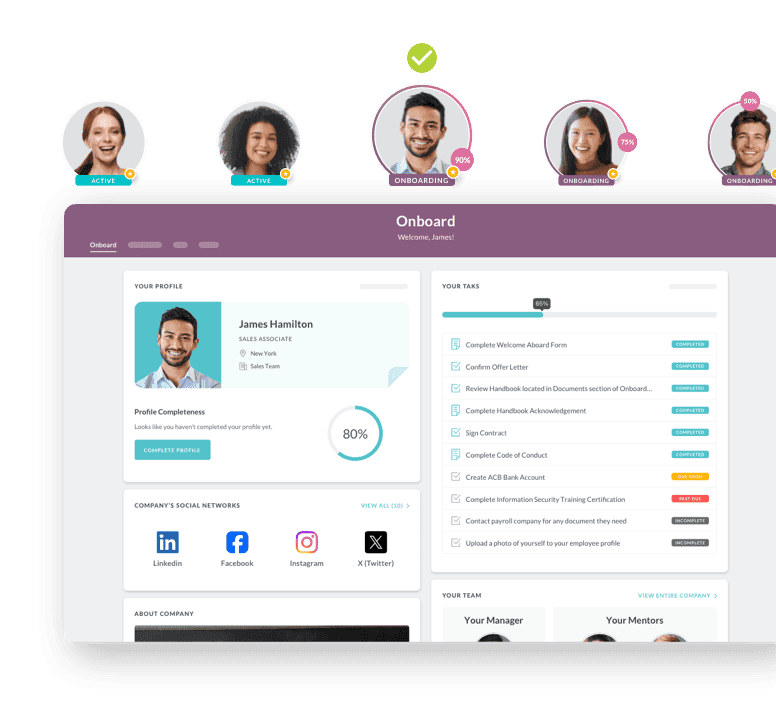
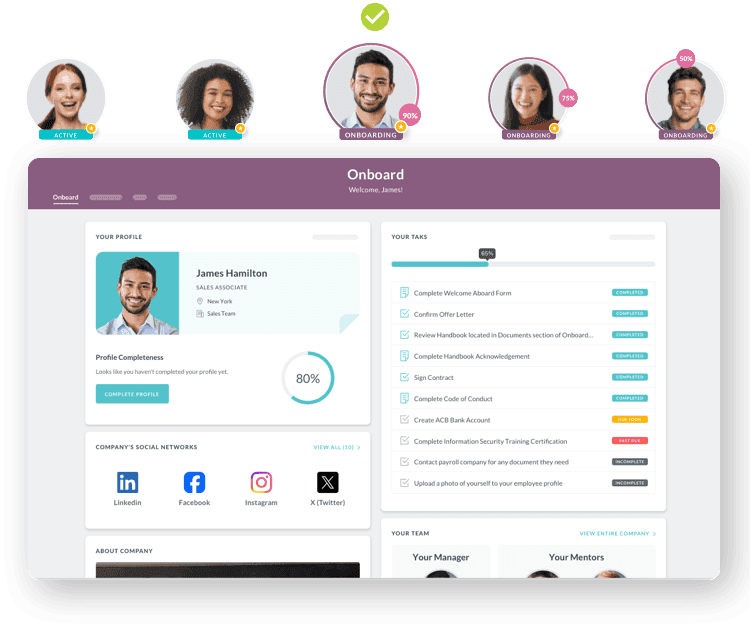
HR Cloud's Onboard achieves 75%+ mobile onboarding completion rates, according to HR Cloud customer data. That number demonstrates Onboard’s mobile experience is built for the environment field workers actually operate in.
5. Implementation Timeline and Enterprise Deployment Support
A platform that requires 12 months to implement is not solving your onboarding problem. Just creating a new project for your already-stretched HR operations team.
Ask for a realistic 30-60-90 day implementation roadmap, and ask for references from at least two enterprises of comparable size and complexity who deployed on that timeline.
Time-to-value matters.
Enterprise budgets are tied to fiscal years. A platform that can't demonstrate ROI within your budget cycle is a harder sell to your CFO than what the vendor's deck will suggest.
6. Security, Data Privacy, and Audit Readiness
SOC 2 Type II is the minimum bar for security these days.
Depending on your industry, you may also need HIPAA compliance, data residency options, and whether the platform maintains a complete, exportable audit trail of every onboarding action.
Don't delegate this to your IT team and forget about it. In a compliance audit, HR owns the documentation trail and if the platform can't produce it cleanly, the ultimate ownership lies with you.
9 Best AI Onboarding Software for Enterprise in 2026
Every AI onboarding tool below was evaluated against the six criteria above. Platforms that couldn't demonstrate genuine AI functionality — agentic decision-making, adaptive personalization, or LLM-based interaction — were excluded regardless of market position or brand recognition.
1. Workday (with Paradox / Olivia)
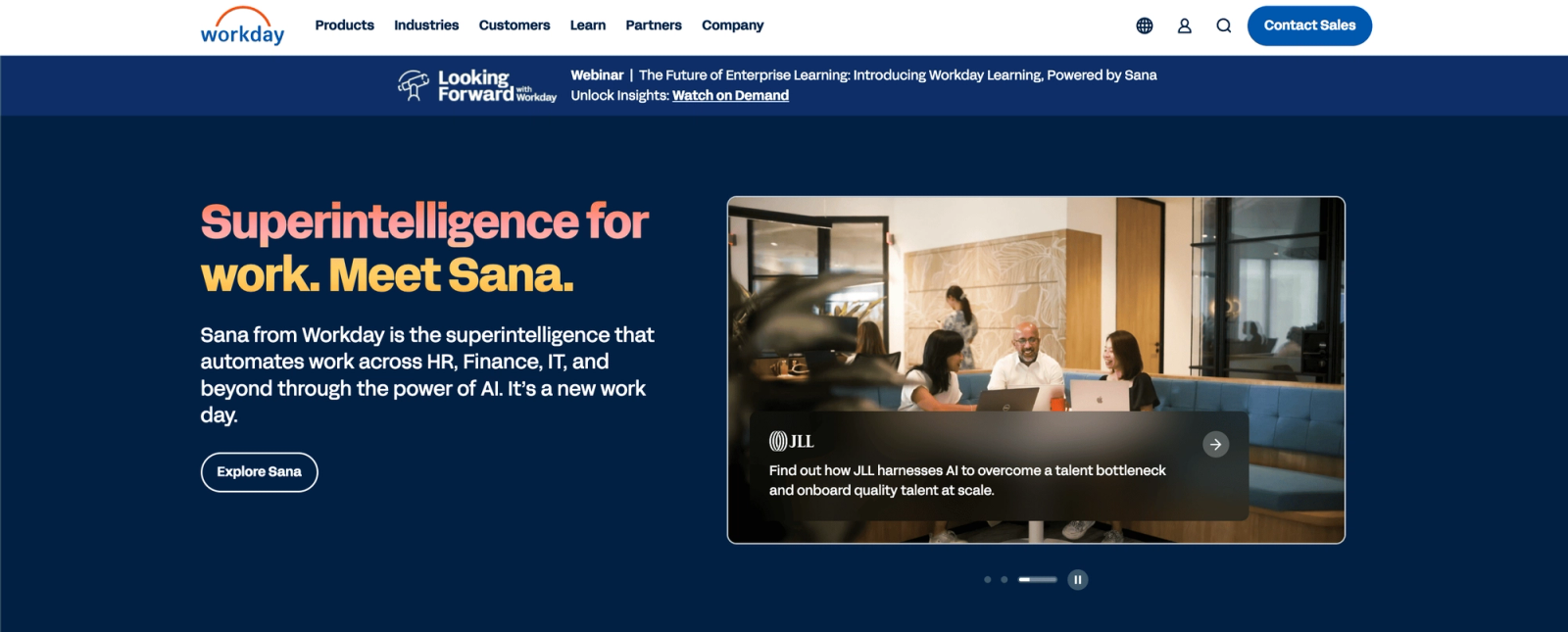
Best for: Large enterprises already deeply invested in the Workday ecosystem.
Olivia strengthens Workday's onboarding significantly but only if Workday is already your HRIS. If your organization isn't already on Workday, factor full HCM migration costs into the evaluation, not just onboarding functionality.
The AI onboarding capability is embedded in the Workday contract, not available as a standalone purchase.
Workday's October 2025 acquisition of Paradox for $1 billion brought Olivia — Paradox's conversational AI agent — into the Workday HCM ecosystem. Olivia handles candidate scheduling, document collection, interview coordination, and new hire Q&A in natural language. For enterprises already running on Workday, this is a genuinely meaningful addition to their onboarding workflow.
Key AI capabilities:
- Conversational AI agent (Olivia) handling candidate and new hire interaction in natural language
- AI-guided frontline hiring and onboarding workflow coordination
- Deep integration with Workday Recruiting, HCM, and payroll within one ecosystem
2. HR Cloud Onboard
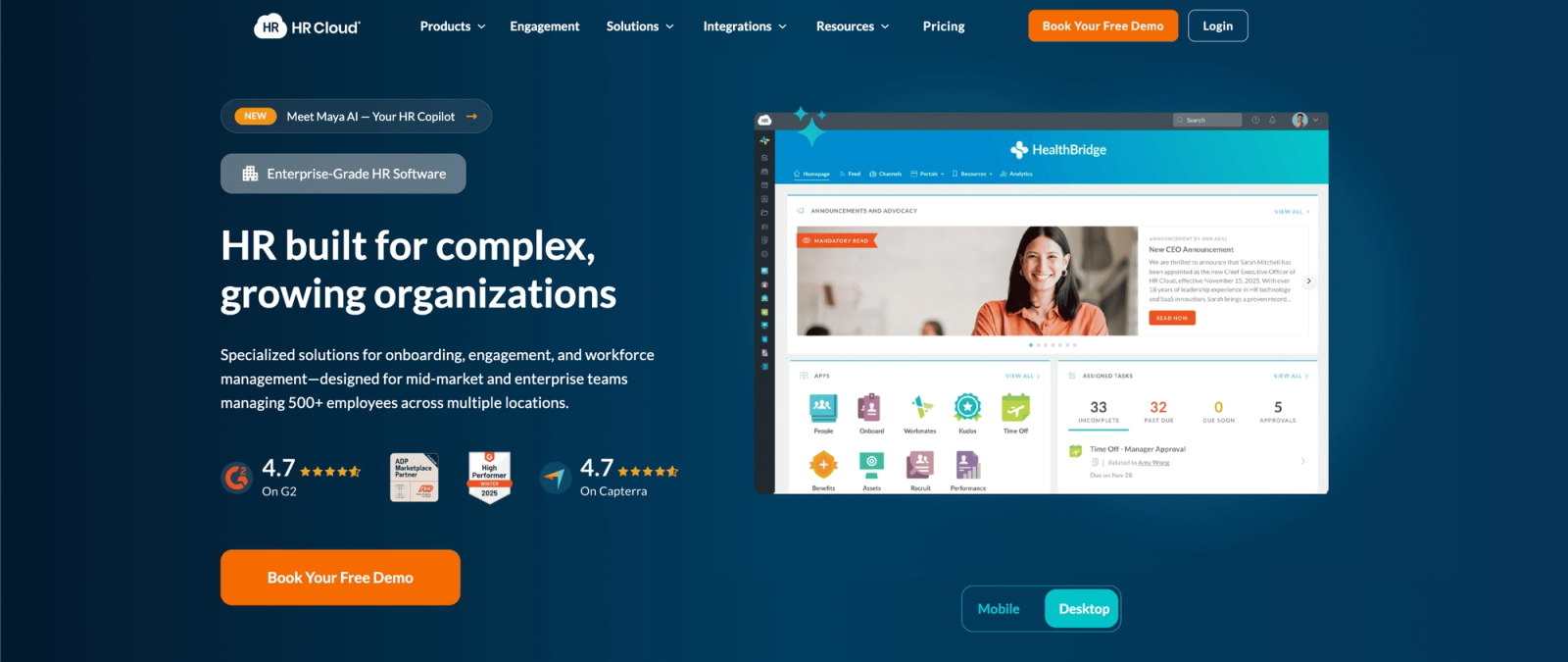
Best for: Enterprises with field or distributed workforces, high-volume compliance requirements, or organizations that need a modular platform that integrates with existing payroll providers (ADP, UKG) without replacing their full HRIS.
HR Cloud's Onboard module is the AI onboarding platform built specifically for enterprise organizations where the workforce is large, distributed, and compliance-sensitive.
Its AI onboarding agent plans, decides, and acts across onboarding tasks without requiring a human trigger for every step. It coordinates across HR, IT, and managers to provision access, request documents, schedule tasks, and flag compliance exceptions before Day 1.
This is agentic AI, not a workflow engine with a chatbot attached. The distinction is operational. When an I-9 window is at risk, Onboard's agent doesn't wait for a coordinator to notice on a dashboard. It acts.
Key AI capabilities:
- Agentic onboarding AI that coordinates autonomously across HR, IT, and manager workflows without manual triggers
- Automated I-9 and E-Verify compliance — tracks deadlines and flags exceptions in real time
- Mobile-first architecture with 75%+ field onboarding completion rates
Enterprise proof: Veolia used Onboard to onboard more than 10,000 field employees through mobile-first AI workflows. According to HR Cloud customer data, that's a workforce distributed across multiple states, often with limited connectivity, completing onboarding at scale.
Behavioral Progression reported 3X faster onboarding speed after implementation, with their CEO noting that "automated prompts for assigned tasks resulted in increased overall efficiency."
Across HR Cloud's customer base, the platform delivers 7 hours saved per week on onboarding administration, a 65% HR efficiency improvement, and a 60% reduction in new hire questions.
Here's my take: when your workforce is field-first and compliance-intensive simultaneously, the evaluation narrows fast. Onboard is the only platform in this guide with verified enterprise proof in both areas — at 10,000+ employee scale, in an actual field deployment. A documented outcome.
If those two requirements apply to your organization, Onboard belongs at the top of your shortlist.
3. Enboarder
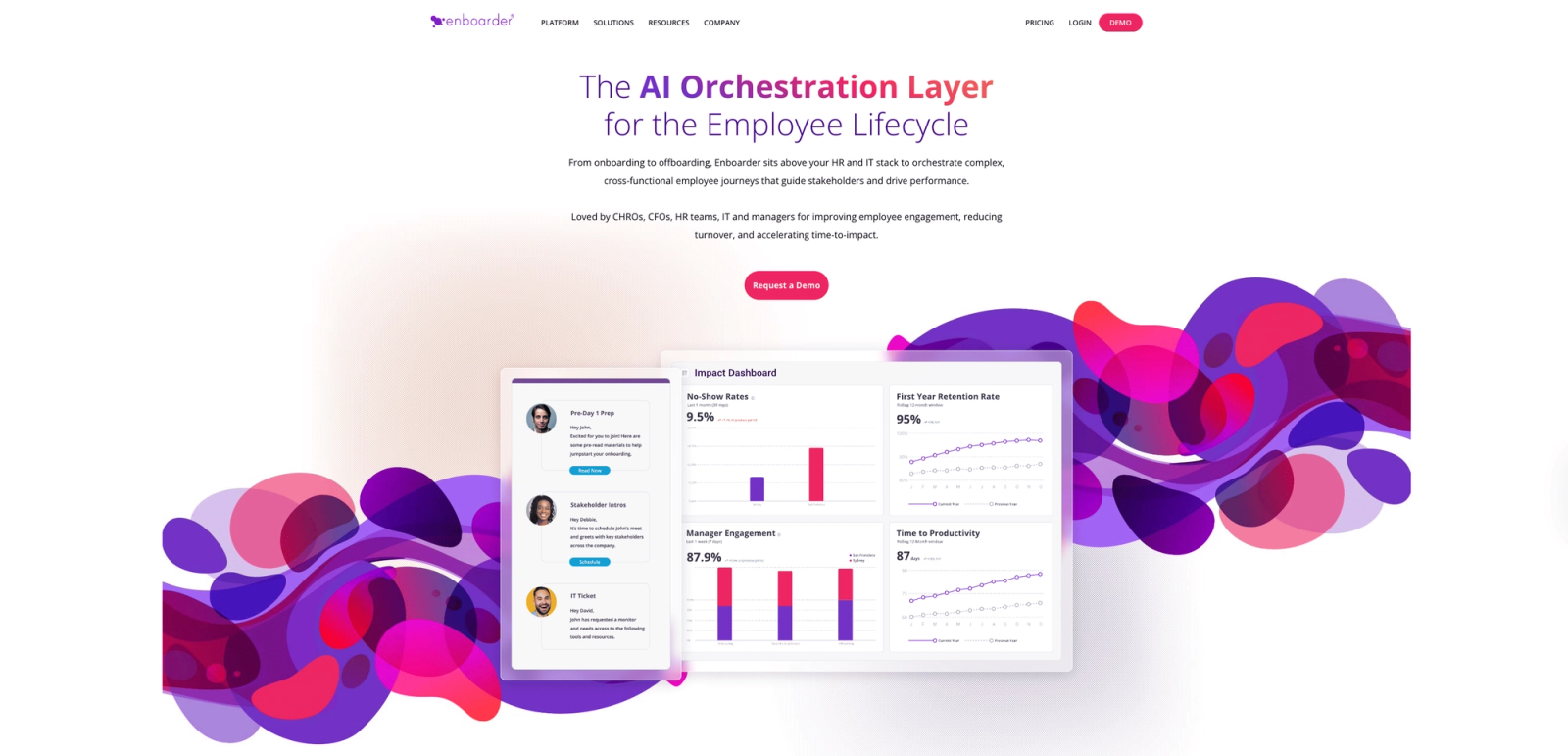
Best for: Enterprises where the primary onboarding problem is new hire experience quality. Think culture reinforcement during rapid growth, engagement measurement across cohorts, and manager accountability for onboarding outcomes.
Enboarder describes itself as an Intelligent Journey Platform. Its AI agents build role-specific 30-60-90 day onboarding plans for each new hire and adapt those plans in real time, based on engagement behavior, feedback signals, and manager input.
The journey changes based on what the new hire does and how managers respond.
Key AI capabilities:
- Adaptive AI journey builder generating role-specific, time-phased onboarding plans per new hire
- Proactive manager nudge engine that surfaces recommended actions before they're missed
- Predictive engagement analytics identifying disengagement risk before the new hire acts on it
Enterprise proof: Enboarder reports a 20% increase in manager engagement and 99% engagement rate for new joiners and buddies.
4. Rippling
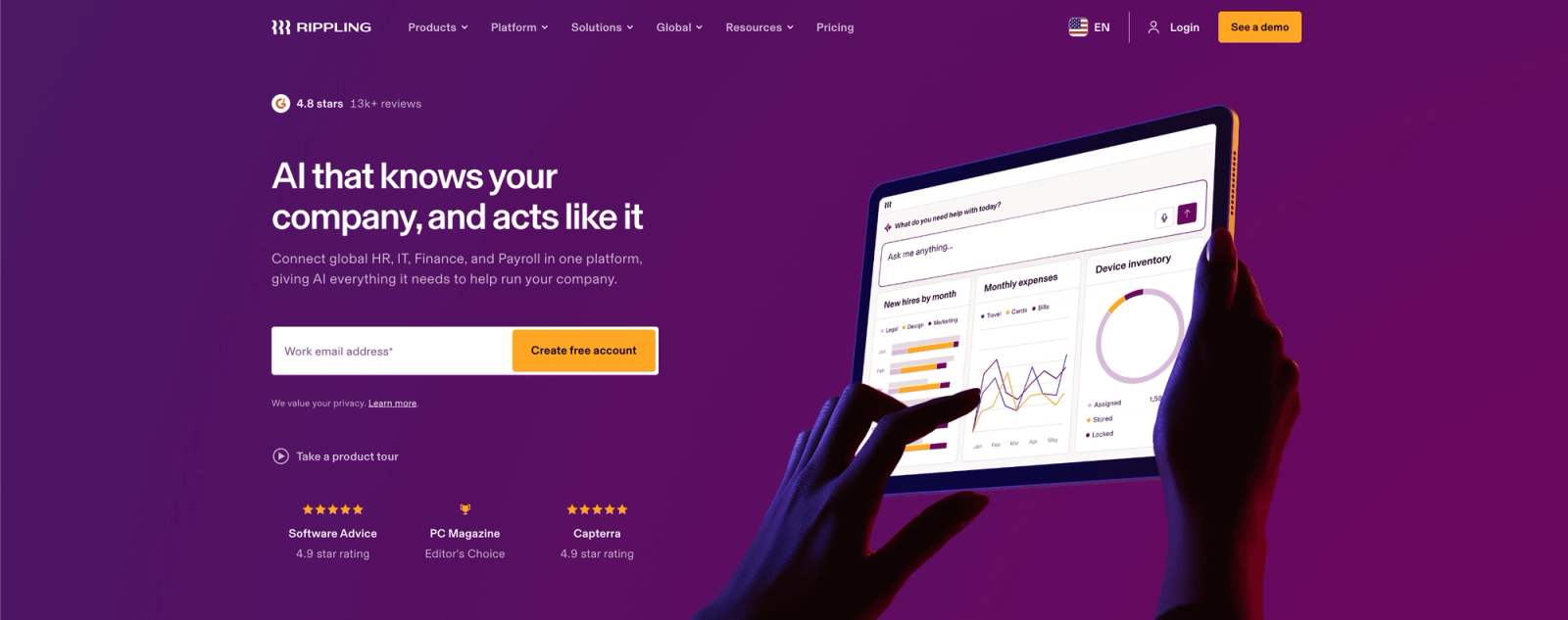
Best for: Enterprises where IT provisioning is as important as HR onboarding. That is, if a new hire can't access their tools on Day 1, it is a direct operational problem.
Also a strong fit for fast-scaling organizations with global hiring needs.
Rippling's onboarding differentiator is speed through unification.
A single hiring event in Rippling simultaneously triggers payroll enrollment, benefits setup, application provisioning, device management, and IT access allocation — all coordinated across HR, IT, and Finance.
The platform claims this reduces onboarding to under 90 seconds for returning hires.
Key AI capabilities:
- Unified HR and IT onboarding automation from a single hiring event, removing cross-departmental handoffs
- AI-powered global workforce onboarding workflows for multi-country hiring
- AI prompts for international compliance documentation in multi-country onboarding scenarios
Here’s my take: If new hire experience personalization and culture reinforcement during onboarding is your primary gap, look at Enboarder or HR Cloud's Onboard alongside it.
5. Leena AI
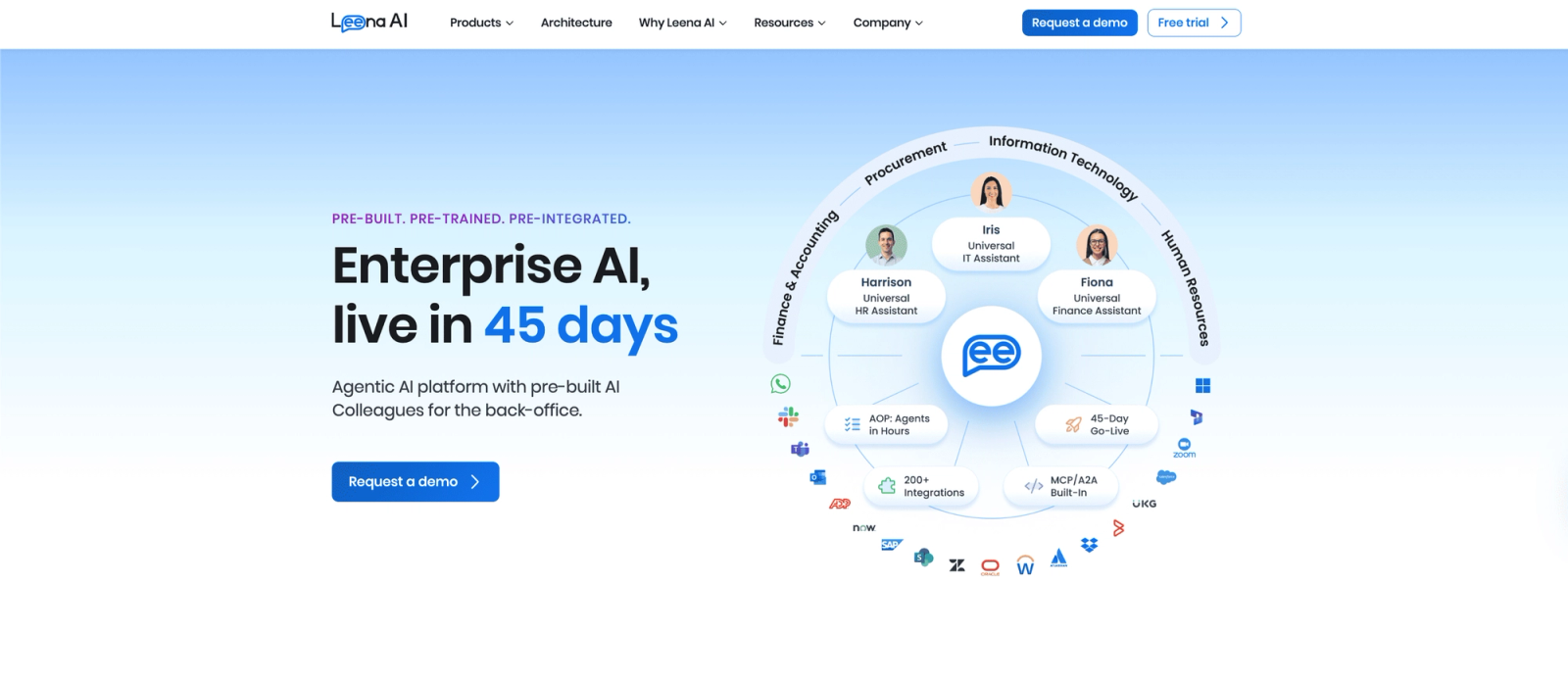
Best for: Enterprises with high new hire question volume or lean HR teams who need to reduce the administrative burden of answering the same 40 questions every cohort asks.
Also effective for organizations that want to add a conversational AI capability without a full platform replacement.
Leena AI provides a conversational AI layer on top of existing HRIS infrastructure. So it’s not really AI-native.
Its AI assistant answers new hire questions 24/7 in natural language — covering benefits, policies, procedures, task completion, and HR service requests — without requiring HR team involvement for each response.
It integrates with Workday, BambooHR, and other major HRIS platforms, which means you can add conversational AI capability without replacing your current system.
Key AI capabilities:
- LLM-powered HR assistant answering new hire questions around the clock in natural language
- Automated service request routing to the right team without manual triage by HR coordinators
- HRIS-integrated knowledge management that draws from live system data, not a static FAQ database
6. Atomicwork
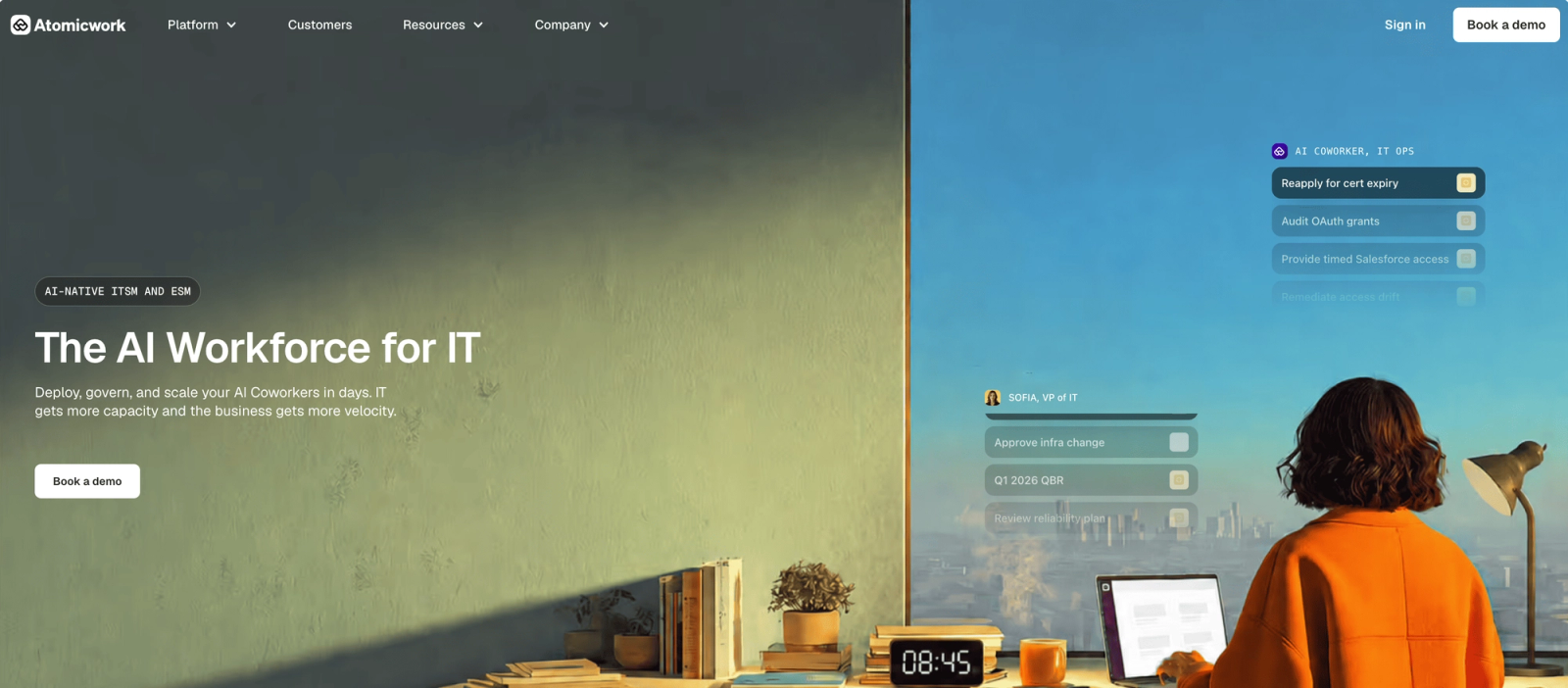
Best for: Enterprises where new hire onboarding involves significant IT setup, knowledge base navigation, and cross-functional service requests from multiple departments simultaneously.
Atomicwork's AI agent, Atom, gives every employee a single conversational interface from Day 1 to access enterprise knowledge, request HR and IT services, and receive system access, without opening a support ticket or waiting for a coordinator response.
It can pull information from Notion, SharePoint, Confluence, and other organizational knowledge bases.
Key AI capabilities:
- Agentic AI (Atom) coordinating HR and IT requests through a single conversational interface
- Integrations with ITSM platforms including ServiceNow and Jira Service Management
- Device provisioning and access allocation from Day 1, connected to identity and device management systems
Here is my take: If your onboarding bottleneck is new hires waiting on IT provisioning and not knowing where to find internal information, Atomicwork solves that specifically without requiring a full HRIS replacement to get there.
7. Deel
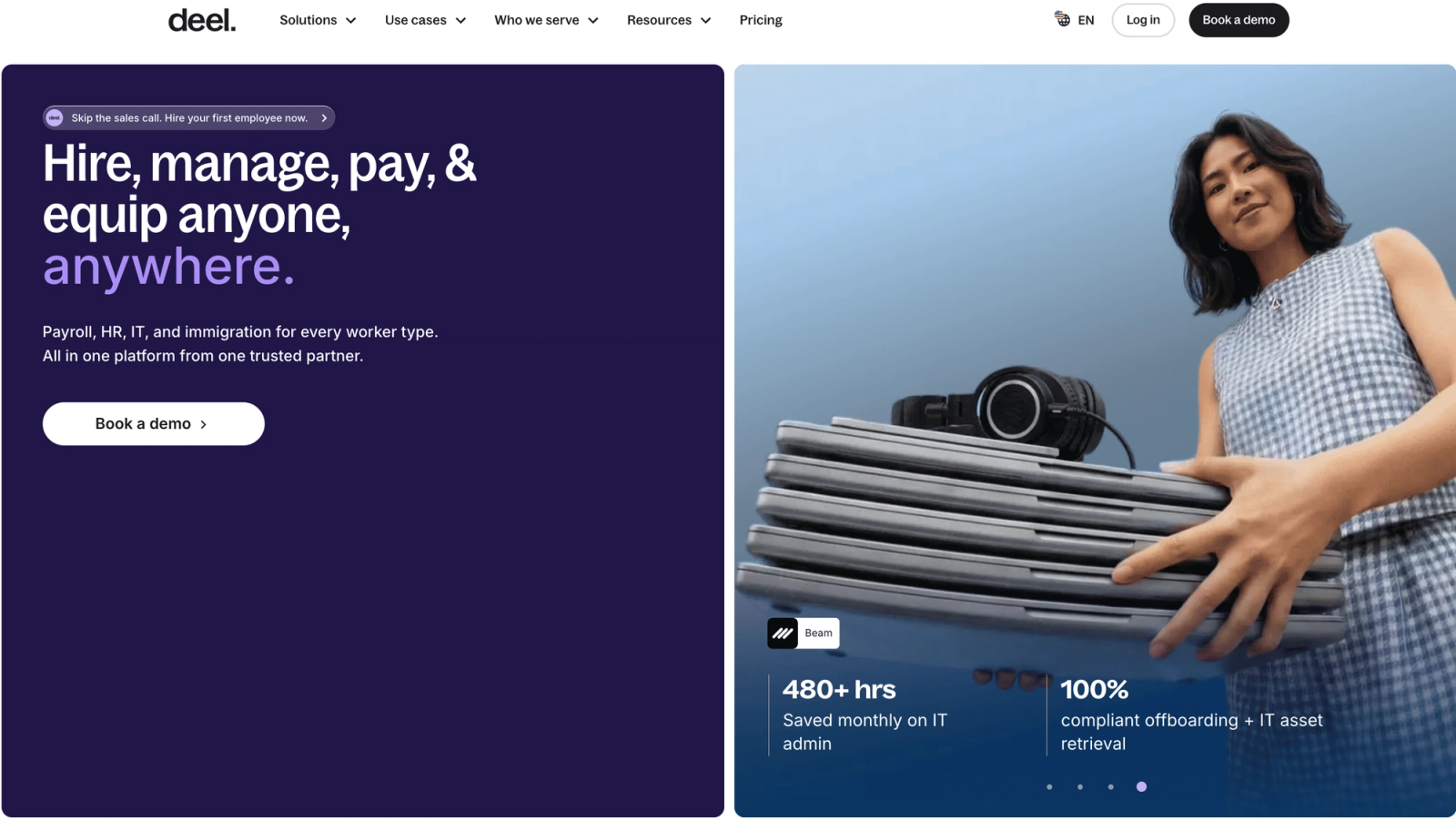
Best for: Enterprises onboarding across multiple countries, engaging international contractors alongside full-time employees, or managing a globally distributed workforce where local compliance requirements differ materially by market.
Deel's AI onboarding capability is built for global and cross-border complexity.
Its AI automates contractor vs. employee classification, generates jurisdiction-specific compliance documentation, and localizes onboarding workflows across more than 150 countries.
It successfully reduces the manual compliance burden that global HR teams carry when onboarding across international markets.
Key AI capabilities:
- AI compliance guidance for international onboarding, including jurisdiction-specific documentation requirements
- Automated contract generation based on employment type and jurisdiction — reducing legal review cycles
- Integrated global payroll, benefits, and tax documentation across 150+ countries
How to Choose the Right AI Onboarding Software for Your Organization
The right AI onboarding software is the one that solves your organization's specific onboarding failure mode. Go back to the three failure modes from earlier in this article. Which one is costing you the most — in compliance risk, in new hire dropout, or in a field workforce that simply can't be reached by your current tools?
Your answer to that question should drive your shortlist more than any feature comparison.
If Your Primary Problem Is Field or Distributed Workforce Access
Your AI onboarding software must be genuinely mobile-first and offline-capable. It needs to reach workers who don't have corporate email or who work in areas with poor internet connectivity.
Ask any vendor this exact question: "Can your platform complete onboarding for a worker with intermittent cell coverage?"
If the answer involves workarounds or caveats, the vendor is not right for you.
HR Cloud's Onboard has the most credible enterprise proof in this category. Veolia onboarded over 10,000 field employees across multiple states using Onboard's mobile-first AI workflows — a genuinely distributed workforce, often with limited connectivity, completing onboarding at scale.
According to HR Cloud customer data, that implementation delivered 75%+ mobile completion rates, demonstrating what field-first architecture actually delivers in practice.
Download Comprehensive AI Onboarding Checklist
Most onboarding checklists tell you what to do. This one also tells you who does it, and when, so that nothing falls through the cracks.
Download Now
If Your Primary Problem Is Compliance Automation at Scale
Here you need AI that actively monitors deadlines, triggers re-verification, and surfaces exceptions before they appear in an audit. The tool should act on those triggers, not just alert.
For regulated industries — healthcare, utilities, financial services — this is a risk management requirement.
Ask any vendor on your shortlist this question: "How does your AI handle an I-9 that hasn't been verified within the three-day window?"
The answer tells you whether the AI is doing the compliance work or whether your coordinator still is.
If Your Primary Problem Is Global Onboarding Complexity
You need AI that understands the difference between an employee and a contractor in 40 countries and generates the correct documentation automatically.
The manual version of this process, where your HR team researches local requirements for each new market, cannot scale.
When cross-border complexity is the core challenge, start with exploring Deel and Rippling. And if you also have a field workforce within those global markets, HR Cloud's modular architecture means you can deploy Onboard alongside your existing global HR platform. You don't need to replace your full HRIS to add enterprise-grade AI onboarding for your distributed teams.
HR Cloud's Onboard was designed for enterprise organizations where scale, compliance, and field workforce access aren't edge cases — they're the operational baseline. If that's your reality, it belongs at the top of your shortlist.

Discover how our HR solutions streamline onboarding, boost employee engagement, and simplify HR management
Book Your Free DemoChoose the Capability, Not the Label
The AI onboarding market is consolidating fast and the direction is clear. Every major HCM vendor is racing to add genuine AI to their onboarding workflow because enterprise buyers have started asking harder questions about their capabilities, and the old answers don't hold up.
The enterprise HR leaders who evaluate carefully now — who apply a real AI qualification bar instead of accepting "AI-powered" as given — will build onboarding programs that compound. Faster ramp time. Fewer compliance incidents. Lower early attrition. These aren't soft benefits. They're measurable, and they're achievable with the right platform.
The ones who don't? They'll spend another year paying coordinators to chase I-9s.
Not every platform that claims AI deserves the label. The nine on this list do. Match the right one to your specific failure mode and take one step this week — book a demo with the platform that fits before your next hiring cohort starts without the right support behind it.
Before evaluating vendors, read: What Is an AI Onboarding Agent? (2026 Guide)
Or explore the distinction in depth: AI Onboarding vs Traditional Onboarding: Buyer's Framework
FAQs
What is AI onboarding software?
AI onboarding software uses artificial intelligence — including large language models, machine learning, and agentic AI — to manage and personalize the employee onboarding experience. Unlike rule-based automation, it makes decisions, adapts to each new hire's needs, and acts without requiring a human trigger for every step. For a deeper look at how this works: What Is an AI Onboarding Agent? (2026 Guide)
What is the difference between AI onboarding software and regular onboarding software?
Regular onboarding software digitizes fixed workflows — checklists, reminders, document collection. AI onboarding software adapts journeys based on role and behavior, coordinates actions across systems autonomously, and flags compliance risks before they occur. The difference is whether the platform makes decisions or simply executes them. AI Onboarding vs Traditional Onboarding: Buyer's Framework
What features should I look for in AI onboarding software?
For enterprise buyers, the six most important features are: (1) agentic AI capability — the platform acts without human triggers; (2) HRIS integration depth; (3) compliance automation for I-9, E-Verify, and credential tracking; (4) mobile-first architecture for field workers; (5) realistic implementation timeline; and (6) SOC 2 Type II certification. Learn more about automating employee onboarding
Is AI onboarding software suitable for large enterprises?
Yes. Enterprise scale is exactly where AI onboarding delivers its clearest ROI. At 500+ annual new hires, manual coordination creates compliance gaps and early attrition risk that AI onboarding eliminates without adding headcount. HR Cloud's Onboard proved this at Veolia: 10,000+ field employees onboarded successfully, according to HR Cloud customer data. AI onboarding for field and deskless workers
Can AI onboarding software handle compliance and I-9 verification?
The best AI onboarding platforms automate I-9 and E-Verify workflows, track compliance deadlines across new hire cohorts, and flag exceptions before they become violations. Not all platforms offer this natively — confirm compliance automation depth with each vendor before shortlisting. HR Cloud's Onboard includes I-9 and E-Verify automation as a native capability. You can read more on agentic AI in HR if curious.
What is an AI onboarding agent and how is it different from a chatbot?
An AI onboarding agent plans, decides, and takes action across onboarding tasks — autonomously. A chatbot answers questions. An AI agent does things: it provisions access, requests documents, schedules tasks, and flags compliance gaps without being asked. That's the distinction that actually matters when you're evaluating whether a vendor's AI is working. What Is an AI Onboarding Agent? (2026 Guide)
How long does it take to implement AI onboarding software?
Modular platforms — including HR Cloud's Onboard and Leena AI — typically deploy for enterprise customers within 4–8 weeks. Full HCM suite implementations like Workday or ServiceNow require 3–6 months at minimum. The most useful vendor question: how many comparable-size enterprises have deployed in that timeframe, and can you speak with one?
About the author

Keep Reading


Like What You Hear?
We’d love to chat with you more about how HR Cloud® can support your business’s HR needs.
Book Your Free Demo