
5 Things HR Admins Can Do Today to Improve Caregiver Retention

Caregiver turnover costs home care agencies thousands per lost employee and is sitting at 75% industry-wide. Five immediate actions — plus two longer-term structural fixes — can meaningfully shift retention in the first 100 days and beyond, without overhauling your entire HR strategy.
Key Takeaways
- Caregiver turnover sits at 75% nationally, according to the 2025 Activated Insights Benchmarking Report
- Nearly 4 out of 5 caregivers who leave do so within the first 100 days — making early engagement the highest-leverage window
- Why caregivers leave and why they stay aren't mirror images — both sides require intentional action
- Peer recognition, structured onboarding, pulse surveys, and targeted communication each independently reduce early attrition
- Burnout and lack of career advancement are structural drivers that surface-level fixes alone won't solve
- HR Cloud's Workmates platform gives HR admins concrete tools to act on all of these levers
- Agencies offering 8+ hours of orientation training generate measurably higher revenue than those that offer fewer
The Turnover Problem Nobody's Fully Solved
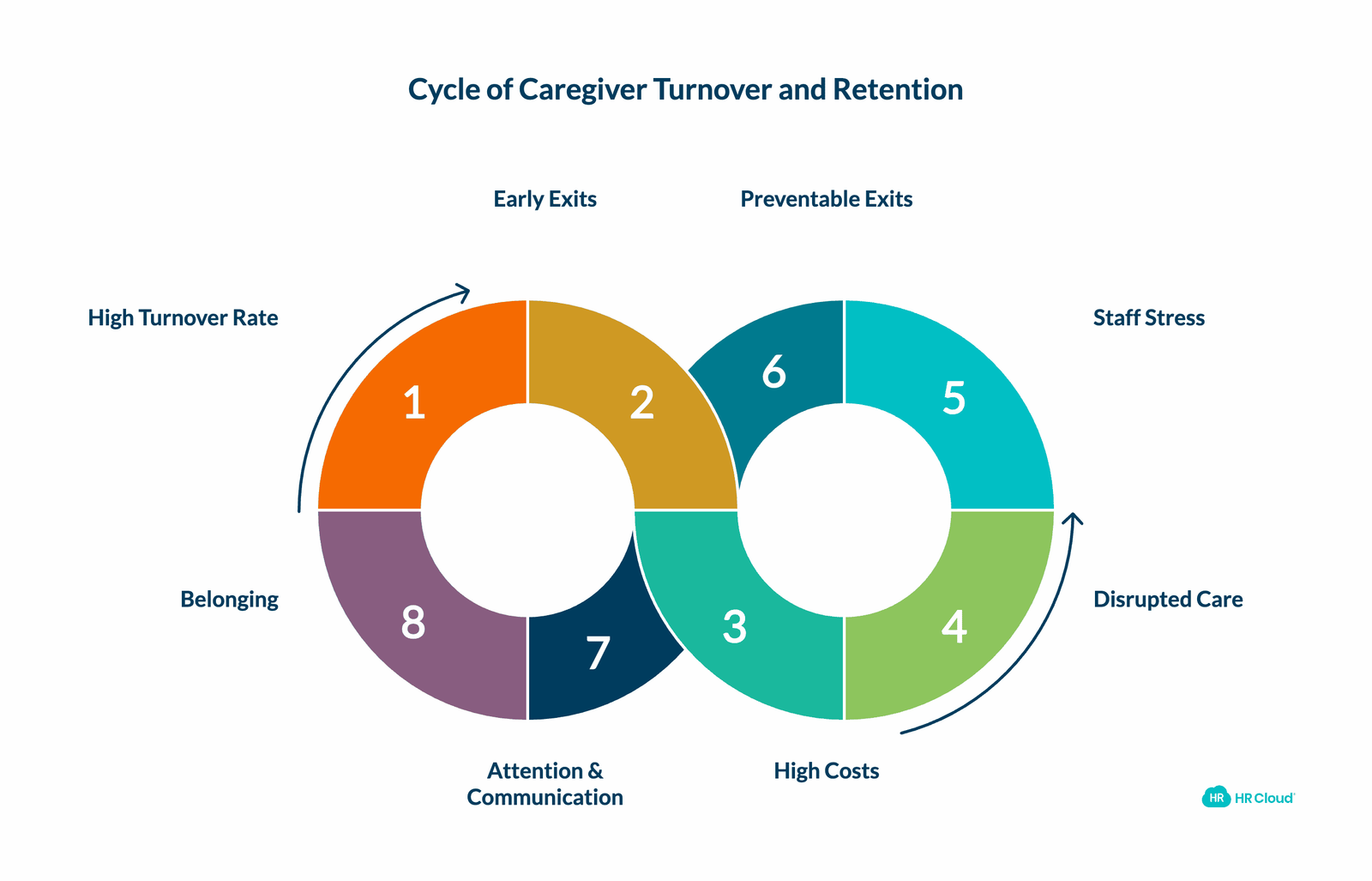
Here's a number worth sitting with: 75%.
That's the median caregiver turnover rate in the U.S. home care industry, per the 2025 Activated Insights Benchmarking Report. It's slightly down from a peak of 79.2% in 2023 — progress, but it still means that three out of every four caregivers leave each year. For a 50-person care team, that's potentially 37 replacements annually. Each one costs an estimated $2,600 in recruitment and onboarding alone, and that doesn't count the disruption to client care quality or the compounding stress on remaining staff.
The first 100 days are where the problem concentrates. Research from Activated Insights found that nearly four out of five departing caregivers leave within that window. (For a deeper look at what's driving that attrition, HR Cloud's guide to caregiver turnover in home-based care covers the structural causes.) Which means the actions an HR admin takes in the early weeks of employment — or fails to take — shape whether someone stays or goes.
The good news? Most of these early exits are preventable. Not all of them, but enough to shift the numbers materially. And the fixes aren't expensive. They're mostly about attention, communication, and systems that make people feel like they belong.
Here's what HR admins can do today.
Why They Leave vs. Why They Stay
One thing worth understanding before jumping to tactics: the reasons caregivers leave and the reasons they stay aren't mirror images. Fixing what drives people out doesn't automatically build what keeps them in. Both sides need attention.
| Why Caregivers Leave | Why Caregivers Stay |
|---|---|
| Feeling unseen or unappreciated | Consistent, genuine recognition |
| Chaotic scheduling and poor communication | Predictable schedules and clear information |
| No sense of belonging, especially in home care | Community — feeling connected to a team |
| Unclear expectations during onboarding | Structured start with a clear path forward |
| Burnout from emotional and physical demands | Support from supervisors who check in |
| No career growth in sight | A visible path to advancement |
| Feeling like a number, not a person | Being known by name, not just a shift slot |
The five actions below address most of these. Two deeper structural ones — burnout and career pathing — are covered at the end, because they take longer to build but matter just as much.
1. Fix the First Week Before Day One
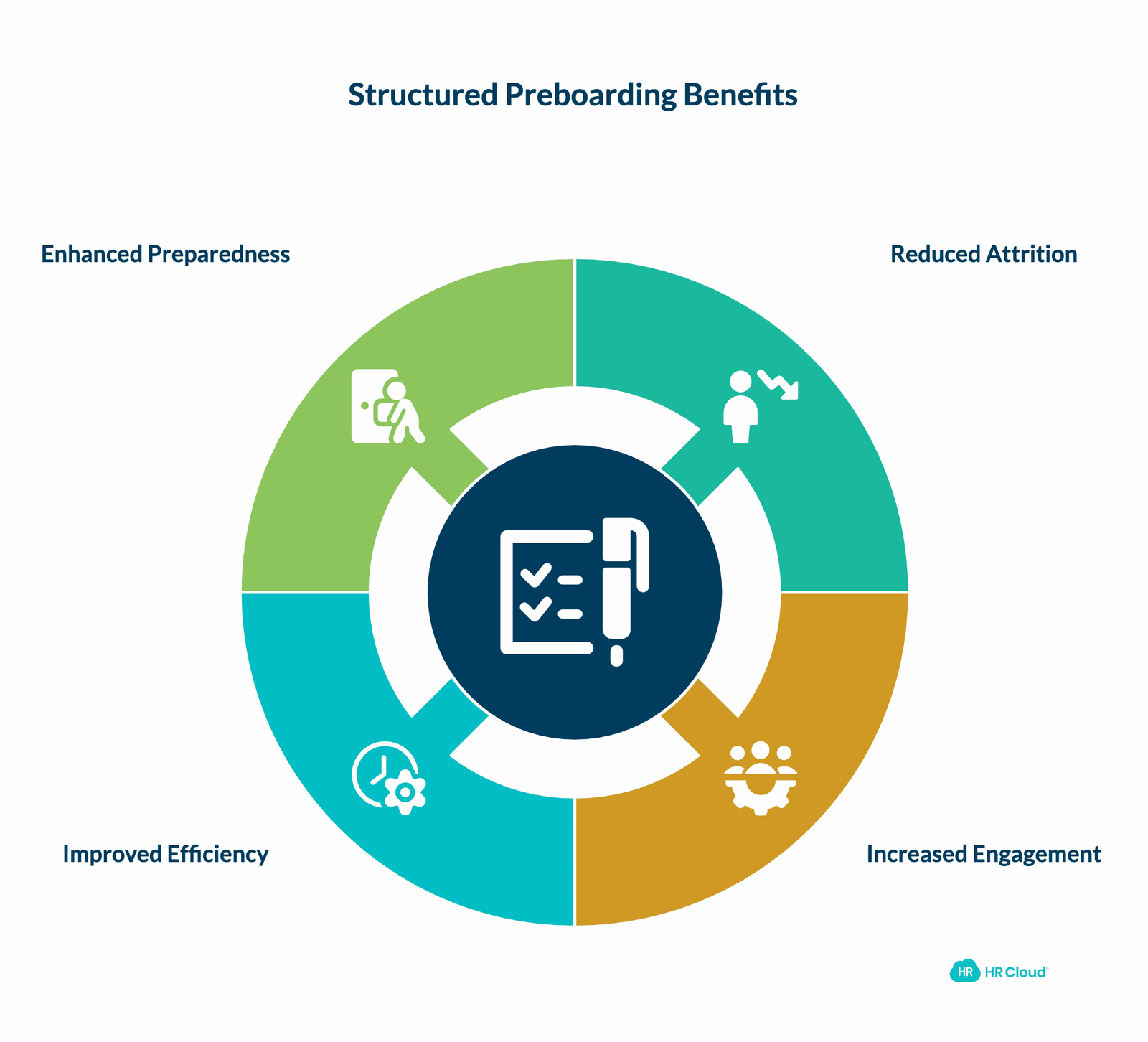
Most caregiver onboarding problems start before the caregiver walks in the door. They accept an offer, wait a few days with no contact, then arrive on Day 1 to a stack of paperwork and no clear sense of what the next week looks like. Some never make it to Day 2.
Structured preboarding changes this dynamic. A simple check-in message three days before the start date, a welcome post on the company feed, and a first-week task checklist visible in a platform they can access from their phone — these things cost almost nothing but signal that the organization is prepared and that the new hire was expected.
HR Cloud's Onboard module supports bulk onboarding for agencies bringing on multiple caregivers at once. But the feature worth noting here is the ability to set up chained tasks — where Step 2 only unlocks after Step 1 is completed. For caregivers who may feel overwhelmed by a long list of compliance tasks, this structure gives them a clear, manageable path without the anxiety of seeing everything at once. If you're building out that task structure from scratch, HR Cloud's free onboarding checklists and templates are a useful starting point, and the onboarding best practices guide covers the four-stage framework behind effective onboarding programs.
The Workmates platform also lets HR admins automatically announce new hires on the company feed, triggering a visible welcome from the broader team. For a caregiver who may be joining an organization they've never set foot in, seeing their name in a public welcome post — before they've even handled their first patient — matters.
Want to see how structured onboarding reduces early caregiver attrition? Book a demo with HR Cloud to walk through the Onboard module.
What a Structured First 100 Days Actually Looks Like
The stat about 4 in 5 caregivers leaving within 100 days is alarming. But it's also useful — it tells you exactly where to concentrate effort. Here's a simple framework HR admins can implement with HR Cloud's Onboard and Workmates:
| Milestone | Action | HR Cloud Tool |
|---|---|---|
| 3 days before start | Send welcome message, assign preboarding tasks | Onboard (Prehire tasks) |
| Day 1 | Auto-announce new hire on company feed | Workmates Campaigns / Company Feed |
| Week 1 | Complete compliance and orientation tasks via chained checklist | Onboard (Chained Tasks) |
| Day 30 | Run anonymous NPS pulse survey | Surveys (NPS) |
| Day 45 | Manager check-in + Kudos for early contributions | Workmates Kudos |
| Day 60 | Questionnaire survey — schedule, workload, belonging | Surveys (Questionnaire) |
| Day 90 | Final early-tenure survey + milestone recognition | Surveys + Auto Rewards |
None of this requires manual tracking once it's set up. The tasks trigger on schedule, the surveys run automatically, and the recognition fires without a manager having to remember.
2. Run Pulse Surveys at 30, 60, and 90 Days
Asking how someone is doing sounds obvious. But most agencies don't do it in a structured, anonymous way — and "in a structured, anonymous way" is the part that makes the difference.
A caregiver who's frustrated about scheduling won't necessarily say so to a manager. But they might say it in a short anonymous survey. And if the agency actually responds to what the survey surfaces? That's the moment trust gets built.
The 90-day window is where this matters most. Sending a brief pulse survey at Day 30, Day 60, and Day 90 gives HR admins early warning on problems that are still fixable. A recurring NPS survey asking one simple question — "How likely are you to recommend this employer to someone you know?" — takes about 30 seconds to answer and can surface dissatisfaction before it becomes a resignation letter.
HR Cloud's Survey feature supports both Questionnaire Surveys (for detailed feedback) and NPS Surveys (for quick sentiment checks). Surveys can be set to run on a recurring schedule — weekly, monthly, or at custom intervals — and responses are anonymous. Once more than four employees complete a survey, HR admins can view analytics, filter results, and export data.
The key is closing the loop. Running surveys without acting on the results is actually worse than not running them at all — it communicates that the feedback didn't matter. When something surfaces in a 30-day survey, address it visibly by Day 60. That cadence tells caregivers: this organization is paying attention.

3. Make Recognition Part of the Daily Workflow
Caregiving is emotionally demanding work. The relationship between a caregiver and a client can be one of the most intimate in either person's life — and yet, from an employment standpoint, the work often goes unacknowledged. No customer reviews, no performance metrics that capture empathy or patience. Just the absence of complaints.
That's a retention problem dressed up as a management philosophy.
Recognition doesn't require elaborate programs. It requires consistency. A supervisor who takes 90 seconds to send a Kudos to a caregiver who handled a difficult client situation well — that moment sticks. Especially when it's visible on a shared feed and a colleague replies with a reaction.
HR Cloud's Kudos feature within Workmates lets anyone on the team give peer-to-peer recognition tied to custom categories or badges. For agencies setting up a formal program for the first time, the peer-to-peer recognition guide walks through how to structure it — governance, launch approach, adoption tactics — so it sticks rather than fading out after week two. HR admins can set up Kudos with Rewards, assigning points that caregivers can redeem for gift cards or custom rewards — an extra PTO day, a company-branded item, whatever the organization decides. The system supports spending limits and approval workflows so there's no budgetary surprise.
Workmates' automated milestone recognition awards points on work anniversaries and birthdays — reliably, without depending on a manager to remember. Caregivers who feel chronically unseen are also chronically on the way out. Consistent recognition — even at small scale — changes that equation over time.
Agencies can also run Kudos Nominations campaigns, where employees nominate peers for specific recognition categories, with winners announced publicly. For teams that are spread across locations or working independently, this kind of structured peer recognition builds a sense of shared identity that's otherwise hard to create.
HR Cloud's recognition tools are built for teams that don't all work in the same building. See how Workmates handles distributed recognition.
4. Create Communication Channels by Role and Location
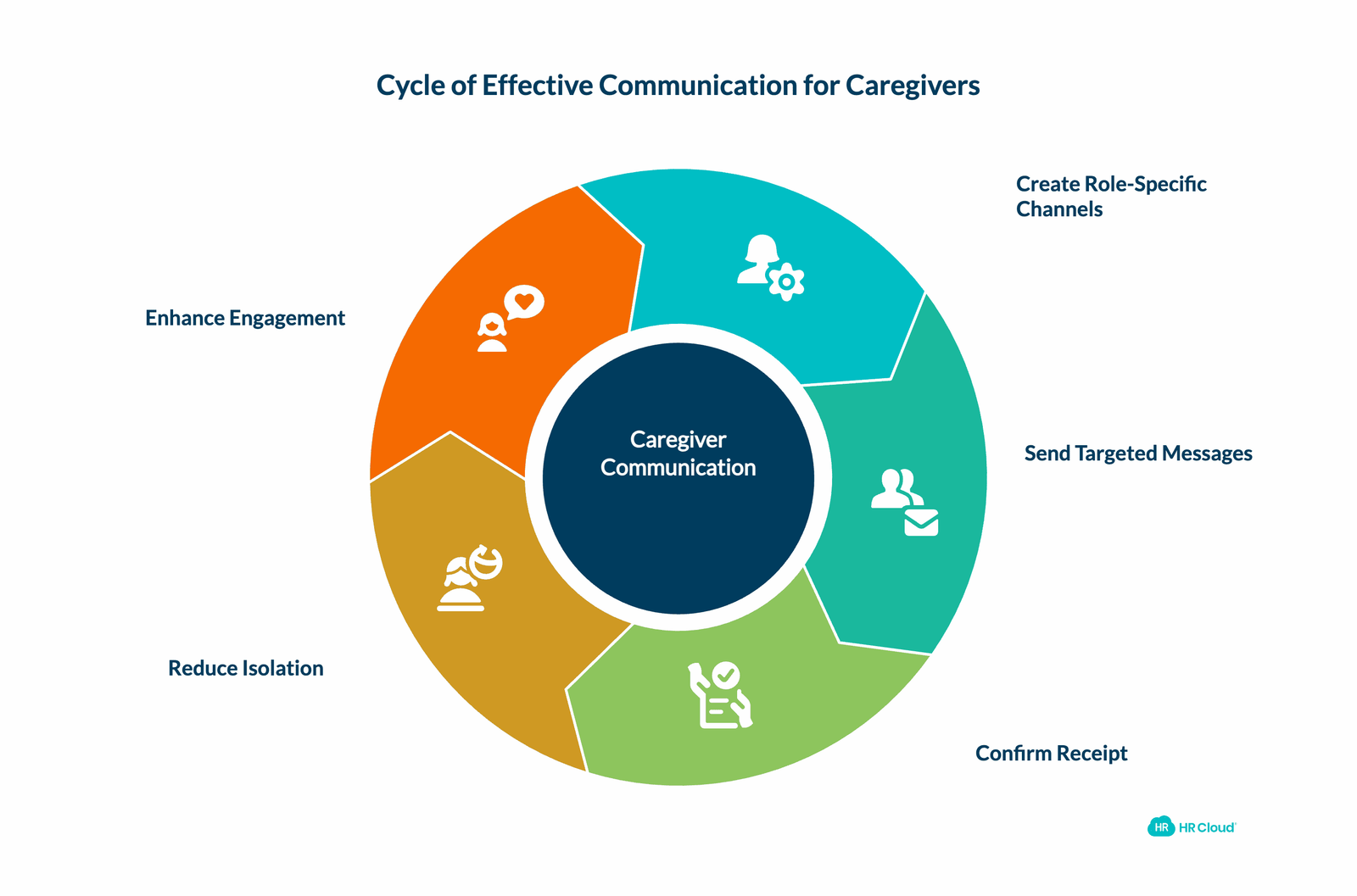
One of the quieter causes of caregiver attrition is feeling informationally disconnected. Caregivers working in clients' homes or across multiple facilities rarely get the same information at the same time as office-based staff. A policy update goes out in an all-hands email. The caregiver is in the middle of a shift. They miss it. Then they're told two weeks later they were supposed to follow the new protocol.
This kind of disconnection accumulates. It tells caregivers that they're on the periphery — that the organization communicates around them rather than with them.
HR Cloud's Channels feature in Workmates lets HR admins create role-specific or location-specific communication groups. A channel for field caregivers. A channel for CNAs at a specific facility. A channel for the overnight shift. Messages posted in those channels are targeted — they reach the right people, not everyone. Assignment rules can automatically add new hires to the relevant channel based on their role, department, or location.
For policy updates or safety reminders that require confirmation, Mandatory Read Announcements let HR admins verify that specific employees have acknowledged the communication — with confirmed and unconfirmed status visible in the platform's analytics. That's a meaningful compliance capability, but it's also a communication discipline that builds trust. When caregivers know they'll always receive relevant information, they stop feeling like they have to go looking for it.
Workmates Chat adds one-on-one and group messaging, letting caregivers reach supervisors or colleagues directly without needing to navigate separate tools. For distributed care teams, reducing communication friction reduces the sense of isolation that drives early attrition.
5. Surface Problems With Polls Before They Become Exit Surveys
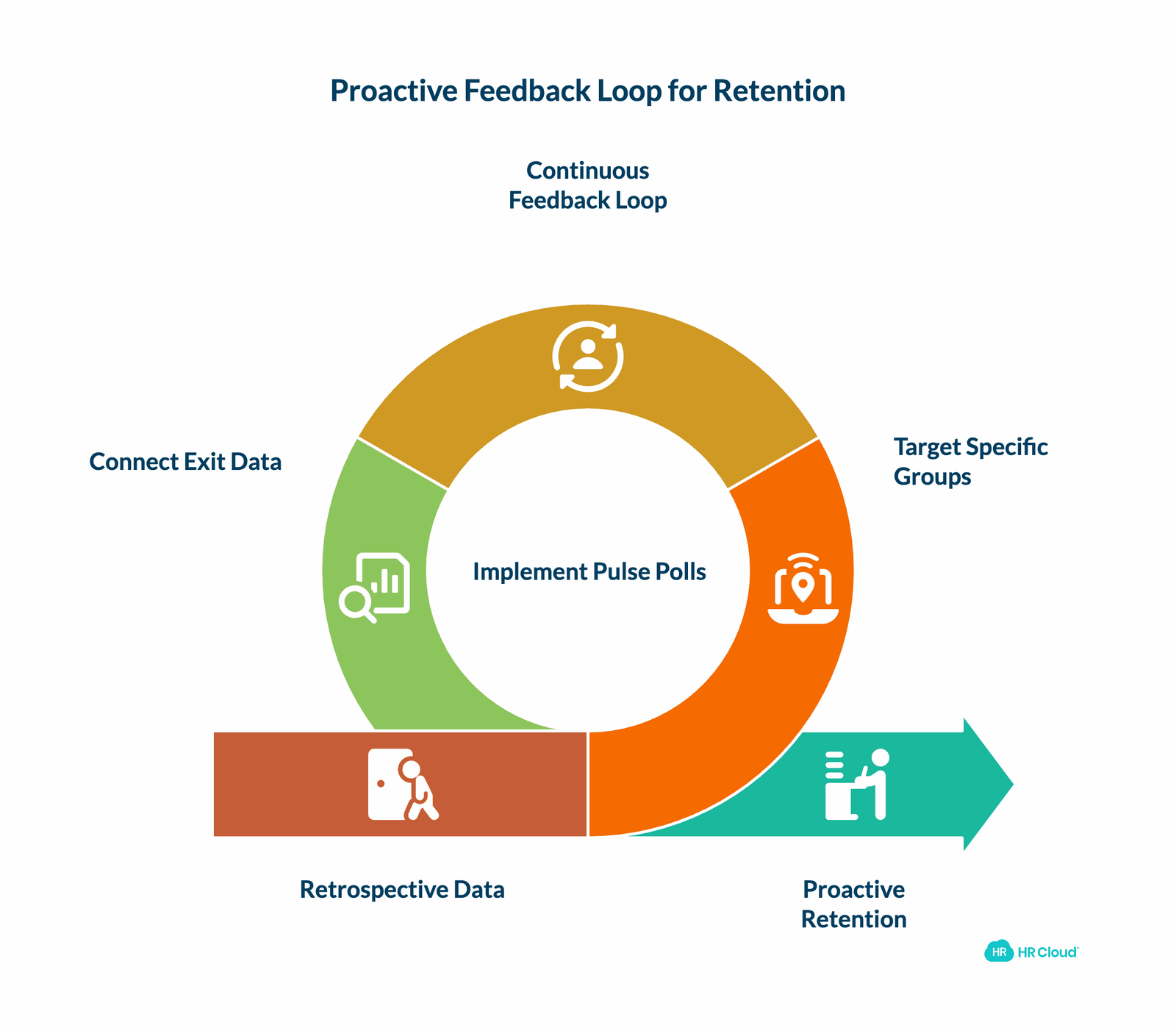
By the time an HR admin learns why a caregiver left, the conversation is over. The retention window has closed. Exit interviews are useful data — but they're retrospective data.
Polls are a different instrument. They're fast, low-commitment, and when used well, they surface operational friction while there's still time to act on it. "Is your schedule meeting your needs this month?" "How clear was your supervisor's feedback last week?" "Would you feel comfortable raising a safety concern?" These questions take under a minute to answer. The patterns in the responses take about five minutes to read.
HR Cloud's Workmates platform supports Polls posted directly to the company or channel feed. Results are anonymous. HR admins can target polls to specific groups — field caregivers only, a specific location, a specific shift — so the questions stay relevant to the people answering them.
The goal here is a feedback loop that runs continuously rather than in annual cycles. An HR admin who runs a monthly two-question poll to field caregivers will know about scheduling friction in February, not in the year-end engagement survey in December. That's three or four more retention conversations that happen at the right time.
One more thing worth building: a connection between exit data and your pulse survey questions. When you start seeing patterns in why people leave — "my schedule was unpredictable," "I didn't hear from my supervisor enough" — those answers should directly shape what your next 30-day survey asks. Exit interviews are retrospective, but the patterns they reveal are prospective. Using them that way turns a lagging indicator into an early warning system.
Two Deeper Problems Worth Addressing
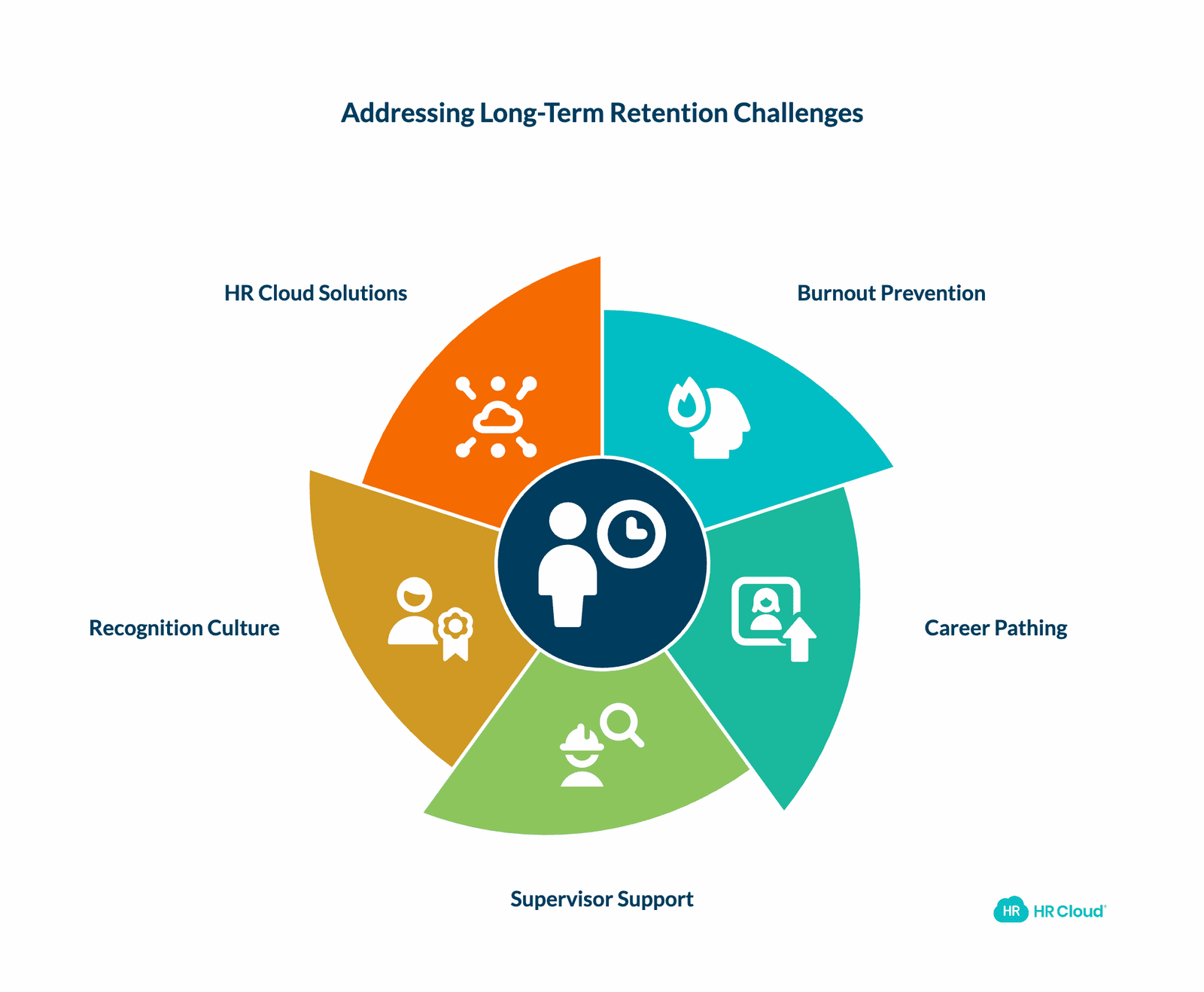
The five actions above are things HR admins can move on this week. These two take longer to build — but skipping them means fighting a structural problem with surface-level tools.
Burnout Is a Retention Issue, Not Just a Wellness One
Caregiving is one of the most emotionally demanding jobs that exists. The physical toll — lifting, repositioning, long hours on your feet — compounds with the emotional weight of forming bonds with clients who are often declining. Home care workers operate in isolation, without the team buffer that hospital staff have. There's no colleague in the next room to decompress with after a hard shift.
PHI's research on the direct care workforce identifies poor job quality — including heavy workloads, limited supervision, and inadequate support — as a persistent structural driver of turnover. Burnout doesn't just make people unhappy. It makes them leave.
HR admins can't fix care intensity or staffing ratios overnight. But they can do two things consistently: make it easy for caregivers to flag when they're struggling, and make it visible when supervisors respond. Anonymous surveys and direct-access channels are part of this. So is a recognition culture that acknowledges hard shifts, not just good outcomes. HR Cloud's healthcare engagement software is built specifically for this dynamic — surfacing concerns before they become resignations, in environments where staff rarely sit at a desk. And if you want the research behind why engagement and burnout are so tightly linked, HR Cloud's piece on employee engagement and mental health covers the data in depth.
The manager relationship matters enormously here. Research across industries consistently shows the direct supervisor is the single biggest predictor of whether someone stays. In home care, many frontline supervisors are stretched thin — managing schedules, handling client issues, covering gaps. HR admins can support those supervisors with regular poll data, flagged when caregiver sentiment drops, so they know when to lean in before someone's already decided to leave.
Career Pathing Gives Caregivers a Reason to Stay Long-Term
Most retention conversations in home care focus on keeping people from leaving in the first 90 days. That's the right priority. But there's a second problem for agencies that do manage early retention: what happens at 18 months, when a caregiver has gotten good at the job and starts wondering what's next?
PHI notes that direct care jobs are characterized by limited advancement. The next formal rung — LPN — requires time, resources, and credentials that most caregivers can't access. Without visible growth options, experienced caregivers leave not because they're unhappy, but because staying feels like standing still.
HR admins can build internal career paths even without formal credentialing programs. Senior aide roles, peer mentor designations, training leads — these create advancement that doesn't require leaving the organization. Recognizing these milestones publicly through Workmates Kudos Nominations, and acknowledging years-of-service anniversaries automatically through Auto Rewards, signals that tenure is valued. Caregivers who can see a next step are more likely to take it than to walk out the door.
What Consistent Effort Actually Looks Like
None of these actions is a one-time fix. They're habits — practices that, when maintained, create an environment where caregivers feel seen, supported, and like there's somewhere to go.
The agencies gaining ground on retention in 2024 and into 2025 share one trait: they treat communication, recognition, and feedback not as HR programs but as ongoing operational disciplines. The tools are accessible. What's harder is the consistency.
| Action | Timing | HR Cloud Feature |
|---|---|---|
| Structured preboarding and Day 1 welcome | Before start date | Onboard + Workmates Campaigns / Company Feed |
| 30/60/90-day pulse surveys | Rolling | Surveys (NPS + Questionnaire) |
| Ongoing peer-to-peer recognition | Daily/weekly | Kudos, Kudos with Rewards, Auto Rewards |
| Role-specific communication channels | Ongoing | Channels + Mandatory Read Announcements |
| Monthly operational polls | Monthly | Polls via Workmates Feed |
| Burnout signals and manager check-ins | Ongoing | Surveys + Channels + Workmates Chat |
| Career milestone recognition | Ongoing | Kudos Nominations + Auto Rewards |
HR Cloud gives care organizations the tools to build each of these practices into their standard workflows — without requiring a dedicated HR team to maintain them manually. Request a demo to see how Workmates and Onboard work together for caregiver retention.

Experience how Workmates can transform communication and strengthen culture—all in one powerful platform
Book Your Free DemoFrequently Asked Questions
What is the average caregiver turnover rate in home care?
According to the 2025 Activated Insights Benchmarking Report, the median caregiver turnover rate in home care is 75%. This is a modest improvement from a peak of 79.2% in 2023, but still represents significant workforce instability. Most turnover occurs within the first 100 days of employment.
Why do caregivers leave their jobs so quickly?
Research consistently points to a few root causes: feeling unseen or unrecognized, poor communication from employers, unclear expectations during onboarding, and scheduling challenges. Many of these factors are addressable through structured early engagement — preboarding, regular check-ins, and peer recognition — rather than compensation changes alone.
How can HR admins reduce caregiver turnover without a large budget?
Structured onboarding, anonymous pulse surveys at 30/60/90 days, consistent peer recognition, and targeted communication channels are all high-impact, low-cost interventions. Platforms like HR Cloud's Workmates centralize these capabilities so small HR teams can maintain them without manual overhead.
What role does recognition play in caregiver retention?
Recognition is a significant factor. Caregivers frequently report feeling that their work goes unnoticed, particularly those in home-based settings where there's limited peer interaction. Structured recognition programs — including peer-to-peer Kudos, point-based rewards, and anniversary milestones — directly address this gap and are associated with improved engagement and reduced early attrition.
How does structured onboarding reduce caregiver turnover?
Agencies offering 8 or more hours of orientation training generate measurably higher revenue and experience better retention, according to the 2025 Activated Insights Benchmarking Report. Structured onboarding sets clear expectations, gives new hires a sense of belonging early on, and reduces the confusion and isolation that often drives first-week and first-month exits.
What HR software works well for home care and caregiving organizations?
HR Cloud is designed for organizations with distributed workforces, including home care agencies and healthcare providers. The platform combines employee onboarding, engagement, recognition, and internal communications — tools that address the specific retention challenges caregiver-heavy organizations face.
How soon should HR admins start retention efforts for new caregivers?
Retention efforts should begin before Day 1. Preboarding touchpoints — including a welcome message, task assignments, and a public new hire announcement — signal that the organization is prepared and that the new employee matters. Waiting until 90 days to assess retention risk is often too late.
How does caregiver burnout affect retention?
Burnout is one of the most significant and underaddressed drivers of caregiver turnover. The physical and emotional demands of caregiving — compounded by isolation, limited supervision, and heavy workloads — erode job satisfaction over time. HR admins can address burnout indirectly by making it easy for caregivers to flag struggles anonymously through surveys, ensuring supervisors receive timely signals when sentiment drops, and building a recognition culture that acknowledges hard shifts rather than just positive outcomes.
How can home care agencies build career paths for caregivers?
Most home care organizations lack formal career ladders beyond entry-level roles. HR admins can create internal advancement opportunities — senior aide designations, peer mentor roles, training lead positions — that give experienced caregivers a visible next step without requiring them to leave the organization. Recognizing these milestones publicly through peer nominations and milestone rewards reinforces that growth within the company is possible and valued.
About the author

Keep Reading


Like What You Hear?
We’d love to chat with you more about how HR Cloud® can support your business’s HR needs.
Book Your Free Demo