A Practical Guide to Standardizing Staff Onboarding Across Multiple University Campuses

The Medical School does it one way. The Engineering Department does it another. And the satellite campus two states away? They have their own parallel universe running.
If you're the head of HR at a large university, you know exactly what I'm talking about.
You've got deans who've built their own HR processes over decades. Departments that operate like independent fiefdoms. And somewhere in the middle of all this, your central HR team is trying to maintain consistency, manage compliance, and create something that even remotely resembles a unified employee experience.
Here's what I want you to know first: This isn't a failure of your leadership.
This is a consequence of institutions growing organically, accumulating history, and giving smart people the autonomy to solve their own problems. Although, the result often is a patchwork of onboarding approaches that provides fragmented brand experiences and inconsistent training, creating significant compliance gaps in their wake.
The solution to this non-compliant nightmare isn't to strip away departmental autonomy. Instead, you need to build a "Centralized Framework, Decentralized Delivery" model.
Think of the model as the hub-and-spoke approach for university HR.
And this is how it works: Central HR controls what must be unified across campuses. Departments own what should be their jurisdiction. And everyone finally speaks the same language when it comes to staff onboarding.
Let me show you how this actually works.
Why University Onboarding Lacks Standardization
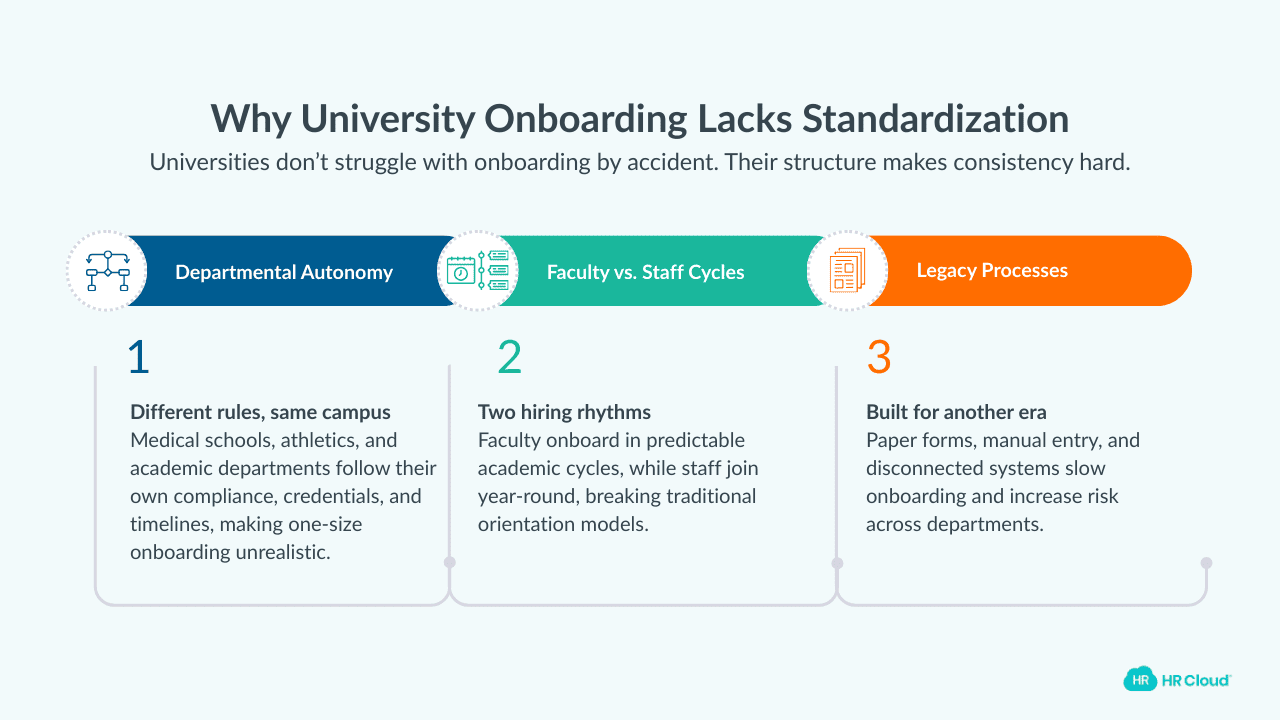
Before we fix anything, we need to dive deeper into the problem so that the solution presents itself.
McKinsey's research on higher education HR says that university HR departments face unique challenges because of decentralized governance models and tailored processes for different employee types.
- Departmental Autonomy: Your Medical School has specific credentialing requirements. Your Athletics Department operates under NCAA compliance rules most of campus has never heard of. And need a way to make them co-exist
- Faculty onboarding versus staff onboarding: These two completely different animals. Faculty join at predictable times. Staff arrive any week of the year, making standardized orientations nearly impossible.
- Legacy Systems and Paper-Based Processes: Many universities still run onboarding processes designed in a pre-digital era. Paper forms. Manual data entry. Documents living in filing cabinets instead of secure digital systems.
The Compliance Nightmare of Decentralization
A unified onboarding isn't just about convenience but about accuracy and being able to actually prove compliance when auditors arrive.
Let's talk about what makes your days chaotic as university HR leader.
I-9 verification deadlines. E-Verify requirements. State-specific labor laws. FERPA training. Title IX compliance. Clery Act requirements.
When every department handles onboarding differently, compliance becomes a game of chance. Did the Business School complete that I-9 within three days? Can anyone actually prove that?
With I-9 paperwork violations now costing anywhere between $281 and $2,789 per form, that can add up fast for a university hiring hundreds of employees each year.
What you need is a system where compliance requirements are non-negotiable and automatically enforced, regardless of which department is doing the hiring.
But what about departmentsla autonomy? Because many departmenrs are very different, as we have seen till now, and that’s needed as well.
The answer lies is having a framework that takes care of both—departmental autonomy as well as the need for a unified onboarding process.
The "Core" vs. "Custom" Framework: Your Blueprint for Standardized Onboarding
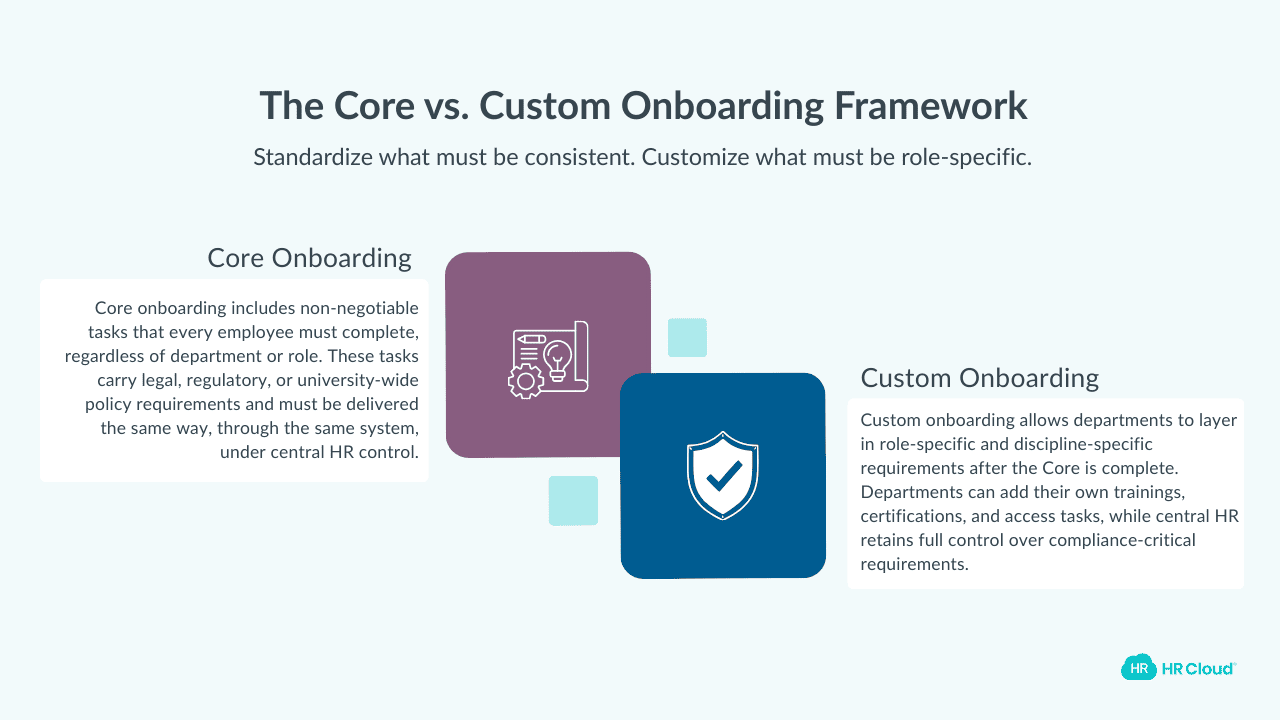
The university onboarding framework should separate onboarding into two categories: Core tasks that central HR controls completely, and Custom tasks that departments own.
Defining the "Core" of Dual Onboarding Framework
There are some, rather many, non-negotiable onboarding tasks for every employee.
These tasks form the Core. Every employee, whether joining Department of Philosophy or Athletic Training, completes these the same way, through the same platform.
A task has legal or regulatory implications and is necessary for all employees, irrespective of their department, it belongs in the Core:
- Direct deposit setup
- Form I-9 and E-Verify verification
- Mandatory harassment and discrimination training
- Federal and State Tax Forms (W-4 and state equivalents)
- University-wide policy acknowledgments (Code of Conduct, Data Security)
- FERPA training (for anyone with potential student record access)
- Emergency contact documentation
- Benefits enrollment information
Empowering Departments with "Custom" Onboarding Checklists
Once the Core is handled, department heads can add their own custom tasks. These are typically role-specific requirements that central HR need not dictate.
So your Athletics Department HR might add NCAA compliance training and equipment protocols. Your Medical School adds lab safety certifications and HIPAA training. Department of Software Engineering includes specialized software access and project management system onboarding. And so on.
The key is to ensure that the departments can add tasks, but they can't remove or modify Core requirements.
Central HR maintains compliance control. Departments maintain role-specific ownership. And the onboarding process does not leave compliance gaps.
Solving for Multi-Campus Logistics
If your university operates across multiple campuses—or multiple states—you've got additional complexity.
Handling State-Specific Labor Laws and Policies
Each state has its own employment laws, wage requirements, and compliance mandates. An employee at your Arizona campus needs different forms than someone at your California extension.
Here you need a system that automatically presents correct state-specific forms based on work location. Without requiring manual intervention on the part of HR or the new hire.
Creating a Consistent Experience for Remote and Hybrid Staff
According to CUPA-HR 2025 Higher-ed survey, 28% of the surveyed employees worked remotely and 33% more felt that their work could easily be done remotely.
Unfortunately, most onboarding processes still assume new hires will physically walk into an office.
Your employee onboarding process needs to work just as well for someone at home as it does for someone on main campus. Think digital forms, electronic signatures, virtual orientations, and clear communication that don’t rely on in-person interaction.
Done right, remote onboarding isn't a lesser experience but simply a different delivery method.
A case in point is The University of Florida's "Warm Welcome" program that creates connections through virtual events where new hires interact with leadership.
Creating a "Lite" Onboarding Flow for Student Employees
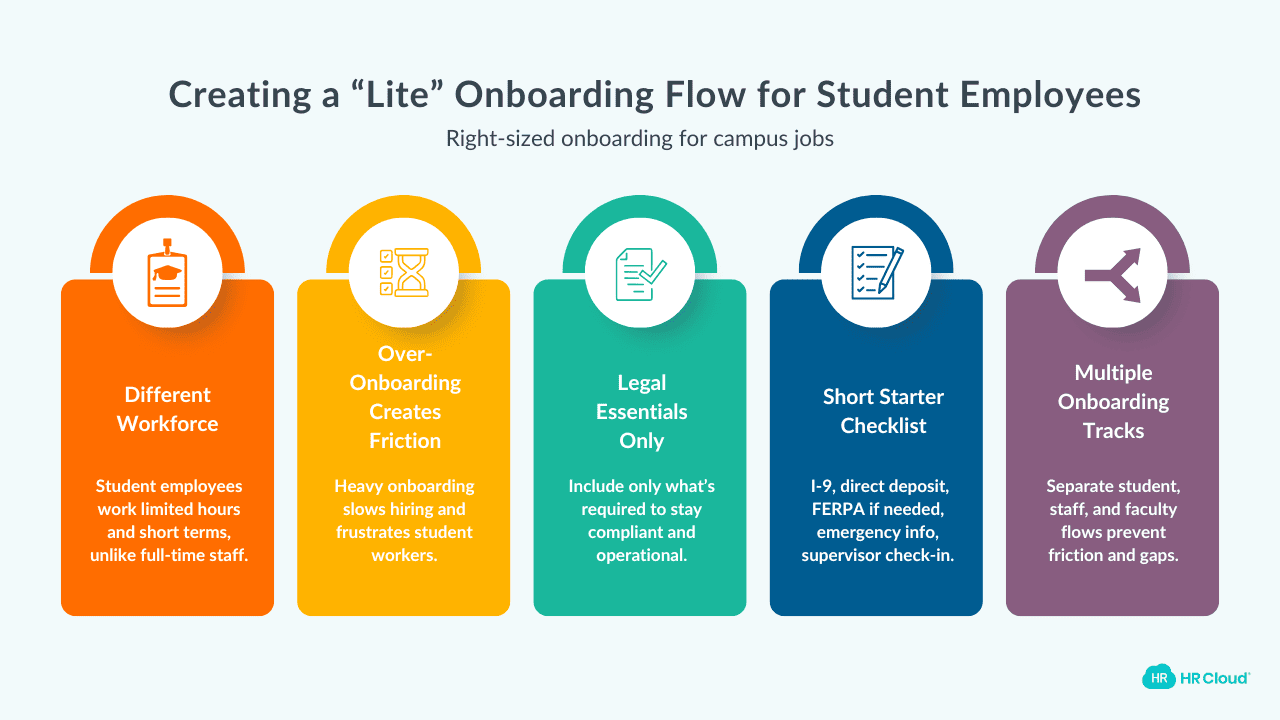
Universities hire large numbers of student workers. Do you think they need the same onboarding as full-time staff?
Absolutely not. A full staff onboarding process is an overkill for student employees.
When a work-study student gets hired to staff the library for 10 hours weekly, they don't need benefits enrollment. And they definitely don't need 47 policy acknowledgments irrelevant to their role.
A process-heavy onboarding creates friction, wastes everyone's time, and signals that the institution doesn't understand its own workforce.
Key Components of a Simplified Student Onboarding Checklist
Student workers need a streamlined and quick new hire onboarding experience covering only what's legally required and operationally necessary:
- Form I-9 completion
- Direct deposit setup
- FERPA training if they'll access student records
- Basic emergency information
- Supervisor check-in
That's it. Keep it tight ang get them working quickly.
The ability to create differentiated onboarding tracks depending on employee types is essential for universities.
Unifying Your University Onboarding with the Right Tech: HR Cloud Onboard
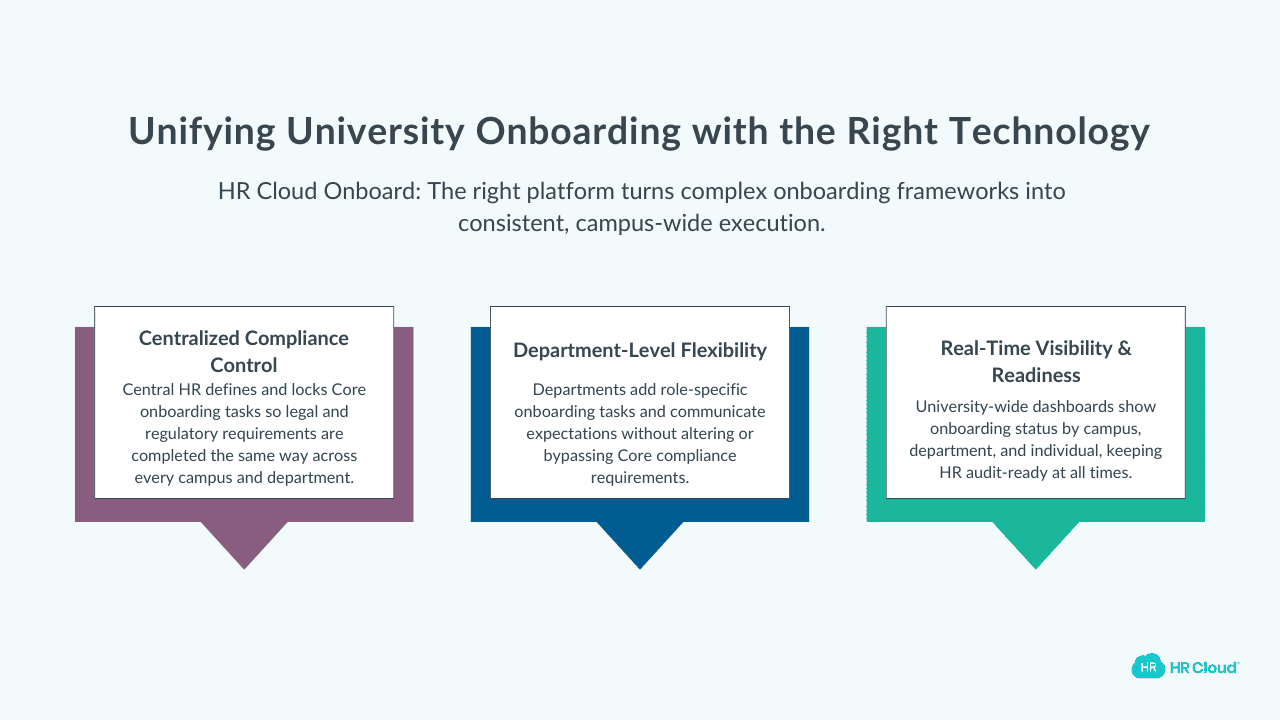
Everything we have discussed till now—the Core vs. Custom framework, multi-campus compliance automation, student employee workflows— works smoothly only when technology can execute it.
Let’s discuss the critical requirements of such a platform.
Centralized Control with Decentralized Execution
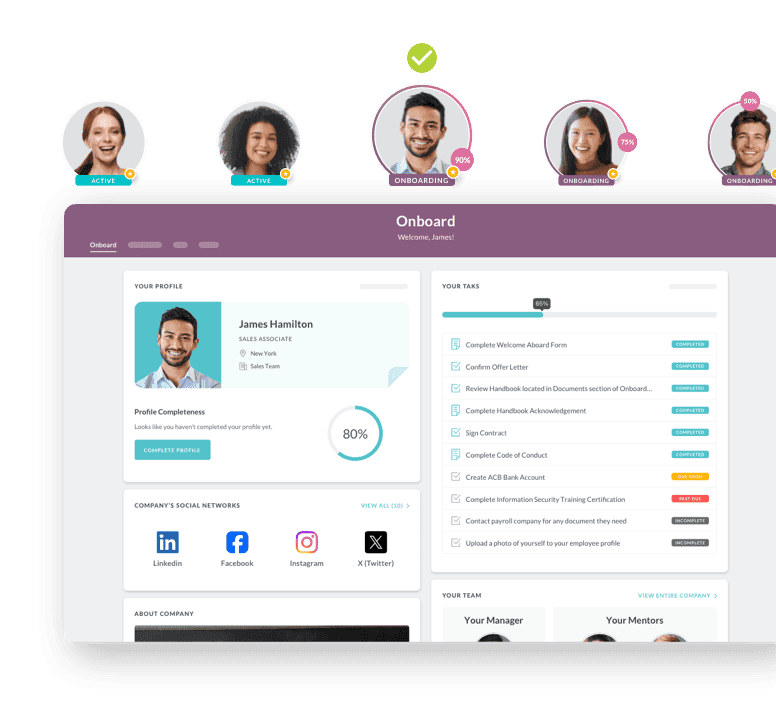
The platform needs to give central HR complete control over compliance requirements while giving departments flexibility to customize their piece.
In HR Cloud, central HR defines the "Core" tasks and those tasks are locked. No one at the department level can delete or modify them. But departments can add custom checklists on top, creating role-specific tasks and tracking completion without touching compliance infrastructure.
If you're looking to streamline onboarding workflows, this architecture makes it possible without sacrificing consistency.
Role-Based Permissions for Department Heads
A dean should be able to:
- monitor their department's onboarding progress from their dashboard
- add role-specific tasks
- communicate with new hires about department expectations.
But, they shouldn’t be able to touch Core compliance tasks. Those are handled by central HR, automatically enforced and documented.
Tracking and Reporting for University-Wide Compliance
When someone asks, "Are we compliant?" you need data to answer them.
Dashboards show exactly where every new hire is in the process. Which campuses are on track? Which departments have bottlenecks? Which individuals haven't completed their I-9 on time?
These HR onboarding keep you audit-ready always, and HR Cloud Onboard helps you achieve exactly that.
Organizations like Behavioral Progression use automated task cascades to finish onboarding 3X faster.
Will implementing the dual onboarding framework be perfect? Maybe, maybe not. But research from Brandon Hall Group found that organizations with strong onboarding improve retention by 82% and productivity by 70%. And that seems like a good place to start.
How to Start Changing Your Onboarding Process?
Start small. Baby steps.
This week, map out what currently happens when someone is hired at three different departments. Interview the people doing the hiring. And then talk to the new hires. Document every form, every email, every task.
You'll find overlap you didn't know existed. You'll also be able to point out compliance gaps that are automatically created as a result. And that’s where you'll find the foundation for your Core vs. Custom framework— a smart framework that gives everyone what they actually need.
So, are you ready to eliminate compliance gaps and create a world-class staff onboarding experience across all your campuses?
See how HR Cloud's employee onboarding software can help.
For more examples of onboarding automation success, you can also explore our HR Cloud onboarding case studies.

Discover how our HR solutions streamline onboarding, boost employee engagement, and simplify HR management
Book Your Free DemoFrequently Asked Questions
What is the difference between onboarding and orientation in a university setting?
Orientation is typically a single event—often within the first week—that covers campus-wide information like benefits, parking, and key policies. Onboarding is a longer-term strategic process that integrates a new employee into the university's culture and their specific role. Effective onboarding often extends 90 days to a full year and includes goal setting, compliance training, departmental integration, and ongoing check-ins with supervisors.
How can we create a standardized onboarding process without taking away autonomy from department heads?
The most effective approach is a "Core vs. Custom" framework. Central HR defines non-negotiable compliance and university-wide tasks—these are locked and apply to every new hire. Department heads are then empowered to add their own role-specific tasks through onboarding software. This preserves autonomy where it matters while ensuring consistency on compliance requirements.
What are the most critical compliance requirements for staff onboarding in higher education?
Key requirements include timely Form I-9 and E-Verify completion (within three business days), federal and state tax form collection, distribution of mandatory notices (FMLA, EEO), and acknowledgment of university policies on Title IX, data security, and codes of conduct. FERPA training is essential for anyone who may access student records. For universities with federal contracts, OFCCP compliance adds additional requirements.
How long should university staff onboarding last?
Orientation—covering campus basics and initial paperwork—happens in the first few days. But comprehensive onboarding should extend 90 days to a full year. Research shows strategic onboarding lasting at least one year ensures high retention. Key milestones include 30-day check-ins, 90-day performance conversations, and monthly supervisor meetings throughout the first year.
How should universities onboard adjunct faculty and temporary staff differently from full-time employees?
Adjunct and temporary employees need robust but modified onboarding. Best practices include online pre-employment tasks completed before day one, "just-in-time" training that delivers information exactly when needed, and peer networking opportunities. Many institutions hold annual "Adjunct Academy" events combining policy refreshers with welcoming activities. The key: always onboard regardless of appointment length, but compress the timeline to what's essential.
What metrics should universities track to measure onboarding effectiveness?
Track time-to-productivity, 90-day retention rates, new hire satisfaction scores, and onboarding completion rates. SHRM recommends comparing turnover rates across different cohorts of new hires and monitoring compliance metrics like I-9 completion within required timeframes. Supplement quantitative data with focus groups or surveys from recent hires.
What special considerations apply when onboarding international faculty and staff?
Begin planning 4-6 months before the start date. Coordinate between HR, International Student and Scholar Services, and academic departments on visa type (H-1B or J-1), USCIS processing timelines, and employment authorization verification. Non-profit universities are exempt from the H-1B cap, offering more hiring flexibility than private employers.
Do temporary employees need the same onboarding as permanent staff?
They need the same commitment—but compressed. Focus on essential compliance, clear expectations, and key introductions. Include temporary staff in orientation so accountability standards are clear. Thorough onboarding also builds your talent pipeline, since temporary employees often become candidates for permanent roles.
About the author

Keep Reading


Like What You Hear?
We’d love to chat with you more about how HR Cloud® can support your business’s HR needs.
Book Your Free Demo