AI Recruiting for Healthcare: How to Fill Nursing Roles 3x Faster

Every unfilled nursing shift costs your organization $2,500 or more in agency fees and overtime differential.
Your ATS probably has applications in it right now. More than you've reviewed. So the problem clearly isn't pipeline. It's the process sitting between "application received" and "credentialed, ready to start."
Most healthcare HR teams don't have a talent problem. They have a process problem.
Four specific bottlenecks add weeks to every nursing hire. AI recruiting for healthcare addresses each one directly, and the teams using it are filling roles in under 20 days (see the timeline comparison below), compared to the industry average of 78 days.
If you want to understand what an AI recruiting agent actually is before diving into the bottlenecks, HR Cloud's guide to AI recruiting agents for healthcare teams covers that thoroughly. This post covers the specific bottlenecks in nursing recruitment — the four process failures that add weeks to every hire — and shows what changes when AI handles each one.
Why healthcare recruiting is breaking in 2026
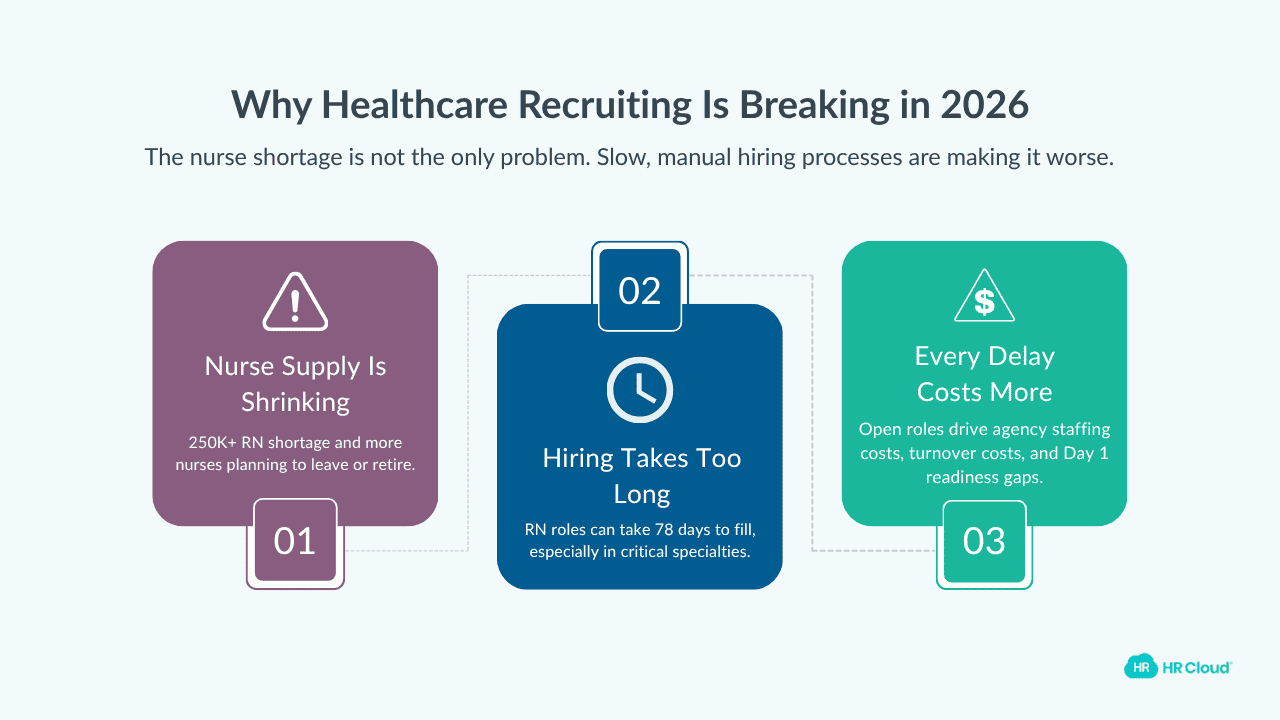
The U.S. is already short more than 250k registered nurses, and HRSA's workforce projections show the gap widening through the decade. The NCSBN's 2026 national nursing workforce study found that 40% of all nurses plan to leave the profession or retire within the next five years. Supply is tight and getting tighter.
But the average time-to-fill for an RN position is 78 days, according to the 2026 NSI National Health Care Retention & RN Staffing Report. In ICU, OR, and ED specialties, it runs 60 to 90 days. That's not a shortage timeline. That's a process timeline.
Each day that the position is open has a direct financial cost. An agency nurse costs $100–$250 per hour. A staff nurse costs $35–$65. Every day a role stays open while your process runs its course is the difference between those two numbers. Becker's Hospital Review puts the total cost of replacing one nurse at $40,000–$60,000 when recruiting, onboarding, and lost productivity are combined.
Hospitals are losing $3.9 million to $5.7 million per year to nursing turnover.
The process was designed for a world where candidates checked email, credentialing ran on paper, so that HR teams can manually shepherd every application through a multi-step pipeline. That world does not exist in real life for nurses working in shifts or homecare.
The 4 bottlenecks slowing every nursing hire
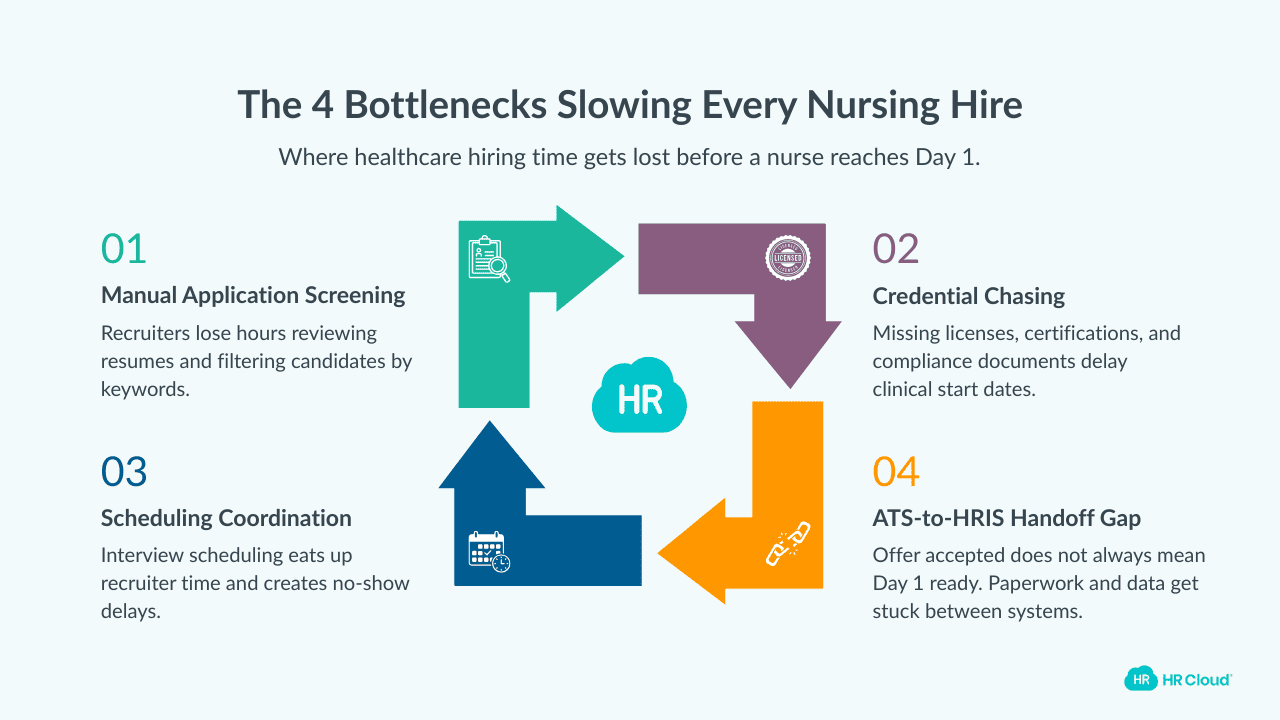
Healthcare HR directors aren't slow because they're disorganized. They're slow because the processes they're running were never designed for the volume, the compliance requirements, or the candidate behavior patterns of frontline clinical hiring.
Here's where the time actually goes.
Bottleneck 1: Manual application screening
A team of 6 recruiters handling 500 applications per month is processing 83 applications per recruiter before credential follow-up even starts. And a traditional ATS doesn't help the way it should.
Keyword matching filters out qualified nurses who phrase their experience differently on a resume. "3 years ICU RN" and "3 years critical care nursing" describe the same person. Legacy systems can't tell.
The time cost: 23 hours per open role consumed in screening alone.
AI recruiting reduces that by 75%, and it evaluates applications against structured criteria rather than keywords. Qualified candidates stop falling out of the funnel before a human ever sees them.

Ready to simplify hiring from job post to offer?
Track candidates, customize hiring stages, schedule interviews, and connect recruiting to onboarding in one easy-to-use ATS.
Explore Recruit ATS
Bottleneck 2: Credential chasing
This is where most healthcare hiring timelines bleed out. Credential verification, license validation, background checks, and occupational health screenings add 30 to 60 days between verbal offer and first clinical shift.
Most ATS platforms were built for tech companies. They were designed for knowledge-worker hiring environments, not clinical ones, so Joint Commission documentation logic and HIPAA acknowledgment workflows were never part of the build. The credential check ends up happening after the offer, via email threads and manual reminders that nobody owns until they're already late.
Healthcare credential tracking is mission-critical in a way most general-purpose recruiting platforms weren't designed to handle.
And know this: the Joint Commission's new nursing requirements effective January 2026 include competency validation and staffing documentation standards that surveyors now actively check.
A credential gap discovered on Day 1 is a patient safety issue and a Joint Commission audit risk rolled into one. AI recruiting flags those gaps before an offer is made.
The Healthcare High-Volume Recruiting Playbook
How to fill clinical roles faster, stay compliant, and stop losing new hires between offer and Day 1.
Download Now
Bottleneck 3: Scheduling coordination
A team scheduling 150 interviews per month at 15 minutes per scheduling task is spending 37 hours every month on calendar coordination. That's nearly a full work week, every month, just moving time slots around.
Nurses work rotating shifts — and non-traditional nursing schedules make coordinating availability across candidates, hiring managers, and interview panels genuinely complex. When a candidate no-shows without reminder systems in place, the team starts another 3 to 5 day cycle from scratch.
AI recruiting handles calendar coordination autonomously. SMS reminders go out the night before and day of. No-show rates drop when candidates confirm via text rather than email. Your recruiters get 37 hours a month back — time redirected from calendar coordination to shift scheduling decisions that actually need judgment.
Bottleneck 4: The ATS-to-HRIS handoff gap
Most ATS platforms treat "offer accepted" as the finish line. Most HRIS systems treat "employee record created" as the starting line. The time lag between those two events — often a week or more, depending on the organization — is where paperwork goes missing, new hires go silent, and compliance problems are quietly created.
Manual data re-entry into the HRIS takes 3 to 7 days after offer acceptance. During that window, the new hire receives nothing. No I-9 request. No compliance documents. No credential upload instructions. They show up for their first shift and HR scrambles.
That Day 1 emergency didn't start on Day 1. It started in the recruiting process, at this handoff. A complete nurse onboarding checklist can help you audit exactly where the gaps are in your current workflow — and poor onboarding in that gap is one of the clearest predictors of early turnover in healthcare.
From job post to credentialed: a timeline comparison
Here's what the difference looks like across the 10 milestones between posting a nursing role and having a fully credentialed employee ready for their first shift.
| Milestone | Manual process | AI-assisted |
|---|---|---|
| Job description written | 2–4 hours | 15 minutes |
| Job distributed to boards | 1–2 days | Automatic, same day |
| Applications screened | 3–5 days | Same day |
| Credential check initiated | After offer (weeks later) | During screening |
| Candidate follow-up | 24–48 hr delay | Within minutes |
| Interview scheduled | 3–5 days coordination | Automated |
| Interview reminder sent | Manual or skipped | Automated SMS |
| Credential gap flagged | Day 1 | Pre-offer |
| Offer letter sent | 1–2 days | Automated |
| Preboarding initiated | 3–7 days after offer | Same day as offer |
| Total: posting to Day 1 ready | 45–78 days | Under 20 days |
The biggest compression happens at Bottlenecks 2 and 4.
Running credential verification in parallel with interviews, rather than sequentially after the offer, cuts 2 to 3 weeks from the timeline on its own. Triggering preboarding the same day as the offer removes another week. You don't need to fix everything at once to see significant results.
What 3x faster looks like in practice
Organizations like Interim HealthCare and Team Select Home Care deal with this problem at volume. Home health agencies and healthcare staffing firms fill dozens of nursing and home health aide roles per month, often with a lean HR team, against candidates who work rotating shifts and don't check email between patients.
The worst bottleneck for most is credential chasing. A verbal offer goes out on Monday. The credential request goes to the candidate via email on Tuesday. Nothing happens until Thursday when a recruiter follows up. The candidate uploads documents the following Monday, if they do at all. By that point, you're 10 days past offer with nothing to show for it.
SMS-native recruiting changes that. HR Cloud's Recruit platform uses the same approach as Maya for preboarding: text-based communication with no portal login, no app download, and no email inbox required. The completion rate is 89% via SMS versus 52% via portal. For nurses and CNAs who spend their shifts away from a desk, that difference isn't a feature. It's whether the candidate completes the process or accepts someone else's offer first.
The same dynamic plays out for field and clinical staff onboarding — and for travel nurses, where credential verification timelines are even tighter given contract start dates.
And when a candidate accepts their offer in Recruit, Maya activates automatically. The new hire receives their I-9, compliance documents, credential upload requests, and direct deposit setup via text before Day 1. No manual data re-entry. No preboarding gap. No nurse arriving for their first shift with incomplete paperwork.
That's one connected system from first application to first productive shift. HR Cloud's Recruit ATS and Maya were built to close the gap that most platforms leave open.
HR Cloud's Recruit ATS connects to Maya preboarding end-to-end. Here's what that looks like.
If you're still manually screening applications and chasing credential paperwork via email in 2026, the problem isn't your team's effort. It's the architecture of the process. That's fixable.
Healthcare organizations like Interim HealthCare and Team Select Home Care are already running AI recruiting workflows that connect directly into Maya preboarding: from first application to first productive shift in one system, without the 78-day process, without the Day 1 scramble, and without the $2,500-per-shift agency cost filling the gap while a role sits open.
The bottlenecks are real. They're also solvable.
Book a demo to see how AI recruiting works for high-volume healthcare hiring. We'll walk you through the full pipeline in your environment.
Discover how our HR solutions streamline onboarding, boost employee engagement, and simplify HR management
Book Your Free DemoFrequently asked questions
How does AI recruiting reduce time-to-fill for nursing roles?
AI recruiting agent does these four things in parallel: running credential verification in parallel with screening rather than after the offer, automating candidate follow-up via SMS so candidates respond in minutes rather than days, eliminating manual calendar coordination, and triggering preboarding the same day an offer is accepted. Each of those changes removes 1 to 3 weeks from the traditional timeline. The 2026 NSI Staffing Report puts the current industry average at 78 days. Teams running AI recruiting can fill the same roles in under 20.
Does AI recruiting handle Joint Commission and HIPAA requirements?
Yes, Healthcare-specific platforms do. But most general-purpose ATS platforms don't because they were built for non-clinical hiring environments and treat credentialing as an afterthought. HR Cloud Recruit builds credential flag logic into the screening stage so Joint Commission documentation requirements and HIPAA acknowledgments are captured before an offer is extended. That's the difference between a credential gap that surfaces in screening versus one that becomes a compliance emergency on Day 1.
Can AI recruiting reach nurses and CNAs who don't use email during the hiring process?
Yes, if it's SMS-native. Nurses and CNAs working active shifts aren't monitoring a personal email inbox or logging into a portal to check application status. Any recruiting platform that communicates via SMS — no login, no app download required — will reach them where they actually are. The same 89% vs. 52% completion rate that drives Maya's onboarding results applies to recruiting — see how Maya uses the same approach in preboarding: candidates who receive a text respond. Candidates who receive a portal link frequently don't.
About the author

Keep Reading


Like What You Hear?
We’d love to chat with you more about how HR Cloud® can support your business’s HR needs.
Book Your Free Demo