
The Complete Guide to Caregiver Retention in Home Care (2026)

Seventy-five percent of home care caregivers leave their positions within a year. That's three out of every four home health aides, certified nursing assistants, and personal care workers agencies invest in recruiting, training, and certifying. When a caregiver walks out the door, they take $2,600 in replacement costs with them—and often a piece of your agency's reputation. For home healthcare providers managing chronic caregiver shortages, reducing caregiver turnover isn't just an HR challenge—it's a business survival issue.
TL;DR: Home care agencies and home health providers face caregiver turnover rates averaging 75% annually, costing agencies billions in recruitment, training, and lost productivity. This comprehensive guide outlines proven retention strategies for home healthcare workers including automated onboarding workflows, mobile-accessible recognition programs, flexible scheduling solutions, competitive compensation approaches, career development pathways for CNAs and home health aides, and communication systems that reduce direct care worker turnover while improving patient care quality.
Key Takeaways
- Caregiver turnover in home care reached 75% in 2024, down from 79.2% in 2023 according to the Activated Insights Benchmarking Report—showing modest improvement but remaining critically high
- Nearly 80% of caregivers leave within their first 100 days according to industry research, making strong onboarding essential for retention
- The average cost to replace a caregiver is $2,600, not including lost productivity and client disruption
- Agencies that implement comprehensive retention strategies combining technology, recognition, and structured support see turnover rates drop by 20-40% based on SHRM retention research
- Home care industry needs an additional 1.2 million direct care workers by 2030 according to PHI (Paraprofessional Healthcare Institute), making retention more urgent than ever
Why Caregiver Retention Matters for Home Care Agencies
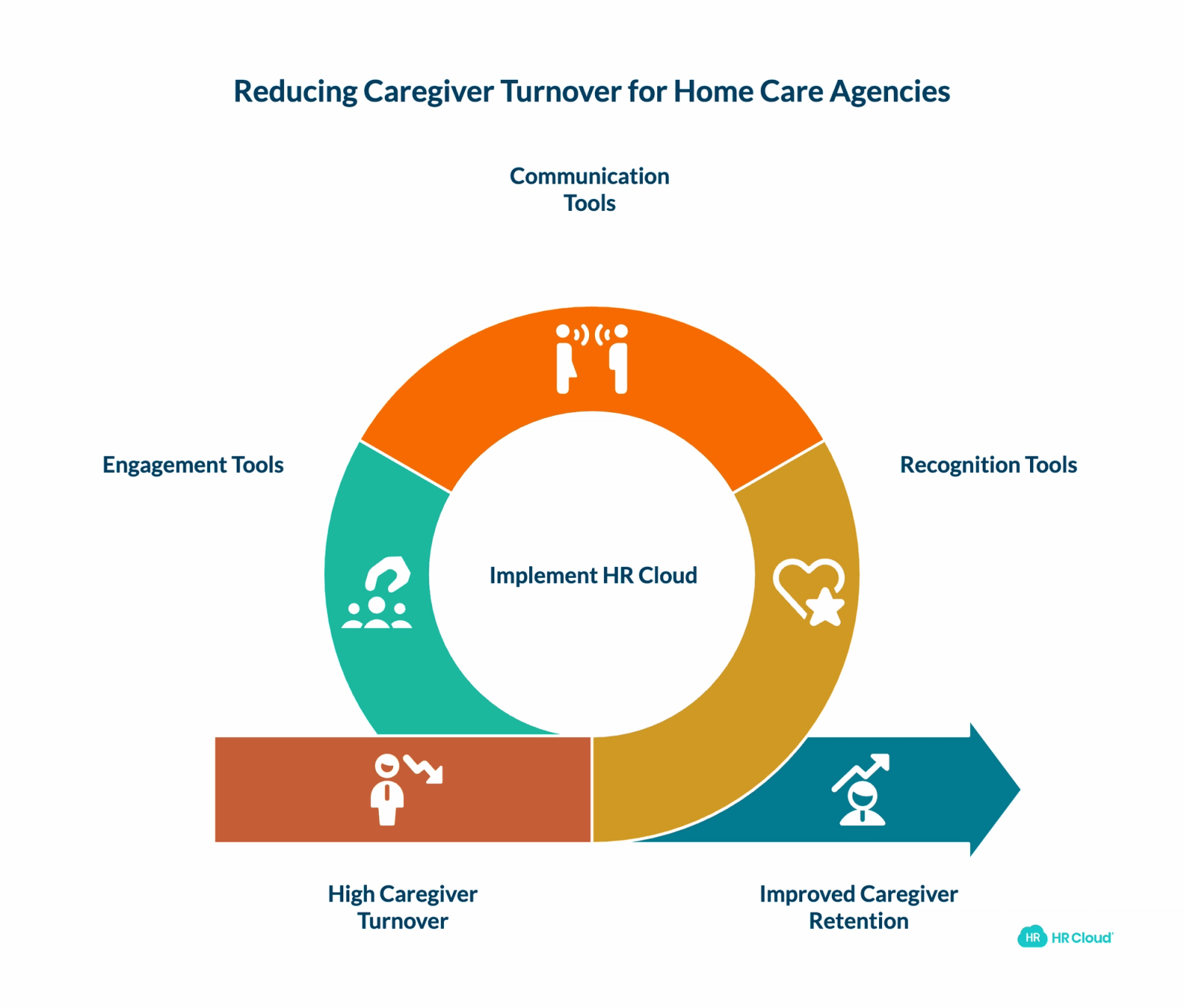
Home care agencies operate in a perfect storm. Demand for in-home care services is exploding as 17.5% of the US population reaches age 65 or older. Revenue across the home healthcare industry hit $107 billion in 2025 and is projected to reach $176.3 billion by 2032. But here's the catch: 59% of home care providers report they're running with insufficient staff. They're turning away clients not because of lack of demand, but because there's nobody to provide the care.
When a home health aide or personal care worker leaves, the costs cascade. Direct replacement expenses average $2,600 per departure, but indirect costs multiply from there: lost productivity during vacancy periods, overtime premiums for remaining staff covering gaps, disrupted client relationships requiring relationship rebuilding, quality inconsistencies during care transitions, and reputational damage when continuity of care breaks down.
For a 50-caregiver operation experiencing the industry average 75% annual caregiver turnover rate, that's 37-38 replacements annually. Nearly $100,000 in direct replacement costs alone—before accounting for the operational disruption that comes with perpetual staff churn.
Struggling with caregiver turnover? HR Cloud's Workmates platform provides the recognition, communication, and engagement tools that make caregivers feel valued and connected—even when they're working alone in the field.
Understanding the Root Causes of Caregiver Turnover
You can't fix what you don't understand. Caregiver turnover stems from several interconnected factors, many of which agencies have more control over than they realize.
Compensation and Benefits Reality
The median hourly wage for home care aides sits at $15.14 according to Bureau of Labor Statistics data—far below the national living wage threshold in most markets. When home health aides and personal care workers can earn similar or better wages in retail, food service, or warehouse positions that don't require certification or expose them to infectious disease risk, the calculation becomes straightforward.
Fewer than 20% of direct care workers receive employer-sponsored health insurance according to PHI research. The irony isn't lost on anyone: people providing healthcare services to vulnerable populations often can't afford healthcare for themselves.
The Onboarding Problem
Here's where most home care agencies shoot themselves in the foot. According to industry research from Activated Insights, nearly 80% of home health aides and personal care workers leave within their first 100 days. That's not a recruitment problem—it's an onboarding and early experience problem.
Many home healthcare providers treat new hire onboarding as a compliance checkbox exercise. New caregivers complete required certifications, sign paperwork, and receive a brief orientation. Then they're sent into clients' homes, often feeling unprepared for the emotional and physical demands of direct care work.
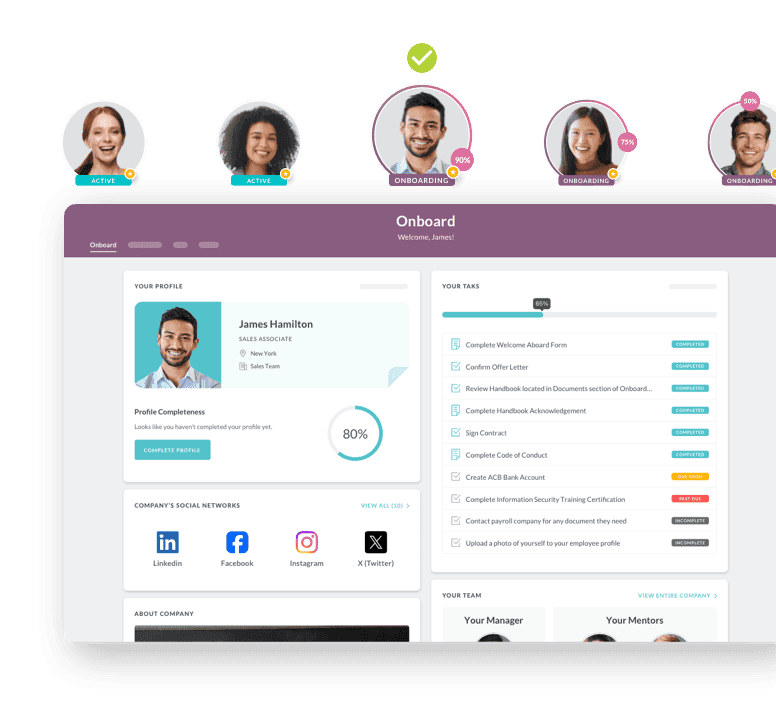
Effective caregiver onboarding extends well beyond the first week. It should encompass at least 90 days of structured support, regular manager check-ins, mentorship pairing with experienced caregivers, and gradual complexity increases in care assignments.
Isolation and Lack of Recognition
Unlike hospital or facility-based healthcare workers, home care aides and home health workers operate independently in client homes. There's no breakroom camaraderie, no visible supervision, and often no immediate peer support when difficult care situations arise.
When direct care workers feel invisible and unappreciated, they disengage. Employee recognition isn't just nice to have—it's foundational to retention. Research from Gallup and Workhuman shows that well-recognized employees are 45% less likely to leave after two years, and those receiving high-quality recognition are 65% less likely to actively seek new job opportunities.
Limited Career Advancement
Too many caregivers view home care as a temporary job rather than a career because agencies don't provide clear pathways for growth. When someone can spend five years as a caregiver with no meaningful progression in responsibility, compensation, or title, they'll eventually look elsewhere.
| Root Cause | Why It Drives Turnover | Evidence-Based Solution | HR Cloud Capability |
|---|---|---|---|
| Poor Onboarding | 80% leave in first 100 days | Structured 90-day onboarding with automated workflows | Onboard: Workflow-based task assignments, automated reminders, and bulk onboarding checklists |
| Feeling Invisible | Isolated workers disengage without recognition | Mobile-accessible peer recognition system | Workmates: Kudos recognition, reward points, and customizable badge |
| No Career Path | "Dead-end job" perception | Multiple advancement tracks with documented development | Performance management: Goal tracking, development plans |
| Low Compensation | Can't compete with retail wages | Recognition rewards supplement base pay strategically | Kudos with Rewards: Points-based gift cards, custom rewards |
| Administrative Burden | Unnecessary friction signals disrespect | Unified platform reduces login fatigue, data duplication | Integrated HRIS: Single mobile app for all functions |
| Communication Gaps | Distributed workers feel disconnected | Segmented channels, peer chat, mobile announcements | Workmates: Channels, chat, push notifications |
What Actually Works: Evidence-Based Retention Strategies
Let's move past the theory and into what actually reduces turnover in the real world.
Strategy 1: Structured Onboarding That Extends Beyond Week One
Organizations with strong onboarding programs see 82% higher retention rates according to Brandon Hall Group research. The difference isn't complicated—it's about treating onboarding as a process, not an event. Automation makes consistency possible at scale.
Effective onboarding begins before the first day. During the preboarding period, new caregivers should receive welcome communications, complete administrative paperwork digitally through e-signature workflows, meet their team virtually or in person, and start absorbing company culture. This engagement during their notice period keeps them committed and reduces pre-start dropouts by up to 30%.
The first week should establish foundations: compliance training completion, care protocols and safety procedures, introduction to scheduling systems, and assignment of an experienced mentor or buddy. Chained tasks ensure caregivers complete steps in proper sequence—preventing someone from accessing client homes before background checks clear or safety training completes.
Days 30-60 represent the integration phase. New caregivers should receive regular check-ins with supervisors, gradually increasing case complexity, documented feedback sessions, and early performance recognition for small wins. Automated reminder systems ensure managers don't miss critical 30-day and 60-day check-ins even during busy periods.
The 90-day mark isn't the finish line—it's a milestone. Agencies should conduct formal performance reviews, solicit feedback on the onboarding experience, confirm cultural fit and job satisfaction, and map out preliminary career development discussions.
For agencies hiring in batches—such as seasonal ramp-ups or new service area expansions—bulk onboarding capabilities allow simultaneous assignment of standardized onboarding checklists to dozens of new hires, ensuring consistency without overwhelming administrative staff.
| Onboarding Approach | Manual Process | Automated Platform | Consistency & Scalability |
|---|---|---|---|
| Task Assignment | HR emails individual tasks, tracks in spreadsheets | Automated checklist assignment with chained dependencies | 100% consistency, no tasks forgotten |
| Document Collection | Paper forms, scanning, manual filing | Digital e-signature workflows, automatic storage | 60% faster completion, zero lost paperwork |
| Reminder System | Manual calendar entries, easy to miss | Automated reminders to assignees and managers | Manager check-ins happen on schedule |
| Progress Visibility | Phone calls, email follow-ups | Real-time dashboard showing completion status | Instant identification of bottlenecks |
| Background Checks | Manual coordination with vendors | Background check integrations triggered during onboarding workflows | Chained tasks prevent field access before clearance |
| Scalability | Linear time increase per hire | Bulk onboarding for 50+ hires simultaneously | Enables growth without proportional admin hiring |
| Onboarding Phase | Duration | Key Activities | Retention Impact |
|---|---|---|---|
| Preboarding | Acceptance to Start | Digital paperwork, welcome communication, team introductions | Reduces pre-start dropouts by 30% |
| First Week | Days 1-7 | Compliance training, safety protocols, mentor assignment | Sets cultural expectations |
| Integration | Days 8-60 | Regular check-ins, graduated complexity, feedback loops | 60% reduction in early turnover |
| 90-Day Review | Day 90 | Performance review, satisfaction survey, career planning | Establishes long-term engagement |
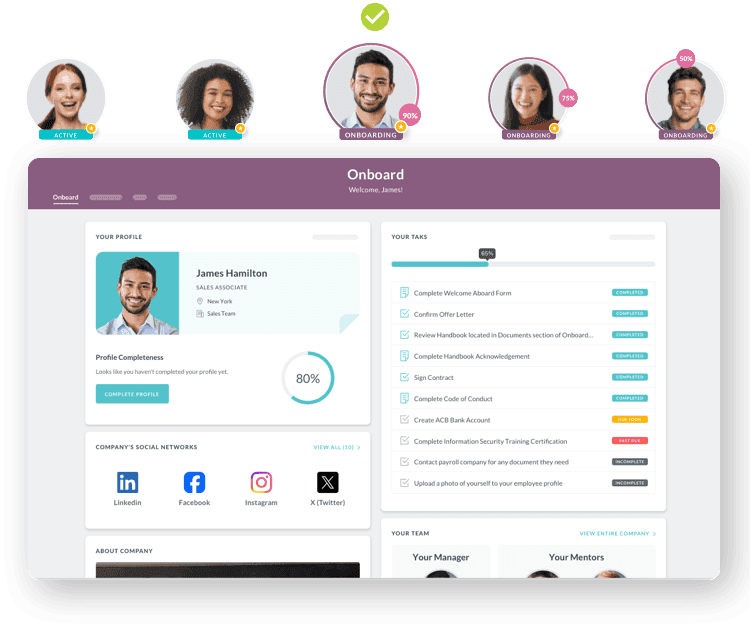
HR Cloud's Onboard platform automates onboarding workflows, assigns tasks sequentially, sends automated reminders, and tracks completion rates—ensuring every new caregiver receives a consistent, high-quality experience.
Strategy 2: Recognition Systems That Reach Distributed Workers
When caregivers work in clients' homes across a service area, traditional recognition programs fall flat. Birthday cakes in the breakroom don't work when there's no breakroom. Quarterly awards ceremonies don't resonate when people work evening shifts.
Effective recognition for home care workers must be immediate, specific, peer-driven, and accessible via mobile devices. Modern platforms like HR Cloud's Workmates enable this through features designed specifically for distributed healthcare workers.
Immediate recognition means acknowledging good work when it happens, not weeks later during a monthly meeting. When a caregiver handles a difficult family situation with grace, supervisors or peers can send Kudos recognition instantly via mobile app—the caregiver sees the appreciation in real time, even while still in the field.
Specific recognition connects praise to concrete behaviors. Instead of "great job this month," effective recognition says "thank you for staying late Tuesday when Mrs. Johnson's daughter was delayed—your flexibility made a real difference." Kudos badges can be customized to recognize specific achievements like "Patient Advocate," "Team Player," or "Crisis Management Excellence."
Peer-driven recognition creates culture. When caregivers can recognize each other—not just receive recognition from management—it builds connections across an otherwise isolated workforce. Platforms that enable peer-to-peer recognition with point-based reward systems allow caregivers to both give and receive recognition, creating reciprocal appreciation loops.
Auto Rewards functionality eliminates oversight on milestone recognition. Caregivers automatically receive points on work anniversaries and birthdays, ensuring no one feels forgotten even when working independently. These points convert to tangible rewards through gift card redemption or custom agency-defined rewards like extra PTO days or premium parking spots.
| Recognition Approach | Traditional Method | Platform-Based Recognition | Impact on Distributed Workers |
|---|---|---|---|
| Timing | Monthly meetings, quarterly awards | Instant mobile recognition, real-time Kudos | Immediate validation vs. delayed appreciation |
| Accessibility | Requires physical presence | Mobile-first, accessible 24/7 from field | Evening/weekend shift workers included |
| Who Can Recognize | Management only | Peer-to-peer + management | Builds horizontal culture, not just vertical |
| Specificity | Generic "employee of the month" | Customizable badges tied to specific actions | Reinforces exact behaviors agencies want repeated |
| Tangible Value | Certificate, plaque | Points → Gift cards or custom rewards | Monetary value caregivers can use for necessities |
| Milestone Tracking | Manual oversight, often missed | Auto Rewards for birthdays/anniversaries | Zero administrative burden, 100% consistency |
Strategy 3: Career Development and Skills Growth
Home health aides and personal care workers who see a future at your agency stay longer. Career development for direct care workers doesn't necessarily mean everyone becomes a supervisor. It means creating multiple pathways for growth based on individual interests and strengths.
Some certified nursing assistants and home care aides want to specialize. Agencies can offer certification paths in dementia care and Alzheimer's support, chronic disease management for diabetic and cardiac patients, palliative care and end-of-life support, pediatric home care for medically complex children, or specialized medical equipment operation.
Others want expanded responsibility without leaving direct patient care. Lead caregiver or senior caregiver roles can include mentoring newly hired staff, serving as subject matter experts for complex care cases, or participating in quality improvement and care plan initiatives.
Still others aspire to care coordination or management roles. Agencies should identify high-potential direct care workers early and provide structured development opportunities including shadowing administrative and clinical staff, leading small team improvement projects, formal management and leadership training, and graduated supervisory responsibilities.
| Career Path | Skills Required | Typical Progression | Retention Impact |
|---|---|---|---|
| Clinical Specialization | Advanced certifications, specialized training | CNA → Specialized Care Provider → Clinical Trainer | 25% longer tenure |
| Lead Caregiver | Mentorship, communication, problem-solving | Caregiver → Senior Caregiver → Lead Caregiver | Peer influence improves team retention |
| Care Coordination | Organization, client relations, scheduling | Caregiver → Care Coordinator → Operations | Creates internal promotion pipeline |
| Management Track | Leadership, operations, business acumen | Caregiver → Supervisor → Branch Manager | Builds leadership from frontline understanding |
Want to track caregiver development and create structured growth pathways? HR Cloud's performance management tools enable goal setting, progress tracking, and documented development conversations that demonstrate your investment in caregiver careers.
Strategy 4: Compensation Strategies Within Budget Constraints
Not every agency can become the highest-paying employer in their market. But every agency can be strategic about how they structure total compensation.
Wage increases matter. Even modest raises—50 cents to a dollar per hour—signal that experience and loyalty are valued. Annual raises that at minimum track inflation prevent real wage erosion over time.
Benefits creativity makes a difference when budgets are tight. Agencies have successfully implemented mileage reimbursement programs, referral bonuses for recruiting new caregivers, flexible scheduling as a benefit, and professional development stipends.
Recognition-based reward systems offer particularly compelling ROI. Unlike across-the-board wage increases that carry permanent cost implications, point-based recognition programs allow agencies to allocate reward budgets strategically. Caregivers earn points through exceptional performance, peer recognition, milestone achievements, and special accomplishments. They redeem accumulated points for gift cards, custom agency rewards like extra PTO or preferred scheduling, or transfer points to colleagues.
This approach creates variable compensation that rewards performance without permanently increasing base labor costs. A caregiver who consistently goes above and beyond might accumulate $500 in gift card rewards annually—meaningful recognition that costs the agency a fraction of equivalent wage increases when factoring in payroll taxes and benefits calculations.
Some agencies are experimenting with additional nontraditional benefits: student loan repayment assistance for caregivers pursuing advanced certifications, childcare subsidies or partnerships with local childcare providers, wellness program access including gym memberships or mental health resources, and performance-linked bonuses for quality metrics or client satisfaction scores.
The most effective agencies communicate total compensation value clearly. When caregivers understand the full value of their benefits package beyond base pay—including retirement contributions, insurance coverage, PTO accrual, and recognition rewards—perceived compensation increases significantly.
Strategy 5: Technology That Reduces Administrative Burden
Home health aides and personal care workers don't quit because scheduling is complicated—they quit because unnecessary administrative friction makes them feel undervalued and overwhelmed.
Modern home care workforce management technology should simplify shift selection and swapping, automate time tracking and mileage logging for compliance, provide mobile access to schedules and care assignment updates, reduce paperwork through digital forms and e-signatures, and enable direct communication with care coordinators and scheduling managers.
When workforce management technology reduces the administrative headaches that have nothing to do with actual patient caregiving, it signals respect for direct care workers' time and expertise. That respect translates directly to improved retention rates.
| Technology Solution | Problem It Solves | Caregiver Impact | Retention Effect |
|---|---|---|---|
| Mobile Scheduling | Inability to view/change shifts remotely | Flexibility and control | 15% reduction in schedule-related turnover |
| Automated Reminders | Missed assignments, confusion | Confidence and preparation | Fewer errors, higher satisfaction |
| Digital Onboarding | Paperwork overwhelm, delays | Faster time to productivity | 60% faster onboarding completion |
| Recognition Platform | Feeling invisible and unappreciated | Validation and connection | 45% lower turnover after 2 years |
| Integrated HRIS | Fragmented systems, data errors | Seamless experience | 20-30% reduction in administrative friction |
The real retention gains come from integration. When onboarding, recognition, communication, performance management, and scheduling exist in separate systems, caregivers navigate a frustrating maze of different logins, disconnected workflows, and duplicated data entry. Each additional platform adds friction—and friction drives turnover.
HR Cloud's unified platform architecture addresses this directly. A caregiver completing onboarding tasks automatically becomes eligible for recognition programs. Recognition received during onboarding appears in the same communication feed where they see company announcements and peer messages. Performance goals set during 90-day reviews link to the same profile where managers access onboarding completion data. Everything connects.
For healthcare agencies managing distributed workforces, this integration isn't luxury—it's operational necessity. When workforce members access everything through a single mobile app, adoption increases and administrative burden decreases. When data synchronizes automatically between modules, errors drop and visibility improves. When workflows connect across functions, caregivers experience organizational coherence rather than departmental silos.
Learn how HR Cloud's unified platform eliminates the fragmented technology stack that drives caregiver frustration. See onboarding, recognition, communication, and performance management working together in a single system designed for distributed healthcare workforces.
Strategy 6: Communication Systems for Distributed Teams
When home health aides and personal care workers operate across dozens of client locations, maintaining connection requires intentional communication infrastructure. Employee engagement platforms designed for distributed healthcare workforces solve this through mobile-first architecture and segmented communication channels.
Regular all-hands meetings via video ensure everyone hears from leadership consistently. These shouldn't just be information dumps—they should include caregiver recognition spotlights, Q&A sessions with management, and peer success stories from direct care workers. Company announcements posted through newsfeed systems remain accessible for home health aides who miss live sessions due to shift conflicts or client care responsibilities.

Targeted communication channels allow home care agencies to segment messaging by shift, geographic location, care specialization, or role. Night shift caregivers don't need notifications about daytime policy changes. Dementia care specialists benefit from channels dedicated to sharing evidence-based techniques and resources specific to their work. Creating topic-specific channels prevents information overload while ensuring relevant updates reach the right direct care workers.
Peer communication tools let home health aides and personal care workers connect with each other, not just with management. Built-in chat functionality enables one-on-one conversations when a caregiver needs advice on a challenging care situation, or group chats where evening shift workers can coordinate coverage or share patient care experiences. Discussion spaces for shift workers, channels for specific care specializations like palliative care or pediatrics, and informal social channels all combat the isolation inherent to home healthcare work.
Mobile accessibility makes all of this possible. Home health aides check their phones between client visits—they're not logging into desktop systems. Push notifications deliver urgent care assignment updates while non-urgent communications queue for review during breaks.
| Communication Method | Email-Based | Text/WhatsApp Groups | Integrated Platform | Reach & Engagement |
|---|---|---|---|---|
| Urgent Updates | Delayed, often unread | Reaches caregivers quickly | Push notifications + persistent feed | Platform: 95%+ read rate vs. email 20-30% |
| Segmentation | Manual distribution lists | Difficult to segment | Channel-based filtering by role/location | Only relevant messages reach each caregiver |
| Peer Connection | Reply-all chaos | Lost in thread clutter | Dedicated chat + discussion channels | Caregivers can find help without manager intermediary |
| Information Retention | Buried in inboxes | Messages disappear in scroll | Searchable announcement archive | Policy updates accessible when needed |
| Recognition Integration | Separate from other tools | Not possible | Recognition appears in same feed | Cohesive employee experience |
| Compliance | No audit trail | Privacy/compliance concerns | Encrypted, HIPAA-compliant messaging | Agency protections + caregiver safety |
Building a Retention-Focused Culture: Beyond Individual Programs
Individual programs matter. But retention isn't about programs—it's about culture. The agencies with lowest turnover don't just implement recognition systems or career development pathways. They build organizational cultures where caregivers genuinely feel valued, heard, and supported.
Culture starts with leadership behavior. When agency executives know caregivers by name, visit field sites regularly, and respond personally to caregiver feedback, it sends a message. When leadership treats caregivers as interchangeable labor units, that sends a message too.
Culture extends to how problems are handled. In retention-focused agencies, when a caregiver makes a mistake, the first question is "what support did they need that they didn't receive?" rather than "how do we punish this?" That doesn't mean eliminating accountability—it means approaching challenges from a developmental rather than punitive perspective.
Culture shows up in resource allocation. Agencies that invest in caregiver comfort—proper equipment, adequate supplies, backup support for challenging situations—demonstrate tangible respect for the work being done.
Common Retention Mistakes That Undermine Good Intentions
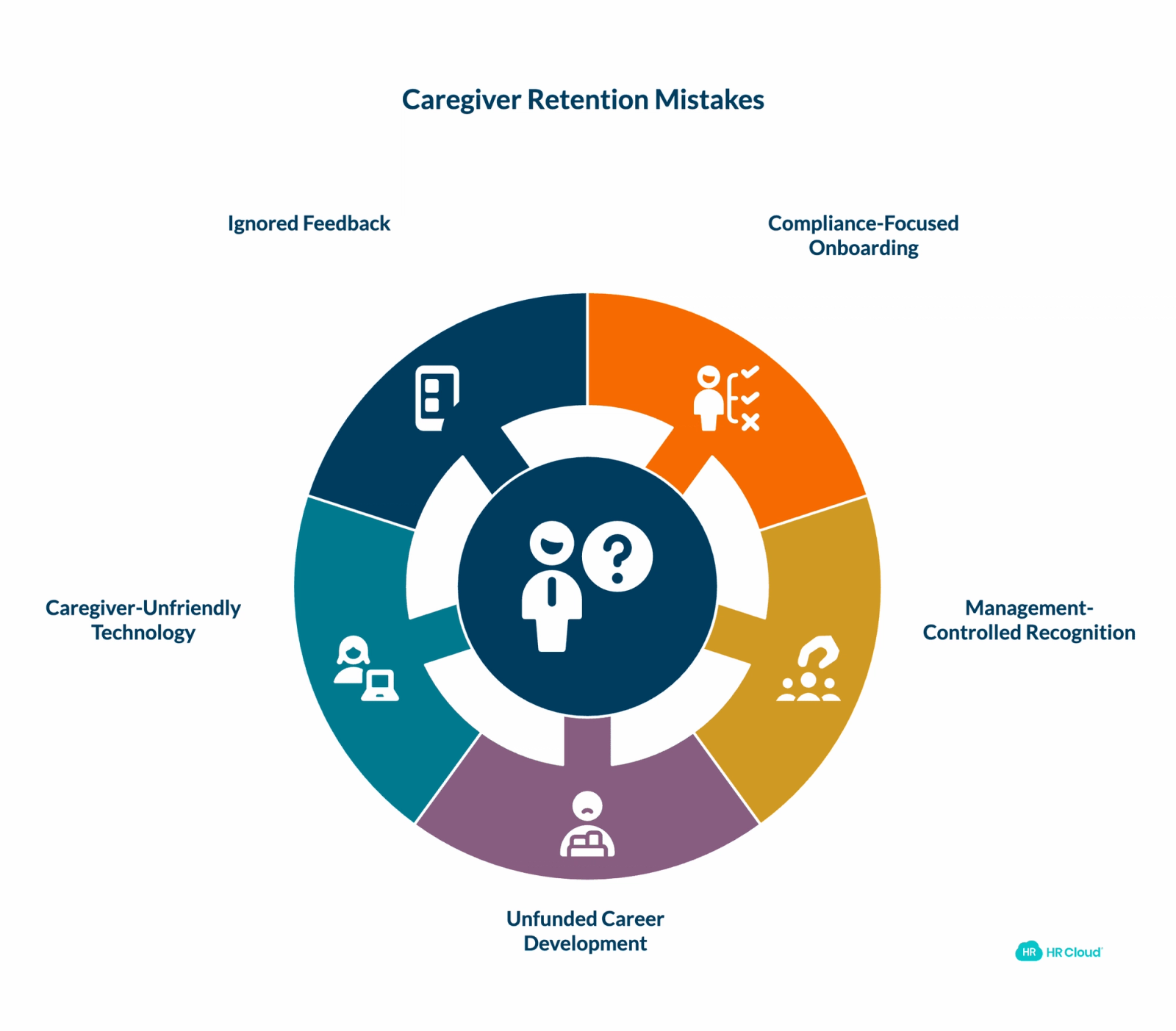
Even agencies with excellent intentions make predictable mistakes that sabotage retention efforts.
Treating onboarding as a compliance checkbox rather than a relationship-building process is the most common error. Completing I-9s and OSHA training doesn't constitute onboarding.
Implementing recognition programs that management controls entirely misses the point. When only managers can recognize caregivers, it reinforces hierarchy rather than building peer culture. The most effective recognition systems are predominantly peer-to-peer.
Creating career development programs without budget to actually promote people builds cynicism rather than engagement. If you're going to talk about growth opportunities, you need to actually create them.
Using scheduling software that makes coordinators' lives easier but makes caregivers' lives harder is counterproductive. Technology should serve frontline workers first.
Surveying caregivers about satisfaction and engagement, then ignoring the results destroys trust faster than not surveying at all. If you're going to ask for feedback, you need to act on it visibly.
Measuring Retention Program Success
You can't manage what you don't measure. Effective retention programs require clear metrics tracked consistently over time. Modern HRIS platforms consolidate these metrics in dashboards, making it possible to spot trends before they become crises.
Turnover rate overall provides the baseline, but more important is turnover segmentation: new hire turnover in first 90 days, voluntary versus involuntary turnover, turnover by supervisor or branch, and high performer versus average performer turnover.
Time-to-productivity metrics reveal whether new caregivers are ramping up appropriately. Track days to independent assignments, client satisfaction scores for new caregivers, and error rates during onboarding period.
Engagement indicators predict turnover before it happens. Monitor satisfaction survey scores, recognition program participation rates, internal transfer and promotion rates, and exit interview themes. Analytics showing declining recognition engagement or increasing time between manager check-ins can flag at-risk caregivers before they resign.
Financial impact assessment connects retention to business outcomes. Calculate cost per hire and replacement costs, revenue impact of understaffing, client retention correlation, and quality metrics by tenure.
| Metric Type | Leading Indicators (Predictive) | Lagging Indicators (Historical) | How Platform Analytics Help |
|---|---|---|---|
| Onboarding | Task completion rates by day 7, 30, 60 | 90-day retention rate | Automated dashboards flag incomplete onboarding |
| Engagement | Recognition participation trends, peer interaction frequency | Annual engagement survey scores | Declining Kudos activity alerts HR to at-risk caregivers |
| Performance | Manager check-in consistency, goal progress tracking | Annual review completion rate | Automated reminders ensure check-ins happen on schedule |
| Satisfaction | Pulse survey trends, exit interview early themes | Annual turnover rate | Real-time feedback collection vs. annual surveys |
| Development | Internal promotion pipeline depth, training completion | Promotion rate, vacancy fill time | Career path visibility shows growth opportunities |
| Communication | Message read rates, channel engagement | Employee satisfaction with information access | Analytics show which channels reach which workers |

Experience how Workmates can transform communication and strengthen culture—all in one powerful platform
Book Your Free DemoFrequently Asked Questions About Home Care Caregiver Retention
What's a realistic retention improvement goal for a home care agency?
Reducing turnover by 20-40% within 12 months is achievable for most agencies through comprehensive retention programming. Agencies starting with 75% turnover can realistically target 45-60% turnover with sustained effort. The highest-performing agencies maintain turnover below 40%, but that requires mature programs and sustained cultural investment over multiple years.
How much should agencies budget for retention programs?
Industry data suggests investing 2-4% of total caregiver labor costs in retention programming delivers positive ROI through reduced replacement costs. For a 50-caregiver agency, that typically translates to $15,000-$30,000 annually for technology platforms, recognition program budgets, training development, and program administration. The investment breaks even quickly when replacement costs average $2,600 per departure.
What causes high turnover rates in home care?
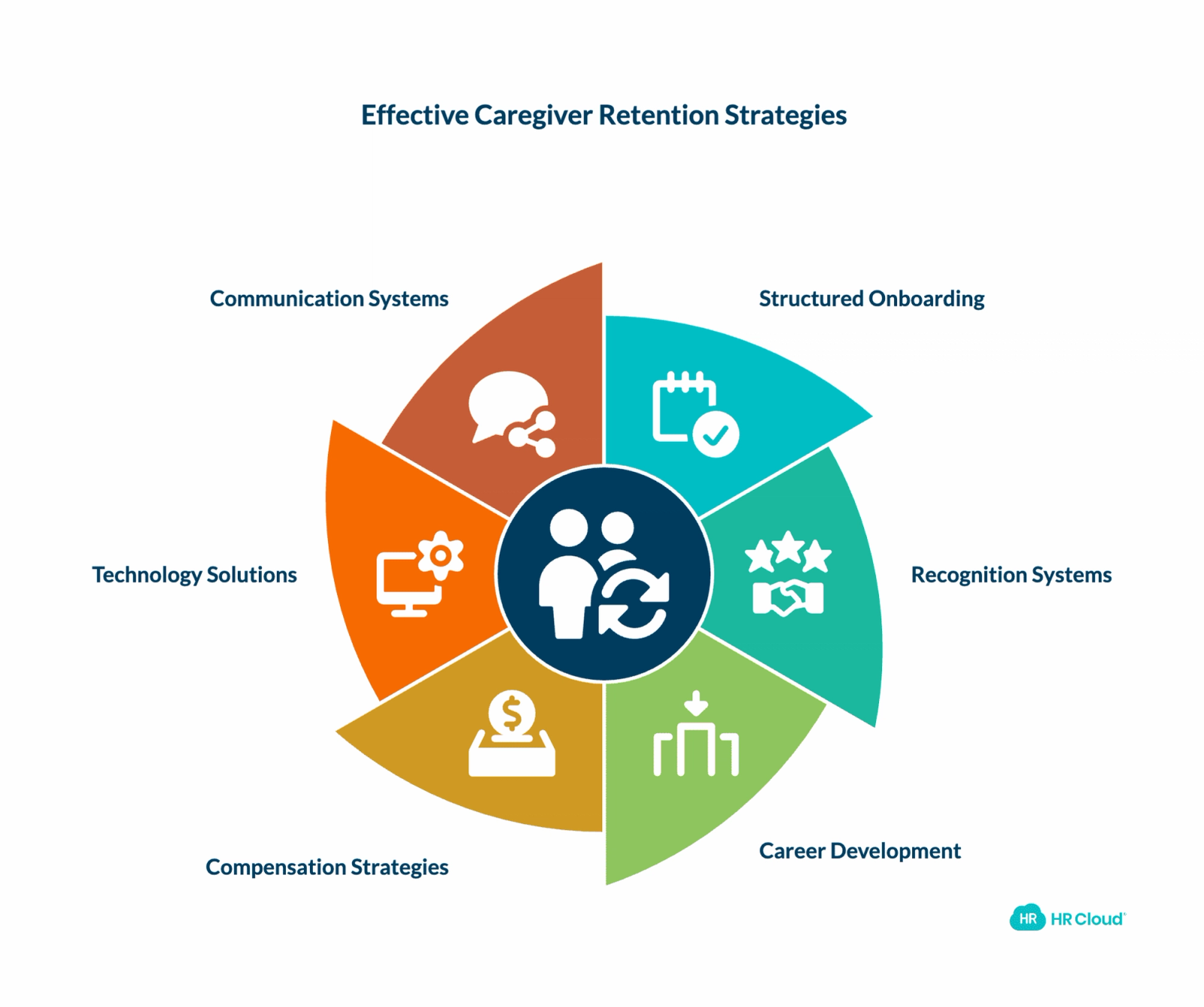
High caregiver turnover stems from six primary factors: inadequate onboarding programs that leave new hires unprepared, lack of recognition for isolated workers, limited career advancement opportunities, compensation below living wage thresholds, administrative burden from fragmented systems, and communication gaps in distributed workforces. Addressing all six factors simultaneously produces the strongest retention improvements.
How can home care agencies reduce caregiver turnover?
Home care agencies reduce caregiver turnover through structured 90-day onboarding programs, mobile-accessible recognition systems, documented career development pathways, strategic compensation including recognition-based rewards, integrated technology platforms that reduce administrative friction, and segmented communication channels for distributed teams. Agencies implementing comprehensive retention strategies see turnover decrease by 20-40% within 12 months.
What's the single most effective retention intervention?
If forced to choose one intervention, structured 90-day onboarding with regular check-ins, mentorship, and feedback reduces early turnover most dramatically. However, sustainable retention requires multiple strategies working in concert—there's no silver bullet.
How do you retain caregivers when you can't match competitors' wages?
Agencies that can't compete on base wages can still retain talent through total compensation messaging, flexible scheduling that honors work-life balance, visible career development opportunities, strong recognition culture, and operational excellence that reduces daily frustrations. Many home health aides and personal care workers will accept slightly lower wages for substantially better working conditions.
What role does technology play in caregiver retention?
Technology platforms enable retention by reducing administrative friction, facilitating peer recognition, automating onboarding consistency, and providing analytics for early intervention. Integrated HRIS systems that combine onboarding, recognition, communication, and performance management in single mobile-accessible platforms show the strongest impact on retention metrics. Technology alone doesn't solve retention—but culture without technology limits scalability.
How long does it take to see retention improvements?
Early indicators appear within 30-60 days as new hire turnover declines. Statistically significant overall turnover reduction typically requires 6-9 months of consistent program implementation as improved practices work through the full employee lifecycle. Sustainable cultural change that produces industry-leading retention rates generally requires 18-24 months of sustained effort.
Why do caregivers leave within the first 100 days?
Nearly 80% of caregiver departures in the first 100 days result from inadequate onboarding experiences. New caregivers leave when they feel unprepared for job demands, receive insufficient manager support, lack clarity on expectations, experience administrative overwhelm, or perceive no recognition for their work. Agencies with structured 90-day onboarding programs that include regular check-ins, mentorship pairing, and early recognition reduce first-100-day turnover by 60%.
What are the best employee retention strategies for home healthcare workers?
The most effective retention strategies for home healthcare workers include automated onboarding workflows with task sequencing, mobile-accessible peer-to-peer recognition platforms, auto-rewards for anniversaries and milestones, career path documentation with skills tracking, recognition-based reward programs that supplement base compensation, and communication channels segmented by shift, location, and specialization. These strategies address the unique challenges of distributed healthcare workforces.
The home healthcare industry stands at a crossroads. Demand for in-home care services and skilled nursing will continue rising for decades as the aging population grows. The home care agencies and home health providers that solve caregiver retention challenges will thrive. Those that treat retention as merely an HR problem rather than a strategic business imperative will struggle with perpetual caregiver shortages, declining quality of care, and compressed profit margins.
Caregiver retention is solvable. It requires investment in onboarding automation, employee recognition programs, career development pathways, and integrated workforce management technology—but investment that pays for itself many times over through reduced turnover costs, improved patient outcomes, and stronger competitive positioning in the home healthcare market.
Ready to transform your home care caregiver retention strategy? Schedule a demo with HR Cloud to see how integrated onboarding, recognition, and engagement tools reduce home health aide and personal care worker turnover while improving quality of care.
About the author

Keep Reading


Like What You Hear?
We’d love to chat with you more about how HR Cloud® can support your business’s HR needs.
Book Your Free Demo