
What ADP's AI Agents Don't Cover (And What HR Teams Should Know)

Global employee engagement fell to 21% in 2024 — only the second time in the last 12 years. That decline cost the global economy $438 billion in lost productivity. And yet, HR teams investing heavily in AI tools that automate payroll and compliance tasks assume that it covers the engagement problem too.
It doesn't, and that's a scope distinction worth understanding clearly.
ADP Assist launched its persona-based AI agents in January 2026, followed by a curated AI agent marketplace in March 2026. For ADP clients, this is a meaningful step forward, particularly for payroll accuracy and compliance efficiency. And here's something you should know: ADP Assist does what it was built to do, and it does it well.
But Payroll AI and engagement AI are not in the same genre. Because they run on different data, solve different problems, and serve fundamentally different parts of the employee experience. Conflate the two, and you end up with a coverage gap that no amount of payroll automation can fill.
The gap isn't about the tool failing. It's about the assumption that one tool covers everything. So what does ADP Assist actually cover and where does its scope end?
That's what this article maps.
What ADP Assist's AI Agents Are Actually Built to Do
Before we talk about gaps, let's be clear about what ADP Assist delivers. The tool is far more capable than its critics suggest. And like any purpose-built solution, it has a clear and deliberate scope.
The Core Use Cases
ADP Assist targets five core areas where HR teams lose the most time each week:
- Flags payroll anomalies before errors happen. Early adopters report saving up to 30 minutes per payroll cycle through proactive variance detection.
- Answers employee policy questions drawn directly from company handbooks — saving nearly 19,000 minutes of work across 600+ organizations in a single month, according to ADP's own data.
- Tracks down missing or incomplete state and local tax registration IDs and guides clients through every step of fixing them.
- Generates workforce analytics reports through conversational chat — you type a question, you get a dashboard.
- Routes new hire data automatically into payroll, benefits, and HR records at the moment of hire.
Real time savings. Real operational value. And definitely worth acknowledging before we get into what's missing.
The Data Foundation
What makes ADP Assist's payroll intelligence credible is the scale behind it.
The platform draws on 1.1 million clients across 140 countries and 42 million wage earners. For payroll anomaly detection and compliance benchmarking, it creates a real signal. The agents are embedded in Workforce Now, ADP Global Payroll, and ADP Lyric HCM. They also extend into Microsoft Teams for daily accessibility.
ADP Marketplace expanded this in March 2026 with a curated destination of third-party AI agents — partners like Quantum Workplace, Tapcheck, Payactiv, and MakeShift covering adjacent HR needs. Some of those gaps are partially addressed there.
The word "partially" is doing a lot of work in that sentence. Where does the gap actually begin? And why does it matter?
4 Areas Where HR Teams Need More Than ADP Assist
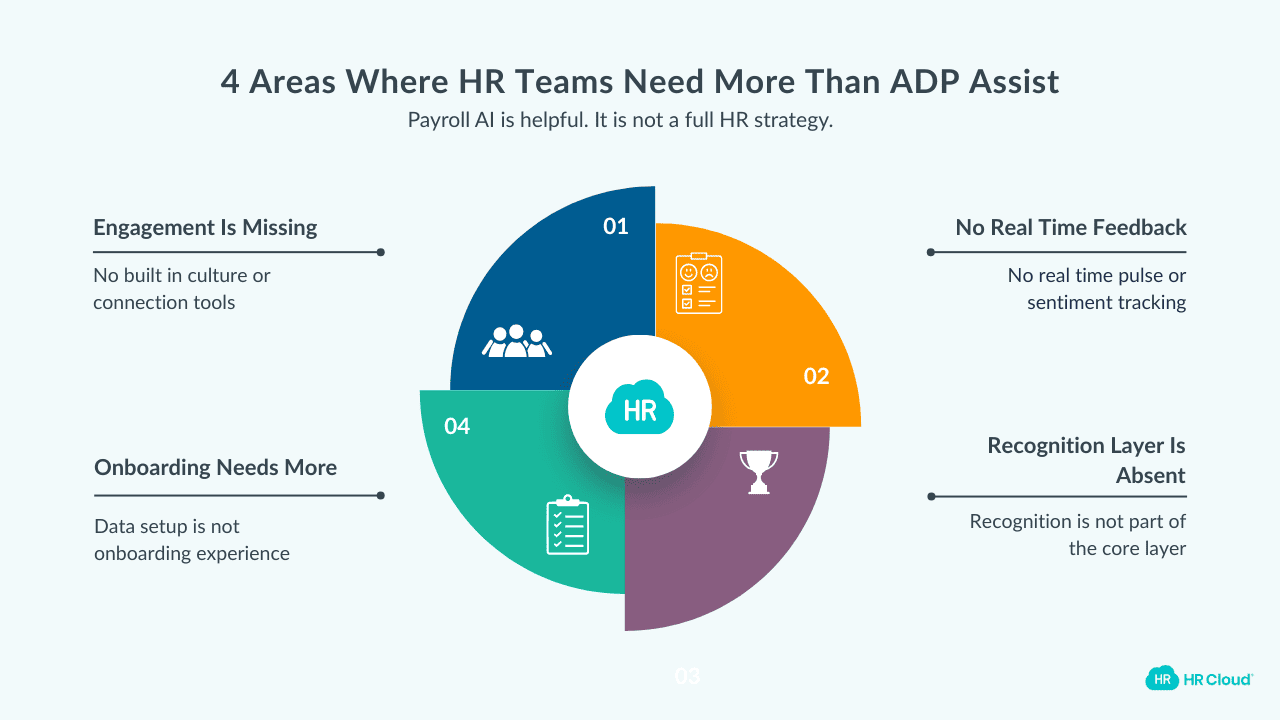
The most dangerous assumption in HR tech, or for that matter any tech, is that a tool powerful enough in one area covers all other areas equally well.
ADP Assist is a powerful payroll and compliance tool. That is not the same as a complete HR AI strategy. The four gaps below can have real operational consequences. But what does that actually cost you?
Gap 1: Employee Engagement Is Out of Scope
Since payroll and engagement data live in the same system, many HR leaders assume ADP Assist could cover engagement too. But despite the same platform and same login, the two are different problem entirely. Gallup's research consistently shows that highly engaged teams drive 23% higher profitability and 51% lower turnover. No payroll agent is going to move those numbers; you need a dedicated engagement AI tool for that.
ADP Assist does not natively drive recognition, peer connection, sentiment measurement, or culture-building. It surfaces workforce data. It does not act on the relational signals that determine whether an employee will choose to stay.
If you're an ADP user wondering where to start on the engagement side, the answer isn't inside ADP Assist. It's in a purpose-built layer alongside it. Here's what that looks like in practice for ADP clients.
ADP Connect, a marketplace add-on, covers some internal communication. But it is a separate product — and as a standalone intranet for ADP users, it doesn't carry the same intelligence or automation depth as a native engagement platform.

Gap 2: Continuous Feedback and Pulse Surveys Are Not Native
ADP Assist pulls from historical, aggregate workforce data. It does not capture real-time employee sentiment through pulse surveys or always-on feedback loops. So how do you catch a retention risk before it becomes a resignation? Definitely not with annual survey data. By the time that surfaces a problem, your at-risk employee already has an offer letter.
Annual engagement surveys — the kind most organizations still rely on — are widely recognized as insufficient. The dos and don'ts of employee engagement make this clear: measuring engagement once a year is one of the most common and costly mistakes HR teams make. Quantum Workplace and Praisidio are available through ADP Marketplace to address this gap — but both require separate implementation, separate budget, and separate data configuration. The intelligence does not flow natively between them and ADP Assist.
Gap 3: Onboarding Experience Is Different from Onboarding Data
This is the gap most HR leaders don't see coming. ADP Assist automates data routing when a new hire is added to the system — payroll setup, benefits enrollment, record creation. That is data automation.
But it is not an onboarding experience. So what actually makes an onboarding experience stick?
According to SHRM, nearly 90% of employees decide whether to stay or leave within their first six months. The experience that shapes that decision involves pre-boarding portals, cultural orientation, structured task sequences, and Day 1 recognition—capabilities that sit outside ADP Assist's payroll-focused scope. It handles the data infrastructure that surrounds that experience.
But effective onboarding requires far more than data routing. They require a structured human experience from offer acceptance through the first year on a dedicated onboarding platform.
Gap 4: The Recognition and Rewards Layer Is Missing
Recognition is one of the highest-ROI levers in HR.
Employees who feel consistently recognized are more productive, less likely to leave, and more likely to advocate for the organization. When the recognition layer is missing from HR tech stack, companies see materially lower engagement and retention outcomes. And this layer is not part of ADP Assist's AI architecture.
Some recognition capability exists through ADP Connect. But it doesn't prompt recognition based on tenure milestones, performance signals, or behavioral patterns the way a purpose-built engagement platform does. It is more like a communication channel, not a recognition engine.
And that's not even the most overlooked gap.
The Frontline Worker Blind Spot Most HR Leaders Miss
The ADP AI agent architecture assumes corporate access. And that assumption excludes a significant portion of most workforces. The deskless workforce.
Nurses, warehouse staff, field technicians, retail associates, construction crews, logistics drivers. These are not edge cases; represent approximately 80% of the global workforce. They are the majority. And they typically don't have corporate email, a company-issued laptop, or access to Microsoft Teams.
ADP Assist's agents operate within ADP's platforms and Teams. For those environments, the experience is seamless. But for the frontline worker clocking in on a shared kiosk, completing tasks on a personal phone, or working in the field without reliable connectivity, access dependency becomes a hard barrier.
ADP Marketplace offers partners like OurPeople and Beekeeper specifically to address frontline communication. Both are solid tools. But they are just add-ons. They do not share ADP Assist's intelligence layer. The AI-driven HR experience available to a desk-based practitioner is not the same as what's available to the nurse on a night shift or the technician in the field.
What Frontline-First HR AI Actually Requires
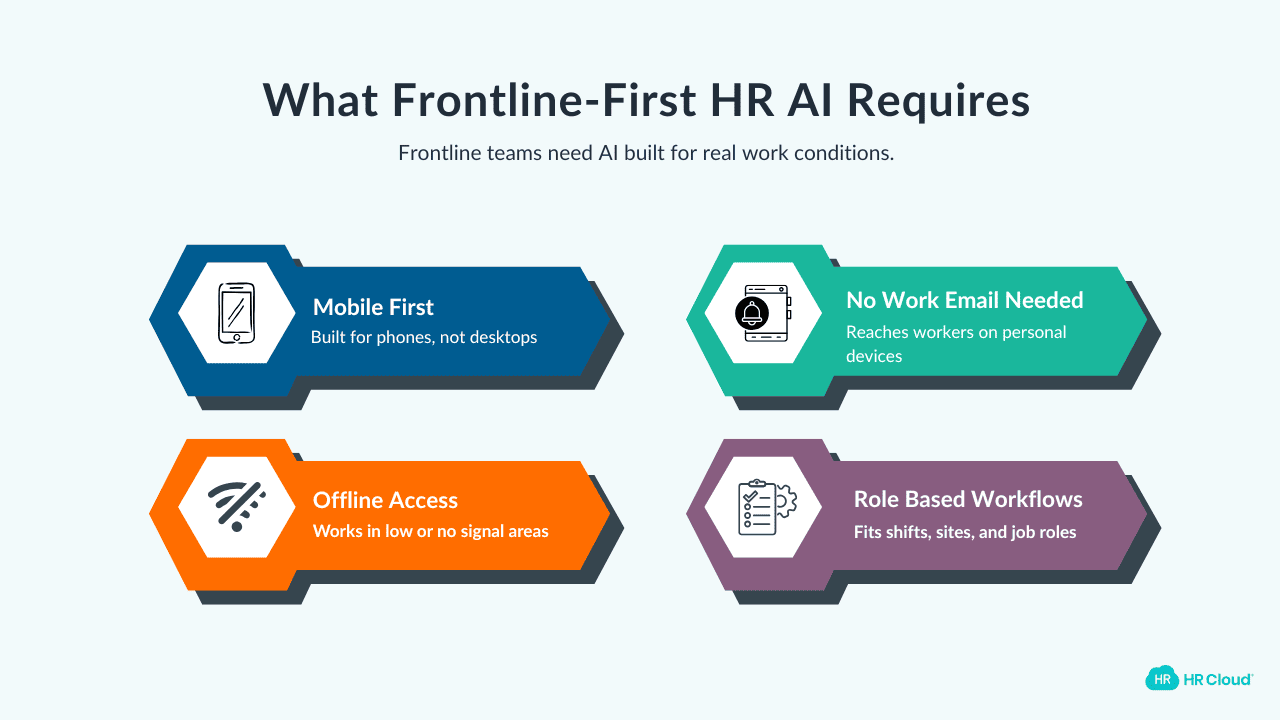
So what does frontline-first AI actually need to do? There are four non-negotiables:
- Native mobile access: not a desktop tool with a mobile view but a full-featured experience built for people who live on their phones.
- No corporate email dependency: the system must reach workers on personal devices.
- Offline capability: for field work environments without reliable connectivity.
- Role-specific workflows: that adapt to shift patterns and job site realities. Not a standard 9-to-5 office context.
As an HR leader you must be aware that these are platform-level engineering decisions. You can't add them as a marketplace plugin — they have to be built in from the start. A frontline onboarding guide that works for deskless workers begins with this architecture. And recognition programs that actually reach field staff require a fundamentally different design than what most corporate-first platforms provide.
Why Payroll AI Cannot Be Customized to Double As Engagement AI
In one sentence, because the two are fundamentally different.
Payroll AI is transactional. It detects anomalies, flags variances, routes data, and automates rule-based compliance tasks. The data it runs on is structured, numerical, and backward-looking: -
- What happened in this payroll cycle?
- What registration is missing?
- What report was requested?
It is designed to answer just one question: Did we pay people correctly?
On the flip side, engagement AI is relational. It surfaces sentiment, identifies flight-risk signals before they become resignations, prompts recognition moments, and adapts to individual behavioral patterns over time.
The data it requires is qualitative, behavioral, and forward-looking:
- How does this person feel right now?
- What is changing in their tenure patterns?
- What is the team's sentiment trend this quarter?
It is designed to answer an entirely different question: Are people choosing to stay? Why or Why not?
The two require different data architectures, different feedback loops, and different design philosophies.
What the Distinction Means for Your HR Tech Stack
So what does this differentiation mean for your stack right now?
This means you need two separate tools. ADP Assist can handle payroll and compliance intelligence. A purpose-built engagement and experience platform would sit alongside it, feeding the relational layer that transactional AI cannot reach.
You don't have to choose because the two can co-exist. You simply have to stop assuming one can do the job of both.
So how do you know exactly where your own coverage ends?
How HR Teams Should Audit Their AI Coverage
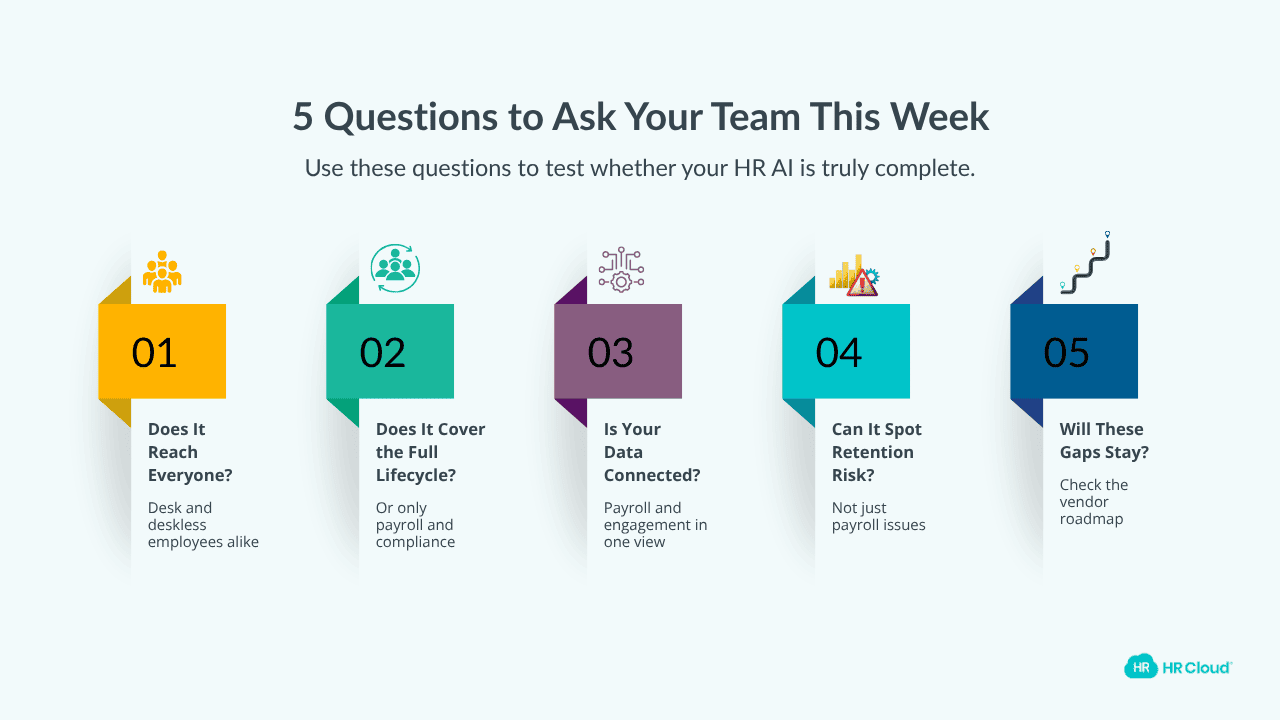
Most HR teams have adopted point solutions reactively — a tool for onboarding here, a platform for payroll there, a survey tool added after an engagement crisis. Very few have mapped where their AI actually reaches versus where it stops.
Before you go looking for new tools, map your actual coverage.
Ask your team these five questions this week.
1. Does your AI reach every employee type — desk-based and deskless — with the same quality of experience?
2. Does it support the full employee lifecycle, or only the payroll and compliance portion?
3. Are your engagement data and payroll data connected through any intelligence layer, or sitting in completely separate systems?
4. Can your AI surface a retention risk signal — not just a payroll variance?
5. Does your vendor's roadmap address the gaps you've identified, or are those gaps likely to persist for the next 12 to 18 months?
Encourage honest answers so that you get a realistic picture of your AI coverage. In most organizations, the blind spots cluster around engagement, frontline reach, and the onboarding experience.
How HR Cloud Fills the Gaps ADP Assist Leaves
A closer look at HR Cloud-ADP integrations shows you don't have to displace your existing payroll infrastructure to close these gaps. The two platforms are designed to work together.
HR Cloud's Workmates platform delivers the engagement, recognition, communication, and pulse survey capabilities that ADP Assist does not natively provide. It's the relational layer — the part of HR that determines whether employees feel connected, valued, and inclined to stay — built alongside the transactional layer ADP already handles well.
For frontline and deskless teams specifically, HR Cloud's mobile-first architecture closes the access gap directly. The mobile app is not a lite version of a desktop product. It is a full-featured tool built for employees who operate entirely from their phones — healthcare workers, manufacturing staff, logistics teams, field services. No corporate email required. Full functionality in the environments where your frontline workforce actually works.
For onboarding, HR Cloud and ADP Workforce Now work together to cover the full experience — not just data routing:
- Pre-boarding portals.
- E-forms and e-signatures.
- Structured task sequences.
- I-9 and E-Verify compliance workflows.
- New hire engagement from offer acceptance through Day 30.
That's the part of onboarding that shapes the retention decision. Not the payroll record creation but the human experience built around it.
HR Cloud targets six weeks from kickoff to production. Not the typical six-to-twelve month enterprise suite deployment that makes HR leaders hesitate to make any change at all.
Building the Right AI Stack: A Practical Starting Point
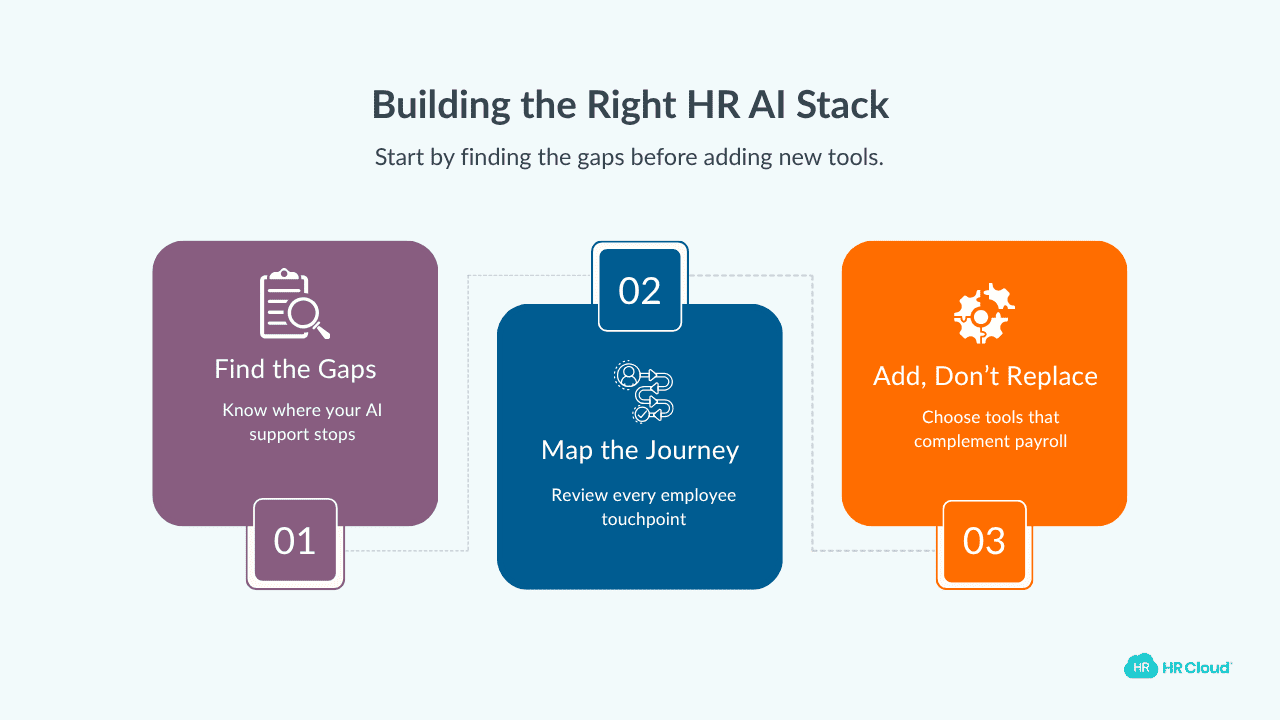
Here's where to start — but first, an honest reality check.
Step 1: Be honest about your current coverage gaps.
Most HR teams don't know exactly where their AI coverage ends because nobody mapped it. And that should be the first thing to fix.
HR Cloud closes the specific relational gaps that ADP Assist was never designed to fill, without forcing you to rebuild your payroll infrastructure from scratch. For ADP clients who've hit these coverage walls, it's the right next step and it doesn't require starting over.
Step 2: Map your coverage before you shop for tools.
List every touchpoint in your employee lifecycle. From offer acceptance through the first year and mark which touchpoints are currently AI-supported, which are manual, and which have no visibility at all.
Once you have that map, identify the highest-risk gaps first. In most organizations, those are frontline reach and early-tenure engagement.
Step 3: Choose complementary tools, not replacements.
The goal is not a rip-and-replace. It's filling the relational layer alongside your payroll intelligence so that your AI strategy covers the full workforce, not just the administrative portion of it.
Your payroll runs better with ADP Assist. Your people stay longer with an engagement layer built for them. You don't have to pick one.
See how HR Cloud works alongside ADP

Experience how Workmates can transform communication and strengthen culture—all in one powerful platform
Book Your Free DemoFrequently Asked Questions
What does ADP Assist do?
ADP Assist is an AI-powered platform embedded in ADP's HR and payroll products. It automates payroll anomaly detection, identifies tax registration gaps, answers employee policy questions drawn from company handbooks, and generates workforce analytics reports via conversational chat. It is persona-based — with agents tailored for employees, managers, HR practitioners, and payroll teams.
What are the limitations of ADP AI agents?
ADP Assist's AI agents are designed primarily for payroll, compliance, and analytics workflows. They do not natively support employee engagement, recognition, continuous feedback, or pulse surveys. Frontline and deskless workers may also face access barriers, since the agents operate within ADP's platforms and typically require corporate email or system access. Many adjacent use cases are available only through third-party ADP Marketplace partners, each requiring separate implementation and budget.
Is ADP Assist available for all ADP plan tiers?
ADP Assist capabilities vary by product and plan. Core features are embedded in Workforce Now, ADP Global Payroll, and ADP Lyric HCM. Not all Assist capabilities are available across all subscription tiers or geographies. Organizations should confirm feature availability with their ADP account representative before building workflows around specific Assist functionality.
Does ADP Assist support employee engagement?
ADP Assist does not natively support employee engagement in the recognition, culture, or sentiment sense. Its AI agents focus on payroll and compliance automation. ADP offers engagement tools through ADP Connect and marketplace partners like Quantum Workplace — but these are separate products, not extensions of the Assist AI layer. HR teams seeking integrated engagement AI will need a complementary platform.
What HR tasks can ADP AI agents not automate?
ADP Assist does not automate employee engagement programs, peer recognition, onboarding experience design, or real-time sentiment collection. It also does not replace performance management workflows, continuous learning delivery, or culture-building initiatives. Any HR task that is behavioral or relational — rather than transactional or compliance-driven — falls outside ADP Assist's current AI agent scope.
Can ADP Assist be used effectively by frontline workers?
ADP Assist's agent interface is primarily designed for users working within ADP platforms or Microsoft Teams — environments that typically require corporate email access and a connected device. Frontline and deskless workers without those resources may have limited access to Assist-driven functionality. ADP Marketplace partners like OurPeople and Beekeeper extend reach to frontline teams, though these require separate implementation and do not share Assist's AI layer natively.
About the author

Keep Reading


Like What You Hear?
We’d love to chat with you more about how HR Cloud® can support your business’s HR needs.
Book Your Free Demo