
Why Compliance and Engagement Must Work Together in Healthcare HR

Picture your most experienced RN. She's twelve hours into a shift when she receives her third "urgent" reminder this week—expired CPR certification, overdue HIPAA training, and a flagged I-9 document. None of these reminders come with context. None of them come at a good time. And none of them have anything to do with the recognition programme HR launched last quarter.
Here's the thing: this isn't a compliance problem or an engagement problem in isolation. It's both, and the gap between them is costing you more than you realize.
When healthcare HR compliance is managed reactively—reminders, scrambles, audits—it signals to clinical staff that HR exists to police, not to support. That signal erodes trust. And eroded trust is the single biggest engagement killer that no wellness survey will ever catch.
The research confirms this pattern. According to the U.S. Surgeon General's Advisory on Building a Thriving Health Workforce, reducing administrative and documentation burdens is one of the most critical steps to protecting healthcare worker wellbeing.
Compliance and engagement in healthcare should not be competing priorities. This article makes the case for integration and shows you exactly how to build it.
Why Siloed Compliance Destroys Trust (And Engagement)
Most healthcare organizations don't set out to pitch compliance against engagement. It happens gradually. Each function optimizes for its own metrics. Neither is aware of what the two together are costing the workforce. And here's what I want you to know before we go further: this isn't a failure of intent. It's a failure of structure.
Don't Make Compliance Feel Like Punishment
Manual, reactive healthcare compliance management creates four predictable friction points. Are you guilty of any of them?
One, license renewals surface as emergencies rather than planned workflows. Every hour HR spends chasing expirations in spreadsheets is an hour not spent on development conversations or meaningful touchpoints with clinical staff.
Two, credentialing, I-9 paperwork, and background checks pile up redundantly, asking staff to submit the same information to multiple systems.
Download free I-9 Audit Checklist for healthcare employees.
And don't even get me started on reminders, the third one. Those urgent, deadline-driven notifications carry an inherently punitive tone, even when that isn't the intent.
There's a fourth friction point that rarely shows up in staff surveys but shows up everywhere else: audit panic.
When a Joint Commission inspection is announced and the scramble begins, it doesn't stay contained to the compliance team. Frontline staff notice. The anxiety is visible. And the message it sends — that leadership isn't on top of its own systems — erodes confidence that no recognition programme will quickly repair.
I firmly believe that the problem isn't the compliance requirement. It's the experience of compliance.
When a nurse or a physician receives a reminder with no context and no easy way to act on it mid-shift, they don't read it as "we need to stay compliant." They reads it as "HR doesn't understand what my day looks like."
Data confirms this as well. Research from Medical Economics found that paperwork was the leading burnout contributor cited by physicians. This figure is double the next leading cause — work-life balance, suggesting the administrative load is a critical problem.
Those signals compound, eroding trust. And eroded trust is the engagement killer no pulse survey will fully capture.

The Engagement Blind Spot
Meanwhile, on the other side of the HR floor, the engagement team is running pulse surveys, launching recognition programmes, and planning wellness initiatives. Entirely unaware of the compliance burden building next door.
What would it look like if you tied compliance milestones to recognition?
A unit hitting 100% training completion celebrated the same way a quota gets celebrated. That connection is available. Most healthcare HR teams never make it.
Instead, this is what happens.
The engagement team doesn't see the compliance reminders. The compliance team doesn't see the survey results. The clinical staff member caught between both — drowning in paperwork, trying to fit in a recognition nomination — starts to feel that HR speaks two very different languages. Neither translates into their daily reality.
This is how silos duplicate effort and miss opportunity simultaneously. The two functions need to connect the dots and then act accordingly.
Why Healthcare Needs Engagement-Centric Compliance
The narrative of compliance and engagement as separate departments has a logical alternative. What if the same system that tracked license renewals also delivered onboarding recognition? What if the platform chasing HIPAA training completion also surfaced manager check-in prompts?
That is the core idea behind engagement-centric compliance and it changes the entire employee experience.
What Is Engagement-Centric Compliance?
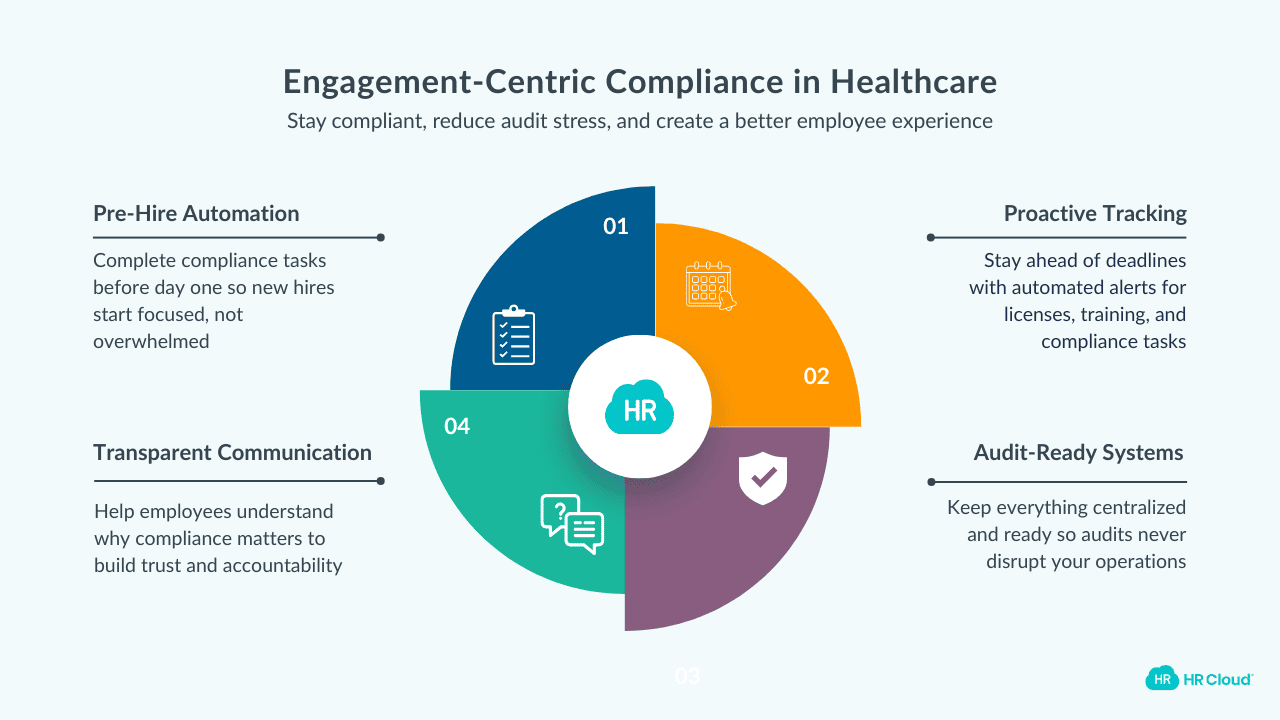
Engagement-centric compliance is built on four principles.
1. Pre-hire automation: onboarding workflows that complete I-9 verification, background checks, and credentialing before a new hire walks through the door. So, day 1 feels like a welcome, not a paperwork sprint.
2. Proactive tracking: Automated alerts for license renewals, training deadlines, and audit preparation surface weeks—not days—before they become urgent. This removes the panic from both HR and clinical staff.
3. Transparent communication: Clear messaging on why compliance requirements exist—patient safety, regulatory integrity, staff protection—rather than just demanding action.
4. Audit readiness as standard: Real-time dashboards and centralized documentation that make inspection preparation a non-event rather than an organizational crisis.
You can read more about the full compliance lifecycle in healthcare compliance software designed for this kind of integrated approach.
How Engagement-Centric Compliance Transforms Employee Experience
When these principles are in place, something shifts.
New hires arrive to digital checklists and mobile-accessible documents, not stacks of forms. Clinical staff stay focused on patient care rather than chasing HR for paperwork clarification. HR transitions from compliance firefighting to genuine relationship-building. And compliance itself stops feeling like a top-down mandate and starts functioning as a shared organizational value.
Organizations using integrated healthcare HR software report 38% faster onboarding and a 47% increase in employee engagement. Proof that compliance infrastructure and culture are not in tension. They're the same investment, made more efficiently.
Building the Integration: Practical Steps for Healthcare HR Leaders
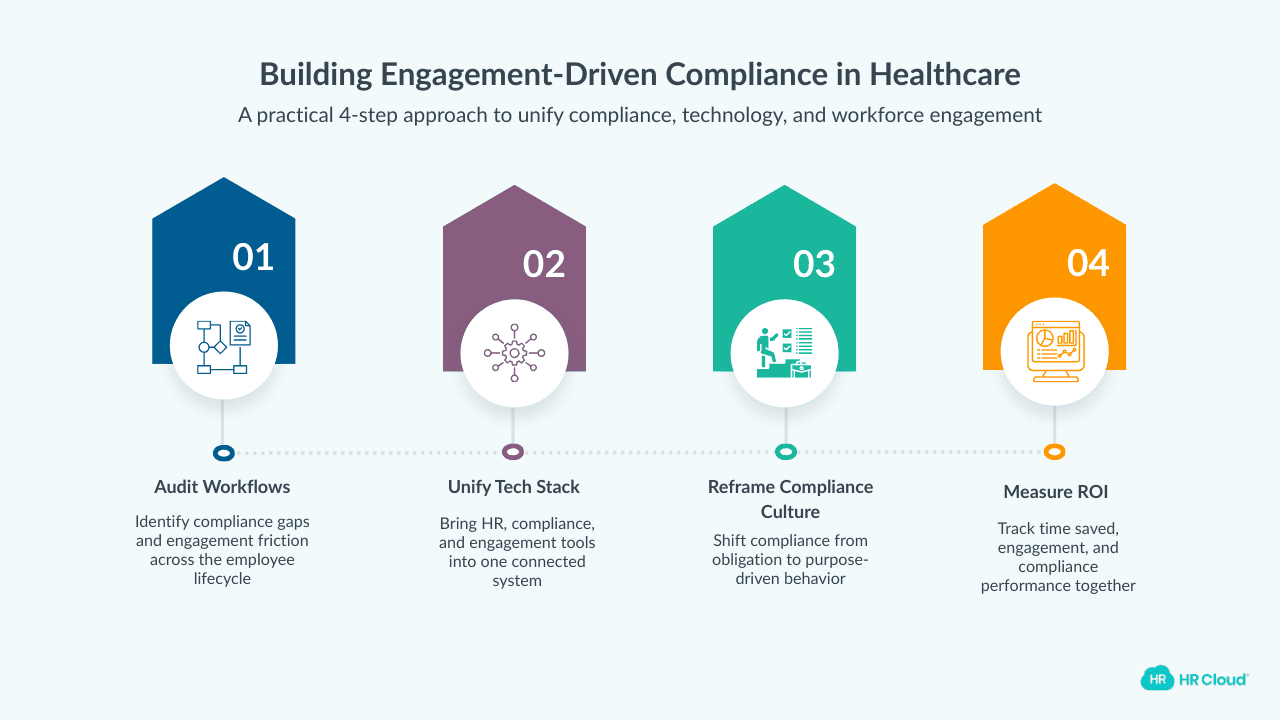
Integration sounds complex. In practice, it follows a clear sequence. These steps will help you build the foundation for genuine clinical workforce engagement grounded in seamless compliance.
Step 1: Audit Your Current Workflows
Before you can unify, you need to map.
Track every compliance touchpoint from pre-hire to exit and note where staff complain most and where HR spends the most time. Then benchmark your engagement data against those friction points. You will almost certainly find correlation. High compliance burden tends to cluster in the same departments where employee engagement in healthcare scores are lowest.
Step 2: Unify Your Tech Stack
Replace siloed tools with an integrated platform that handles HRIS, compliance, and engagement in the same system.
These must-haves are non-negotiable:
- Automated credentialing and license tracking to ensure renewals surface as planned events, not emergencies.
- Mobile-first onboarding for deskless workers so that clinical staff can complete compliance steps from their phone between shifts without needing a desktop.
- Real-time compliance dashboards to give HR and compliance officers a single source of truth, eliminating the duplicate reporting that potentially wastes hours.
- Engagement tools—recognition, pulse surveys, mobile communication—in the same system so that employees experience one login, one experience, one clear signal that HR is not a fragmented function.
Step 3: Reframe Compliance as Culture
This step is where technology meets leadership.
Educate new hires on why compliance requirements exist; not just what they are. When an RN understands that HIPAA protects the patients she cares about, not just the organization's liability, her relationship with that requirement changes.
Celebrate compliance milestones—100% training completion, zero expired licenses heading into a review period—as team wins, not just administrative checkboxes.
Empower managers to connect compliance requirements to the mission the team shares.
This reframe strengthens the integration by aligning the emotional logic of engagement (belonging, purpose, mission) with the operational logic of compliance (protection, accountability, standards). You can find additional strategies on how to increase employee engagement in healthcare through this integrated lens.
Step 4: Measure the ROI
Track time saved on admin tasks by HR and by clinical staff.
Monitor engagement scores alongside compliance completion rates, and watch for correlation.
Track how to improve compliance and engagement together by reducing audit prep time from weeks to hours.
These are the metrics that will make the business case to leadership for sustained investment in the integration.
How HR Cloud Integrates Compliance and Engagement for Healthcare
Mid-market healthcare organizations face a particular challenge.
They carry the compliance burden of larger health systems—HIPAA, OSHA, credentialing, Joint Commission readiness—but often without the dedicated compliance infrastructure. HR Cloud is built for exactly this context.
The platform brings pre-hire compliance automation together with engagement tools in a single system:
- I-9 and E-Verify processing, background checks, and credentialing workflows complete before day one.
- Automated alerts manage license and certification renewals with full audit trails, so inspections become a review, not a rescue operation.
- Recognition tools, pulse surveys, and mobile-first communication for deskless clinical staff live in the same environment—one login, one source of truth, no duplicate data entry.
All About Kids, a 1,200-employee paediatric healthcare organization, used HR Cloud to gain complete compliance visibility across their workforce, including the ability to rapidly adapt to changing regulatory requirements like vaccination status tracking.
That kind of agility is only possible when compliance and engagement infrastructure share the same foundation.
See how integrated workflows reduce compliance burden and improve employee engagement in healthcare. Request a demo today.
Explore practical strategies to improve employee engagement in healthcare that integrate directly with a compliance-first HR approach.
Conclusion: From Compliance Burden to Engagement Driver
The story of compliance and engagement in healthcare doesn't have to end in chaos. The clinical staff drowning in reminders, the HR team buried in spreadsheets, the audit that costs two weeks of panic and staff morale.
It can end differently. Via healthcare HR that is proactive rather than reactive. Compliance that builds trust instead of eroding it. Engagement strategies that meet clinical staff where they actually are—mobile, deskless, shift-based, and chronically short on time.
Stop treating compliance as a burden to manage in parallel with engagement.
When your clinical staff see that the organization has built systems that respect both their time and their regulatory responsibilities, they become your greatest compliance advocates.
The integration of compliance and engagement in healthcare is not an HR project. It is an organizational strategy. And the healthcare organizations getting it right are not working harder but working from a unified foundation.
See how HR Cloud makes that foundation possible—request a demo.

Experience how Workmates can transform communication and strengthen culture—all in one powerful platform
Book Your Free DemoFAQs
Why is compliance important in healthcare HR?
Compliance in healthcare HR ensures organizations meet regulatory requirements, including HIPAA, OSHA, and Joint Commission standards, while protecting patient safety and avoiding costly penalties. It encompasses credentialing, license tracking, training, and documentation. When integrated with engagement strategies through platforms like HR Cloud's healthcare HR software, compliance processes build trust, reduce administrative friction, and support a positive employee experience for clinical and deskless staff alike.
How does compliance affect employee engagement in healthcare?
Poor compliance processes—manual tracking, last-minute training mandates, audit scrambles—generate stress and signal disorganization, directly eroding staff trust and engagement scores. Engagement-centric compliance takes the opposite approach: automated workflows, proactive renewal alerts, and transparent communication that respects clinical staff time. When compliance and engagement are unified in a single platform, the result is reduced administrative burden, stronger retention, and improved patient care outcomes. HR Cloud's engagement software for healthcare is built for exactly this integration.
How can healthcare organizations improve compliance and engagement together?
Healthcare organizations can improve both by taking four concrete steps: auditing current workflows to identify friction points where compliance burden correlates with low engagement; unifying their tech stack into a single platform covering HRIS, credentialing, and engagement; reframing compliance as a cultural value tied to patient safety and organizational mission; and measuring ROI through time saved, engagement scores, and audit readiness. Learn how to increase employee engagement in healthcare through this integrated approach.
What are the biggest compliance challenges for healthcare HR?
The most common challenges include manual license and credential tracking that consumes HR bandwidth, reactive training management that produces resentment rather than learning, audit preparation stress that signals organizational chaos to frontline staff, and disconnected systems that force duplicate data entry. Each of these has a direct engagement cost. Healthcare compliance automation through a unified platform addresses all four—and is explored in detail in HR Cloud's resources on top healthcare HR challenges.
What features should healthcare HR software include for compliance and engagement?
The non-negotiables span both functions. For compliance: automated I-9 and E-Verify processing, credentialing and license tracking, training management with deadline alerts, and real-time audit dashboards with role-based access. For engagement: recognition tools, pulse surveys, and mobile-first communication designed for deskless clinical workforces. Integration is what makes both functions work—a single platform with no duplicate data entry, unified reporting, and a consistent employee experience from pre-hire onboarding to annual review.
About the author

Keep Reading


Like What You Hear?
We’d love to chat with you more about how HR Cloud® can support your business’s HR needs.
Book Your Free Demo