
How to Improve Employee Engagement in Hospitals Without Increasing Headcount (6 Strategies Inside)

Picture a five-person hospital HR team managing 800 employees across three facilities.
They're chasing I-9 completions and fielding new hire questions.
They're manually tracking compliance training and trying to run engagement surveys.
Meanwhile, turnover is climbing and the CFO has frozen headcount for the next two quarters.
Here's the uncomfortable truth: adding more people isn't the answer. It never was.
Programmes designed for office workers — recognition lunches, annual surveys, town halls — structurally exclude the 70% of your workforce who are deskless, shift-based, and never sitting at a desk when HR is open. You already know this. The problem isn't effort. It's systems.
The hospitals gaining ground on employee engagement in healthcare aren't hiring engagement coordinators. They're building systems that scale and reclaiming the HR capacity to do the human work that actually moves the needle.
This article covers six automation-driven strategies to improve employee engagement in hospitals without adding a single person to your team.
6 Automation-Driven Strategies to Improve Employee Engagement in Hospitals
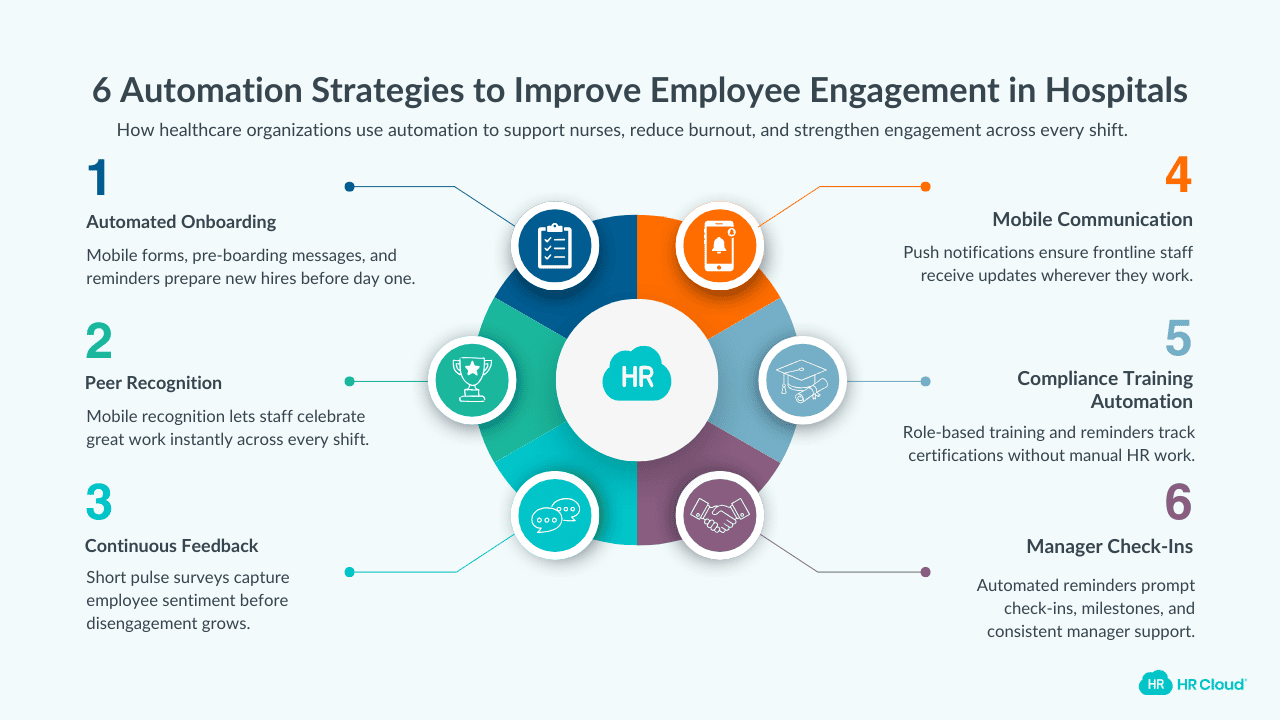
1. Automate Onboarding to Create Consistent First Impressions
Onboarding is where most healthcare engagement problems start — often before a single shift begins.
A new RN showing up to a stack of paper forms and a generic group orientation gets a clear message about how things work here. And if their manager isn't up to speed on their start date, that message gets louder.
It's the digital age — the new-age workforce expects all admin processes to be digital, and when they're not, new hires notice.
They treat these as signals for how things will unfold. You can't really blame them if many begin looking for alternatives before they've had a single meaningful patient interaction.
Automated onboarding workflows change this without adding HR workload. The system handles what used to fall through the cracks:
- Pre-arrival welcome sequences sent before day one.
- Digital I-9 and policy acknowledgements completed on mobile.
- Manager task reminders triggered automatically at days 7, 14, and 30.
The results are measurable.
Renaissance Outpatient Rehabilitation Center — a multi-site clinical services organisation — cut their onboarding time in half after automating with HR Cloud. They also saved the equivalent of two HR manager positions, totalling nearly $75,000 annually. (Read the Renaissance story)
Remember, a employee's experience in healthcare begins before the first shift — and automation makes it consistent and professional, regardless of which manager oversees the process.
“HR Cloud gave us back hours each week. Onboarding is now smooth, fast, and fully trackable.”
— Travis French, CEO, Renaissance Outpatient Rehabilitation Center

2. Deploy Peer Recognition Programmes That Run Themselves
Recognition in most hospitals is manager-led. And when it depends entirely on manager initiative, it breaks down.
Night and weekend shift staff receive far less recognition than day-shift employees — not because their work matters less, but because the process was built around business hours and manager memory.
Monthly award nominations require someone to coordinate, compile, and communicate results on top of an already full workload. The programme launches with good intentions and quietly fades within a quarter.
Besides fixing manager-led recognition, there is something else you can do quickly: roll out automated peer recognition programs.
Automated peer-to-peer hospital employee recognition programmes remove the manager bottleneck entirely. Because:
- Instant recognition is possible via mobile — any employee, any shift, in under 30 seconds.
- Recognition posted to a shared team feed, visible across the organisation.
- Points accrue automatically toward a rewards catalogue.
- Reports generated without any manual data compilation.
A night-shift CNA can recognise a day-shift colleague at 6 a.m. on a Sunday and the entire team sees it.
Toyota Material Handling — managing a large, distributed workforce with the same deskless communication challenge as a hospital system — found that giving employees the ability to recognise peers directly from their smartphones drove measurable gains in connection and engagement across the company. (Read the Toyota story)
Gallup research confirms what this demonstrates in practice: employees receiving regular recognition report higher engagement and lower burnout.
Recognition doesn't need to be complicated. It needs to be accessible to every shift, every role, every facility.

3. Orchestrate Continuous Feedback Without Survey Fatigue
Annual engagement surveys tell you what happened twelve months ago. By the time results are compiled, the nurses most at risk have already left.
The problem isn't that hospitals don't want feedback. It's that traditional survey processes are manual, slow, and easy to deprioritize when teams are stretched thin.
Automated pulse surveys change this without adding HR workload. Because smart healthcare HR systems ensure:
- A quick three-question survey is sent automatically after a new hire's first month.
- Conditional logic adjusts questions by role (RNs see different prompts than EVS staff).
- Low-score auto-alerts that reach managers before a disengaged employee has quit.
- Follow-up triggers at key tenure milestones and post-training completions.
HR receives aggregated reports without compiling a single response manually.
The goal here isn't more surveys but right feedback, from the right people, at the right moment, without anyone having to chase it.
4. Streamline Communication for Shift Workers and Deskless Teams
Email open rates for hospital clinical staff average around 20%. Shift bulletins go unread. Town halls scheduled during business hours structurally exclude the majority of your workforce — the nurses, CNAs, and technicians who are on the floor when HR is sending announcements.
This isn't an engagement problem but a delivery problem, and it's entirely solvable.
Mobile-first communication for shift-based healthcare staff changes the reach entirely:
- SMS and push notifications with open rates above 90%.
- Shift-specific scheduling so night staff receive updates at the right time.
- Policy updates, recognition notifications, and safety reminders on the device clinical staff already carry.
- Acknowledgement tracking so HR knows who has received and read critical communications.
Veolia — managing 10,000+ field-based employees who, like frontline clinical staff, lacked regular email or desktop access — achieved a 75%+ mobile onboarding completion rate after switching to HR Cloud's mobile-first approach. (Read the Veolia story)
For a workforce that is never sitting at a desk, mobile-first communication isn't a preference. It's the only channel that reliably reaches them.
5. Automate Compliance Training to Free Up Time for Culture Work
Healthcare compliance training requirements are non-negotiable. Between HIPAA, infection control, OSHA, Joint Commission standards, state licensure renewals, the average clinical employee needs to complete 40+ mandatory training hours annually.
When HR is manually tracking completions, sending reminders, and escalating overdue modules, there's no capacity left for engaging with the employees to improve work culture, patient outcomes, and retention numbers.
Here's my take: compliance and culture aren't competing priorities. They only compete when compliance is manual.
Automated training systems ensure:
- Full training sequences assigned automatically on day one by role, unit, and licensure requirement.
- Reminder cadences set once, running indefinitely without HR intervention.
- Escalations triggered when modules are overdue — to the right manager, automatically.
- Real-time completion dashboards accessible without anyone building a single report.
All About Kids — a 1,200-employee paediatric healthcare organisation — gained complete visibility into every employee's compliance status after automating with HR Cloud. They were also able to adapt rapidly when new requirements emerged mid-programme, building a custom documentation task for vaccination status tracking without IT involvement. (Read the All About Kids story)
The time your team saves, anywhere from 15 to 20 hours per month, can go directly back into the employee engagement and retention work that requires human judgment. Tasks like stay conversations, manager coaching, culture initiatives, and more.
Automation creates the time and space to do them.
6. Use Automated Task Orchestration to Support Manager–Employee Connections
If you have ever wondered why your best and most popular nurses struggle to become good people managers, this one is for you.
It's not a character issue. Charge nurses and unit managers face a three-pronged challenge that makes consistent people leadership nearly impossible:
- They are clinically stretched beyone capacity.
- Administrative tasks stack up with hard deadlines.
- Their environment is one where patient needs will always — rightly — come before an HR calendar reminder.
Blaming managers for missed one-on-ones doesn't solve any of this. Thinking out of the box does.
The answer is automating the scaffolding around connection so meaningful moments happen consistently, even when managers are stretched.
That means:
- Scheduled check-in prompts reach managers before the touchpoint window closes.
- Templated one-on-one agendas arrive ahead of time so managers show up prepared rather than improvising.
- Anniversary and milestone acknowledgements are sent automatically to every employee, every shift.
- Overdue tasks escalate to HR before a missed touchpoint becomes a flight-risk signal.
Here's what makes this approach worth noting: it doesn't remove the human element.
When a supervisor has a few extra minutes, they can add a personalised note to an automated milestone message. The system handles the consistency; the manager adds the warmth when they can.
Clinical staff engagement improves not because managers suddenly have more time but because the right prompts make meaningful moments happen reliably. That consistency, more than any single conversation, is what sustains engagement at scale.
Measuring What's Working: A Step-by-Step Guide to Engagement Metrics
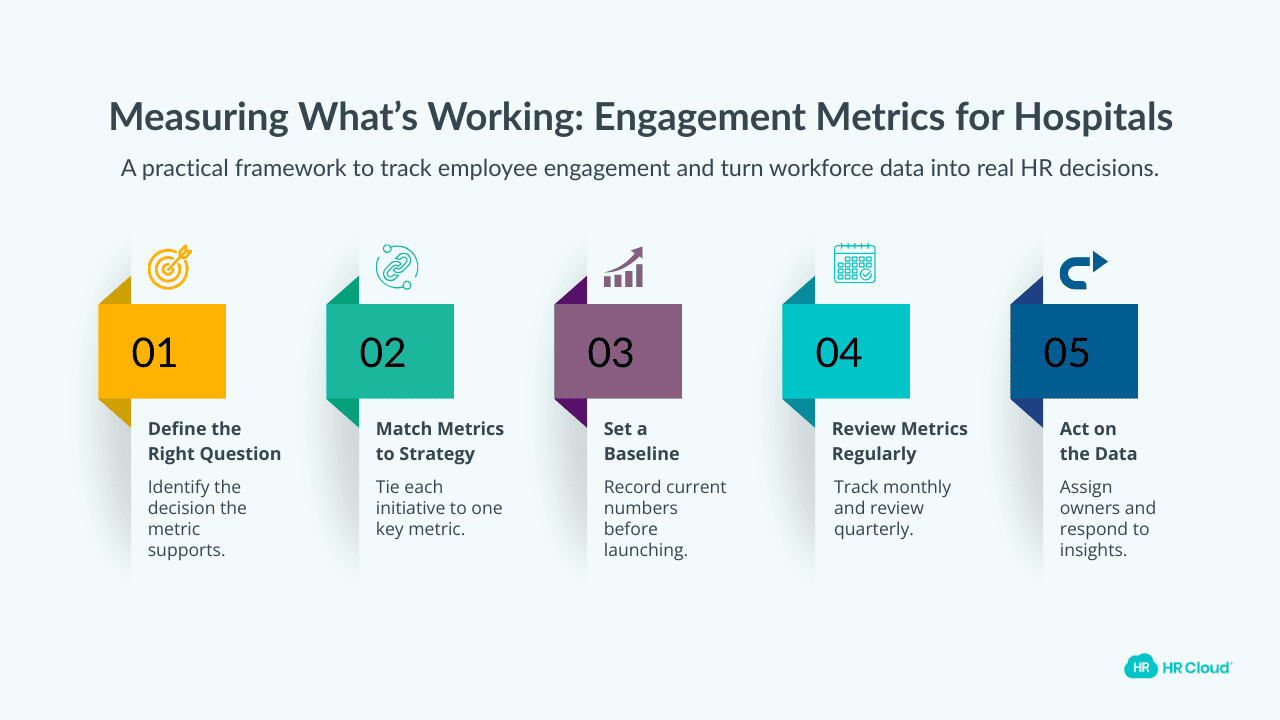
Most hospital HR teams track what's easy to measure but that might not be what is useful to act on.
So, here is a practical framework for choosing the right metrics and building a measurement cadence your team can actually sustain.
Step 1: Decide What Question You're Trying to Answer
Before you choose a metric, identify the decision it needs to support. There are three distinct questions, and each requires a different data type.
- "Is the system working?" — These are leading indicators. They tell you whether your engagement infrastructure is functioning before it shows up in turnover data. Recognition participation rates by shift, pulse survey completion by department, and onboarding task completion at 30 days all belong here.
- "Is engagement improving?" — These are lagging indicators. They confirm outcomes over time: 90-day voluntary turnover, 12-month retention by department, eNPS by unit, and time-to-fill for open positions.
- "Can I make the business case?" — These are outcome metrics. HCAHPS patient satisfaction scores, safety incident rates by unit, and absenteeism data connect engagement to the numbers your executive team reviews. Gallup's research confirms that engaged clinical staff consistently deliver measurably better patient experiences.
Step 2: Match the Metric to the Strategy
Not every metric is relevant to every strategy. A thumb rule: each automation strategy you deploy should have at least one leading indicator tied directly to it.
Here's how that maps:
- Onboarding automation → 30-day onboarding task completion rate; manager task completion at day 7, 14, and 30.
- Peer recognition → Monthly recognition participation rate by shift; percentage of staff receiving at least one recognition per month.
- Pulse surveys → Survey completion rate by department and shift; average response time after trigger.
- Mobile communication → Push/SMS open rates by message type; acknowledgement completion on policy updates.
- Compliance training → Training completion rate by due date; average days-to-completion on new assignments.
- Task orchestration → Manager check-in completion rate; percentage of overdue touchpoints escalated vs. resolved.
Step 3: Set a Baseline Before You Launch
Metrics are only useful in comparison. Before deploying any strategy, record your current baseline, even informally.
What is your 90-day voluntary turnover rate right now?
What percentage of night-shift staff completed the last compliance training on time?
These numbers don't need to be precise. They need to exist.
Without a baseline, you can't demonstrate progress to leadership and you can't identify which strategy is underperforming.
Step 4: Review at 30, 60, and 90 Days
Leading indicators should be reviewed monthly for the first quarter after launch. Lagging indicators — turnover, retention, eNPS — need at least 90 days to show movement, and are better evaluated at six and twelve months.
A practical cadence for a five-person hospital HR team:
- Monthly: Recognition participation, survey completion, onboarding completion, training completion rate.
- Quarterly: eNPS by unit, 90-day voluntary turnover, manager check-in completion.
- Annually: 12-month retention by department, HCAHPS correlation analysis, absenteeism trend.
Step 5: Act on the Data, Not Just Collect It
Dashboards are only useful if someone is accountable for responding to what they show. Low survey completion in a specific unit should not be treated as another data point but a trigger for a manager conversation.
A recognition participation rate below 40% in night shift should not become footnote in a report. It should be taken as a signal to improve things.
To ensure action is taken based on insights, assign clear ownership: who reviews each metric, at what cadence, and what the escalation path looks like when a metric falls below threshold.
Automated platforms generate the data. Your team has to use it to take action.
Engagement at Scale Starts With the Right Infrastructure
Automation is the lever for engagement at scale because it removes the administrative drag that stops the human element from being applied where it matters.
Is this a perfect solution? No.
Automation surfaces problems it can't fix — culture issues, manager relationships, unit-level dynamics that require human judgment to resolve.
But it creates time and space where your team can actually address them. That's worth something.
See how HR Cloud's employee engagement software for hospitals handles onboarding, recognition, communication, and compliance in one connected mobile-first platform.
Or explore practical strategies to improve employee engagement in healthcare with resources your team can act on this month.

Experience how Workmates can transform communication and strengthen culture—all in one powerful platform
Book Your Free DemoFAQs
How can hospitals improve employee engagement without increasing headcount?
Hospitals can improve employee engagement without adding staff by automating HR processes including onboarding, peer recognition, feedback surveys, compliance training, and manager check-in reminders. Automation scales personalised touchpoints across all shifts while freeing HR teams to focus on strategic culture work. Mobile-first employee engagement software ensures deskless clinical workers can participate from their phones, regardless of shift or location.
What are the best employee engagement strategies for hospitals?
The most effective hospital employee engagement strategies combine automation with human connection: automated onboarding for consistent first impressions, peer recognition programmes accessible to all shifts via mobile, pulse surveys with smart triggers, shift-specific mobile communication, streamlined compliance training, and automated manager task reminders for one-on-ones. These tactics reduce HR workload while increasing staff touchpoints and satisfaction.
Why is employee engagement important in healthcare?
Employee engagement in healthcare directly impacts patient outcomes, safety, and satisfaction scores. Engaged nurses and clinical staff experience lower burnout rates and higher patient satisfaction, according to Gallup research. Engagement also reduces costly turnover — hospitals lose millions annually to avoidable departures — and improves compliance with training and protocol requirements.
How do you engage deskless hospital employees?
Engage deskless hospital employees through mobile-first tools: SMS and push notifications for updates and recognition, mobile pulse surveys, peer-to-peer kudos apps accessible from any smartphone, and on-demand mobile training. Automate shift-specific communication so night staff receive the same information as day shift. Ensure managers have automated reminders to check in with all direct reports regardless of schedule.
What metrics measure hospital employee engagement?
Key hospital employee engagement metrics include participation rates in recognition and surveys, eNPS by department and shift, voluntary turnover rate at 90 days and 12 months, manager one-on-one completion rates, and training completion speed. Modern engagement platforms auto-generate these dashboards in real time — eliminating the manual reporting burden that typically falls on already stretched HR teams.
How does automation improve employee engagement in hospitals?
Automation improves hospital employee engagement by eliminating manual HR tasks — tracking recognition, chasing survey responses, assigning training — and returning that time to strategic culture work. It scales personalised touchpoints that would be impossible to deliver manually at any meaningful volume: automated welcome messages, peer recognition notifications, birthday acknowledgements, and milestone check-ins that reach every employee on every shift.
What are examples of hospital staff engagement activities?
Effective hospital staff engagement activities include automated peer recognition via mobile app, shift-based wellness challenges, automated anniversary and birthday acknowledgements, department-specific pulse surveys, manager-led check-ins prompted by automated task reminders, and mobile-accessible microlearning modules. The most successful activities are designed to be shift-agnostic — accessible and meaningful for night staff and weekend workers, not just day-shift employees.
About the author

Keep Reading


Like What You Hear?
We’d love to chat with you more about how HR Cloud® can support your business’s HR needs.
Book Your Free Demo